What water for an espresso machine? Hardness, filters and limescale
 4 min read
Updated 27 August 2026
The reflex "the softer the water, the better" is wrong. It's the first thing to fix when you're choosing water for an espresso machine: too hard and it furs up the heating circuit, too soft and it under-extracts into a flat cup.
The numbers that matter
The Specialty Coffee Association publishes these benchmarks:
| Parameter | Target | Accepted range |
|---|---|---|
| TDS (total dissolved solids) | 150 mg/L | 75 to 250 mg/L |
| Calcium hardness (CaCO₃) | 68 mg/L | 50 to 175 mg/L |
| Alkalinity | 40 to 70 mg/L | |
| pH | 6.5 to 7.5 |
In France the unit is the French degree, 1 °f being worth about 10 mg of calcium carbonate per litre. Water counts as hard above 15 °f and very hard above 30 °f, with 35 to 42 °f in Champagne-Ardenne against 5 to 12 °f in Brittany, the Massif Central, the Vosges or Corsica (Adoucisseur-eau.fr). Those are the numbers that answer the question of what water to use for an espresso machine day to day.
Check your water hardness for coffee, for free
You don't need a test strip. Your water bill has to state the hardness every year (PagesJaunes), and the interactive map built on French health ministry data gives the value town by town, free.
That figure sets the machine's hardness level, and that level drives the descaling counter. On a De'Longhi ECAM23210B the interval the maker quotes drops from about 250 L to about 40 L of water depending on the setting (ECAM23210B manual).
Cartridge, jug or bottle?
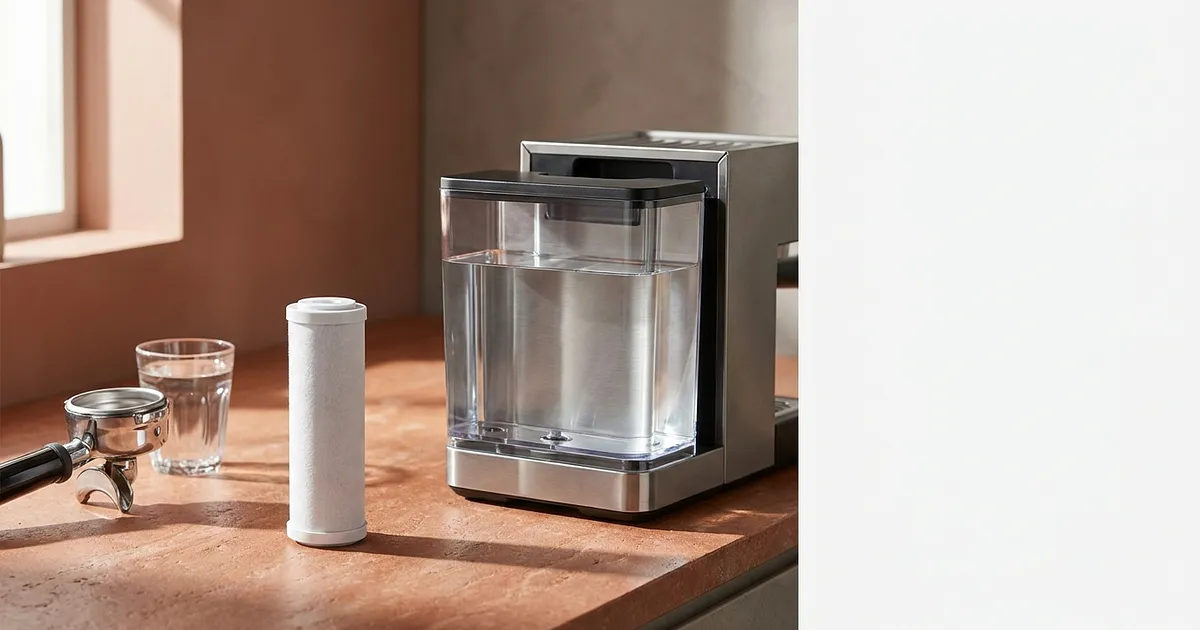
Installing a coffee machine water filter, whether on an espresso machine or any other, cuts limescale before it reaches the circuit. The question is whether it's worth it against a bottle.
Dry residue runs from about 130 mg/L for Volvic to 309 for Evian, 840 for Vittel, 2,094 for Contrex and 2,513 for Hépar (Eau Hexagonale). A factor of 20 between the extremes. So "I'll just buy bottled" means nothing until someone reads the label.
A filter cartridge costs between €18 and €50 depending on the model (Brita Maxtra price comparison), and needs replacing every two to three months with daily use. Litre for litre, bottled water costs noticeably more. At one or two coffees a day, the cartridge comes out cheaper.
So, what water for an espresso machine should you actually pick? Bottled only defends itself if your tap water lands a long way outside the window: start by looking up your town on the map, the rest follows.
Frequently Asked Questions
Is demineralised water suitable for an espresso machine?
No. The Specialty Coffee Association benchmarks set a hardness floor around 50 mg/L of CaCO₃. Below that, extraction thins out and the cup goes flat. Water with almost no minerals isn't neutral water for the machine.
What hardness should I aim for in French degrees?
Roughly 5 to 17.5 °f, which matches the 50 to 175 mg/L of CaCO₃ range published by the Specialty Coffee Association. The target sits around 6.8 °f.
Does a filter replace descaling?
Not really. It stretches the interval, it doesn't remove it. The machine's counter depends on the hardness level you set, not on the cartridge.
Is bottled water suitable for an espresso machine?
With the right brand, yes: Volvic's dry residue is around 130 mg/L, inside the wide SCA range. Workable, but pricier in use than filtered tap water.
Sources
- Specialty Coffee Association benchmarks littlecupexperts.com
- Adoucisseur-eau.fr adoucisseur-eau.fr
- PagesJaunes traitement-eau.pagesjaunes.fr
- interactive map built on French health ministry data data.gouv.fr
- ECAM23210B manual manualslib.com
- Eau Hexagonale eauhexagonale.fr
- Brita Maxtra price comparison cherchons.com