Best Bean to Cup Coffee Machine 2026: The Full Comparison
 17 min read
A Nespresso-format capsule works out at roughly €0.42 a shot. The same cup pulled from freshly ground beans costs somewhere between €0.08 and €0.17, according to estimates from Grain d'Expert, which puts the yearly gap at €80 to €230 for a household drinking two coffees a day. That arithmetic, as much as the taste, is what pushes French buyers towards a bean-to-cup machine. It's also what makes the decision miserable: open any product listing and you're hit with "19 bar", "1450 W", "15 drinks", and not one of those three numbers says anything about the cup.
Price snapshot taken 8 August 2026. The six prices in this article come from an Amazon.fr check on that date, and they move fast.
This article rests on no in-house testing. We haven't bought, measured or tasted any of these machines. What follows cross-references the published protocols of UFC-Que Choisir, a 60 Millions de Consommateurs panel, the view of a specialist repairer, and the manufacturer listings. It names who says what, every time.
The comparison: six bean-to-cup machines from €262 to €529
Six models, all sold on Amazon.fr, all with an integrated grinder. Every cell carries its unit, and any value the manufacturer doesn't publish stays written as not stated rather than guessed.
| Model | Price (Amazon.fr, 8 August 2026) | Rating (Amazon.fr reviews) | Milk system | Grinder | Stated pump pressure |
|---|---|---|---|---|---|
| Philips Series 2200 EP2220/10 | €262.99 | 4.2 / 5 from 26,597 reviews | Integrated milk frother | burr, type not stated | not stated on the listing |
| De'Longhi Magnifica S ECAM11.112.B | €287.99 | 4.1 / 5 from 7,586 reviews | Manual steam wand | burr, type not stated | not stated on the listing |
| KRUPS Essential Compacte | €299.99 | 4.2 / 5 from 5,702 reviews | not stated on the listing | burr, type not stated | 15 bar (manufacturer figure, repeated in the product title) |
| De'Longhi Magnifica Start ECAM222.91.B | €457.99 | 4.1 / 5 from 1,387 reviews | LatteCrema automatic | burr, type not stated | not stated on the listing |
| De'Longhi Rivelia EXAM440.35.B | €525.00 | 4.3 / 5 from 376 reviews | not stated on the listing | burr, interchangeable bean hopper | not stated on the listing |
| Philips Series 5500 EP5546/70 | €529.00 | 4.3 / 5 from 13,836 reviews | LatteGo automatic | burr, type not stated | not stated on the listing |
Look at that last column. Five listings out of six don't even publish the pump pressure, and the sixth puts it in the product title. That alone should tell you how much the number is there to sell rather than to describe.
The "Grinder" column is the real scandal of this table. Not one of the six manufacturers says, on its Amazon.fr listing, whether the burrs are conical or flat, or what they're made of. It's the part that decides your cup, and it's the single piece of information nobody gives you.
Two myths that make people buy badly
"More bar means better espresso"
No. Coffeediag, who has repaired bean-to-cup machines for more than 23 years, explains that the pressure advertised in store is first and foremost a sales argument. In practice, extraction always happens at around 9 bar, because an over-pressure valve regulates the pressure at the group head whatever the pump is rated for.
Put another way: a machine sold as 19 bar and a machine sold as 15 bar extract your coffee at the same pressure. The 19 bar figure is the peak the pump can reach against no resistance, not the working pressure at the puck.
That number is where this site got its name, so let's be blunt about it. If a salesperson steers you to a model "because it has 4 bar more", you're being sold marketing.
"A bean-to-cup machine is basically barista level"
This one needs qualifying too. Fresh grinding genuinely changes the aromatics compared with pre-ground coffee or a capsule, and a well-maintained automatic is consistent. But it gives you no control over dose, tamping or pre-infusion time, and its milk system doesn't texture the way a steam wand worked by hand does.
"Close to" isn't "the same as". If you want to pour latte art, none of the six machines here will get you there.
The grinder, the part that actually decides the cup
A bean-to-cup machine is a coffee grinder with an espresso machine wrapped around it. So the burr grinder is the first thing to look at, a long way ahead of how many pre-programmed recipes the thing offers.
Two burr geometries share the domestic market.
Conical burrs are cheaper to make, turn more slowly, therefore heat the grounds less and preserve the aromatics better. The trade-off is a less even particle size. This is what you'll find in the overwhelming majority of consumer machines.
Flat burrs produce more uniform particles, which is what specialty coffee is after, but they spin faster, run hotter, cost more and take up more room. You mostly meet them above €800.
And the grind itself? According to David Oudín, roaster at the Coffee Lab in Toulouse, the Specialty Coffee Association recommends water between 90.5 and 96 °C, with grind size remaining the key variable for balancing extraction and taste. Translated into something you can act on: on a bean-to-cup machine, the grinder's fineness setting is the only knob that genuinely changes your coffee. The other fifteen adjust water volume.
Here's a tip you won't read on a product listing. Only touch the grind adjustment while the burrs are actually turning, machine switched on, and move one notch at a time. Adjusting it dry can jam the burrs on a lot of models.
Under €300: the entry ticket
At this price you're buying a burr grinder, a pump, and a brew group. Milk gets the bare minimum and the interface is spartan. Which is already an enormous step up from a capsule machine, and already limiting if cappuccino is what you drink.
Philips Series 2200 EP2220/10, the volume seller
€262.99 at the 8 August 2026 check, and 26,597 reviews at 4.2 / 5 on Amazon.fr, by far the largest user sample in this comparison. When a model piles up that many reviews at that rating, it isn't a guarantee of quality. It's a guarantee that there's no massive design fault. Not the same thing, but at this price it's reassuring enough.
The listing promises an integrated milk frother and a touchscreen. What you won't get: textured foam for a flat white, or fine control over the recipes.
The flaw to know about before you pay is frother upkeep, which is the part entry-level owners neglect most and which clogs fastest.
Philips Série 2200 EP2220/10 - Expresso Broyeur avec Mousseur à Lait, Écran Tactile
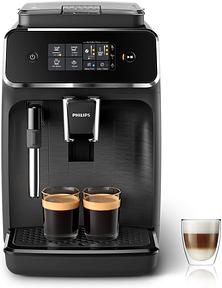
Philips Série 2200 EP2220/10 - Expresso Broyeur avec Mousseur à Lait, Écran Tactile
View at Amazon (as of Aug 10)Affiliate link. Buying through it earns us a commission; the price stays the same for you.
De'Longhi Magnifica S ECAM11.112.B, the manual steam wand
€287.99, 4.1 / 5 from 7,586 reviews. Twenty-five euros more than the Philips, for a difference that matters if milk matters to you: the product listing specifies a manual frother, meaning a wand you drive yourself.
A manual wand takes practice and cleans up in three seconds under the tap. An automatic system does the reverse: nothing to learn, and a circuit to rinse. Pick whichever side you'd rather do the work on.
That 4.1 is the lowest score in the table, level with the Magnifica Start. Across 7,586 reviews, a 0.1 gap with the Philips doesn't mean much, honestly, but I'm not going to hide it either.
The model is written ECAM11.112.B. De'Longhi's range runs to a dozen or so references that differ by a single letter, and they don't carry the same equipment. Check the exact code, not just "Magnifica".
De'Longhi Magnifica S ECAM11.112.B - Perfetto Machine à Café Automatique avec Mousseur à Lait Manuel
Not available in your region — closest match
Philips Série 2200 EP2220/10 - Expresso Broyeur avec Mousseur à Lait, Écran Tactile
View at Amazon (as of Aug 10)Affiliate link. Buying through it earns us a commission; the price stays the same for you.
KRUPS Essential Compacte, the one 60 Millions de Consommateurs picked
€299.99, 4.2 / 5 from 5,702 reviews. This machine deserves a special mention for a historical reason: in a test run with 5,983 panellists, 60 Millions de Consommateurs put the Krups Essential top of the bean-to-cup category at 14.6 / 20, at a then-price of around €359.
One qualification that matters. That test dates from September 2023. It isn't a 2026 verdict, and the range has moved since. Take it as a marker of the brand's reliability, not as a current recommendation.
The compact footprint is its real argument. A bean-to-cup machine eats far more worktop than a capsule machine, and in an average French kitchen the size question often ends up settling the debate.
Its listing doesn't state the milk system. Worth checking before you order if you drink cappuccino every morning.
KRUPS Essential Compacte - Machine à Café à Grain Automatique 15 bars
Not available in your region — closest match
Philips Série 2200 EP2220/10 - Expresso Broyeur avec Mousseur à Lait, Écran Tactile
View at Amazon (as of Aug 10)Affiliate link. Buying through it earns us a commission; the price stays the same for you.
€450 to €530: what the extra buys
Be careful what you expect from this bracket. The extra €200 does not buy a better espresso. It buys automatic milk, a more legible interface, and often better acoustic insulation around the burrs.
If you drink black espresso, keep your €200 and put it into coffee. Specialty beans from a roaster cost two to three times supermarket beans, and they change the cup far more than a machine upgrade does at this level.
De'Longhi Magnifica Start ECAM222.91.B, milk on autopilot
€457.99, 4.1 / 5 from 1,387 reviews. The argument is in the name: LatteCrema, De'Longhi's automatic milk carafe system. You drop the carafe in, press a button, and the machine handles the foam.
Those 1,387 reviews make up the second-smallest sample in this comparison. On a recent model that's normal, but it does mean three-year reliability isn't documented by users yet. At €458, that's a real unknown.
De'Longhi Magnifica Start ECAM222.91.B - Perfetto Machine à Café Automatique avec LatteCrema
Not available in your region — closest match
Philips Série 2200 EP2220/10 - Expresso Broyeur avec Mousseur à Lait, Écran Tactile
View at Amazon (as of Aug 10)Affiliate link. Buying through it earns us a commission; the price stays the same for you.
De'Longhi Rivelia EXAM440.35.B, the two bean hoppers
€525.00, 4.3 / 5 from 376 reviews, the thinnest sample in the table. Its party trick is genuinely clever: the bean hopper is interchangeable, so you can switch from an espresso bean to a filter bean, or from a soft arabica to a punchy blend, without emptying or purging the grinder.
For a household where two people don't drink the same coffee, it's the only one of the six that answers the problem. For someone who buys a single kilo of beans at a time, it's €240 more than the Philips 2200 for a feature that'll never get used.
Its listing doesn't detail the milk system. With only 376 reviews, you're also among the first buyers, with everything that implies.
Not available in your region — closest match
Philips Série 2200 EP2220/10 - Expresso Broyeur avec Mousseur à Lait, Écran Tactile
View at Amazon (as of Aug 10)Affiliate link. Buying through it earns us a commission; the price stays the same for you.
Philips Series 5500 EP5546/70, the quiet one (allegedly)
€529.00, 4.3 / 5 from 13,836 reviews, and that's the best rating-plus-volume combination here: the highest score, on a sample ten times bigger than the Rivelia and the Magnifica Start put together.
Two things sit in its product title. LatteGo, the two-piece milk system that comes apart and goes in the dishwasher. And SilentBrew, a Philips label for noise reduction. The first is verifiable in your kitchen. The second is a manufacturer trade name, not an independent measurement: Philips publishes no decibel value on the Amazon.fr listing, so there's nothing to compare it against.
This is the one I'd look at first in this bracket, for the only defensible reason available here. It's the model the largest number of buyers have spoken about, and they say they're happy.
Philips Série 5500 EP5546/70 - Expresso Broyeur avec LatteGo, SilentBrew
Not available in your region — closest match
Philips Série 2200 EP2220/10 - Expresso Broyeur avec Mousseur à Lait, Écran Tactile
View at Amazon (as of Aug 10)Affiliate link. Buying through it earns us a commission; the price stays the same for you.
Steam wand or automatic frother: the milk question
This choice decides your purchase more reliably than price does.
Latte art is only possible with foam textured on a steam wand. Automatic frothers, easier to use, produce airier foam that's less suited to a precise pour (Astuce Maison & Jardin).
The decision rule fits in two lines.
You want control, microfoam, maybe a pour one day, and you accept that your first twenty attempts will be rubbish? Manual steam wand, so the Magnifica S here.
You want a decent cappuccino at 7am by pressing one button, without thinking? Automatic system, so LatteGo or LatteCrema.
What nobody tells you: the automatic system carries a daily upkeep cost. A milk circuit gets rinsed after every use, or it turns. A manual wand, you wipe it and purge two seconds of steam. The "simple" option is the more demanding of the two, day to day.
Noise, which is no small thing in a flat
No French comparison treats this properly, which is a shame, because UFC-Que Choisir measures it phase by phase in its published protocol: rinse, grind, then dispense, each with its own decibel value.
According to figures compiled by Grain d'Expert, grinding stays the loudest phase of a bean-to-cup machine, with levels measured between 62 and 75 dB depending on the model. A grinder that stays under 65 dB at one metre counts as discreet.
The number doesn't tell the whole story. Grinding lasts five to eight seconds and produces a dry, high-pitched sound that goes through a partition wall far better than a pump's low drone. In a one-bedroom flat with the bedroom behind the kitchen wall, that's the noise that wakes people up. Not the rest of the cycle.
Two fixes that cost nothing: a silicone counter mat under the machine, which kills transmission through the worktop, and pushing the first coffee back by ten minutes. No consumer machine is quiet while it grinds.
Descaling, upkeep and how long the thing lasts
The test protocol published by UFC-Que Choisir ranks cleaning and ease of maintenance among the deciding criteria for a good bean-to-cup machine, alongside consistency of volume in the cup and temperature stability. That's a strong signal from a body with nothing to sell you.
And in its panel of 5,983 people, 60 Millions de Consommateurs flagged limescale as the number one cause of breakdown on espresso machines. Not the grinder. Not the pump, not the control board. Limescale.
The direct consequence for your purchase: water hardness varies enormously from one French commune to the next, and if you live in a hard-water area, your descaling rhythm has nothing in common with someone living in the Vosges. A machine that asks you to descale every two months and gets ignored will die before its neighbour does.
What I'd look at, in order: whether the brew group comes out and rinses under the tap, whether the milk circuit comes apart, and whether the manufacturer's descaler is priced like gold leaf. That third one happens more often than you'd think.
What it actually costs to run
Back to the numbers from the top, but in euros per year.
Two coffees a day means 730 cups. On capsules at €0.42 a shot per Grain d'Expert, you're at roughly €307 a year. On beans at €0.12 a cup, the midpoint of the €0.08 to €0.17 range given by that same source, you're somewhere around €88. Call it a yearly gap close to €220, which sits comfortably inside the €80 to €230 range that source proposes.
That calculation is mine, built on their figures, and it ignores electricity, water, descaler and filters. An order of magnitude, not a set of accounts.
In practice, a €263 machine pays for itself in about a year and a half against capsules, a €529 machine in about two and a half. At that consumption rate, going for the most expensive model doesn't undermine the economics of the switch. It just pushes the break-even point back by a year.
Integrated grinder or separate grinder
Plenty of buyers hesitate between an all-in-one bean-to-cup machine and a portafilter paired with a separate coffee grinder. Both make coffee. They don't do the same job.
The all-in-one wins on one point and one only: you press a button. Which is worth a great deal at 7:10 on a Tuesday.
The portafilter plus a dedicated burr grinder wins everywhere else. You choose your dose to the gram, you tamp it yourself, you swap the grinder without swapping the machine, and you repair each piece independently. It's also two appliances on the worktop, a real accessories budget, and a learning curve measured in weeks.
My take, and it's only mine: for a first machine, buy the all-in-one. The portafilter has a high abandonment rate among people who buy one thinking the machine does the work. It doesn't.
The last word
If I had to reduce the six models to one line each: the Philips 2200 for the best price-to-documented-reliability ratio, the Magnifica S if the steam wand appeals, the Krups for a narrow worktop, the Magnifica Start for automatic milk at the lowest price, the Rivelia for a household drinking two different coffees, the Philips 5500 because it's the best rated on the biggest sample.
None of these six will give you a roaster's espresso. They'll give you coffee that's clearly better than a capsule, at three to four times less per cup, with a grinder whose burr geometry not one manufacturer is willing to tell you. That's the state of the market in August 2026, and it's irritating.
One last thing before you order: recheck today's price. The six figures in this article date from 8 August 2026, and in this category they swing by tens of euros from one month to the next. The table above gives you the comparison, not the bill.
All products from this post
The ones we named above are marked; the rest are alternatives in the same category.
Not available in your region — closest match
Philips Série 2200 EP2220/10 - Expresso Broyeur avec Mousseur à Lait, Écran Tactile
View at Amazon (as of Aug 10)
Not available in your region — closest match
Philips Série 2200 EP2220/10 - Expresso Broyeur avec Mousseur à Lait, Écran Tactile
View at Amazon (as of Aug 10)
Not available in your region — closest match
Philips Série 2200 EP2220/10 - Expresso Broyeur avec Mousseur à Lait, Écran Tactile
View at Amazon (as of Aug 10)
Not available in your region — closest match
Philips Série 2200 EP2220/10 - Expresso Broyeur avec Mousseur à Lait, Écran Tactile
View at Amazon (as of Aug 10)
Not available in your region — closest match
Philips Série 2200 EP2220/10 - Expresso Broyeur avec Mousseur à Lait, Écran Tactile
View at Amazon (as of Aug 10)Affiliate notice: As an Amazon Associate, we earn from qualifying purchases. Product prices and availability are subject to change.
Frequently Asked Questions
What is the best cheap bean to cup coffee machine?
Under €300, this comparison has three: the Philips Series 2200 EP2220/10 at €262.99, the De'Longhi Magnifica S ECAM11.112.B at €287.99 and the KRUPS Essential Compacte at €299.99, prices checked on Amazon.fr on 8 August 2026. The Philips carries the most reviews, the De'Longhi gives you a manual steam wand, the Krups is the most compact. None of them makes barista-grade foam.
Does a 19 bar machine make a better espresso than a 15 bar one?
No. Coffeediag, a specialist repairer, explains that extraction happens at around 9 bar on all of these machines, because an over-pressure valve brings the pressure at the group head back to that value whatever the pump can manage. The 15 or 19 bar on the box is the peak the pump hits with no resistance. What decides the cup is grind size, dose and temperature stability.
Should you buy De'Longhi, Krups or Philips?
Depends what you drink. De'Longhi covers the widest range and has the only manual steam wand in this comparison, on the Magnifica S. Philips carries the biggest review counts, with LatteGo for dishwasher-safe milk parts. Krups led the 60 Millions de Consommateurs test of September 2023, which is a reliability marker rather than a 2026 verdict. Check the exact model code, not the range name.
Bean to cup machine or a separate grinder with a portafilter?
All-in-one for daily simplicity, portafilter for control. With a portafilter you set the dose to the gram, tamp yourself and time the shot, and you can replace the grinder without replacing the machine. In exchange you spend several weeks learning, and two appliances sit on the worktop. For a first purchase, the all-in-one is still the sensible bet.
How often should you descale a bean to cup coffee machine?
Follow the machine's own alert, which counts cycles, and don't put it off. In its panel of 5,983 people, 60 Millions de Consommateurs identified limescale as the number one cause of breakdown on espresso machines. Water hardness varies a lot from one French commune to the next: in a hard-water area the interval can drop to every two months. A water filter in the tank stretches it out.
Are bean to cup coffee machines noisy?
Grinding is the loud phase, measured between 62 and 75 dB depending on the model according to figures compiled by Grain d'Expert. It lasts five to eight seconds, but the sound is high-pitched and travels through walls, which matters in a flat. UFC-Que Choisir measures noise phase by phase in its protocol. A silicone mat under the machine damps what the worktop transmits.