Coffee machine bean hopper size: the formula and table for how much you drink
 15 min read
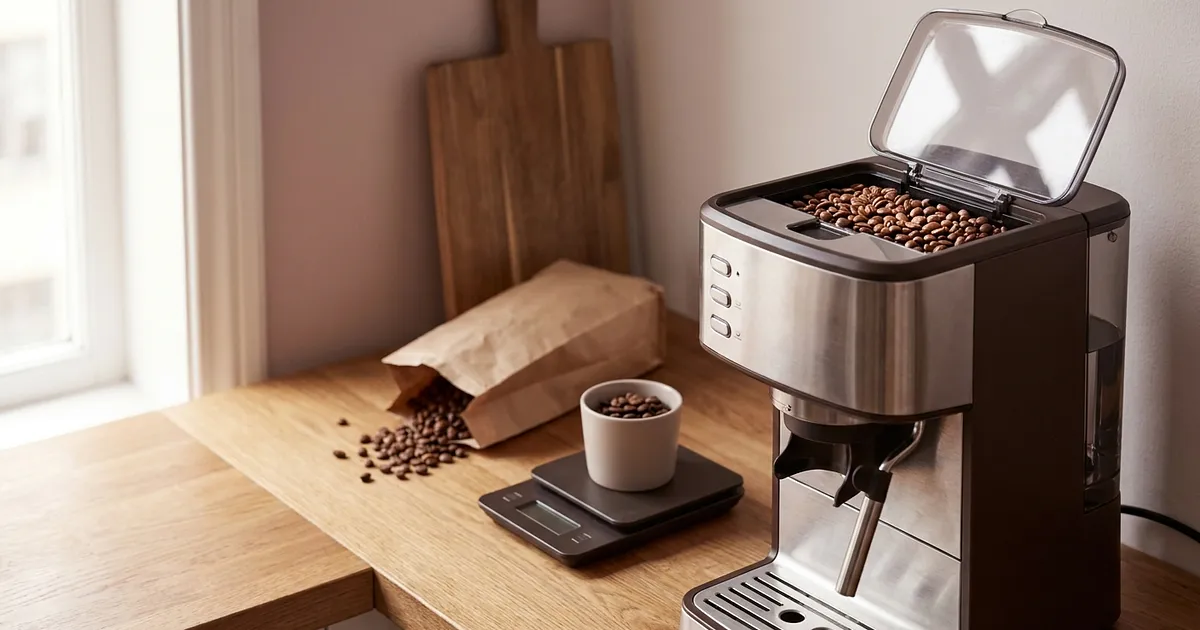
Search for "coffee machine bean hopper size" and you'll mostly land on product pages: 110 g here, 250 g there, a 1.8 L water tank in bold. None of them tell you what those numbers mean for you, in the morning, with your cup and your dose. So let's do the division the spec sheets never bother with.
Updated September 28, 2026. Capacities quoted here are manufacturer figures or come from the linked sources. Novebar didn't measure them.
This isn't about picking a machine. It's about reading two numbers, grams and liters, on any machine you're looking at.
How many grams of coffee beans does one cup take?
Between 7 and 9 g for a single espresso. That's the benchmark French roaster Cafés Méo gives for 30 ml of water, with 14 to 18 g for a double. French appliance retailer Electro Dépôt lands in almost the same spot for bean-to-cup machines, 7 to 8 g per espresso, and adds that a kilo of coffee makes somewhere between 70 and 140 hot drinks.
A roaster on one side, an appliance seller on the other, same range. That's enough for me to use 8 g as the working number for everything below. That number is what lets us work out the bean hopper size you actually need.
| Drink | Coffee dose | Water | Source |
|---|---|---|---|
| Single espresso | 7 to 9 g | 30 ml | Cafés Méo |
| Double espresso | 14 to 18 g | not stated | Cafés Méo |
| Espresso, bean-to-cup machine | 7 to 8 g | not stated | Electro Dépôt |
| Filter coffee | 60 g | 1 L | Cafés Méo |
What about a long coffee? On a bean-to-cup machine the coffee dose depends on your settings, but it's mostly the water that climbs. Keep that in mind for the tank. We'll get there.
If you drink doubles, or crank the strength setting all the way up, use the top of the range. Your own number will probably beat mine anyway.
The formula: how many days does a full hopper last?
Your hopper's autonomy is its capacity in grams divided by what you grind each day. Same logic for the tank, in milliliters. Three lines, that's it.
Grams per day = cups per day × grams per cup
Hopper autonomy (days) = hopper capacity (g) ÷ grams per day
Tank autonomy (days) = tank capacity (ml) ÷ (cups per day × ml per cup)
Say you drink three espressos a day at 8 g. That's 24 g. A 250 g hopper lasts a little over ten days (250 ÷ 24 = 10.4). Same person, 1.8 L tank, 30 ml espressos: 90 ml a day, so 20 days on paper.
Only on paper, though. A lot of bean-to-cup machines rinse their circuit when they switch on and off, and that water comes out of the same tank. I don't have a reliable figure for how much, since it varies by model and by how often you power the machine up in a day. Treat the result as a ceiling.
And even if the math says 20 days, I wouldn't let water sit in a tank that long. For the tank, the real question runs the other way: does it get through a normal day without quitting on you halfway through the second latte?
The Krups example: 110 g versus 250 g in one lineup
Same brand, same kind of machine, and capacities that more than double from one model to the next. The French comparison site graindexpert.fr lists these manufacturer figures for three models on sale today:
| Krups model | Bean hopper | Water tank |
|---|---|---|
| Essential EA81 | 110 g | 1.7 L |
| Evidence EA8250 | 200 g | 1.8 L |
| Arabica EA9010 | 250 g | 1.8 L |
Manufacturer figures as listed by graindexpert.fr, checked September 28, 2026.
For the EA81, graindexpert notes it "needs frequent refilling, roughly every 10 coffees." My formula at 8 g gives closer to 13 espressos per fill. The gap probably comes from the dose setting or from doubles. What matters is the order of magnitude, and that holds.
Now run the formula on those three hoppers:
| Consumption | EA81 (110 g) | EA8250 (200 g) | Arabica (250 g) |
|---|---|---|---|
| 1 espresso a day (8 g) | about 14 days | about 25 days | about 31 days |
| 2 espressos a day (16 g) | about 7 days | about 12 days | about 16 days |
| 4 espressos a day (32 g) | about 3 days | about 6 days | about 8 days |
Our own calculation, 8 g per espresso.
For a couple drinking four coffees a day, the Arabica fits nicely: one refill a week, give or take. For someone living alone with one morning espresso, that same hopper lasts a whole month.
And that's where it goes wrong. More on that in a minute.
Still at Krups, the KRUPS Coffee Crush Extra – Machine à Café à Grain Ultra Compacte 15 cm (SA4028E0), an ultra-compact machine, lists a 150 g hopper (manufacturer figure). At two espressos a day that's a bit over nine days of autonomy (150 ÷ 16 = 9.4), right in the zone I'd call sensible for a small household.
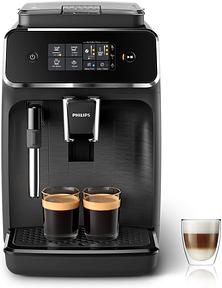
Not available in your region — closest match
Philips Série 2200 EP2220/10 - Expresso Broyeur avec Mousseur à Lait, Écran Tactile
View at Amazon (as of Aug 10)Affiliate link. Buying through it earns us a commission; the price stays the same for you.
The lookup table: cups per day, bean hopper size and tank
For one or two cups a day, a small 110 to 150 g hopper is plenty and keeps your beans fresh. From four cups up, 250 g starts to make sense. On the water side, long coffees decide things, not espresso.
| Cups per day | Coffee per day (8 g per cup) | 150 g hopper lasts | 250 g hopper lasts | Water per day (100 ml long coffee) | 1.8 L tank lasts |
|---|---|---|---|---|---|
| 1 | 8 g | about 19 days | about 31 days | 100 ml | about 18 days |
| 2 | 16 g | about 9 days | about 16 days | 200 ml | about 9 days |
| 4 | 32 g | about 5 days | about 8 days | 400 ml | about 4 days |
| 6 | 48 g | about 3 days | about 5 days | 600 ml | about 3 days |
| 8 | 64 g | about 2 days | about 4 days | 800 ml | about 2 days |
| 10 | 80 g | about 2 days | about 3 days | 1 L | about 2 days |
Our own calculation. 8 g dose per cup based on Cafés Méo and Electro Dépôt. The 100 ml long coffee is an example, not a standard: swap in the volume your machine is set to. Water excludes rinse cycles. If you only drink 30 ml espressos, divide the water figures by a bit more than three.
How would I read this? Look for the cell where the hopper empties in 7 to 14 days.
One cup a day: a 110 to 150 g hopper, and a one-liter tank is more than enough.
Two cups: 150 g works well. A 250 g hopper is fine too, as long as you only fill it halfway.
Four to six cups is 250 g hopper territory, with a tank of at least 1.5 L, or 1.8 L if several people drink long coffees.
Past eight cups the tank becomes the real limit. Two days of autonomy on 1.8 L means refilling almost daily, and that's where a plumbed-in water line starts making sense.
A model like the De'Longhi Magnifica S ECAM11.112.B - Perfetto Machine à Café Automatique avec Mousseur à Lait Manuel, which the manufacturer lists with a 250 g hopper, suits a household drinking four to six coffees a day. The Philips Série 2200 EP2220/10 - Expresso Broyeur avec Mousseur à Lait, Écran Tactile, for its part, ships with a listed 1.8 L tank: roughly four days of long coffees at four cups a day, rinses not included (1,800 ÷ 400 = 4.5).
Not available in your region — closest match
Philips Série 2200 EP2220/10 - Expresso Broyeur avec Mousseur à Lait, Écran Tactile
View at Amazon (as of Aug 10)Affiliate link. Buying through it earns us a commission; the price stays the same for you.
Philips Série 2200 EP2220/10 - Expresso Broyeur avec Mousseur à Lait, Écran Tactile
View at Amazon (as of Aug 10)Affiliate link. Buying through it earns us a commission; the price stays the same for you.
Is your hopper or tank too small?
A few telltale signs, plus one that points the other way:
You're refilling the hopper every two days or more often. Not a disaster, but it gets old.
The machine demands water right in the middle of a round of coffees for guests.
You top up the tank every single morning before the first cup.
On the flip side, there are still beans in your hopper three weeks after the last refill. That's not a size problem. Your hopper is just overfilled for your pace.
Is a big bean hopper an advantage or a freshness risk?
A risk, once the hopper takes more than two or three weeks to empty. Beans are at their best for espresso between day 10 and day 21 after roasting, then decline until they're stale around day 45. A 250 g hopper filled to the brim for a solo drinker pushes the end of that load outside the window.
None of the hopper-size guides I've read raise this. And it's the question that matters most for what ends up in the cup.
Degassing and staling aren't the same thing
As Methodical Coffee puts it, degassing is a normal process after roasting, when the beans release CO2. Staling is something else: a slow oxidation of aroma compounds that sets in over several weeks. Methodical Coffee puts the useful espresso window at 7 to 21 days after roasting.
Brewed Barista gives a slightly more detailed timeline (published June 20, 2026). A dark roast releases 60 to 70% of its CO2 in the first three days, while a light roast spreads that degassing over 7 to 10 days.
| Days after roasting | What happens for espresso | Source |
|---|---|---|
| 0 to 3 days | Heavy degassing, especially with dark roasts | Brewed Barista |
| 7 to 21 days | Useful espresso window (10 to 21 days per Brewed Barista) | Methodical Coffee, Brewed Barista |
| 21 to 45 days | Aromatics fade, flavor flattens | Brewed Barista |
| 45 days and up | Stale: papery notes, rancid oils on dark roasts | Brewed Barista |
Both sources are clear that these limits shift with roast level and storage. They're ranges, not a use-by date.
The math nobody likes
The clock starts at roasting. Not when you pour the beans into the hopper.
Picture a bag opened ten days after its roast date, when there's one printed on it. Here's how old the last ground bean is, depending on how full you loaded the hopper:
| Situation | Load lasts | Age of the last ground bean |
|---|---|---|
| 2 espressos a day, full 110 g hopper | about 7 days | about 17 days after roasting |
| 2 espressos a day, full 250 g hopper | about 16 days | about 26 days after roasting |
| 1 espresso a day, full 250 g hopper | about 31 days | about 41 days after roasting |
Our own calculation, bag opened 10 days after roasting, 8 g per espresso.
41 days. That's right at the doorstep of the stale zone Brewed Barista describes. The big hopper sold as a convenience turns, for a solo drinker, into a waiting line of aging beans.
Will you taste the difference between day 20 and day 26? Honestly, I don't know. It depends on the roast, the origin, your palate. Between day 17 and day 41, though, both sources are describing two different coffees.
The bag isn't off the hook either: a kilo at 16 g a day is more than 60 days of drinking (1,000 ÷ 16 = 62.5).
And manufacturers know it. French coffee retailer Maxicoffee notes that some high-end hoppers add an airtight seal and UV protection to keep the aroma in. If manufacturers go to the trouble, beans clearly sit in hoppers long enough to suffer.
The fix: fill less, don't buy smaller
A big hopper isn't a flaw in itself. Filling it to the brim is the problem. The fix is simple: pour in only what you'll drink over a few days.
Flip the formula around: amount to pour = grams per day × days you're aiming for. At two espressos a day and a one-week target, that's 112 g (16 × 7). The rest of the bag waits, sealed.
Single or dual bean hopper: what's the difference?
A dual hopper means two compartments, so two coffees on tap without emptying anything: a strong espresso and a decaf, say. Total capacity is split between the two, and the formula applies to each compartment separately.
That's where the freshness trap sneaks back in. The second compartment almost always holds the minority coffee, the evening decaf or the beans only one person in the house drinks. Take a 100 g compartment as an example and one decaf every other day, so 4 g a day on average: 25 days to empty it (100 ÷ 4). Go easy when you fill that one.
So who's it for? A household where two people really drink two different coffees, every day. If decaf is occasional, plenty of bean-to-cup machines have a chute for pre-ground coffee, and a small bag of ground decaf solves it without a second hopper.
Removable, fixed or plumbed-in tank: what changes day to day
A removable tank fills straight from the tap. A fixed one gets filled with a jug. A plumbed-in machine has no tank at all and draws from the water line, which is mostly aimed at offices and very heavy use.
At home, removable is the most common setup on bean-to-cup machines, and it's the more practical version day to day. One detail no spec sheet highlights: check which way it comes out. A tank that lifts out from the top, on a machine sitting under low cabinets, gets annoying fast, while front access is never an issue.
Pod machines play in a different category, with smaller tanks tied to their format. The reasoning in this guide is about bean machines.
For a household that goes through milk drinks one after another, the PHILIPS machine à café grain 5500, 20 boissons chaudes & glacées, LatteGo | Carafe LatteGo facile à nettoyer, SilentBrew 40% plus silencieux, QuickStart, App HomeID, Expresso broyeur Noir (EP5544/50) is listed with 20 drinks on the menu and a 1.8 L tank. At six 100 ml long coffees a day, that's about three days of autonomy. For that profile, the big tank isn't a luxury.
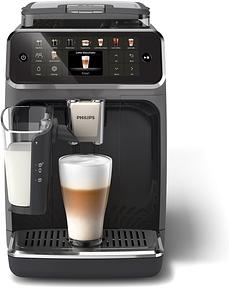
Affiliate link. Buying through it earns us a commission; the price stays the same for you.
What I'd do before buying or refilling
Take your real dose and count your cups over a normal week, not the one where the whole family's visiting. Do the division: that's what tells you whether you've got the right coffee machine bean hopper size, not the number on the spec sheet.
If you haven't picked a machine yet, our guide on which bean-to-cup machine to choose based on how many cups you drink a day starts from the same question, from the buying side.
And keep in mind the one number product pages never give you: the roast date on your bag.
All products from this post
The ones we named above are marked; the rest are alternatives in the same category.
Not available in your region — closest match
Philips Série 2200 EP2220/10 - Expresso Broyeur avec Mousseur à Lait, Écran Tactile
View at Amazon (as of Aug 10)
Not available in your region — closest match
Philips Série 2200 EP2220/10 - Expresso Broyeur avec Mousseur à Lait, Écran Tactile
View at Amazon (as of Aug 10)
Affiliate notice: As an Amazon Associate, we earn from qualifying purchases. Product prices and availability are subject to change.
Frequently Asked Questions
What's the ideal bean hopper size?
The one you empty in one to two weeks. At 8 g per espresso, one or two cups a day sit comfortably with a 110 to 150 g hopper. From four cups up, a 250 g hopper makes sense. A bigger hopper still works as long as you don't fill it to the brim.
Is a large bean hopper a risk for coffee freshness?
Yes, if your hopper takes more than two or three weeks to empty. Beans peak for espresso between 10 and 21 days after roasting, then decline until they're stale around day 45. For a solo drinker, a full 250 g hopper lasts you about a month, too long. The fix: fill it less, not necessarily buy a smaller one.
How many cups does a 1.5 liter water tank make?
About 50 espressos of 30 ml in theory, or 15 long coffees of 100 ml if you mostly drink bigger cups. In practice, count on a bit less: your machine probably rinses its circuit on startup and shutdown using water from that same tank.
What's the difference between a single and a dual bean hopper?
A dual hopper gives you two compartments for two different coffees, often an espresso and a decaf. Capacity is shared, and each compartment empties at its own pace. If one of them is your weekend coffee rather than your everyday one, fill it sparingly, that's the one likely to go stale.
Should you empty and clean the bean hopper even when it isn't empty?
Not with every bag. If beans have been sitting there for more than three weeks, it's better to let the hopper run almost empty before pouring in a fresh bag rather than topping up over the old beans. For cleaning, follow the schedule in your machine's manual.