Coffee machine electricity cost: the annual calculation
 3 min read
Your coffee machine electricity cost depends on how you use it, not just its rating-plate wattage. For a home bean-to-cup machine, add complete-session energy and standby outside those sessions, then apply your electricity unit rate. There’s no universal annual bill.
Quick answer: measure accumulated Wh from startup through normal shutdown, with standby timed separately. Energy used to keep the machine ready to brew belongs in the session. A whole-day reading already contains its standby energy, so you mustn’t add it again.
Measure complete sessions, not a watt peak
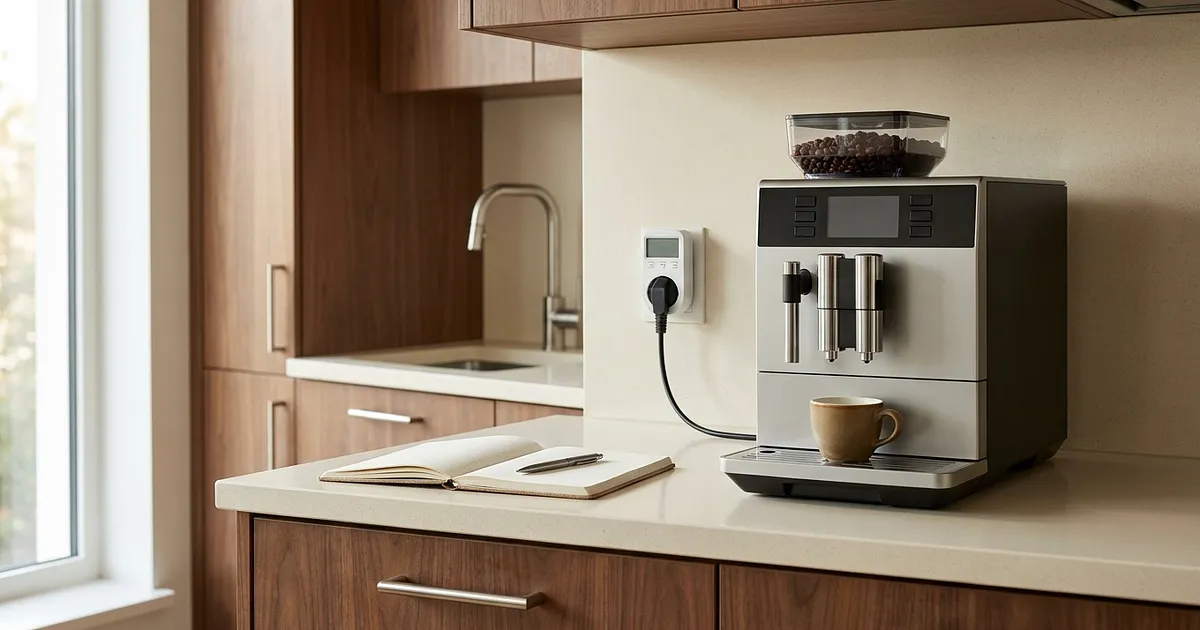
A suitable borrowed plug-in meter may be enough. Reset its energy counter or subtract the starting reading from the final one. Repeat representative sessions covering heating, rinsing, grinding and brewing, including milk preparation. Gross and Bush’s paper of 3 June 2022 distinguishes operating phases; this household formula isn’t their test protocol.
Topten’s November 2022 criteria define standby with heaters inactive and reheating required before coffee. A heater maintaining brew-readiness belongs in the session; residual warmth after shutdown doesn’t establish that state. The thermoblock and boiler explainer covers the hardware.
Standby W must be an average over a separately timed interval, not one instantaneous reading. Check the meter’s low-power range and accuracy. A displayed zero doesn’t prove zero consumption, and longer recording won’t fix below-range error.
Annual arithmetic without overlapping hours
For identical days, using comparable sessions or their average:
kWh/year = days × (Wh/session × sessions/day + average standby W × standby hours/day) / 1000
Annual cost = annual kWh × unit rate
Entirely hypothetical example, not measured: 365 days, two 40 Wh sessions occupying 1 hour daily in total, then 23 hours of standby averaging 0.5 W. The illustrative calculation is 365 × (40 × 2 + 0.5 × 23) / 1000 = 33.3975 kWh/year, rounded to 33.4 kWh/year. At a fictional €0.25/kWh, that’s €8.35/year. Neither actual average consumption nor a current tariff.
For irregular use, sum different days separately, including coffee-free days. Count cleaning outside sessions and any power used while switched off but plugged in separately, without overlapping hours. Time-of-use intervals each need their own rate. Exclude the standing charge; beans versus capsules ownership costs cover more than electricity.
Compare auto-off settings safely
Topten identifies automatic power-down as an energy-saving option. If the delay is adjustable, compare measured Wh under a shorter setting with similar use, rather than assuming savings. Follow normal shutdown instructions and let any required rinse finish before unplugging. The energy-label article explains regulation.
Frequently Asked Questions
What will my yearly electricity bill be?
Annual kWh multiplied by your unit rate gives the variable cost. Without representative measurements, there’s no reliable figure.
Should I multiply session energy by cups?
Not if the measured session includes several coffees. Count sessions instead.
Can I add standby to a whole-day reading?
No. That total already includes standby energy.