Bean-to-cup or capsules: the real cost per cup over 3 years
 9 min read
Updated 28/08/2026. Machine prices taken from Amazon.fr on 28/08/2026; coffee prices come from the sources linked below.
MisterBean reckons that at 5 cups a day, a month of Nespresso capsules costs almost 7 times a month of whole beans. That ratio is probably right. It just says nothing at all to someone who drinks one coffee in the morning and nothing after. They're the one wondering whether a €286 machine is worth it. That's exactly where the maths flips, and none of the comparisons cited here shows where, bean-to-cup or capsules, that flip actually sits.
What goes into the calculation
A cost table is only as good as the numbers you feed it. Here are ours, stated openly so you can redo the sum with your own prices.
| Item | Whole beans | Capsules |
|---|---|---|
| Machine | €286 (De'Longhi Magnifica S, Amazon.fr, 28/08/2026) | €78 (Krups Inissia, Amazon.fr, 28/08/2026) |
| Coffee per cup | €0.18 (7 g dose, beans at €25/kg) | €0.35 (average across common systems) |
| Maintenance | €70/year (descaler and filters, no service contract) | €15/year (occasional descaling only) |
| Horizon | 36 months | 36 months |
The coffee price comes from Grain d'Expert, whose April 2026 survey puts a kilo of beans in France at €25 to €31, which works out at €0.17 to €0.21 for a 7 g dose against €0.25 to €0.55 per capsule depending on the system. We took €0.18 and €0.35, give or take the middle of both ranges.
The cross-check comes from Coffee-Spirit (MaxiCoffee), which costed a year at 3 cups a day in February 2025: around €186 for beans, €324 to €486 for Nespresso Original, close to €560 for Vertuo. Our two figures land inside that.
Two caveats, honestly the two things readers argue about every single time. A 7 g dose is already generous next to what a lot of articles assume. NeozOne went with 5 g and its own commenters pointed out that a real bean-to-cup machine pulls closer to 7 to 9 g, and a dose that low quietly inflates the bean saving. The other caveat is the machine price. At €700 for the grinder machine, the break-even moves a long way to the right.
Bean-to-cup or capsules: the 36-month table
Estimated total, machine plus coffee plus maintenance, divided by the number of cups. This is our own arithmetic from the line items above, not a quoted figure.
| Consumption | Beans total (36 mo) | Capsules total (36 mo) | Gap |
|---|---|---|---|
| 1 cup/day (1,095 cups) | €693, or €0.63/cup | €506, or €0.46/cup | capsules cheaper by €187 |
| 2 cups/day (2,190 cups) | €890, or €0.41/cup | €890, or €0.41/cup | a dead heat, under €1 apart |
| 4 cups/day (4,380 cups) | €1,284, or €0.29/cup | €1,656, or €0.38/cup | beans cheaper by €372 |
Two cups a day. That's the crossover.
Below it, the bean machine and its upkeep never pay back inside three years, simply because there aren't enough cups to work off the €208 gap at purchase. Above it, every cup hands €0.17 back to the beans and the gap runs away. At six cups a day NeozOne finds payback in under a year, which fits our slope.
The hidden costs nobody prices in
None of the comparisons we looked at includes maintenance. It's the line that moves the crossover.
A bean-to-cup machine wants descaler, water filters and cleaning tablets. Adding up ordinary retail prices lands somewhere around €150 to €300 a year if you also pay for a service visit, and closer to €10 to €40 a year if you do everything yourself. That's a range reconstructed from retailer pricing, not a figure published by a lab or a manufacturer, so treat it as an order of magnitude and not much more.
We settled on €70/year, a middle value that assumes descaler and filters bought regularly with no service contract.
How often depends on your water. Above 15 °dH it's monthly. On soft water, every three or four months does the job.
And no, capsule machines are not maintenance-free. They need descaling too, less often and more cheaply, which is where the €15/year in the table comes from.
When capsules genuinely win
This part needs saying plainly, because most sites writing about it sell beans. At one cup a day the capsule is the rational choice. Over three years it costs €187 less, it takes less counter space, it wakes nobody at 7 in the morning and it needs no dialling in at all.
UFC-Que Choisir reported in February 2025 that capsules and pods now account for more than a third of coffee volumes sold in French supermarkets, despite costing clearly more than beans or ground coffee. That isn't a collective mistake. It's a trade the buyer makes on purpose, price against simplicity.
For a one-person household, occasional use, or a backup machine for guests, the Krups Inissia at €78 covers it with no argument.
Nespresso Krups Inissia Blanc - Machine à café Compacte & Kit de bienvenue
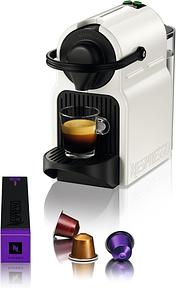
Nespresso Krups Inissia Blanc - Machine à café Compacte & Kit de bienvenue
View at AmazonAffiliate link. Buying through it earns us a commission; the price stays the same for you.
Going over to beans: two routes
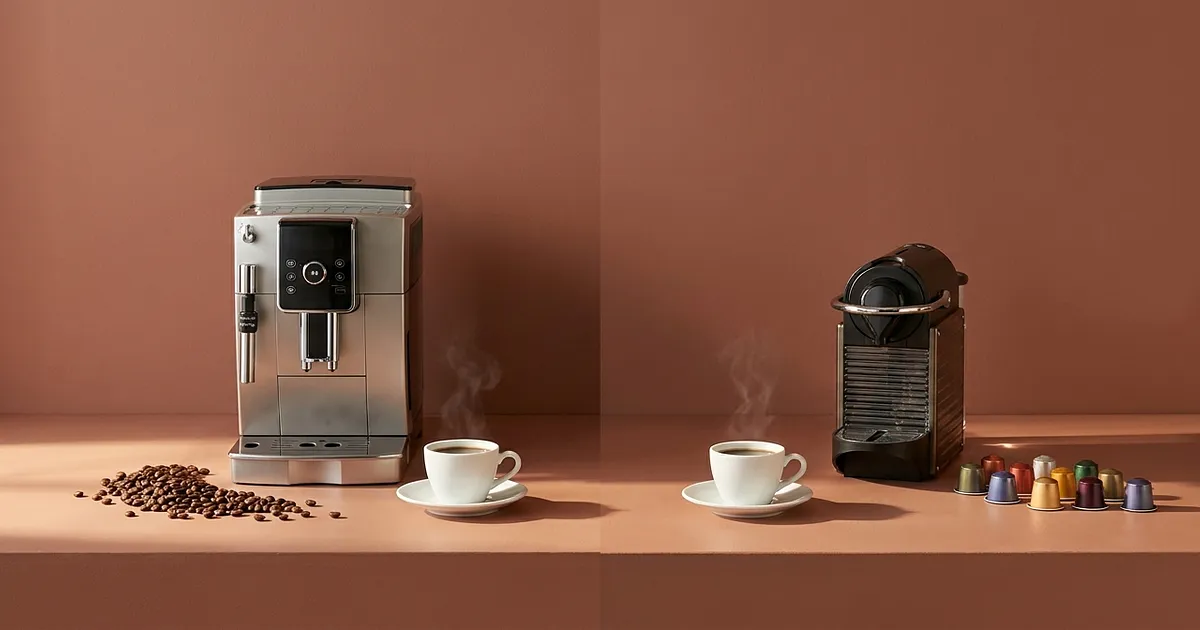
Two routes exist, and our built-in vs separate grinder comparison breaks down the trade-offs of each. Here's a quick bean to cup machine comparison between the two routes before you pick a product.
The easy route, a built-in grinder
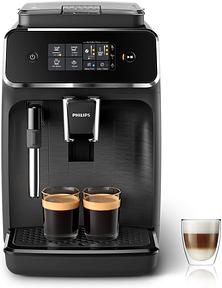
Press the button, the machine grinds, you get a cup. The De'Longhi Magnifica S is the most visible entry-level model in this category in France at €286 on Amazon.fr as of 28/08/2026, and it's the machine price used throughout this article. Its Amazon.fr rating sits at 4.1 across 7,623 reviews on the same date. At that price and with that rating, it stays one of the best value-for-money bean-to-cup machines with a built-in grinder sold in France.
De'Longhi Magnifica S ECAM11.112.B - Perfetto Machine à Café Automatique avec Mousseur à Lait Manuel
Not available in your region — closest match
Philips Série 2200 EP2220/10 - Expresso Broyeur avec Mousseur à Lait, Écran Tactile
View at Amazon (as of Aug 10)Affiliate link. Buying through it earns us a commission; the price stays the same for you.
The cheaper route, portafilter plus a separate grinder
A portafilter espresso machine costs less than a bean-to-cup and leaves the dose and the tamp in your hands. The De'Longhi Dedica Style EC685 is €140 as of 28/08/2026.
One word about the number on the box, since it's the number everyone reads first. A consumer espresso machine is usually advertised at 15 or 19 bar of pump pressure. Espresso extracts at roughly 9 bar at the puck (see our explainer on espresso's ideal pressure if the number on the box has you curious). That pump peak is a sales figure, not the working pressure, and it does not make the coffee better. Grind and dose decide the cup.
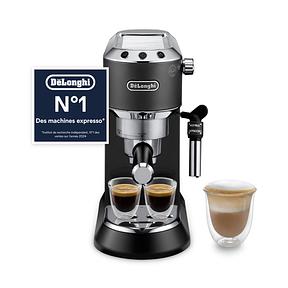
De'Longhi Dedica Style EC685.BK
View at Amazon (as of Aug 11)Affiliate link. Buying through it earns us a commission; the price stays the same for you.
The grinder, half the budget people forget
For whole beans, a portafilter without a burr grinder is pointless, because supermarket pre-ground is too coarse and too stale for espresso. The De'Longhi KG79 at €49 as of 28/08/2026 is the usual entry point, listed by the manufacturer with 16 grind settings. So the pair costs €189 against €286 for the built-in grinder machine: cheaper, but more handling every morning. To compare other models, see our pick of the best electric burr coffee grinders.
De'Longhi KG79 - Moulin à Café Électrique à Meules, 16 Niveaux de Mouture
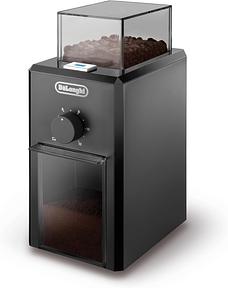
De'Longhi KG79 - Moulin à Café Électrique à Meules, 16 Niveaux de Mouture
View at AmazonAffiliate link. Buying through it earns us a commission; the price stays the same for you.
What the table leaves out
The sum only talks about money. It ignores taste, the 1,460 capsules a year that four daily cups amount to, the counter space a grinder machine eats, and the fact that a bean machine has to be cleaned.
Bean-to-cup or capsules, the honest answer sits in your own numbers, not ours. Run the table again with your own figures: your price per kilo, your real consumption, the machine you actually have in mind. Under two cups a day, keep the capsules and spend the difference on better coffee. Above it, beans are already ahead well before year three ends. If you're going the bean route, our guide to the best bean-to-cup coffee machines helps you pick the right model for your budget.
All products from this post
The ones we named above are marked; the rest are alternatives in the same category.
Not available in your region — closest match
Philips Série 2200 EP2220/10 - Expresso Broyeur avec Mousseur à Lait, Écran Tactile
View at Amazon (as of Aug 10)
Affiliate notice: As an Amazon Associate, we earn from qualifying purchases. Product prices and availability are subject to change.
Frequently Asked Questions
At how many cups a day do whole beans pay off?
Two cups a day, over a 36-month horizon, with a €286 machine and coffee at €25/kg. Below that, capsules cost less in total. Above it, each cup hands roughly €0.17 back to the beans. A pricier machine or specialty coffee pushes the threshold higher.
What does a cup of bean coffee really cost?
Figure on €0.17 to €0.21 per cup for a 7 g dose, with coffee at €25 to €31/kg, the French average measured in April 2026. Supermarket beans drop to €8 to €14/kg and specialty grades run €40 to €80/kg. That one line alone can double the cost per cup.
Does a capsule machine need maintenance?
Yes, though not much. Periodic descaling covers it, with no water filter and no cleaning tablets. We put it at around €15 a year against a much wider range for a bean-to-cup. The idea that capsules are maintenance-free is wrong, even if the gap stays real.
Do I need a separate grinder with a portafilter machine?
Yes. Supermarket pre-ground is too coarse for espresso and loses its aroma within days of opening. An entry-level burr grinder costs about €49 and does more for the cup than another €100 spent on the machine itself.
Do the advertised 15 or 19 bar change anything?
No. That's a pump pressure peak, not the extraction pressure. Espresso extracts at roughly 9 bar at the puck. Look at the grinder, the grind range and temperature stability instead, because those are the settings you can actually taste.