Office coffee machine: what changes compared with home
 8 min read
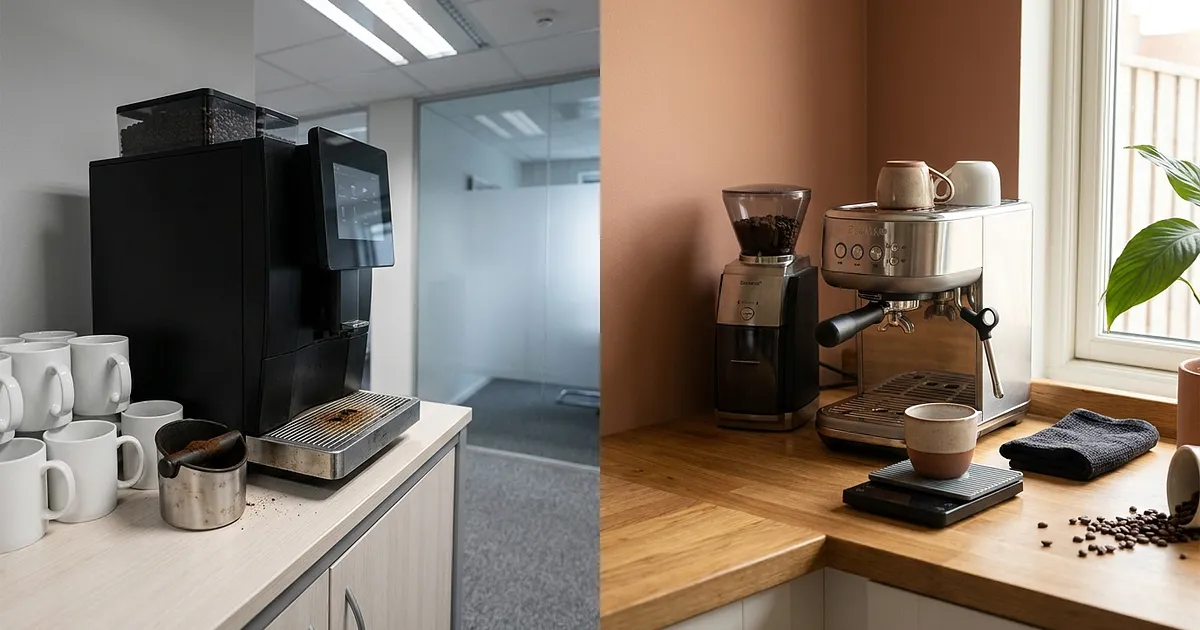
An office coffee machine and the one sitting in your kitchen perform the exact same gesture. They don't solve the same problem. At home you pick the beans, the grind, the moment. At work nobody picks anything: the thing is there, it runs from eight in the morning until six, and the only real decision belongs to whoever signs off on the consumables invoice.
That gap is what makes the comparison worth writing about. Coffee at work is throughput. Coffee at home is adjustment.
Figures checked on 27/08/2026.
Two coffees, two very different office coffee machine jobs
At home the machine runs three to five times a day, usually for the same person, usually with the same coffee. You know its noise. You know when it wants a rinse. You drop the grind a notch when the bag changes. It's an object you learn, slowly, and it eventually gives back exactly what you ask of it.
At work that same appliance turns into shared equipment. A dozen different hands, settings nobody touches because nobody dares, a puck bin everyone notices and nobody empties. The relationship isn't the same any more. You don't learn it. You just use it.
And this is where most buying guides miss the point entirely. They compare machines. The gap that matters sits somewhere else, in the number of cups.
Volume decides the office coffee machine, not taste
People who kit out offices for a living work from a blunt rule of thumb: two coffees per employee per working day, non-drinkers included. The same supplier, looking at several hundred client companies, lands closer to 1.8 cups per employee per day. These are commercial observations rather than published research, and they should be read that way. But the two numbers hold together, which is enough to size an appliance.
Turn that into volume. Ten people means roughly twenty coffees a day. Twenty to fifty people means fifty to a hundred cups, with a plumbed water line and a one-kilo bean hopper. At home you're looking at three to five extractions.
That's a spread of one to twenty. No spec sheet survives a spread like that.
A consumer bean-to-cup machine handles twenty coffees in a busy day perfectly well. What it doesn't handle is forty cups a day, every day, for two years.
Wear is counted in cups, not in years
Grinder, pump and brew group don't age by the calendar. They age by cycles. A machine pulling eight coffees a day and the same model pulling forty are not the same mechanical age after twelve months, even bought on the same date, even serviced with the same care.
Descaling follows the identical logic. The more the appliance runs, the more water passes through it, the faster scale builds up. Water hardness only speeds that up or slows it down. Take whatever descaling interval works in a kitchen, apply it to office throughput, and it tightens on its own.
Wear parts behave the same way. Group gaskets and shower screens get replaced according to how many shots have gone through them, never according to a purchase date.
Cost per cup: invisible at home, structural at work
At home, cost per cup doesn't register. A capsule here and there weighs on nothing. Multiply by headcount and the invisible becomes a budget line somebody has to defend in a meeting.
A simulation published by myecocafe (figures dated 15/05/2026) puts an office-grade capsule at around €0.45 per cup against roughly €0.18 for well-chosen beans, consumables included. Across a team of ten drinking two coffees a day, which works out at 5,280 cups a year, the annual gap clears €1,400: about €2,376 in capsules against €950 in beans.
A supplier has every reason to sell you beans rather than publish a thesis, worth keeping in mind here. Even so, the gap between €0.45 and €0.18 is wide enough to hold up after allowing for plenty of margin of error, and it explains something nobody says out loud: an office machine is almost never chosen for what it puts in the cup.
"Commercial coffee machines are full of bacteria": what the file actually says
The idea has been circulating since a widely reported Spanish study from 2015. A counter-investigation run by RTBF on its own samples found no pathogenic bacteria at all, only harmless micro-organisms already present in tap water.
So no, the machine down the corridor isn't a health hazard.
The real issue is duller and more demanding: consistency. Puck bin emptied, drip tray rinsed, cup rest wiped. At home you do it when you see it. At work, if it isn't written down and assigned to somebody, it simply doesn't happen, and that's what makes the coffee bad long before it makes it suspicious.
What you genuinely lose when you walk into the office
Control.
At home you drop the grind a notch, tweak the dose, switch roast when the current one bores you. The grinder decides the cup far more than the number of programmes printed on the display, which is why a better grinder usually changes the result more than a better machine does.
At work that adjustment turns into a group compromise. A standard that offends nobody and excites nobody.
Then there are two constraints that professional buying guides skip almost every time. Noise first: a grinder firing up three metres from an open-plan desk, forty times a day, wears down patience much faster than a home machine used four times before nine. Footprint second: a plumbed appliance claims a location, not a corner of a worktop.
The question isn't "which machine", it's "for what throughput"
Compare an office machine and a home machine on their spec sheets and you're comparing two objects that look remarkably alike. Compare them on what's being asked of them and the gap becomes obvious. One has a rate to sustain. The other has a cup to dial in.
And if there's a machine at home you're fond of, leave it at home. It'll be better where it is.
Frequently Asked Questions
How much coffee per employee should you budget for at the office?
Office coffee suppliers work from a rule of thumb of two coffees per employee per working day, non-drinkers included. Across several hundred client companies, Javry reports an average closer to 1.8 cups per employee per day. These are commercial benchmarks rather than published research: useful for sizing an appliance, not for proving anything.
Can a domestic coffee machine work in an office?
For three or four people, yes. Beyond that the problem isn't cup quality, it's cycle count. Grinder, pump and brew group wear according to how many coffees they've made. A machine designed for three to five extractions a day and pushed to forty degrades mechanically faster, even with flawless maintenance.
Does an office machine need descaling more often?
Yes, and the difference is sizeable. Scale builds up in proportion to the water passing through the circuit, so a machine running all day scales far faster than the same model used four times each morning. Water hardness speeds that rhythm up or slows it down, but it doesn't replace it.
Capsules or beans at work: which costs less?
Beans, comfortably, once volume climbs. A myecocafe simulation dated 15/05/2026 puts office-grade capsules at around €0.45 per cup against roughly €0.18 for beans, consumables included, which comes to about €2,376 versus €950 a year for ten employees drinking two coffees a day. A supplier-sourced figure, best read as a strong trend rather than an independent audit.
Are shared coffee machines really full of bacteria?
The claim traces back to a heavily reported Spanish study from 2015. A counter-investigation by RTBF on its own samples found no pathogenic bacteria, only harmless micro-organisms already present in tap water. The real concern is cleaning consistency, the puck bin above all, rather than any health risk.