Water hardness, alkalinity and TDS: coffee explained
 9 min read
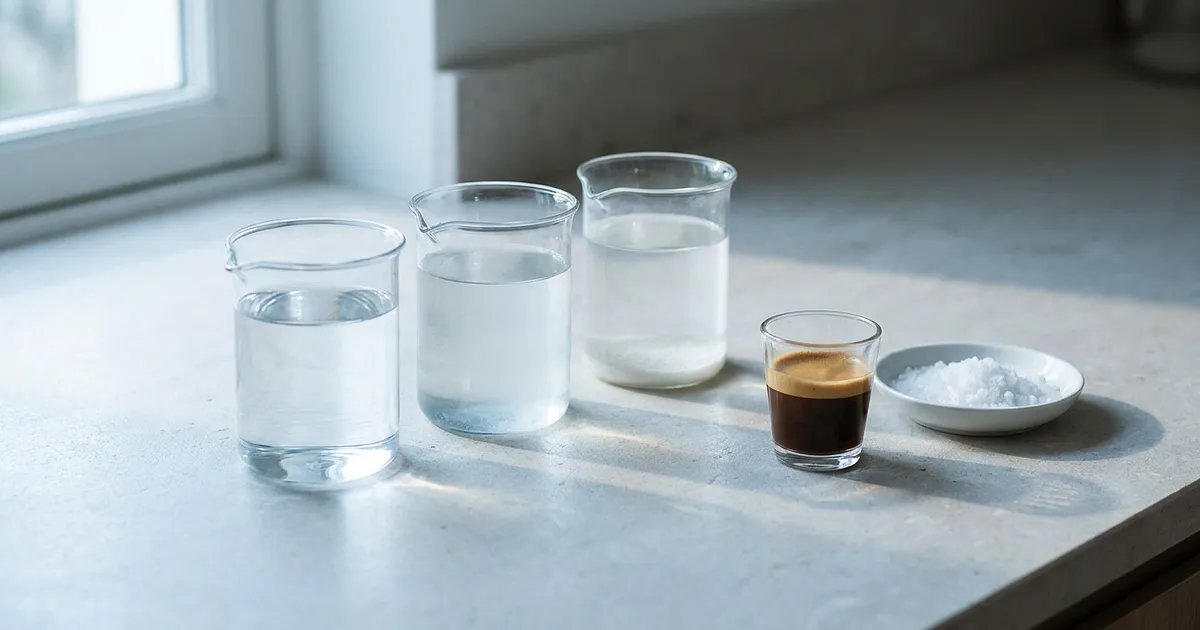
Your water has to do two things that pull against each other. Enough minerals to actually drag flavour out of the coffee, and few enough that the machine doesn't scale up. Because those two demands run in opposite directions, the numbers you find online never line up: a filter brand quotes °dH, a French water bill quotes °f, the professional standard quotes ppm, and almost nobody converts between them. Water is still one of the seven core settings for espresso at home, and the one most guides cover in a single throwaway line.
Three separate measurements sit underneath that mess. They don't measure the same thing.
Hardness (GH): calcium and magnesium
Hardness is how much calcium and magnesium is dissolved in the water. French utilities call it TH, titre hydrotimétrique, and calculate it as TH = 10 × ([Ca²⁺] + [Mg²⁺]) with concentrations in mmol/L (Wikipédia, Dureté de l'eau). Baristas say GH, for general hardness. That abbreviation is borrowed from fishkeeping, honestly, because aquarium shops were selling cheap accurate titration kits long before anyone made one for coffee.
Those ions aren't passive contaminants. Magnesium drives extraction, calcium is the one that ends up as scale inside the boiler, and so the same water decides both how the cup tastes and how often you'll be descaling the machine.
Chemist Christopher Hendon, co-author of a 2014 study, put it this way: "hard water is generally considered to be bad for coffee, but we found it was the type of hardness that mattered, while high bicarbonate levels are bad, high magnesium ion levels increase the extraction of coffee into water and improve the taste."
Read that twice. It splits apart two things that nearly every article on this topic treats as one.
Not the same as TDS. Hardness counts two ions. TDS counts everything else too.
Alkalinity (KH): the number that flattens a cup
Alkalinity of water measures how well it buffers an acid, and that buffering comes from bicarbonate and carbonate. French utilities call it TAC, titre alcalimétrique complet. Baristas say KH, from the German Karbonathärte, another loan word out of the aquarium hobby. The SCA range is 40 to 70 ppm CaCO₃.
More bicarbonate means the coffee's own acidity gets buffered away, and the cup reads flat, one of the signs that let you diagnose an espresso that's too flat or too sour straight from the taste. It's probably the worst understood of the four numbers in the standard, mostly because people fold it into pH, which is only the visible consequence.
This isn't hardness by another name. Water can be soft in GH and still heavily buffered in KH: neither figure tells you the other.
TDS: everything that's dissolved
TDS stands for total dissolved solids, and it adds up everything in the water: calcium, magnesium, sodium, chlorides, nitrates. The SCA range is 75 to 250 ppm, with a target of 150 ppm. Useful as an aggregate, but it says nothing about the GH to KH ratio, and two waters sharing a TDS figure can taste nothing alike.
And the big one: this is not the TDS of your cup. Brewed coffee TDS, also called strength, gets measured with a refractometer and expressed as a percentage of the drink's mass, roughly 1.15 to 1.35% in North America and 1.20 to 1.45% in Europe, alongside an extraction yield of 18 to 22% (detailed definitions). One abbreviation, two scales, two different moments. The logic traces back to Earl Lockhart's work at the Coffee Brewing Institute, published in 1957 (history of the brewing chart). None of this is new.
°f, °dH, ppm: converting the number you already have
One French degree equals 10 mg/L CaCO₃, and the German degree that filter brands print equals 17.85 mg/L (conversion table).
| Unit | What it equals | SCA range converted |
|---|---|---|
| ppm (mg/L CaCO₃) | the unit the SCA standard uses | 50 to 175 ppm |
| °dH (German degree) | 1 °dH = 17.85 mg/L CaCO₃ | 2.8 to 9.8 °dH |
| °f (French degree) | 1 °f = 10 mg/L CaCO₃ | 5 to 17.5 °f |
| °e (Clark degree) | 1 °e = 14.25 mg/L CaCO₃ | 3.5 to 12.3 °e |
Right-hand column: our own arithmetic from the factors in the middle column, not a figure the SCA publishes.
Tap water in Paris runs somewhere around 25 to 30 °f, so 250 to 300 ppm, well above the band. Brittany and the Massif Central sit on granite and come in at 5-15 °f, landing inside it with no treatment at all (regional hardness in France). So you may not have a water problem. You might just have a units problem.
Why nearly pure water brews flat coffee
Reverse osmosis water often sits below 10 to 50 mg/L of dissolved minerals (common misconceptions about RO water), which puts it under the SCA floor of 75 ppm. And coffee brewed with it doesn't come out weak, exactly. It comes out hollow and harsh at the same time.
This isn't a taste preference. Researchers at the University of Bath showed, in a 2014 paper in the Journal of Agricultural and Food Chemistry, that dissolved sodium, magnesium and calcium coordinate to nucleophilic motifs in coffee and pull them into solution. Take the minerals out and nothing is left to do that job.
Here's the irony. RO water gets sold, fairly, as the safest thing to drink. For extraction that same purity is precisely the flaw.
Measuring your own water
Three ways to find your starting number. One of them is free:
A hardness test strip gives you one number in seconds, nothing on alkalinity or TDS.
For the aggregate in ppm, though never the GH to KH ratio, there's a TDS meter.
Free, and probably already in a drawer: your water bill's report.
A hardness test strip
A strip dipped for a few seconds gives you hardness in French degrees, which is enough to place yourself in the table above. It tells you nothing about alkalinity or TDS. If you only want one number, this is the one.
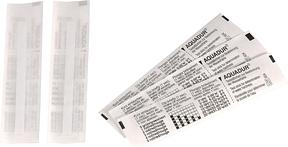
COMAP S900671 – languette de test de dureté (TH) de l'eau
View at AmazonAffiliate link. Buying through it earns us a commission; the price stays the same for you.
A TDS meter
An electronic meter shows TDS in ppm within seconds. Worth knowing what it actually does: it reads conductivity and converts, so what you get back is the aggregate, never the GH to KH ratio.
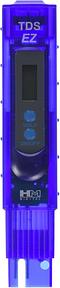
HM Digital TDS-EZ – testeur TDS numérique 0-9990 ppm
View at AmazonAffiliate link. Buying through it earns us a commission; the price stays the same for you.
The report attached to your water bill
Free, and probably already in a drawer. In France, official water quality results including hardness are published commune by commune through the Service-Public.fr portal; most utilities elsewhere publish an equivalent annual analysis.
Reading a mineral water label
A bottle never prints the word "hardness". It prints dry residue at 180 °C, which is the closest thing to TDS. Then calcium and magnesium in mg/L, which give you hardness through the French formula above. Then bicarbonate (HCO₃⁻), which carries the alkalinity. Four lines, and any bottled water can be placed against the SCA table.
You know what to look for. Choosing is the next part
You can read hardness, alkalinity and TDS now, and you know why those three numbers decide how your coffee tastes. What's left is the real question: which water to buy, which filter to fit, and whether a softener actually earns its keep. That one lives in what water for an espresso machine.
All products from this post
The ones we named above are marked; the rest are alternatives in the same category.
Affiliate notice: As an Amazon Associate, we earn from qualifying purchases. Product prices and availability are subject to change.
Frequently Asked Questions
What water hardness does coffee need?
The Specialty Coffee Association standard calls for calcium hardness of 50 to 175 ppm CaCO₃, which converts to roughly 2.8 to 9.8 °dH or 5 to 17.5 °f. Below that band extraction runs thin. Above it the cup hardens and the machine scales faster. Paris tap water, at 25 to 30 °f, sits well outside the range.
What's the difference between hardness and alkalinity?
Hardness counts dissolved calcium and magnesium. Alkalinity measures how well the water buffers an acid, which comes from bicarbonate. French utilities call the first TH and the second TAC. The two move independently, so water can be soft and heavily buffered at once. Alkalinity, not hardness, is what flattens a coffee's acidity.
Why does reverse osmosis water make flat coffee?
Because almost nothing is left for the flavour compounds to bind to. Calcium, magnesium and sodium ions coordinate chemically with those compounds and carry them into solution, and reverse osmosis strips them out. The result isn't a light coffee but a hollow, often harsh one, sitting below the recommended TDS floor of 75 ppm.
Is water TDS the same as coffee TDS?
No. Water TDS is measured in ppm before brewing, with a recommended range of 75 to 250 ppm. Brewed coffee TDS, also called strength, is measured with a refractometer as a percentage of the drink, roughly 1.15 to 1.45% depending on the reference. Same abbreviation, two scales, two different moments.
How do I find out my tap water hardness?
Your water utility publishes the hardness of your supply zone, usually online and in an annual analysis. A test strip gives you the same figure in a few seconds. An electronic meter measures TDS instead, which is a different quantity altogether.
How do I read a water hardness test?
A hardness test strip changes colour based on dissolved calcium and magnesium: match the shade to the chart on the pack, in French degrees (°f), then place that number in the conversion table above to see where you sit against the SCA range (5 to 17.5 °f). A TDS meter instead shows a number in ppm, but it measures the aggregate, never hardness alone: two tools, two different answers.
Sources
- Specialty Coffee Association littlecupexperts.com
- Wikipédia, Dureté de l'eau fr.wikipedia.org
- Christopher Hendon phys.org
- detailed definitions en.wikipedia.org
- history of the brewing chart sca.coffee
- conversion table en.wikipedia.org
- regional hardness in France adoucisseur-eau.fr
- common misconceptions about RO water aquabrio.be
- Journal of Agricultural and Food Chemistry researchportal.bath.ac.uk
- Service-Public.fr portal service-public.gouv.fr