Recyclable coffee pods: what the EU's 2026 rules change
 5 min read
Updated 3 September 2026
The words "recyclable coffee pods" on a box tell you far less than they look like they do. Two separate rules landed on coffee capsules this year and almost nobody keeps them apart: an EU regulation about how packaging is designed, and a French sorting change about which bin the capsule goes in. Most coverage sells them as one story.
Recyclable coffee pods under PPWR: a regulation, not a directive
The EU packaging regulation, PPWR, entered into force on 11 February 2025 and has applied since 12 August 2026. Its formal name is Regulation (EU) 2025/40. The old text was a directive, transposed by each country in its own way; this one is a directly applicable regulation across all 27 member states, with no national interpretation gap.
The part that touches your capsule comes later. The text introduces an A to E recyclability grade, and from 2030, packaging graded D or E can no longer go on the EU market. Grade C follows after 2038. So nothing is banned today, and the word "capsule" appears on no list of targeted formats. A genuinely recyclable coffee capsule under the letter of the text doesn't exist yet either: PPWR sets an A to E grade, not an approved format.
France moved its yellow bin before Brussels did
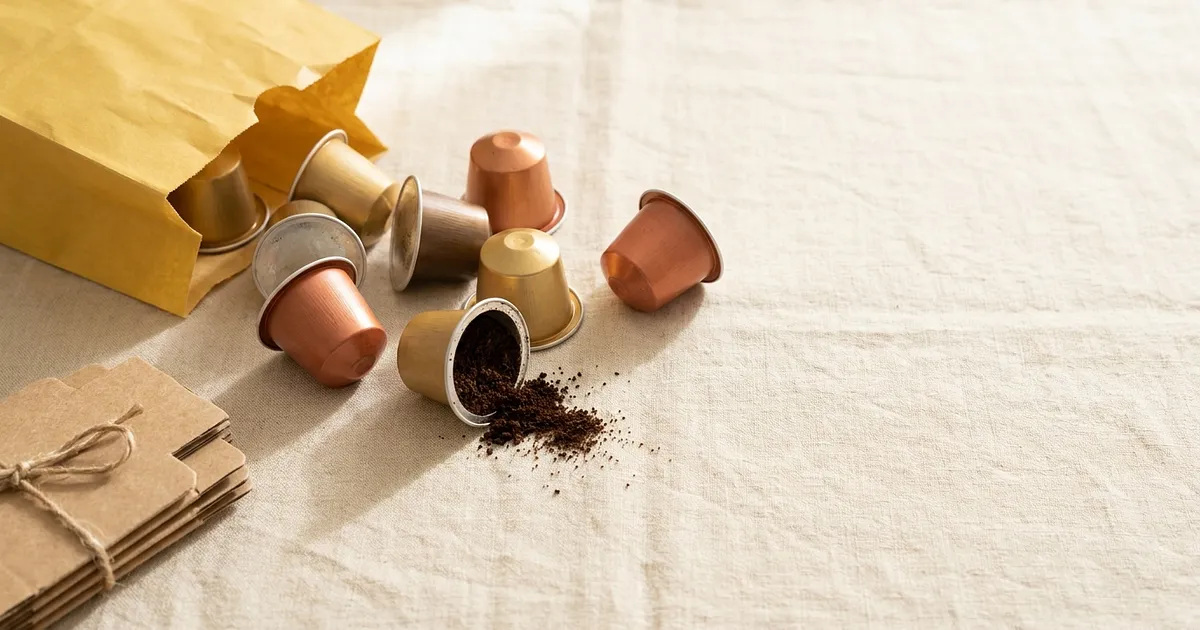
According to franceinfo, aluminium capsules now go loose into the yellow bin everywhere in France, unemptied and without separating the grounds. The nationwide generalisation dates to 1 January 2026, after a rollout spread across 2025. That shift changes coffee capsule recycling at home in a concrete way: no more rinsing, no more separating out the grounds.
Romain Lebegue, head of collection, sorting and recycling at Citeo, gives the one solid number in the story: "We're at 8,000 tonnes of small packaging recycled, which is really very significant for the aluminium stream."
That extension belongs to France's household packaging EPR, a purely domestic scheme run by Citeo. No line of the European regulation decided the colour of anybody's bin.
The professional packaging EPR doesn't apply to you
Here's the trap. A separate EPR stream for professional packaging was created by decree on 17 November 2025, applying from 2026, with eco-contributions due from 1 July 2026.
It targets food service and B2B; the supermarket box of capsules sits outside its scope. If you search for "coffee packaging EPR" and land on industrial compliance material, you're in the wrong stream.
What brands call recycling is not the law
Nespresso, Dolce Gusto and L'OR ran their collection points long before either text existed. Those are voluntary schemes, not evidence of compliance. A brand with no take-back isn't breaking a law, and a brand that runs one has no head start on PPWR.
On real recyclability the gap is still wide. A UFC-Que Choisir investigation from 2 March 2025 went through 28 references: aluminium is infinitely recyclable in theory but depends on the local sorting centre being equipped, and paper pods are barely recycled in France despite the material.
Only four plant-based capsules carried "Home OK Compost" certification. That mess is what PPWR is meant to settle by 2030. A "recyclable" logo on a box, in other words, proves nothing until you've checked what your own local sorting plant actually takes.
What to do with your next box
Two things worth knowing right now. Aluminium capsules go in the yellow bin, loose, grounds included. A paper pod follows whatever the manufacturer prints, compost or general waste, and it never belongs in the yellow bin by default.
The rest sits with the manufacturer rather than with you. And if you'd rather cut the problem off at source, a refillable stainless capsule is honestly the only option that leaves no packaging waste per cup. The grind range it accepts is what separates the good ones, probably more than the material ever will.
One thing worth keeping: a genuinely recyclable coffee pod under the letter of the regulation doesn't exist yet, only your sorting habit changes today.
Frequently Asked Questions
Will coffee capsules be banned in Europe?
No. PPWR names no capsule format. It sets an A to E recyclability grade and blocks packaging graded D or E from sale from 2030. A capsule that hits the required grade stays sellable after that.
Where do aluminium recyclable coffee pods go?
In the yellow bin, loose, without emptying them. Sorting of small aluminium packaging has been generalised across France since 1 January 2026. No need to separate the grounds, since equipped sorting centres handle that.
Are paper coffee pods recyclable in France?
Rarely. Despite the material, most sorting streams won't take them. Some brands provide for industrial composting, which assumes a food-waste collection near you. Trust the exact wording on the box instead.
Does packaging EPR cover capsules sold to consumers?
Yes, but only the household packaging EPR run by Citeo. The stream created in late 2025 for professional packaging targets food service and B2B, not the supermarket box.
Does returning capsules in store make me compliant?
The question runs backwards. Obligations sit with the producer, not the buyer. A brand take-back programme is a commercial service, often a useful one, with no bearing on compliance with the European regulation.
Sources
- EU packaging regulation, PPWR environment.ec.europa.eu
- directly applicable regulation environment.ec.europa.eu
- D or E can no longer go on the EU market orki.green
- franceinfo franceinfo.fr
- separate EPR stream for professional packaging eternity-systems.com
- voluntary schemes labomaison.com
- UFC-Que Choisir investigation from 2 March 2025 quechoisir.org