Bean-to-cup coffee machine for beginners: how to pick
 13 min read
Prices and specifications as of 08/08/2026
Three families of machine compete for a first purchase, and the price tag tells you almost nothing about which one suits you. Deciding which bean-to-cup coffee machine to choose works in a fixed order: machine type first, then the honest budget floor, then the grinder, and only after all that the number of programmed drinks. This page walks those calls with the figures and the sources behind them.
Three routes, and not a ranking
Before any model, there is a fork almost no buying guide handles head-on. Fully automatic bean-to-cup, a portafilter machine with a built-in grinder, or capsules. The right answer is not a score out of ten.
It depends on what you're willing to do every morning. More precisely, on what you refuse to learn.
The fully automatic bean-to-cup machine
It grinds, doses, tamps and pulls without you. As Coffee-Spirit puts it, an automatic bean-to-cup machine stays simpler for a beginner, while a portafilter machine asks you to learn to grind, dose and tamp yourself.
So this is the default route for a first machine, and honestly there's nothing embarrassing about it. The coffee is ground seconds before extraction, which means it's fresher than any capsule, even on an entry-level unit.
Real entry pricing sits around €260. The Philips Series 2200 EP2220/10 runs about €262,99 on Amazon.fr right now, price checked 08/08/2026; the manufacturer states the grinder is 100% ceramic, and it comes with two programmed drinks. Two. Not twelve. For an espresso and a longer black coffee in the morning that's enough, and it's exactly the trade-off a spec sheet nudges you into skipping.
Philips Série 2200 EP2220/10 - Expresso Broyeur avec Mousseur à Lait, Écran Tactile
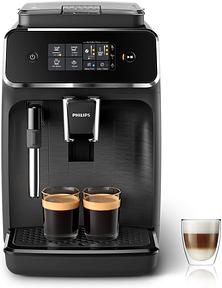
Philips Série 2200 EP2220/10 - Expresso Broyeur avec Mousseur à Lait, Écran Tactile
View at Amazon (as of Aug 10)Affiliate link. Buying through it earns us a commission; the price stays the same for you.
The portafilter machine, the Siebträger route
Here you do the work. Grind setting, dose on a scale, tamp, watch the shot time, adjust. Slower, sometimes ruined, and the only route that hands you real control over the cup.
The De'Longhi La Specialista Arte EC9155.MB sits squarely in this segment: built-in grinder, a manual steam wand, and eight grind settings the manufacturer lists. It goes for about €410,49 on Amazon.fr, price as of 08/08/2026, call it €150 more than the entry-level automatic, for a machine that asks more of you.
That premium only makes sense if the learning curve appeals. If weighing 18 g of coffee at 7 a.m. sounds tiring just described on a page, the answer is no, and that isn't a failure of taste. A grinder-equipped espresso machine like this stays a legitimate beginner choice, just one reserved for whoever actually wants that control.
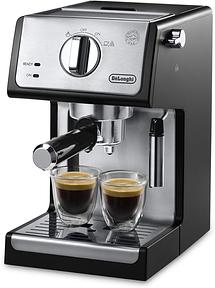
Not available in your region — closest match
View at Amazon (as of Aug 14)Affiliate link. Buying through it earns us a commission; the price stays the same for you.
Capsules, dismissed too fast
A capsule wins on two things: speed, and never having to clean a grinder. What it gives up is freshness, because the coffee inside was ground weeks or months ago.
If you drink one coffee a day, fast, on your way out, a bean-to-cup machine won't make you happier. It'll make you busier.
The budget floor for a bean-to-cup coffee machine, without rounding
This is the question round-ups dodge: what's the least you can spend without regretting it? UFC-Que Choisir puts the market range between €300 and over €1 500 in its buying guide for espresso machines with grinders. The low end is the useful number here.
Several French buying guides, all published by retailers rather than an independent lab, land on the same read: below €200 the compromises hit the grinder, the materials and the fineness of the grind adjustment. Take that for what it is, an editorial consensus, not a study.
The market has tightened since. The two cheapest machines on this page were listed at roughly €262,99 and €299,99 on Amazon.fr on 08/08/2026, so right on that step. The Krups Essential Compacte, whose maker rates it at 15 bar, is the smallest of the five, which makes it a credible small bean-to-cup coffee machine for a 6 m² kitchen.
And if you search for a cheap bean-to-cup machine, you'll find models under €200. They exist, they grind, they make coffee. Where they let you down is the grind adjustment, which happens to be the one setting that changes the cup.
KRUPS Essential Compacte - Machine à Café à Grain Automatique 15 bars
Not available in your region — closest match
Philips Série 2200 EP2220/10 - Expresso Broyeur avec Mousseur à Lait, Écran Tactile
View at Amazon (as of Aug 10)Affiliate link. Buying through it earns us a commission; the price stays the same for you.
The grinder is the bean-to-cup coffee machine
A bean-to-cup machine is only as good as its grinder. Everything else, touchscreen included, comes after.
Grind size decides how much resistance the water meets in the puck, which sets the shot time, which sets the taste. Too coarse and the water rushes through, leaving something thin and sour. Too fine and it barely passes, so you get bitterness instead.
Two numbers are worth hunting on the spec sheet. The count of grind steps first: eight steps stated for La Specialista Arte, a manufacturer figure, against an adjustment range several entry-level automatics simply don't publish. Then the burr material. According to Coffee-Spirit, ceramic burrs don't heat up during grinding, which helps preserve aromatics, while steel stays more common and cheaper.
Dose matters just as much. The Specialty Coffee Association defines espresso as 7 to 9 grams of coffee for a single, 14 to 18 grams for a double, extracted between 90,5 and 96,1 °C over a 20 to 30 second shot. An automatic doses itself, inside a range it usually won't tell you. That's the real price of convenience.
Five machines, row by row
The table below ranks nothing. It shows what the manufacturers publish, and more usefully what they don't. None of these values was measured by Novebar.
| Model | Type | Stated pump pressure (manufacturer) | Extraction pressure | Grinder (manufacturer figure) | Price listed on Amazon.fr, 08/08/2026 | Amazon.fr user rating |
|---|---|---|---|---|---|---|
| Philips Series 2200 EP2220/10 | fully automatic bean-to-cup | not stated | not stated by the manufacturer | 100 % ceramic burrs, step count not stated | approx. €262,99 | 4,2 out of 5 (26 597 reviews) |
| Krups Essential Compacte | fully automatic bean-to-cup | 15 bar | not stated by the manufacturer | not stated | approx. €299,99 | 4,2 out of 5 (5 702 reviews) |
| De'Longhi La Specialista Arte EC9155.MB | portafilter espresso machine, built-in grinder | not stated | not stated by the manufacturer | built-in grinder, 8 grind settings | approx. €410,49 | 4,2 out of 5 (1 457 reviews) |
| Philips Series 5400 EP5447/90 LatteGo | fully automatic bean-to-cup | not stated | not stated by the manufacturer | ceramic burrs, step count not stated | approx. €493,99 | 4,3 out of 5 (13 836 reviews) |
| De'Longhi Eletta Explore ECAM452.67.G | fully automatic bean-to-cup | not stated | not stated by the manufacturer | not stated | approx. €999,99 | 4,3 out of 5 (692 reviews) |
The most telling column is extraction pressure, empty all the way down. Nobody publishes it, probably because it doesn't sell anything. The reference itself doesn't move: the Specialty Coffee Association puts espresso extraction at 9 to 10 atmospheres, so roughly 9 bar at the puck.
Milk: steam wand or automatic carafe
Two mechanisms, two philosophies. The split between a manual steam wand and an automatic milk carafe comes down to this: one bets on simplicity and consistency, the other on control and personalisation (Astuce Maison Jardin).
A manual wand needs a learned movement, and it'll go wrong for the first few weeks. A carafe produces decent foam on the first try, every day, with no way to get better at it.
The Philips Series 5400 EP5447/90 LatteGo goes for about €493,99 on Amazon.fr, price as of 08/08/2026. It sits right on that trade-off: a detachable milk carafe, and twelve drinks with four user profiles according to the spec sheet. Twelve drinks is a lot for a beginner, and it's also the kind of figure that justifies a €200 gap while changing nothing about the espresso.
What the carafe genuinely changes is cleaning. A milk circuit that isn't rinsed properly smells bad within three days, whatever the machine cost.
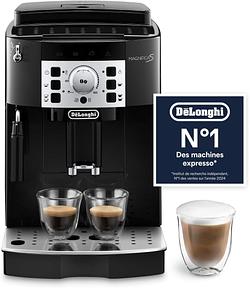
Not available in your region — closest match
De'Longhi Magnifica S ECAM22.110.B
View at Amazon (as of Aug 11)Affiliate link. Buying through it earns us a commission; the price stays the same for you.
Noise and footprint, not afterthoughts
Grinding is the loud part, and it lasts a few seconds per cup. In a studio flat, in a shared house, or with a baby asleep next to the kitchen, those seconds weigh more than three extra programmes ever will.
One honesty note here. Plenty of round-ups print precise decibel figures per model and present them as measured. No accessible authority publishes those numbers, the values contradict each other from site to site for the same machine, and no methodology is given anywhere. Novebar won't repeat them. What is attributable: noise level is one of the criteria UFC-Que Choisir evaluates in its tests of espresso machines with grinders, alongside coffee temperature, foam thickness, flow speed, cleaning and descaling.
So if you're after a quiet bean-to-cup coffee machine, the only solid move is to read a test that says how it measured, rather than an isolated figure on a sales page.
Footprint you can check without anyone's help. Take the manufacturer's dimensions, add the clearance needed to open the bean hopper, and measure the gap under your wall units. It's the dumbest and most frequent reason these machines get returned.
Hard water, the cost nobody prices in
Here's the line beginner guides nearly always skip. In France the hard-water threshold sits at 15 °f, degrés français, according to Adoucisseur-eau.fr; Hauts-de-France ranks among the most calcareous regions, while Brittany has naturally soft water. Paris water is classed as hard, somewhere around 20 to 28 °f depending on the distribution zone.
That value sets your descaling frequency, which sets the real cost of the machine. According to Chacun Son Café, the recommended interval runs from 2 months in a very calcareous area to 4 months with filtered water.
Do that arithmetic before you buy, not after. Descaler, filter cartridges if the model takes them, and the time it all costs: this is a subscription, not a one-off purchase. A reader in northern France and a reader in Quimper are not buying the same machine at the same total cost, even at an identical sticker price.
What to ignore: the number on the box
This is the correction this site is named after. According to UFC-Que Choisir, pressure above 9 bars can turn out too aggressive: the ideal extraction pressure stays 9 bar, whatever maximum the packaging advertises.
So why 15 bar on the Krups, and 19 bar on so many other cartons? Because that's the pump's theoretical peak, not its working pressure. As CafePièces explains, an over-pressure valve caps the real figure around 9 to 11 bar even when the pump is rated at 15 or 19. The number is a sales argument, not a quality signal.
Second figure to ignore: the count of preprogrammed recipes. Twelve drinks on a menu change neither the grind, nor the dose, nor the temperature. They change the price.
When trading up earns it
There is a real step above, and it has nothing to do with pressure. The De'Longhi Eletta Explore ECAM452.67.G runs around €999,99 on Amazon.fr, price checked 08/08/2026, and adds a hot and cold milk system plus cold extraction, both manufacturer figures, with a 4,3 out of 5 user rating across 692 reviews.
Is that worth nearly four times the Philips 2200 for a first purchase? Honestly, no, unless iced coffee is part of your actual routine rather than your intentions. For a beginner, the better use of €1 000 is usually a €300 machine and two years of good beans.
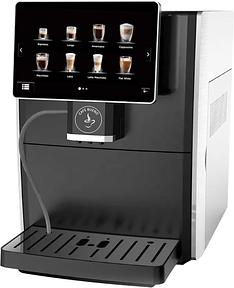
Not available in your region — closest match
View at Amazon (as of Aug 14)Affiliate link. Buying through it earns us a commission; the price stays the same for you.
If you already know the type you want
This page answers the earlier question: which type of machine, for which profile. If you already know you want a bean-to-cup machine and you're hunting the best model, our full bean-to-cup machine comparison takes it from there, model by model.
The two pages serve different moments. This one keeps you from buying the wrong category. That one helps you choose inside the right one.
Where to go next
Four things worth doing before you confirm a basket, in this order:
- Measure your kitchen gap with the bean hopper open.
- Look up your local water hardness in degrés français.
- Reread the spec sheet hunting for the grind adjustment rather than the bar rating.
- If the machine takes a milk carafe, check what the replacement carafe costs, because that part gets lost and broken more than any other.
That's what it takes to know which bean-to-cup coffee machine to choose without trusting the number printed on the box.
Prices on this page were taken from Amazon.fr on 08/08/2026 and move quickly in this segment. The specifications quoted come from manufacturer sheets and are flagged as such, row by row. Nothing here was tested by Novebar.
All products from this post
The ones we named above are marked; the rest are alternatives in the same category.
Not available in your region — closest match
Philips Série 2200 EP2220/10 - Expresso Broyeur avec Mousseur à Lait, Écran Tactile
View at Amazon (as of Aug 10)
Not available in your region — closest match
De'Longhi Magnifica S ECAM22.110.B
View at Amazon (as of Aug 11)
Affiliate notice: As an Amazon Associate, we earn from qualifying purchases. Product prices and availability are subject to change.
Frequently Asked Questions
Which bean-to-cup coffee machine should a beginner choose?
A fully automatic model with a built-in grinder stays the safest pick for a first purchase: it grinds, doses and extracts on its own. Budget at least €300, that's the floor UFC-Que Choisir sets in its market range; below it, the grinder is what gets cut first. Check the grind adjustment before the number of programmed drinks, because grind size is what decides the taste.
Do you really need to spend over €300?
Not strictly, but that's the step where manufacturers stop cutting corners on the grinder and the adjustment range. Several French buying guides, all retailer-published, agree that below €200 the compromises hit the grinder, the materials and grind fineness. Two models listed around €260 to €300 in August 2026 sit right on that threshold.
Is a quiet bean-to-cup coffee machine actually a thing?
Grinding is loud by nature, and it only lasts a few seconds. Be wary of per-model decibel figures on comparison sites: no accessible authority publishes them, and the numbers contradict each other with no methodology attached. Noise level is genuinely one of the criteria UFC-Que Choisir evaluates, so look for a test that explains how it measured.
15 bar or 19 bar, what changes in the cup?
Nothing, as far as the cup goes. Those figures are the pump's theoretical peak, not its working pressure. According to CafePièces, an over-pressure valve brings the real figure back to around 9 to 11 bar, and UFC-Que Choisir notes that past 9 bar extraction turns too aggressive. What decides taste is grind, dose and temperature.
Should you buy a filter cartridge straight away?
Depends on your water. The hard-water threshold in France is 15 °f according to Adoucisseur-eau.fr, and Hauts-de-France is among the most calcareous regions while Brittany runs soft. Chacun Son Café puts descaling frequency between 2 months in a very calcareous area and 4 months with filtered water. Check your local hardness before ordering.
How do you choose a bean-to-cup coffee machine?
Start with the type: fully automatic for simplicity, portafilter if you want to dial in the extraction yourself, capsules if speed matters more than taste. Once that's settled, check the grinder before anything else. It's what decides the grind, and the grind is what decides the taste, long before the touchscreen or the drink count.
Sources
- Coffee-Spirit coffee-spirit.maxicoffee.com
- buying guide for espresso machines with grinders quechoisir.org
- Coffee-Spirit coffee-spirit.maxicoffee.com
- Specialty Coffee Association coffeegear.org
- Astuce Maison Jardin astuce-maison-jardin.fr
- Adoucisseur-eau.fr adoucisseur-eau.fr
- Chacun Son Café chacunsoncafe.fr
- CafePièces cafepieces.com