Cheap bean-to-cup coffee machines: the real prices in France in 2026
 14 min read
Updated 8 August 2026
On 8 August 2026, one bean-to-cup coffee machine sells for €262.99 on Amazon.fr and another for €1,209.90. Both grind beans on demand, both pull an espresso, both plug into the same socket. So there's nothing absurd about hunting for a cheap bean-to-cup coffee machine: the gap is close to €950, and almost none of it plays out in the cup.
Which leaves the real question. What does each slice of budget actually buy?
What a bean-to-cup coffee machine costs in France in 2026
According to Que Choisir's comparison, out of 52 bean-to-cup machines tested on the French market, 10 cost under €400, 27 sit between €400 and €800, and 15 go past €800. Half the market fits inside a single band €400 wide. The French consumer association's own advice fits on one line: "Budget at least €300 for the purchase."
If you're aiming well below €300, the stovetop moka pot (covered elsewhere on this site) doesn't grind beans on demand and has nothing to do with these machines.
That doesn't mean a €300 machine pulls the same espresso as a €1,200 one. It means that below €300 in France, whatever you save comes out of the grinder, and the grinder decides the grind, so it decides the extraction.
The table below is an editorial read of the three bands, not a spec sheet model by model. Every price quoted further down comes from an Amazon.fr survey dated 8 August 2026.
| Price band (France, 2026) | What the band usually buys | What it doesn't buy yet |
|---|---|---|
| €250 to €450 | integrated burr grinder, espresso and lungo, a steam wand you work yourself, 2 to 4 preset drinks | colour screen, saved user profiles, milk carafe |
| €450 to €800 | finer grind settings, automatic milk system on most models, 6 to 15 recipes, better finish | app connectivity, deep per-recipe customisation |
| €800 and up | wide screen, app, plenty of recipes saved per user, metal materials | anything decisive about the extraction itself |
One word about the real bill first. The price of the machine is only half the story, since coffee beans get counted by the kilo every single month, and that's the subject of another article on this site about what beans cost.
Entry level, €250 to €450: what a cheap bean-to-cup machine actually gets you
This is the band where the search for a cheap bean-to-cup coffee machine happens, and it's also where the marketing shouts loudest.
Boxes here love printing 15 bar or 19 bar. That's a pump peak quoted by the manufacturer, not the working pressure: an espresso extracts at around 9 bar at the puck, and neither number tells you a thing about grind quality. Look at the grinder instead. How many grind steps it offers. The tank capacity. Not the figure printed in big type.
Choosing between an integrated grinder and a separate one is its own article on this site.
Two concrete reference points on that date.
The Philips Series 2200 EP2220/10 was listed at €262.99 on Amazon.fr on 8 August 2026, rated 4.2/5 across 26,597 reviews. The De'Longhi Magnifica S Smart ECAM230.13.B was listed at €389.99 on the same French store the same day, rated 4.4/5 across 1,764 reviews.
Those two ratings don't compare lightly. 26,597 reviews is a mass verdict piled up over years of selling; 1,764 reviews is a trend. A tenth of a point between them proves nothing at all. But €127 of difference for two machines doing the same basic job deserves a real reason, not a spec-sheet argument.
Philips Série 2200 EP2220/10 - Expresso Broyeur avec Mousseur à Lait, Écran Tactile
De'Longhi Magnifica S Smart ECAM230.13.B - Machine à café à grain
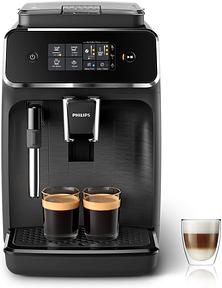
Philips Série 2200 EP2220/10 - Expresso Broyeur avec Mousseur à Lait, Écran Tactile
View at Amazon (as of Aug 10)Affiliate link. Buying through it earns us a commission; the price stays the same for you.
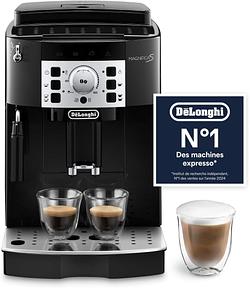
Not available in your region — closest match
De'Longhi Magnifica S ECAM22.110.B
View at Amazon (as of Aug 11)Affiliate link. Buying through it earns us a commission; the price stays the same for you.
Mid-range, €450 to €800: the best value bean-to-cup machine?
This is the most crowded band on the French market, 27 models out of 52 at Que Choisir. It's also where the question of best value for a coffee machine with a grinder gets serious, because this is where most of the features once reserved for premium have come down.
The De'Longhi Magnifica Evo ECAM292.81.B was listed at €489.90 on Amazon.fr on 8 August 2026, rated 4.2/5 across 4,424 reviews. The Siemens EQ.500 classic TP503R09 was listed at €570.20 on the same French store the same day, rated 4.0/5 across 472 reviews.
Might as well say it plainly. Of these six machines, the Siemens carries the lowest rating and the second-smallest review sample, while costing €80 more than the De'Longhi just above it. This isn't a test, only a reading of public numbers on a given date in France. But if you're torn between those two on listed price alone, the gap leans the wrong way.
The real gain in this band isn't the recipe list. It's how finely the grinder adjusts and how steady the temperature stays, two things no spec sheet pushes because they don't fit inside a promo banner. Model-by-model detail sits outside this page. It's covered in our full comparison.
De'Longhi Magnifica Evo ECAM292.81.B
Siemens EQ.500 classic TP503R09 - Machine à café à grain avec broyeur intégré
Not available in your region — closest match
Philips Série 2200 EP2220/10 - Expresso Broyeur avec Mousseur à Lait, Écran Tactile
View at Amazon (as of Aug 10)Affiliate link. Buying through it earns us a commission; the price stays the same for you.
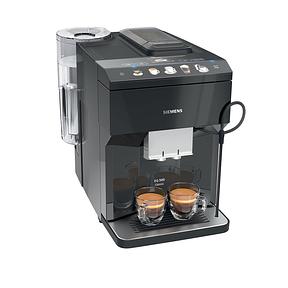
Siemens EQ.500 classic TP503R09 - Machine à café à grain avec broyeur intégré
View at Amazon (as of Aug 11)Affiliate link. Buying through it earns us a commission; the price stays the same for you.
Premium, above €800: where the returns start shrinking
Fifteen models out of 52 pass €800 at Que Choisir. The French comparison runs up to €1,799 for the WMF Perfection 860L and up to €2,004.76 for a De'Longhi PrimaDonna Aromatic.
The Melitta Barista T Smart F850-102 was listed at €1,078.51 on Amazon.fr on 8 August 2026, rated 4.1/5 across 1,117 reviews. The De'Longhi PrimaDonna Soul ECAM612.55.SB was listed at €1,209.90 on the same French store the same day, rated 4.2/5 across 1,334 reviews.
Now the detail that should make you hesitate. On 8 August 2026, that same Melitta Barista T Smart showed at €749.00 on Amazon.de. Same model, same day, €329.51 between two European marketplaces. It isn't a scandal, it's local pricing, and it's worth a check from France before you confirm a four-figure basket.
Above €800, the extra money buys saved recipes, a screen, user profiles and metal trim. Not an extraction built on a different principle. Working pressure stays around 9 bar, beans stay beans, and a badly set grind ruins an espresso just as well on a €1,200 machine as on a €300 one.
Melitta Barista T Smart F850-102 - Machine à café à grain premium
De'Longhi PrimaDonna Soul ECAM612.55.SB - Machine à café à grain haut de gamme
Not available in your region — closest match
De'Longhi Magnifica S ECAM22.110.B
View at Amazon (as of Aug 11)Affiliate link. Buying through it earns us a commission; the price stays the same for you.
Not available in your region — closest match
De'Longhi Magnifica S ECAM22.110.B
View at Amazon (as of Aug 11)Affiliate link. Buying through it earns us a commission; the price stays the same for you.
What has trickled down, and what that changes for your budget
The most useful number in the Que Choisir comparison isn't a price. It's this one. Automatic milk drinks are present on 45 of the 52 models tested.
Put another way, the automatic milk frother is no longer a premium marker in France. It's the norm now, the €400 to €800 band included. Paying extra for that one feature in 2026 means paying for it twice.
Same logic for the touchscreen and app connectivity, which now turn up well before the €800 line. What still genuinely tracks with price? The number of user profiles. Material quality. How quiet the grinder is. And how finely the grind adjusts.
One piece of advice falls straight out of that. Before comparing two machines on price, list the functions you'll really use every morning. If the answer is "an espresso and a lungo", the €450 to €800 band covers the whole need, and the rest of the budget does more good in the beans.
How sales and promotions work on a bean-to-cup machine in France
This is the part product comparisons skip every single time, and it's the part that will save you the most.
France has only two legal sale periods
Floating sales, set freely by the retailer, haven't existed in French law since 2015. Two national windows are left each year, and they're fixed by ministerial order.
The 2026 winter sales ran from 7 January to 3 February inclusive, with a shifted calendar of 2 to 29 January in Meurthe-et-Moselle, Meuse, Moselle and Vosges. The 2026 summer sales opened on Wednesday 24 June at 8am, online included. They finished on 28 July instead of the 21 July originally planned, after an exceptional extension tied to the heatwave. Corsica runs its own calendar, 8 July to 4 August.
Everything else, French Days included, is a private commercial operation. Retailers set their own dates. Boulanger announced its French Days from 29 April to 5 May 2026. Black Friday falls in the same category. No French text frames these as "sales", which doesn't mean they escape French price-reduction law. A coffee machine advertised at Black Friday with 30% off obeys the same rule: nothing exempts it from the 30 days.
The 30-day rule, and why it's so widely ignored
Since 28 May 2022, ordonnance no. 2021-1734, which transposed the EU Omnibus directive into French law, has governed every price-reduction claim in France. The claim has to refer to the lowest price the seller charged over the previous 30 days. Not a list price. Not a manufacturer's recommended price. The lowest price actually charged, on that site, during that month.
Where reductions come one after another, the reference price stays the one from before the very first drop of the promotional period.
Now the number that stings. A UFC-Que Choisir investigation covering nearly 1,000 listings across six large French e-commerce sites found that only 15% of advertised reductions follow the rule. And the two populations look nothing alike. Compliant promotions show an average drop of 11%, against an average advertised discount of 31% where the comparison price had been manipulated.
Keep that ratio in mind. A real promotion in France runs around 11%. A spectacular "30% off" on a bean-to-cup machine is statistically more often an inflated strikethrough price than a bargain.
What that means in practice
The percentage on the banner tells you nothing. The only number that counts is the price you pay, set against what that same model was worth at that same seller in the weeks before.
Three habits that work, and one that doesn't.
Track the price of the model you want for three or four weeks before you buy. A notebook does the job, no tool needed.
Comparing a sale price at one seller against the normal price at another beats comparing two percentages against each other.
The price outside sale season matters more than people expect. An isolated drop in March often beats a strikethrough price in July, and nobody writes about it because it doesn't make a headline.
What doesn't work: waiting for the sales on principle. On a bean-to-cup machine the French legal window guarantees nothing, and the UFC-Que Choisir investigation explains why.
Have prices gone up in France in 2026?
Honest answer: they haven't gone up, and they haven't fallen either. The real story sits somewhere else.
According to the Gifam 2025 report, published on 12 February 2026, automatic espresso machines in France fell 6% by value in 2025, while cheaper manual-grinder espresso machines grew 53% by volume. No inflation, no deflation. Just demand sliding toward the bottom of the market.
The wider context points the same way. French small domestic appliances reached €4.41 billion in 2025, up 2.9%, according to Gifam and GfK figures reported by Neomag, while the average price of a large household appliance in France slipped to €372 from €387 in 2024.
Actual hardware releases get their own round-up elsewhere on this site.
One point missing everywhere else. There is no INSEE index isolating bean-to-cup coffee machines. France's national statistics institute files them inside far broader aggregates. Any page telling you "according to INSEE, coffee machines rose X%" is inventing its source. The Gifam figures do isolate the automatic espresso category, and that's why they're the ones cited here.
What that changes for you, in practice: nothing justifies rushing out of fear of a rise, and nothing justifies waiting for a general drop that isn't happening.
So what budget should you aim for in 2026
If you drink one or two espressos a day and milk doesn't interest you, the €250 to €450 band does the job in France, and the rest of the budget goes into better beans.
If you're not alone at home, or if cappuccino counts, the €450 to €800 band is the one that has gained the most over the last two years. That's where the automatic frother became standard, and where most of the choice sits.
Above €800, you're buying comfort and finish. Legitimate enough, but say it to yourself plainly, because the cup won't change in nature.
To pick between specific models rather than between bands, go and see which bean-to-cup coffee machine to choose based on current tests. That guide compares the references one by one, with grind and heating type, where this page only talks about money.
For plenty of people the goal stays simple. A cheap bean-to-cup coffee machine, without sacrificing the grinder.
And one last thing before you click a red banner. Check the price of that model next week. If the "30% off" is still sitting there, it wasn't a promotion.
All products from this post
The ones we named above are marked; the rest are alternatives in the same category.
Not available in your region — closest match
De'Longhi Magnifica S ECAM22.110.B
View at Amazon (as of Aug 11)
Not available in your region — closest match
Philips Série 2200 EP2220/10 - Expresso Broyeur avec Mousseur à Lait, Écran Tactile
View at Amazon (as of Aug 10)
Not available in your region — closest match
De'Longhi Magnifica S ECAM22.110.B
View at Amazon (as of Aug 11)
Not available in your region — closest match
De'Longhi Magnifica S ECAM22.110.B
View at Amazon (as of Aug 11)Affiliate notice: As an Amazon Associate, we earn from qualifying purchases. Product prices and availability are subject to change.
Frequently Asked Questions
How much does a decent bean-to-cup coffee machine cost in France in 2026?
Reckon on €250 to €450 for a working entry-level machine and €450 to €800 for the bulk of the French market. Of the 52 models tested by Que Choisir, 27 sit in that second band, and the association recommends a minimum budget of €300. Below that, the saving comes out of the grinder, so out of the grind, so out of the extraction.
Should you wait for the sales to buy a bean-to-cup coffee machine in France?
Not on principle. The two legal sale periods in France, winter and summer, guarantee no floor price on this kind of product. An isolated drop outside those windows, at one seller, is common and often better. The sensible move is to follow the price of the model you want for three or four weeks, then buy when it dips, whatever the date.
Is a strikethrough price advertised at 30% off reliable in France?
Rarely. Since 28 May 2022, a strikethrough price in France has to refer to the lowest price the seller charged in the previous 30 days. The UFC-Que Choisir investigation across nearly 1,000 listings found only 15% of reductions follow the rule. Compliant promotions average an 11% drop, against 31% advertised where the comparison price was manipulated.
What's the real difference in France between a €500 machine and a €1,200 one?
Mostly comfort. The extra buys saved recipes, user profiles, a bigger screen, an app and metal materials. The extraction happens at around 9 bar in both cases. Automatic milk drinks, long a premium feature, now ship on 45 of the 52 models Que Choisir tested in France, mid-range included.
Have bean-to-cup coffee machine prices risen in France in 2026?
No, and they haven't crashed either. The Gifam 2025 report, published in February 2026, records a 6% fall by value for automatic espresso machines in France in 2025, alongside a 53% rise by volume for cheaper manual-grinder machines. Demand is sliding toward the bottom of the market rather than prices climbing.
What are the "15 bar" or "19 bar" claims on the box worth?
They're pump peaks quoted by the manufacturer, not the working pressure. An espresso extracts at around 9 bar at the coffee puck. A higher number on the packaging doesn't give you a better espresso. What really decides the cup is how fine the grinder goes, how consistent the grind is, and the dose.
Sources
- Que Choisir's comparison quechoisir.org
- 2026 winter sales service-public.gouv.fr
- 2026 summer sales inc-conso.fr
- Boulanger boulanger.com
- ordonnance no. 2021-1734, which transposed the EU Omnibus directive into French law legifrance.gouv.fr
- UFC-Que Choisir investigation quechoisir.org
- Gifam 2025 report gifam.fr
- Gifam and GfK figures reported by Neomag neomag.fr