Best electric burr coffee grinder 2026: the honest guide
 13 min read
A €27 electric burr coffee grinder and a €220 one both turn beans into powder. What separates them isn't motor wattage and it isn't the setting count printed on the box. It's burr shape, burr material, and how finely you can move the gap. Most of the rest is sales copy.
Updated 08/08/2026. Prices below come from Amazon.fr and were checked on that date. Availability and pricing differ by country.
French specialty site filtre.cafe puts it bluntly in its 30 March 2026 guide: "Un bon café moulu sur un mauvais moulin donne un mauvais café, sans exception." Good coffee ground on a bad grinder makes bad coffee, no exceptions. It cuts the other way too. An €800 machine fed by a €20 grinder pulls a poor shot, and no setting on the machine gets that back.
Separate grinder or bean-to-cup machine: which one is your problem?
These are two different purchases, and mixing them up is expensive.
A bean-to-cup machine grinds for you, inside the same box, on one button. If that's what you want, you can stop reading here and go to our bean-to-cup machine comparison instead, which covers that format on its own.
A separate grinder earns its place in a few situations. You already own a portafilter espresso machine and want to feed it properly. You also grind for filter, French press or Aeropress, so one grind setting no longer covers you. Or you want a better cup without replacing the machine, which is usually the best return per euro anyone in this hobby gets.
The rest of this guide is about the separate grinder.
Burrs or blades: settle this first
A blade grinder doesn't grind. It chops. A propeller spins fast and smashes beans at random, so you get dust and boulders in the same dose.
What happens in the cup follows mechanically. The dust over-extracts while the boulders under-extract, in one brew. You get bitter and sour at the same time, and you can't fix either, because both came from the same coffee.
A burr grinder works differently. Two abrasive surfaces sit a set distance apart and reduce the bean to whatever that gap allows. The gap defines your grind. Nothing else does.
That gap matters more on espresso than on filter. According to Belleville Brûlerie, small variations in particle size hit espresso extraction disproportionately hard, far more than they hit filter. That page is from November 2021, so we cite it for the reasoning rather than its model picks.
Here's the part most roundups skip: "burr" is not a quality label. A €25 conical burr grinder spins fast, heats the beans, and adjusts in coarse jumps. It still beats a blade grinder. That doesn't make it an espresso grinder.
Conical or flat burrs: the difference that shows up in the cup
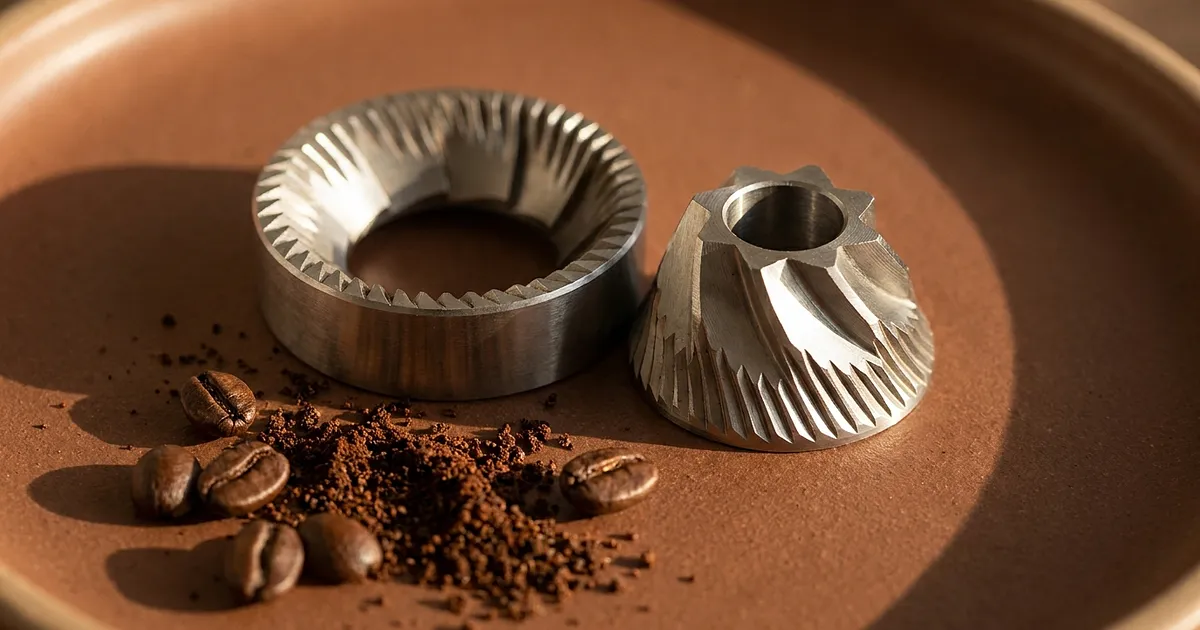
Conical burrs are a cone turning inside a ring. Flat burrs are two parallel discs. This isn't a ranking, it's a different trade-off.
A side-by-side test published by La Grange aux Cafés on 3 March 2026, run on one coffee (Guatemala Huehuetenango), timed an espresso at 25 secondes on conical burrs against 28 secondes on flat burrs at the same dial position. The same test logged a V60 at 4:15 conical against 3:45 flat.
The number to take away isn't the seconds. It's this: the same dial position does not produce the same grind on two different grinders. Switch grinders and you're dialing in from scratch.
Burr speed points the same way. The same source puts conical burrs around 300-500 RPM against 1000-1400 RPM for flat burrs on comparable home models, alongside the note that past 60°C coffee's aromatic oils start to degrade. Slower means cooler.
In practice, conical burrs dominate the entry and mid tiers, and flat burrs turn up when the budget climbs and dose consistency becomes the point. The MaxiCoffee spec sheet for the Eureka Mignon Libra, for instance, lists 55mm reinforced stainless-steel flat burrs and a dosing accuracy of 0.1 to 0.15 grams. That's a manufacturer figure, not an independent measurement.
One word on particle size, since it always comes up. The only figure we could verify on a reachable source is the Specialty Coffee Association's cupping protocol, which asks that 70% to 75% of particles pass a size 20 mesh sieve, roughly 850 microns, per Honest Coffee Guide, updated 10 November 2025. That's the tasting protocol, not the home-equipment standard. Don't read it as a buying spec.
Ceramic or steel: what the burr material changes
Per the Coffee Spirit / MaxiCoffee guide of 18 September 2023, steel is still the material used on professional and espresso-oriented grinders, because it copes better than ceramic with foreign objects in the coffee, a small stone for example.
Ceramic costs less and runs cooler. It also chips more readily. On an entry-level grinder that's a fair trade. On a grinder you plan to keep for a decade, steel is the safer bet.
MaxiCoffee is the editorial arm of a specialty retailer, so read its model preferences accordingly. On burr materials, though, it's the clearest page we found in the French-language set.
What the setting count doesn't tell you about an electric burr coffee grinder
This is the section this article exists for.
One grinder advertises "28 settings". Another says "17 levels". A third claims 60 positions. Those three numbers can't be compared with each other, and none of them tells you whether the machine can hold an espresso grind.
As another Coffee Spirit guide on stepped adjustment explained on 21 September 2023: stepped adjustment is limited by the number of steps built into the mechanism, while stepless adjustment allows infinitely fine positioning. A stepless grinder has zero steps, and it's more precise than most grinders advertising forty of them.
The cleanest demonstration comes from a hand grinder. On the Comandante C40 MK4, Belco lists settings that change completely by method: around 10 clicks for espresso, 18 for Aeropress, 24 for V60, 30 for Chemex, 32 for French press. One grinder, five answers.
So "30 steps" means nothing until you know what range those steps cover. Thirty steps spread from espresso to French press is a coarse jump per click. Thirty steps concentrated in the espresso zone is workable. No Amazon listing tells you which one you're buying.
Look at these instead: does the maker publish the grind range, is the adjustment stepless, and do buyers who actually pull shots say they found their setting. Not one of those is readable from a setting count.
Retention, the number your electric burr coffee grinder almost never prints
Retention is the ground coffee left stuck inside the grinder after a dose, which then comes out mixed into the next one. On an espresso weighed to the tenth of a gram, that's real.
Coffee Chronicler measured 1.1 grams of retention on the Baratza Encore ESP on 26 July 2024, by taking the unit apart and weighing what came out. Stated method, dated figure, named reviewer. That's the standard of evidence we'd like everywhere.
A caveat, and it's an honest one. Other independent reviews of the same model report different figures depending on static mitigation and test protocol. Retention isn't a fixed spec, then. It's a method-dependent measurement, and a single number is a reference point rather than a fact about the machine.
None of the French guides we read for this piece mentions retention at all. It's one of the few genuinely checkable numbers in the category.
Manual or electric: who is each one for?
A well-built manual coffee grinder beats an electric one at the same price, pretty much every time. The mechanics cost less when there's no motor and no electronics to pay for.
You pay for that in time and forearm: budget one to two minutes of cranking per espresso dose. For one person and one coffee in the morning, that's a ritual. For two cups before 8 a.m., it's a chore.
Manual makes sense if you travel, if you grind one or two doses a day, or if your budget stops around €100 and grind quality outranks convenience. Electric takes over as soon as volume goes up, or as soon as there's more than one coffee drinker in the house.
Five electric burr coffee grinders, side by side
Every price below was checked on Amazon.fr on 8 August 2026 and moves often. Ratings and review counts come from the same check, and both differ by marketplace.
| Model | Burr type | Advertised settings | Amazon.fr price (8 August 2026) | Rating and reviews |
|---|---|---|---|---|
| Wancle conical burr grinder | conical | 28 settings (seller listing) | 26,87 € | 4.2/5 from 963 reviews |
| Krups GVX242 | burr | 17 levels (seller listing) | 72,05 € | 4.2/5 from 1,498 reviews |
| De'Longhi KG 520.M | not stated on the listing we checked | not stated | 177,89 € | 4.3/5 from 648 reviews |
| Baratza Encore ESP | conical | not stated | 179,90 € | 4.4/5 from 169 reviews |
| Sage The Smart Grinder Pro | conical | not stated | 221,95 € | 4.5/5 from 745 reviews |
Those "not stated" cells are deliberate. Several of these grinders quote a position count in their marketing, but we found no verifiable source giving the range those positions actually cover, and a count without a range is worth nothing.
An electric burr coffee grinder for every budget
We have not tested any of these grinders. What follows are reference points built from the product data checked on 8 August 2026 and the sources cited above. It isn't a test bench.
Under €30: a first burr grinder
At 26,87 € on Amazon.fr on 8 August 2026, this Wancle conical burr grinder does one job: getting somebody off a blade grinder without a budget argument. Average rating 4.2/5 from 963 reviews on the same date.
The 28 advertised settings are exactly the kind of number the previous section says to discount, since nothing tells you what range they span. At this price, assume you're buying for filter, French press and moka pot, not espresso.
Wancle Moulin à Café Électrique à Meule Conique, 28 Réglages
Not available in your region — closest match
Baratza Encore ESP Moulin à Café à Meules Coniques
View at Amazon (as of Aug 11)Affiliate link. Buying through it earns us a commission; the price stays the same for you.
Around €70: the filter-coffee workhorse
The Krups GVX242 has been in the catalogue a long time, which is why it carries 1,498 reviews at a 4.2/5 rating checked on 8 August 2026. Price seen: 72,05 €.
Its listing quotes 17 levels plus a cup-quantity selector. It's a filter grinder and doesn't pretend otherwise. If you want a grinder for espresso, walk past: the adjustment step on this class of machine wasn't built for the fine end.
Not available in your region — closest match
Baratza Encore ESP Moulin à Café à Meules Coniques
View at Amazon (as of Aug 11)Affiliate link. Buying through it earns us a commission; the price stays the same for you.
Around €180: De'Longhi, the brand bet
The De'Longhi KG 520.M leans on brand recognition more than a detailed spec sheet, rated 4.3/5 from 648 reviews checked on 8 August 2026. Price seen: 177,89 €.
One reservation, and it's a real one. The product data we pulled states neither the burr type nor the adjustment range. On a grinder at this price those are the two facts that decide the purchase. Check the manufacturer spec sheet before ordering, and if espresso is the goal, insist on seeing a published range.
Not available in your region — closest match
Baratza Encore ESP Moulin à Café à Meules Coniques
View at Amazon (as of Aug 11)Affiliate link. Buying through it earns us a commission; the price stays the same for you.
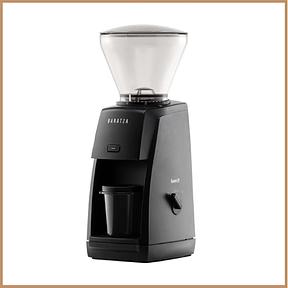
Around €180: Baratza Encore ESP, the documented espresso entry
The Baratza Encore ESP is the best-documented model here, and honestly that's its real value. Conical burrs, 179,90 € on Amazon.fr on 8 August 2026, rated 4.4/5 from 169 reviews.
It's also the one whose retention has been measured in public: 1.1 grams per Coffee Chronicler on 26 July 2024, with the method described. The ESP suffix marks the espresso-oriented version of the Encore, which is where the price gap against the standard Encore comes from.
If you pull shots on a portafilter and your budget lands near €180, this is the pick with the most evidence behind it.
Baratza Encore ESP Moulin à Café à Meules Coniques
View at Amazon (as of Aug 11)Affiliate link. Buying through it earns us a commission; the price stays the same for you.
Around €220: Sage Smart Grinder Pro, for the portafilter
The Sage The Smart Grinder Pro carries the highest rating in this set, 4.5/5 from 745 reviews checked on 8 August 2026, at a price seen of 221,95 €. Conical burrs here too.
Sage markets a high grind-position count. We're not repeating it, because we found no independent source giving the range those positions cover. What is checkable is the positioning: this grinder is sold to sit next to the brand's portafilter machines, and its rating rests on a decent volume of reviews.
Not available in your region — closest match
Baratza Encore ESP Moulin à Café à Meules Coniques
View at Amazon (as of Aug 11)Affiliate link. Buying through it earns us a commission; the price stays the same for you.
Which grinder with which machine?
One rule cuts through most of it: the grinder should be at least as precise as your machine can exploit.
On a bean-to-cup machine the question doesn't arise, since the burr set is built in and that's a separate purchase, covered in our bean-to-cup machine guide. On an entry-level portafilter, a €180 grinder like the Encore ESP is already a sensible match. On a more serious portafilter, the grinder becomes the limiting factor, and spending less on the grinder than on the machine is usually a mistake.
One last pointer, and it isn't a popular one. If you're torn between upgrading the machine or upgrading the grinder, upgrade the grinder. Grind decides more of what lands in the cup than the pump does, and a well-chosen electric burr coffee grinder makes up for a mediocre machine better than the other way round.
All products from this post
The ones we named above are marked; the rest are alternatives in the same category.
Not available in your region — closest match
Baratza Encore ESP Moulin à Café à Meules Coniques
View at Amazon (as of Aug 11)
Not available in your region — closest match
Baratza Encore ESP Moulin à Café à Meules Coniques
View at Amazon (as of Aug 11)
Not available in your region — closest match
Baratza Encore ESP Moulin à Café à Meules Coniques
View at Amazon (as of Aug 11)
Not available in your region — closest match
Baratza Encore ESP Moulin à Café à Meules Coniques
View at Amazon (as of Aug 11)Affiliate notice: As an Amazon Associate, we earn from qualifying purchases. Product prices and availability are subject to change.
Frequently Asked Questions
Are conical burrs better than flat burrs?
No, they're different trade-offs. Conical burrs turn slower and run cooler; flat burrs aim at a more even particle distribution. The La Grange aux Cafés test of 3 March 2026 timed an espresso at 25 seconds on conical against 28 seconds on flat at the same dial setting, which mostly shows that one dial number doesn't mean the same grind on two machines.
What budget do I need for an electric burr coffee grinder that handles espresso?
Around €180 for a documented, espresso-oriented model, based on Amazon.fr prices checked on 8 August 2026. Below €100, mass-market electric grinders target filter coffee. Their adjustment step wasn't designed for the fine espresso zone, whatever setting count appears on the box.
Can I compare two grinders by their advertised setting count?
No. A step only means something relative to the grind range it covers on that specific grinder, and that range is almost never published. A stepless grinder has no steps at all and is still more precise. Look at the published range and the adjustment type instead.
Will a blade grinder do for filter coffee?
Grudgingly, yes, and only for filter or French press. Chopping produces dust and boulders in one dose, so you get bitter and sour together. For espresso the answer is no: the unevenness makes the extraction impossible to correct.
Do I need a separate grinder if I already own a bean-to-cup machine?
Usually not. The built-in burr set does the job you bought the machine for. A separate grinder makes sense if you also brew filter or French press at a different grind, or if you add a portafilter and keep the bean-to-cup machine for everyday coffee.
Sources
- filtre.cafe filtre.cafe
- Belleville Brûlerie cafesbelleville.com
- La Grange aux Cafés lagrangeauxcafes.fr
- MaxiCoffee maxicoffee.com
- Honest Coffee Guide honestcoffeeguide.com
- Coffee Spirit / MaxiCoffee coffee-spirit.maxicoffee.com
- another Coffee Spirit guide on stepped adjustment coffee-spirit.maxicoffee.com
- Belco belco.fr
- Coffee Chronicler coffeechronicler.com