Best Manual Coffee Grinder 2026: The Honest Guide
 16 min read
Last updated: 08/08/2026
A manual coffee grinder at €69 (Amazon.fr, checked 8 August 2026) puts nearly its whole price into the burrs. No motor. No housing, no timer, no plastic hopper. Two pieces that cut the bean, a shaft, a crank. That is the real argument for the category, and it holds up fine. The problem is the one that buying guides have been politely stepping around for years: grinding an espresso dose by hand every morning is physical work, and that work never gets any smaller.
This guide sorts five grinders into budget tiers, with prices taken off Amazon.fr on 8 August 2026 and every technical figure attributed to whoever published it. It opens on the question most of these pages skip. Should you be buying a hand grinder at all?
Is a manual coffee grinder actually right for you?
That question deserves an answer in both directions, not a sales pitch. Start with the cases where manual genuinely wins.
Where a hand grinder wins
Travel. It fits in a bag, needs no socket, doesn't care about American 110 V, and goes through cabin security without a conversation. No electric grinder manages that.
One or two cups a day is the real sweet spot. One dose, a minute on the crank, grind fresh. Some people like the ritual for its own sake, and I get it. It's the only point in the whole process where you physically feel the bean change state.
A budget around €100 to €150. Probably the strongest argument the category has. At that money a hand grinder buys you a set of decent conical steel burrs, while an electric at the same price is mostly buying a motor, a shell and a display. The burrs-per-euro maths isn't close. This hand coffee grinder, unlike its electric counterpart, puts its whole budget into the burrs.
Silence. Pulling a shot at 6 a.m. without waking the house never appears in anyone's comparison table, and it quietly decides a lot of purchases.
No counter space needed. A hand grinder lives in a drawer. An electric one claims a permanent square next to the machine and keeps it.
When you should buy electric instead
Here's the part the affiliate pages skip.
Asser Christensen, a certified Q Grader writing on Coffee Chronicler (14 January 2025), puts it plainly: grinding by hand for espresso takes a lot more force than filter methods, and if the idea of a few push-ups or ten reps with a dumbbell puts you off, an electric grinder is probably the better call. That isn't a turn of phrase. Espresso is the finest setting your grinder can reach, so it's the one that fights back hardest, and it happens to be the one you repeat every single day.
The guide at EspressoAdvice.com (updated 10 July 2026) puts the fatigue threshold above 3 to 4 coffees a day. Below that, hand grinding slots into the morning routine without much friction. The same guide notes that plenty of buyers drop the habit inside six to twelve months when daily volume is high. That's an enthusiast site reporting real-world use, not a lab measurement, and I'm giving it as exactly that. It's still the most useful number I've found on the question.
So two profiles should look elsewhere. Households with several espresso drinkers, and anyone whose wrist or shoulder won't take it. For those readers, Novebar's separate electric grinder roundup, published under the same honest-guide format, covers the ground without me redoing it here.
Burrs, steps, microns: the vocabulary that decides
Four terms carry most of the weight in this category, and product listings mangle at least two of them regularly. Worth pinning down once.
Burr. The two pieces that crush the bean between them. On a hand grinder they're almost always conical: a central cone turning inside a fixed ring. Their diameter and their material decide everything downstream.
Stepped and stepless. A stepped grinder clicks between fixed positions. A stepless one turns continuously, with no detents at all. Worth saying straight away, because comparison tables love this spec: nearly every manual grinder on the market is stepped, including all five listed below. It isn't a deciding factor.
What actually counts is microns per step: how far the burr travels per click. That's the precision figure that matters, far more than a "200 settings" claim on the box. A grinder with 200 steps of 12.5 microns and one with 100 steps of 25 microns cover the same total range at two different levels of fineness.
Double bearing. A shaft held by two bearings instead of one. It limits burr wobble, which means fewer irregular particles, which means fewer fines choking a portafilter. Comandante makes an explicit build argument out of it on the C40.
Steel or ceramic: the myth to drop
Ceramic does not beat steel, whatever the listing says. According to Giulia Bagato of Fiorenzato, quoted by Perfect Daily Grind (3 April 2023), ceramic burrs lose their edge faster and are more fragile, while steel holds its grind precision for longer.
And the usual ceramic sales line, the one about not heating the coffee, falls flat in this specific category. A hand grinder turns at a few dozen rpm where an electric does hundreds. Heat isn't a topic for either material on a crank.
Burr diameter decides your morning
Craft Coffee Spot (updated 5 April 2023) puts the 1Zpresso JX-Pro's 48 mm conical steel burrs at roughly 1 gram per second, so an 18 g espresso dose in under 30 seconds.
Small burrs tell a different story. CoffeeGear360 (28 February 2026) times the Timemore C2 and its 38 mm burrs at around 60 seconds for that same 18 g dose, against roughly 30 seconds for the JX-Pro. Twice the time, and more torque per turn on top of it, because a smaller burr bites less bean per rotation. That's one reviewer's stopwatch rather than a standardised protocol, and I'm presenting it that way.
The rule that falls out of it is simple enough. Bigger burr, shorter session. As far as I can tell it's the only spec that predicts daily effort correctly.
The table: five grinders you can buy on Amazon.fr
Prices and ratings taken off Amazon.fr on 8 August 2026, and volatile by nature. This table also rounds up the latest manual coffee grinder reviews and ratings on Amazon.fr, so you can compare scores and prices at a glance.
| Model | Amazon.fr price (checked 08/08/2026) | Customer rating | Burrs (seller's wording) | Burr diameter (independent source) | Adjustment | Espresso capable? |
|---|---|---|---|---|---|---|
| Vevok Chef, 6 external settings | €37.99 | 4.6/5 from 679 reviews | not stated | not stated | stepped, 6 external positions | not confirmed by an independent source |
| KINGrinder P2 | €49.00 | 4.6/5 from 211 reviews | conical, stainless steel | not stated | stepped | not confirmed by an independent source |
| KINGrinder K2 | €69.00 | 4.8/5 from 338 reviews | conical, stainless steel | not stated | stepped, straight handle | not confirmed by an independent source |
| Timemore Chestnut C3S Pro | €99.00 | 4.7/5 from 158 reviews | not stated (metal body) | not stated | stepped | not confirmed for this exact model |
| 1Zpresso J-Ultra | €199.00 | 4.6/5 from 249 reviews | conical burr | not stated | stepped | yes, 18 g in 30 to 35 s per EspressoAdvice (10/07/2026) |
That "not stated" column shows up five times, and it isn't laziness. No independent, dated source publishes a burr diameter for these five specific models. House style here is to write not stated rather than a plausible-looking number, because an invented diameter would be precisely the failure this guide criticises everywhere else.
The models you won't find on Amazon.fr
These four come up in every serious discussion, and not one of them appeared in our Amazon.fr check on 8 August 2026. In France they sell through roasters and specialist retailers instead.
| Model | Burrs | Adjustment | Published grind time (dose as measured) | Availability in France |
|---|---|---|---|---|
| Comandante C40 MK4 | 39 mm, high-nitrogen martensitic steel (RoastAroma, 2026) | stepped, 25 to 30 microns | 60 to 75 s for 30 to 40 g | €301.90 at L'Arbre à Café; not on Amazon.fr |
| 1Zpresso JX-Pro | 48 mm, steel, conical (Craft Coffee Spot, 05/04/2023) | stepped, 200 positions, 12.5 microns | approx. 30 s for 18 g (CoffeeGear360, 28/02/2026) | specialist retailers; not on Amazon.fr |
| 1Zpresso K-Ultra | 48 mm, heptagonal stainless steel (Coffeeness.de, 01/09/2024) | stepped, over 100 positions, 20 microns | 30 to 40 s for 35 g | specialist retailers; not on Amazon.fr |
| Hario Skerton Pro | ceramic | stepped, ring | approx. 2 min for 14 g at espresso fineness (Coffee Chronicler) | specialist retailers; not on Amazon.fr |
A word about those grind times: they are not all measured on the same dose. The Comandante's 60 to 75 seconds covers 30 to 40 g, and the Skerton Pro's two minutes covers 14 g. Normalising them all to 18 g would need a calculation nobody has published, so each figure keeps the dose it was actually taken on. The Timemore Chestnut X, which comes up constantly in top-end discussions, has no row here. I couldn't find a single dated, attributable spec sheet for its burrs or its grind time.
Entry level: grinding for under €50
This is the tolerance-test tier. EspressoAdvice recommends exactly that in the guide cited above: start small, find out whether the daily crank suits you, then spend €200 if it does.
Vevok Chef, six external settings, €37.99
The cheapest of the five, at €37.99 on Amazon.fr on 8 August 2026, rated 4.6/5 from 679 reviews. Six adjustment positions reachable from the outside, without stripping the grinder down. That's the practical selling point here, because budget grinders often make you pull the burr out to change fineness.
Six steps isn't much, though. For filter or a French press the range is plenty. For a portafilter, six positions leave you nowhere to go when the shot runs too fast or too slow, and the manufacturer doesn't publish a burr diameter. Treat it as a cheap filter grinder, not as a cheap espresso grinder.
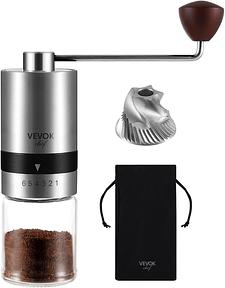
Vevok Chef Moulin à Café Manuel avec 6 Réglages Externes
View at AmazonAffiliate link. Buying through it earns us a commission; the price stays the same for you.
KINGrinder P2, ABS body, €49.00
The P2 fits conical stainless steel burrs into an ABS body, at €49.00 on Amazon.fr on 8 August 2026 (4.6/5 from 211 reviews). The plastic makes people wince, and it's still the right trade at this price. Money saved on the shell goes back into the burrs, which is the whole argument for the category in the first place.
The P2 is also the lightest of the five, which makes it a serious candidate for a travel bag. No dated independent source confirms its espresso capability, so check the range the seller quotes before ordering if that's your main use.
KINGrinder P2 Moulin Café Léger Corps ABS Meule Conique Inox
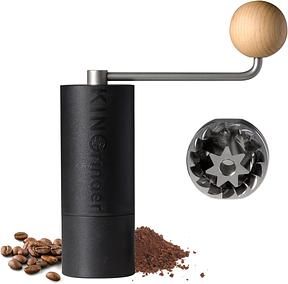
KINGrinder P2 Moulin Café Léger Corps ABS Meule Conique Inox
View at AmazonAffiliate link. Buying through it earns us a commission; the price stays the same for you.
Mid range: where it gets serious
Between €69 and €99 you move from a stopgap to a tool you'll keep for years.
KINGrinder K2, straight handle, €69.00
The K2 takes the best customer rating of the five, 4.8/5 from 338 reviews, at €69.00 on Amazon.fr on 8 August 2026. Conical stainless steel burrs, metal body, straight handle.
That handle deserves a note, because it changes how the thing feels. A cranked handle asks for a shoulder movement. A straight one turns mostly from the wrist and forearm, which helps at a fine setting where torque climbs. On paper it's the best burrs-per-euro deal in the table. Same caveat as the other KINGrinders though: nobody has timed espresso on this exact model with a dated independent source, so I'm not lending it the K6's numbers.
KINGrinder K2 Moulin Café Manuel Poignée Droite Meule Conique Inox
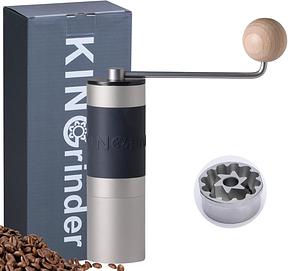
KINGrinder K2 Moulin Café Manuel Poignée Droite Meule Conique Inox
View at AmazonAffiliate link. Buying through it earns us a commission; the price stays the same for you.
Timemore Chestnut C3S Pro, metal body, €99.00
Timemore is the brand French search turns up most often at this tier. The C3S Pro, at €99.00 on Amazon.fr on 8 August 2026 (4.7/5 from 158 reviews), has a metal body that registers immediately in the hand.
Watch the exact name, because the Chestnut line is a maze of suffixes. EspressoAdvice times the C3 ESP Pro at 40 to 50 seconds for 18 g of espresso (updated 10 July 2026). That is not the C3S Pro sold here. It's a neighbouring model in the same series. I can't find any attributable figure for the C3S Pro itself, neither burr diameter nor grind time. The line's reputation is established; this specific model's numbers aren't.
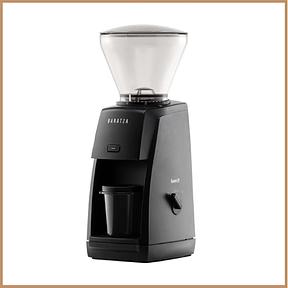
Not available in your region — closest match
Baratza Encore ESP Moulin à Café à Meules Coniques
View at Amazon (as of Aug 11)Affiliate link. Buying through it earns us a commission; the price stays the same for you.
Top end: €199 and above
1Zpresso J-Ultra, €199.00
It's the only one of the five with an espresso figure that is both attributed and dated, and it costs €199.00 on Amazon.fr on 8 August 2026 (4.6/5 from 249 reviews): per EspressoAdvice (updated 10 July 2026), the J-Ultra grinds 18 g at espresso fineness in 30 to 35 seconds. Thirty seconds is roughly where the morning crank stops feeling like a chore.
Pull one espresso a day and plan to keep the grinder ten years, and this is the rational pick in the table. Trying specialty coffee out to see whether you like it? Then it's three times too much. Start with the K2 at €69.00 and move up later.
1Zpresso J-Ultra Moulin à Café Manuel Gris Fer, Fraise Conique
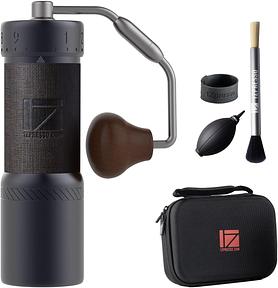
1Zpresso J-Ultra Moulin à Café Manuel Gris Fer, Fraise Conique
View at Amazon (as of Aug 11)Affiliate link. Buying through it earns us a commission; the price stays the same for you.
Comandante, JX-Pro, K-Ultra: the Amazon.fr absentees
The Comandante C40 MK4 runs 39 mm conical burrs in high-nitrogen martensitic steel, adjustable in steps of 25 to 30 microns (RoastAroma, 2026), at €301.90 from French roaster L'Arbre à Café. It's the reference the community names by reflex, and it doesn't go through Amazon.fr. In France you buy it from roasters and specialist retailers.
The 1Zpresso JX-Pro and K-Ultra sit in the same position, with their 48 mm burrs and the grind times documented further up. So does the Hario Skerton Pro, for a different reason that's coming right now.
Is a manual coffee grinder really enough for espresso?
The best hand grinder for espresso isn't just any manual coffee grinder, and this is where most buying guides lie by omission.
On a portafilter machine you don't set the pressure. It settles somewhere around 9 bar at the puck whatever the box claims. What you do set is the grind. A grinder that can't reach a clean, even fineness makes the rest of the chain pointless, tamper included. Tamping, WDT and weighing deserve their own guide, coming soon on Novebar. It isn't this grinder that will make the difference if the rest of your espresso routine isn't dialed in.
Two concrete traps. First one: some grinders aren't aiming at espresso at all. The Timemore C2, with its 38 mm conical steel burrs (Green Plantation), is sold for filter and pour-over methods rather than espresso. That isn't a flaw in the product. It's the brief it was built to.
Second trap: a grinder that technically reaches espresso fineness can still be miserable at that setting. The Hario Skerton Pro can get fine enough for espresso on paper, but Coffee Chronicler warns it will choke the portafilter unless the setting is dialled in perfectly, and that you should budget close to 2 minutes for a 14 g dose. Two minutes of cranking for a ristretto, every morning. Nobody sticks with that.
For a moka pot the constraint relaxes enormously. Moka grind is coarser than espresso, and a budget grinder handles it comfortably, six steps of Vevok Chef included. It's also the best entry point for testing fresh grinding without spending much.
The verdict, by budget
To pick the right manual coffee grinder, three profiles matter. To try hand grinding with nothing much at stake, the KINGrinder P2 at €49.00 does the job and travels well. For the best burrs-per-euro deal in the table, the KINGrinder K2 at €69.00 with its 4.8/5 rating. For daily espresso with a grind figure that's genuinely documented, the 1Zpresso J-Ultra at €199.00.
And if you pull more than three or four coffees a day, buy electric. This guide will have saved you €199, which is still a decent outcome for a buying guide.
One last thing worth watching. The prices above are the ones from 8 August 2026, and this category moves fast. Re-check before you order, and take a look at the bean-to-cup machine comparison if a separate grinder turns out not to be your direction after all. Novebar is also working on a dedicated comparison of built-in grinder versus separate grinder, to settle this exact question if an all-in-one machine tempts you more than a standalone one.
All products from this post
The ones we named above are marked; the rest are alternatives in the same category.
Not available in your region — closest match
Baratza Encore ESP Moulin à Café à Meules Coniques
View at Amazon (as of Aug 11)
Affiliate notice: As an Amazon Associate, we earn from qualifying purchases. Product prices and availability are subject to change.
Frequently Asked Questions
Is a manual coffee grinder good enough for espresso?
Yes, provided you pick a model built for it. Some budget grinders, the Timemore C2 among them, are sold for filter and pour-over only. Others reach espresso fineness but choke the portafilter at the slightest setting error. Aim for a grinder whose fine range is documented and whose burrs clear 40 mm if you want to keep the session under a minute.
Comandante or 1Zpresso: which one should you pick?
The Comandante C40 MK4 runs 39 mm martensitic steel burrs and sells for around €301.90 through French roasters, not on Amazon.fr. The 1Zpresso J and K series run 48 mm burrs, grind an espresso dose faster, and the J-Ultra was listed at €199.00 on Amazon.fr on 8 August 2026. If grind speed matters more to you than finish, take the 1Zpresso.
What should you spend on a first cheap manual coffee grinder?
Between €40 and €70 you already get conical steel burrs and a usable stepped adjustment, which is plenty for filter, a moka pot or a French press. Below €40 the adjustment range gets too short for espresso. Start low on purpose. It's the cheapest way to find out whether the daily crank suits you before committing €200.
Which manual coffee grinder works for a moka pot?
Moka grind is coarser than espresso, so the constraint is light. A six-step external-adjustment grinder around €38 handles it fine, and so does a €49 model with conical steel burrs. The real gain comes from grinding fresh, not from adjustment precision. Keep the rest of the budget for beans.
Where can you buy a manual coffee grinder in France?
Amazon.fr covers KINGrinder, Timemore and 1Zpresso well, with prices recorded between €37.99 and €199.00 on 8 August 2026. Comandante, the 1Zpresso JX-Pro and K-Ultra, and the Hario Skerton Pro mostly go through French roasters and specialist retailers such as L'Arbre à Café or Green Plantation. Compare both channels before ordering.
Sources
- Asser Christensen, a certified Q Grader writing on Coffee Chronicler coffeechronicler.com
- EspressoAdvice.com espressoadvice.com
- Giulia Bagato of Fiorenzato, quoted by Perfect Daily Grind perfectdailygrind.com
- Craft Coffee Spot craftcoffeespot.com
- CoffeeGear360 coffeegear360.co.uk
- RoastAroma, 2026 roastaroma.com
- L'Arbre à Café larbreacafe.com
- Green Plantation greenplantation.fr
- Coffee Chronicler coffeechronicler.com