Coffee bean prices in 2026: why your kilo stays expensive
 15 min read
Coffee bean prices are not rising any more. They already rose, and the bill landed in 2025: over that single year, the French consumer price index for coffee gained 17.8%. Since January 2026 it has barely moved at all. So your bag costs roughly what it cost six months ago, except that "roughly" sits at a high level, and it is staying there.
Last updated: 08/08/2026
The rise in coffee bean prices happened in 2025, and it has ended
Here is the figure almost no French article gives you, because you have to go and dig it out of the INSEE database rather than read it off a press release.
According to the INSEE consumer price index for coffee, coffee rose 17.8% in France over the year 2025 alone, December to December. That is enormous for an everyday food product. And since then, nothing: between January and June 2026, that same index moved by 0.11%.
| Period | Change in the INSEE "coffee and coffee substitutes" index (France) |
|---|---|
| Dec 2024 → Dec 2025 | +17.8% |
| Jan 2026 → June 2026 | +0.11% |
| June 2025 → June 2026 (year on year) | +4.2% |
Watch the third figure. The year-on-year rate fell from +17.5% in January 2026 to +4.2% in June 2026, and a reader in a hurry will read that as relief at the till. It is not. It is a base effect: the 2025 comparison months were already high, so the gap narrows mechanically. The price tag itself has not moved in six months.
One honest caveat about that table. INSEE only publishes the monthly index at the level of "coffee and coffee substitutes", so instant coffee is in there too. That is the finest breakdown available at monthly frequency, not beans on their own. For beans, you have to switch to the annual series.
And the annual series says more. The French index for "coffee beans or ground coffee" gained 14.1% over 2025, after +11.9% in 2023 and +9.7% in 2022. Cumulative 2021 to 2025: roughly +42% (derived from the INSEE indices, base 2025 = 100). A bag that cost you 10 € in France in 2021 changes hands at around 14 € today, at comparable quality.
Two thirds of that rise were already banked before January 2025. This is not a 2026 spike. It is four years of increases that you pay in one go at the checkout.
World futures, on the other hand, have already retreated
This is where most French articles get it wrong, including the ones published this spring.
In February 2025, arabica touched an all-time record close to 4.40 dollars a pound on the futures market, according to an analysis relayed by Protégez-Vous. The previous record dated from 1977. The trend has reversed since: according to StoneX, arabica was back around 2.50 dollars a pound by mid-May 2026, roughly half the peak.
The cause is agricultural. Brazil's 2026/27 harvest is expected at a record level, 71.9 million bags according to the USDA Foreign Agricultural Service, up 14.1% year on year (report of 4 June 2026 relayed by Daily Coffee News), which feeds forecasts of the biggest world surplus in six years. On the robusta side, the average Vietnamese export price fell 22% year on year in the first half of 2026, according to figures cited by Vietnam.vn.
Do not draw conclusions too fast, though. The International Coffee Organization noted in June 2026 that its composite indicator had dropped to a near two-year low before rebounding 17% in a matter of weeks. Its own conclusion: the monthly average masks very real volatility. In early August 2026, market data put arabica around 3.08 dollars a pound. Far from the record, but far from calm as well.
Why your bag never followed the drop
The green coffee your roaster sells today was bought months ago. Contract, harvest, export, shipping, roasting, bagging. The chain takes time, and that delay is exactly the gap you see between the quote screen and the shelf.
The weight of the raw material explains the rest. According to the French roaster Cafés Le Gascon, green coffee makes up 60 to 75% of the cost price of a roasted coffee. At that share, no roaster can quietly absorb a doubling of the green price. They pass it on, and they pass it on slowly, in both directions.
Then there is a regulatory layer. The European EUDR regulation against imported deforestation puts new traceability obligations on coffee, with a due diligence statement per imported lot. The administrative cost will, according to people in the trade, end up on the consumer.
How much exactly? Nobody knows. No source, French or international, has published a verified figure in euros per kilo. Articles that give you one made it up. The mechanism is documented, the amount is not, and I would rather tell you that than hand you a round percentage.
Same logic on the question everyone asks: when will the drop in futures reach the shelf? No serious source puts a date on it. The lag can be sourced. The date it closes cannot.
What your budget actually buys: 14 to 37 € a kilo in France
Let us get concrete. At MaxiCoffee, a French specialist retailer, 1kg bags of coffee beans ranged from about 19 € to 35 € in early August 2026 depending on brand and origin. On Amazon.fr, once you widen the search to multi-packs, the scale goes lower and climbs a little higher.
Here are five products observed on the French market on 08/08/2026, cheapest to priciest per kilo. Amazon prices move constantly, so check again before you buy.
| Product | Format | Price observed on amazon.fr (08/08/2026) | Price per kilo | What you are paying for |
|---|---|---|---|---|
| Caffè Borbone BLU blend | 6 × 1 kg | 82,90 € | 13,82 €/kg | volume, on a widely distributed Italian blend |
| L'OR Absolu intensity 10 | 1 kg | 19,13 € | 19,13 €/kg | a supermarket standard, with no volume commitment |
| Lavazza Qualità Oro 100% arabica | 1 kg | 21,80 € | 21,80 €/kg | branded 100% arabica, the benchmark of the aisle |
| Delta Cafés espresso intensity 14 | 2 × 1 kg | 53,99 € | 27,00 €/kg | a strong espresso profile, in a two-pack |
| Naturela organic pure arabica beans | 1 kg | 37,02 € | 37,02 €/kg | organic, and roasting done in France |
The gap between the first and the last is 2.7 times. That is the real information in this article: above roughly 20 € a kilo on the French market, you are no longer paying for "coffee", you are paying for an origin, a label, a recent roast date or a small batch. Below 15 €, you are paying for volume and a blend calibrated to be consistent rather than remarkable.
Around 14 €/kg: volume, if you drink a lot
This is where cheap coffee beans actually live: the sensible floor for decent beans in 2026, on French prices. You get there by buying multi-kilo packs, never 250g.
Café en grains mélange BLEU Caffè Borbone 1 kg x 6
The six-kilo Caffè Borbone pack works out at 13,82 €/kg at the price observed on 08/08/2026, against 19 to 22 € for a single branded kilo. The saving is real. So is the constraint: six kilos is six months of drinking for a two-person household at four cups a day, and coffee does not improve while it waits. Without serious storage, you turn a saving into waste.
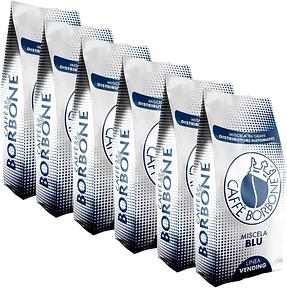
Café en grains mélange BLEU Caffè Borbone 1 kg x 6
View at AmazonAffiliate link. Buying through it earns us a commission; the price stays the same for you.
Between 19 and 22 €/kg: the supermarket standard
This is where most of the French market sits, and it is the reference point to keep in mind when somebody tells you coffee has become a luxury good.
L'OR Absolu Intensité 10 Grains de café 1 Kg
L'OR Absolu at 19,13 € a kilo is an intensity 10 blend, built for domestic bean-to-cup machines. Nothing special, but nothing wrong with it either.
LAVAZZA - Café Grain Lavazza Qualità Oro - 100% Arabica - Paquet de 1 kg
Lavazza Qualità Oro, 21,80 € a kilo in the same set of observations, plays the 100% arabica card. In the cup, the difference with an arabica-robusta blend is less about "quality" than about profile: less body and less crema, more acidity. If you pull a tight espresso and find your cup thin, it is not necessarily the machine. It might be the beans.
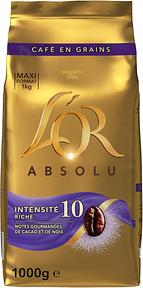
L'OR Absolu Intensité 10 Grains de café 1 Kg
View at AmazonAffiliate link. Buying through it earns us a commission; the price stays the same for you.
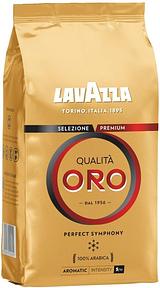
LAVAZZA - Café Grain Lavazza Qualità Oro - 100% Arabica - Paquet de 1 kg
View at Amazon (as of Aug 11)Affiliate link. Buying through it earns us a commission; the price stays the same for you.
27 €/kg and up: the unapologetic espresso profile
Delta Cafés - Café en grains d'espresso, 2 paquets de 1 kg, intensité 14
The two-kilo Delta Cafés pack, at 53,99 € on 08/08/2026, so 27,00 €/kg, aims at intensity 14. The multi-pack format does not bring the price per kilo down here, unlike the Borbone. Useful reminder that "pack" and "cheap" are not synonyms. Work out the price per kilo yourself, every time. It is not always on display.
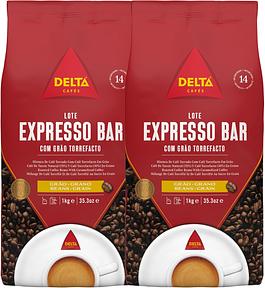
Delta Cafés - Café en grains d'espresso, 2 paquets de 1 kg, intensité 14
View at Amazon (as of Aug 11)Affiliate link. Buying through it earns us a commission; the price stays the same for you.
37 €/kg: organic, and French roasting
NATURELA - Café Grains Bio - Café Grains Pur Arabica Intense - Fabriqué en France - 1 kg
Naturela, at 37,02 € a kilo, stacks up organic, pure arabica and roasting in France. You are paying almost triple the Borbone. Is it worth it? That depends entirely on what you are after, and I am not going to sell you a universal answer. On an 8 g espresso, the gap comes to 0,19 € (derived from the French prices per kilo above). Over a year at four cups a day, it comes to about 270 €. Up to you what 270 € a year is worth in your budget.
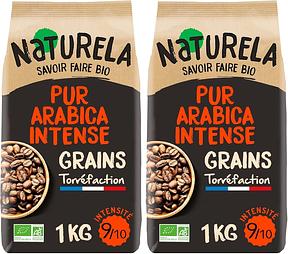
NATURELA - Café Grains Bio - Café Grains Pur Arabica Intense - Fabriqué en France - 1 kg
View at AmazonAffiliate link. Buying through it earns us a commission; the price stays the same for you.
Cost per cup, and the capsule comparison
A home espresso uses 7 to 9 g of coffee. At 8 g, a kilo gives you 125 cups.
| Price per kilo (France) | Cost per cup (8 g dose, derived figure) |
|---|---|
| 13,82 €/kg | 0,11 €/cup |
| 19,13 €/kg | 0,15 €/cup |
| 27,00 €/kg | 0,22 €/cup |
| 37,02 €/kg | 0,30 €/cup |
These amounts are derived from the French prices observed on 08/08/2026 and an 8 g dose. They are not published figures. Change the dose and everything moves: at 9 g you lose 14 cups per kilo.
For a sense of scale, the comparison published by the retailer MaxiCoffee on its Coffee Spirit blog puts a cup brewed from beans at around 0,17 €, against 0,43 € for a Nespresso capsule. That comes from a retailer's own blog, so read it accordingly. Even taking the most expensive organic beans in the table above, you stay under the price of a capsule. Beans are not the luxury product in this story.
I will stop there on that subject: the full three-year cost of ownership, machine included, deserves its own article and does not get settled in three lines.
Paying less without ruining the cup
Four levers, in order of how much they actually do.
Format. Moving from 250g to 1kg is the one guaranteed gain, with no penalty on taste as long as you drink the bag within the month. Moving up to a multi-kilo pack adds another 20 to 30% saving, but it hands you the storage problem.
Channel. Supermarket, hard discount, online roaster and neighbourhood roaster are not fighting on the same ground. The first wins on shelf price, the last wins on roast date, and that date counts for more on a portafilter machine than on an automatic bean-to-cup machine.
Blend. Raising the robusta share brings the price down and brings up body and crema. You lose aromatic finesse. It is not a bad coffee, it is a different coffee, and it is exactly the profile most Italian espressos are after.
Good for freshness, rarely good for price: that is what a subscription is worth. The one from Terres de Café sits at around 37,50 € a month in France, so at the top of the range in the table above. Take it to discover origins, not to save money.
There is a fifth lever and I would advise against it: buying ground coffee to save two euros. You lose most of the aroma within days, and on a bean-to-cup machine it is impossible anyway. If you are still weighing up your machine, the guide to bean-to-cup coffee machines covers the grinder question, which decides the grind and therefore what you actually extract from those 8 g.
Store it properly, or bulk buying is pointless
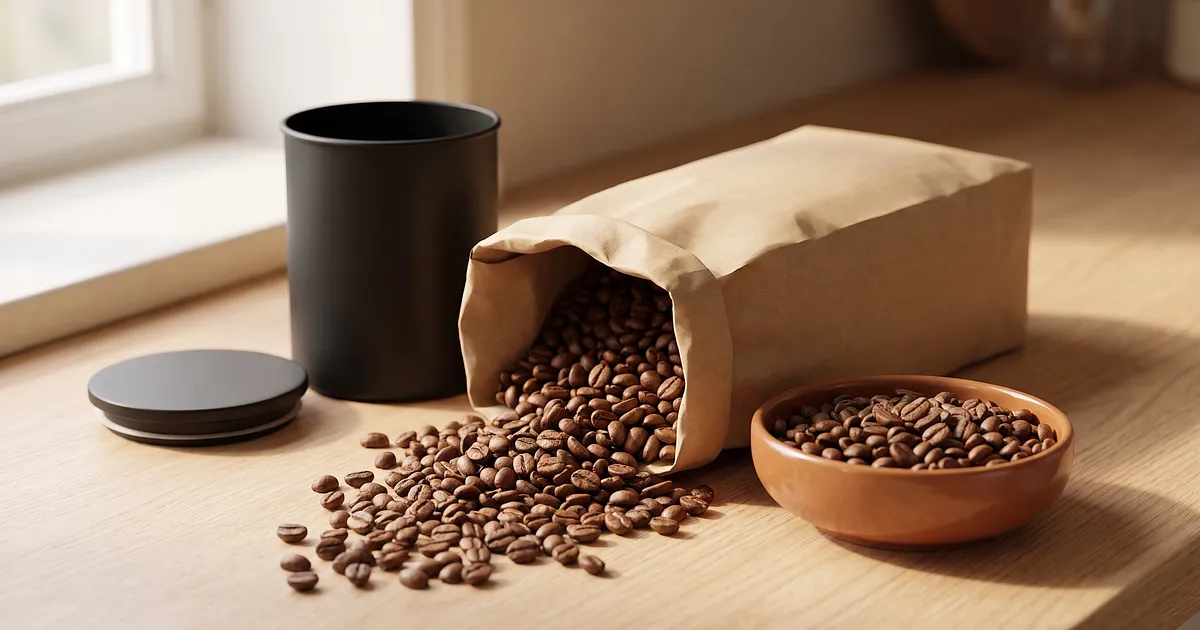
Buying six kilos and leaving the bag open on the worktop means paying 13,82 €/kg to drink coffee that tastes like 37 €/kg gone wrong. Oxygen, light, heat and moisture degrade beans, in that order of importance.
Three rules hold: an airtight opaque container, a stable room temperature, and taking beans out of the original bag only for the week's worth.
Purpledi Boîte à Café Hermétique en Acier Inoxydable, 1,8 L, avec Cadran Dateur et Cuillère Doseuse
A 1.8 L airtight stainless steel tin at 18,99 € on 08/08/2026 pays for itself with the first multi-kilo pack you store properly. The date dial on the lid earns its keep more than it looks: you will know when those beans were opened.
That leaves the freezer question, which is nearly always presented to you as heresy. Reality is more contested than that. The roaster Maison Merling comes down against it, on the grounds that moisture condenses on the beans. Others, like Mon Petit Café, call it a "controversial method, but one with advantages when it is properly handled" and recommend it for stock past its optimal date, provided you portion in advance, seal airtight and never refreeze. If you are buying six kilos, the question deserves better than a reflexive "absolutely not".
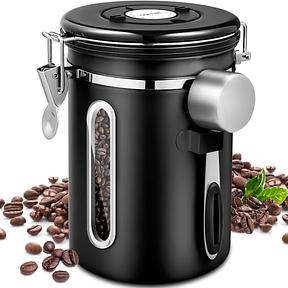
Purpledi Boîte à Café Hermétique en Acier Inoxydable, 1,8 L, avec Cadran Dateur et Cuillère Doseuse
View at AmazonAffiliate link. Buying through it earns us a commission; the price stays the same for you.
So, should you wait?
No, and not because I know what is going to happen. Precisely because nobody does.
Futures have retreated, the announced Brazilian surplus pushes towards easing, and in the same breath the ICO points out that its indicator picked up 17% in three weeks in June 2026. Waiting for a shelf price drop that no source will date, while drinking coffee you enjoy less in the meantime, is a bad trade.
What is under your control: the format you buy, the channel, the profile of the blend, and how you store it. Those four levers are worth several euros a kilo, right now, with no bet on the futures market. Coffee bean prices will not come down on request. Those levers are yours today.
All products from this post
The ones we named above are marked; the rest are alternatives in the same category.
Affiliate notice: As an Amazon Associate, we earn from qualifying purchases. Product prices and availability are subject to change.
Frequently Asked Questions
Why has coffee been getting more expensive since 2021?
Three factors stack up. Repeated droughts in Brazil and Vietnam cut harvests and tripled world futures prices up to the February 2025 record. Green coffee makes up 60 to 75% of the cost price of a roasted coffee, according to the French roaster Cafés Le Gascon, so the rise passes through almost in full. On top of that come the new European traceability obligations, whose administrative cost has not been quantified publicly yet.
Will coffee bean prices fall in 2026?
World futures have already dropped a long way since February 2025, and Brazil's 2026/27 harvest is announced at a record. But the French price tag is stable, not falling: the INSEE index moved only 0.11% between January and June 2026. The lag between buying green coffee and getting bags on the shelf runs to several months. No precise date, and be wary of any source that gives you one.
What does a kilo of coffee cost in France in 2026?
On prices observed on 08/08/2026, a kilo of coffee beans in France goes from about 14 € in a multi-kilo pack to 37 € for organic beans roasted in France. The French supermarket standard sits between 19 € and 22 € a kilo. At a specialist like MaxiCoffee, 1kg bags ranged from about 19 € to 35 € in early August 2026. These prices move constantly.
Do coffee beans work out cheaper than capsules?
Clearly. According to the comparison published by the retailer MaxiCoffee on its own Coffee Spirit blog, a cup brewed from beans costs around 0,17 €, against 0,43 € for a Nespresso capsule. Even with the most expensive organic coffee observed here, at 37,02 € a kilo, an 8 g dose comes to 0,30 € a cup, still less than a capsule. That last one is derived from the price per kilo, not a published figure.
Is 1kg of coffee beans better value than 250g?
Yes, and it is the simplest saving available. The price per kilo drops every time you move up to the 1kg format, with no penalty on taste as long as you finish the bag in about a month. Beyond that, in multi-kilo packs, the saving grows again but storage becomes your job: an airtight opaque tin, away from heat, and only the week's worth taken out of it.
Can you freeze coffee beans?
Roasters are divided, contrary to what most articles claim. The roaster Maison Merling advises against freezing because of condensation on the beans, while other specialists rate it for stock past its optimal date. The conditions are agreed on: portion before freezing, seal airtight, and never refreeze a thawed portion.
Sources
- INSEE consumer price index for coffee insee.fr
- "coffee beans or ground coffee" insee.fr
- Protégez-Vous protegez-vous.ca
- StoneX stonex.com
- report of 4 June 2026 relayed by Daily Coffee News dailycoffeenews.com
- figures cited by Vietnam.vn vietnam.vn
- International Coffee Organization gcrmag.com
- Cafés Le Gascon cafes-legascon.com
- EUDR regulation against imported deforestation javry.com
- MaxiCoffee maxicoffee.com
- Coffee Spirit coffee-spirit.maxicoffee.com
- Terres de Café terresdecafe.com
- Maison Merling maisonmerling.fr
- Mon Petit Café monpetitcafe.fr