Compact bean-to-cup coffee machine: the best models for a small kitchen
 15 min read
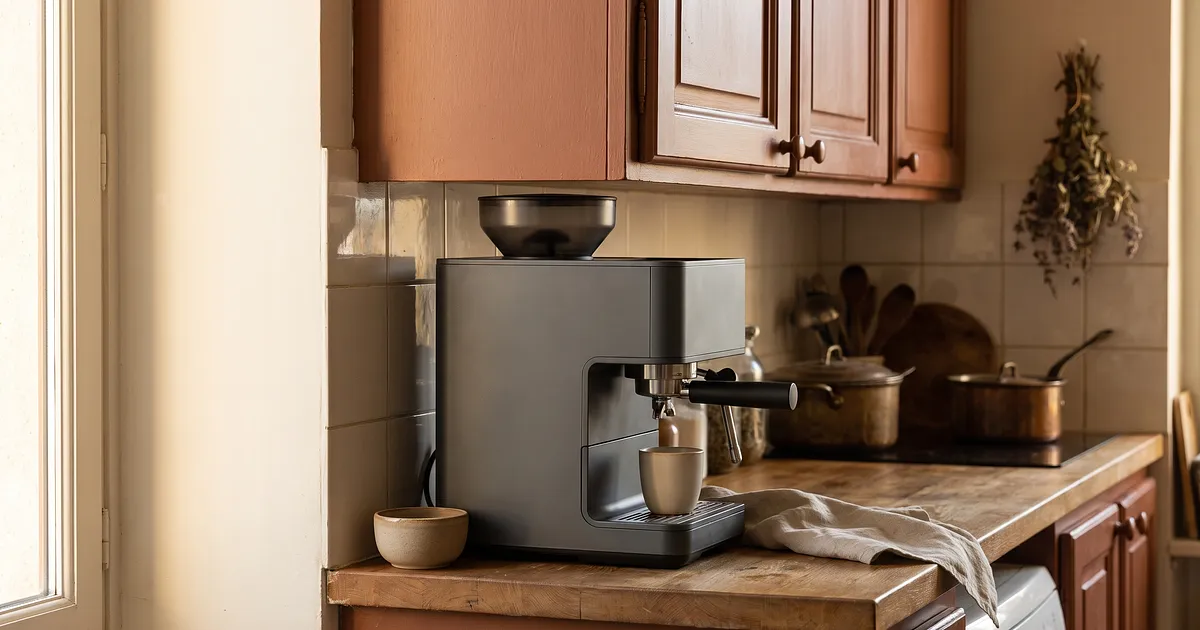
On the box, a compact bean-to-cup coffee machine advertises a width. In your kitchen, width is almost never the thing that blocks you. Depth is, because a French worktop runs 60 cm front to back while the wall unit above it runs only 30, and so is the clear height overhead, because the bean hopper fills from the top. So the five models below are ranked on the space they actually take up, not on what they cost. "Best" here means most compact: the ranking follows worktop footprint, not an overall score and not price.
Last updated: 9 August 2026
Why depth, not width, decides where a compact bean-to-cup coffee machine fits
Shopping for a small bean-to-cup coffee machine starts with the kitchen, not with the machine. That's the opposite of what most comparison pages do, and it's why they quote the wrong number.
Across the French kitchen trade, worktop depth generally sits at 60 centimetres, rising to 70 or 80 cm on an island. That's the French standard; measure your own if you're elsewhere. Above the worktop, Mobalpa recommends leaving a minimum of 60 cm between a wall unit and the counter, with two variants that matter here: 61 cm minimum above a sink, and 45 to 65 cm above a hob depending on the extractor.
The mismatch that actually hurts is elsewhere. A wall unit is generally 30 cm deep, against 60 cm for base units. Its front sits some thirty centimetres back from the edge of your worktop. A machine 45.9 cm deep slides easily under that overhang. It just eats three quarters of the counter, leaving barely room for a cup.
Now height. The bean hopper on these machines fills from the top, so the number that counts isn't the height of the machine, it's the height of the machine plus the clearance to open the lid. Take the Coffee Crush's 36 cm and add 15 cm of clearance, a figure borrowed from a different De'Longhi model's manual (details below), and you get 51 cm (in-house calculation from those two figures). Under a wall unit hung at 60 cm, that fits. In a zone at 45 cm above a hob, no.
One piece of context to close on. According to the GIFAM/NielsenIQ-GfK 2025 figures relayed by Places du Café, automatic bean-to-cup machines are in 13% of French households but fell 6% in value, while manual portafilter espresso machines, which are smaller, jumped 53% by volume. Is space part of the reason? The report doesn't say, and I'm not going to invent it. A hypothesis, not a proven cause.
The table: five machines ranked by footprint
The "worktop footprint" column is an in-house calculation: width multiplied by depth, taken from the dimensions each manufacturer publishes. No manufacturer publishes that value and nobody has measured it on a real unit. It's a multiplication, nothing more, and it exists only to sort the list.
The order it produces is not the price order. The Philips Series 2200 is the cheapest of the five and finishes last; the Coffee Crush is joint most expensive and wins. If your first criterion is budget rather than space, the under-€500 comparison handles that question separately.
| Model | W x D x H (mm, manufacturer) | Worktop footprint (in-house calculation) | Water tank | Bean hopper | Clearance published by manufacturer | Milk system | Amazon.fr price, observed 2026-08-09 |
|---|---|---|---|---|---|---|---|
| KRUPS Coffee Crush Extra (SA4028E0) | 150x295x360 | ~443 cm² | not published | 150 g | not published | none (no carafe, no steam wand) | approx. €329.99 |
| KRUPS Essential Compacte (YY8125FD) | 245x365x330 ¹ | ~894 cm² | 1.7 L | 260 g | not published | manual steam wand | approx. €299.99 |
| Melitta Caffeo Solo (E950-222) | 200x459x334 ² | ~918 cm² | 1.2 L | 125 g | not published | no automatic milk frothing system | approx. €287.99 |
| De'Longhi Magnifica S Perfetto (ECAM22.110.B) | 230x430x340 ¹ | ~989 cm² | 1.8 L | 250 g | not published | manual milk frother | approx. €329.99 |
| Philips Series 2200 (EP2220/10) | 247x434x366 | ~1,072 cm² | 1.8 L | 275 g | not published | simple steam wand | approx. €262.99 |
¹ Axis order inferred, not labelled by the manufacturer. The KRUPS Essential spec sheet comes from a regional manufacturer site that doesn't label its axes; the De'Longhi's 230x430x340 comes from the c_dimensions field on the official product record, with no axis label there either.
² Melitta publishes this figure in height x width x depth order (334x200x459 mm). It's reordered here as W x D x H to stay comparable, without changing any value.
The Melitta sums the trap up in one line: 20 cm across the front, second narrowest in the table, and 45.9 cm front to back, deepest in the table. So it lands behind the KRUPS Essential, which is 4.5 cm wider but 9.4 cm shallower.
What compact bean-to-cup coffee machine manufacturers don't publish
Here's the least comfortable result of this research. Not one of the five machines publishes its depth with the water tank removed, or the clearance you need above it to open the hopper. Five out of five. The manufacturers leave the box empty, not me, which is why the table says "not published" instead of guessing.
Exactly one manual gives the figure, and it covers none of the five models here. The instruction manual for the De'Longhi Magnifica S Smart FEB 2541 requires "a clear space of at least 3 cm between the surfaces of the appliance, the sides and the rear, as well as a clear space of at least 15 cm above the coffee machine" (translated from the French manual). That is what the manual of a neighbouring De'Longhi model requires, not the manual of the ECAM22.110.B compared here, and De'Longhi publishes no equivalent figure for the ECAM22.110.B. Read it as an illustration of the clearance a manual asks for, never as the Magnifica S Perfetto's own value.
Second gap, and this one is more annoying: two dimension errors are circulating on well-ranked comparison pages. Jura's official product page puts the ENA 4 at 27.1 cm wide, where one comparison announces 17.8 cm. Nine centimetres of difference, on the very dimension that triggers the purchase. And Melitta's spec sheet puts the Purista at 20 cm wide and 45.9 cm deep, where another guide shows 27 cm wide and 19 cm deep: width and depth swapped.
The practical takeaway fits in a sentence. Check the manufacturer's spec sheet, not the comparison page. This one included. And don't count on the test labs to fill the gap either: in its comparison of bean-to-cup espresso machines, UFC-Que Choisir measures noise at every stage (grinding, heating, extraction) and how easy each machine is to refill, but publishes neither installation footprint nor clearance.
The five models, smallest to bulkiest
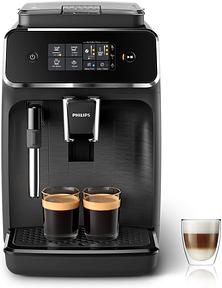
1. KRUPS Coffee Crush Extra: the smallest, by a long way
150x295x360 mm as published by KRUPS, so 15 x 29.5 x 36 cm and roughly 443 cm² on the worktop (in-house calculation). The gap to the next one is brutal: second place takes up double that area. Price observed on Amazon.fr on 2026-08-09: approx. €329.99.
Who it's for: a narrow worktop, the end of a counter, a flat kitchen where 30 cm of depth is already a win. It fits where none of the other four fit.
What that costs you is pretty much everything else. No milk system at all, no carafe and no steam wand, and KRUPS doesn't hide it. The hopper tops out at 150 g, the smallest in this comparison, so you'll be refilling it often. Water tank capacity appears neither in the KRUPS manual nor on the retailer spec sheet: not published, so I can't tell you how often you'll fill it. The most expensive machine of the lot, for the most stripped-down feature set of the lot. You're paying for centimetres.
KRUPS Coffee Crush Extra – Machine à Café à Grain Ultra Compacte 15 cm (SA4028E0)
Not available in your region — closest match
Philips Série 2200 EP2220/10 - Expresso Broyeur avec Mousseur à Lait, Écran Tactile
View at Amazon (as of Aug 10)Affiliate link. Buying through it earns us a commission; the price stays the same for you.
2. KRUPS Essential Compacte: the best footprint-to-capacity ratio in this comparison
245x365x330 mm on the spec sheet of a regional KRUPS manufacturer site, so 24.5 x 36.5 x 33 cm and roughly 894 cm² (in-house calculation), on the assumption that the axis order really is W x D x H. That page doesn't label them; the order is inferred from the convention seen on another KRUPS spec sheet. Worth checking with a tape measure before you pay.
Second in the ranking, and by far the most generous on capacity at the top of the table: a 1.7 L tank and a 260 g hopper, against 150 g for the Coffee Crush. Manual steam wand, no automatic milk carafe. Price observed on Amazon.fr on 2026-08-09: approx. €299.99.
Who it's for: a short worktop that isn't ridiculous, and someone who refuses to refill a tank every other day. What that costs: 36.5 cm of depth, nearly as much as the De'Longhi, plus 33 cm of height and a hopper clearance KRUPS never quantifies.
KRUPS Essential Compacte - Machine à Café à Grain Automatique 15 bars
Not available in your region — closest match
Philips Série 2200 EP2220/10 - Expresso Broyeur avec Mousseur à Lait, Écran Tactile
View at Amazon (as of Aug 10)Affiliate link. Buying through it earns us a commission; the price stays the same for you.
3. Melitta Caffeo Solo: narrow at the front, deep in reality
This is the machine that gave the article its subject. Melitta publishes 334x200x459 mm, reordered here as 200x459x334: 20 cm wide, 45.9 cm deep, 33.4 cm tall. Second narrowest in the table and the deepest of the five, for roughly 918 cm² on the worktop (in-house calculation), so third overall.
On a 60 cm worktop, those 45.9 cm leave you 14 cm in front of the machine, before you subtract the splashback. Call it one cup and nothing else.
A 1.2 L tank, a 125 g hopper, the smallest in this comparison. Melitta states in black and white "no milk frothing system"; whether a manual steam wand is present isn't specified on its spec sheet, so, not published, and I'm not going to guess it. Price observed on Amazon.fr on 2026-08-09: approx. €287.99.
Who it's for: a 20 cm gap between two units, with depth behind it. Definitely not for a shallow worktop.
Melitta Caffeo Solo, Noir – Machine à Café à Grain Compacte (E950-222)
Not available in your region — closest match
Philips Série 2200 EP2220/10 - Expresso Broyeur avec Mousseur à Lait, Écran Tactile
View at Amazon (as of Aug 10)Affiliate link. Buying through it earns us a commission; the price stays the same for you.
4. De'Longhi Magnifica S Perfetto: the safe pick, and 43 cm of depth
230x430x340 mm from the official De'Longhi field, so 23 x 43 x 34 cm and roughly 989 cm² (in-house calculation). Same caveat as the KRUPS Essential: the record doesn't label its axes, and the order is inferred by cross-checking the packaging dimensions in that same record.
1.8 L tank, 250 g hopper, manual milk frother. Price observed on Amazon.fr on 2026-08-09: approx. €329.99.
Who it's for: someone with depth but no width, who wants the best-documented and best-selling model of the five. What that costs: 43 cm front to back, and fourth place on footprint. With an irony I find telling. This is the brand whose clearance clause we have most clearly, on a different model, and nothing whatsoever on this one.
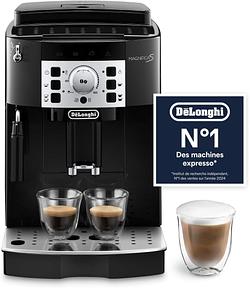
De'Longhi Magnifica S ECAM22.110.B
View at Amazon (as of Aug 11)Affiliate link. Buying through it earns us a commission; the price stays the same for you.
5. Philips Series 2200: the bulkiest, and the cheapest
247x434x366 mm from the retailer spec sheet, so 24.7 x 43.4 x 36.6 cm and roughly 1,072 cm² (in-house calculation). Last in the ranking, at almost 2.5 times the footprint of the Coffee Crush.
And yet it's the cheapest of the five, approx. €262.99 observed on Amazon.fr on 2026-08-09. Which is exactly why this ranking is not a price ranking. Sort by euros and the Philips wins. Sort by centimetres and it loses.
What it gives back: the best capacity in the table, 1.8 L of water and 275 g of beans, plus a simple steam wand. It's also the tallest of the five at 36.6 cm, so it's the one that demands the most clear height to open the hopper, and Philips doesn't publish that figure either.
Who it's for: a clear worktop, where footprint isn't the thing that decides. In that case, the general ranking of bean-to-cup coffee machines will serve you better than this page will.
Philips Série 2200 EP2220/10 - Expresso Broyeur avec Mousseur à Lait, Écran Tactile
Philips Série 2200 EP2220/10 - Expresso Broyeur avec Mousseur à Lait, Écran Tactile
View at Amazon (as of Aug 10)Affiliate link. Buying through it earns us a commission; the price stays the same for you.
How to measure your worktop before buying a compact bean-to-cup coffee machine
Five minutes with a tape measure beats any table, mine included.
- Usable depth. From the front edge of the worktop to the splashback, not to the bare wall. A 2 cm splashback takes 2 cm off you.
- Height under the wall unit. Measure it for real. The 60 cm in the rule is a fitting convention, and a hand-built kitchen drifts.
- Then subtract the hopper clearance. With no published figure to work from, I'd allow plenty: the 15 cm in the FEB 2541 manual is the only documented reference point found, and it's from another model.
- Room behind for the plug. The cable exits at the rear and won't fold flat. A machine pushed against the wall isn't the depth of the machine, it's the depth of the cable.
- Clearance to take the water tank out. Front, side or top changes everything, and none of the five manufacturers documents it. If the tank comes out of the top, your height under the wall unit becomes the limiting factor all over again.
- Finally, every dimension gets cross-checked on the manufacturer's spec sheet. Not on a comparison page alone, mine included.
The verdict by worktop depth
On the footprint axis the order is clean and it doesn't move: Coffee Crush, KRUPS Essential, Melitta Solo, De'Longhi Magnifica S, Philips 2200. The Coffee Crush wins comfortably, takes half the space of the runner-up, and costs more than three of the other four. When space is short, that's the price of space.
Less than 35 cm of usable depth on your counter? The Coffee Crush is the only one of the five that fits comfortably. Between 35 and 45 cm, the KRUPS Essential gives the best footprint-to-capacity compromise on those two measures. Beyond that, footprint stops being the deciding factor and the full comparison, all sizes together answers better than this page does. The right compact bean-to-cup coffee machine for a small kitchen is the one that clears your depth, and past 45 cm that stops being a constraint. If it's getting to grips with the machine that worries you rather than the centimetres, the beginner's guide is written for that.
One last point I'd rather leave open than fill in: nobody, not the manufacturers and not UFC-Que Choisir, publishes the depth with the tank removed. Until that figure exists, a tape measure stays more reliable than the table above.
Prices observed on Amazon.fr on 2026-08-09. Dimensions: manufacturer figures, no unit measured by us. This article contains affiliate links.
All products from this post
The ones we named above are marked; the rest are alternatives in the same category.
Not available in your region — closest match
Philips Série 2200 EP2220/10 - Expresso Broyeur avec Mousseur à Lait, Écran Tactile
View at Amazon (as of Aug 10)
Not available in your region — closest match
Philips Série 2200 EP2220/10 - Expresso Broyeur avec Mousseur à Lait, Écran Tactile
View at Amazon (as of Aug 10)
Not available in your region — closest match
Philips Série 2200 EP2220/10 - Expresso Broyeur avec Mousseur à Lait, Écran Tactile
View at Amazon (as of Aug 10)
Affiliate notice: As an Amazon Associate, we earn from qualifying purchases. Product prices and availability are subject to change.
Frequently Asked Questions
What is the most compact bean-to-cup coffee machine?
The KRUPS Coffee Crush Extra, 15 x 29.5 x 36 cm according to the manufacturer's manual, so roughly 443 cm² of worktop (in-house calculation). It's the smallest of the five models compared here by a long way: the next one up takes double the space. Price doesn't follow size, since it's also joint most expensive, approx. €329.99 observed on Amazon.fr on 2026-08-09. It has no milk carafe and no steam wand.
What is the minimum width I need for a bean-to-cup coffee machine?
Width isn't the right question. On a 60 cm French worktop it's the machine's depth that jams, not its front panel. The Melitta Caffeo Solo is only 20 cm wide but 45.9 cm deep according to Melitta. Measure your usable depth first, splashback included, then compare. And add the clearance the manual asks for, when the manufacturer publishes one.
Can a bean-to-cup coffee machine sit under a wall unit?
Yes, if the total height fits. Kitchen fitters in France generally hang wall units 60 cm above the worktop, 61 cm minimum above a sink, 45 to 65 cm above a hob. A 36 cm machine plus 15 cm of clearance above it therefore needs about 51 cm (in-house calculation). That fits under 60 cm. It does not fit in a zone at 45 cm.
How much space do I need to take the water tank out or open the bean hopper?
None of the five manufacturers publishes that figure, neither the depth with the tank removed nor the height with the lid open. It's the data gap of the whole category. The only documented value found comes from the manual of a different De'Longhi model, the Magnifica S Smart FEB 2541: 3 cm at the sides and rear, 15 cm above. It applies to that model only.
Can you trust the dimensions given by comparison sites?
Not without cross-checking. Two errors turned up during this research: one comparison puts the Jura ENA 4 at 17.8 cm wide when Jura states 27.1 cm on its own site, and another puts the Melitta Purista at 19 cm deep when Melitta publishes 45.9 cm, width and depth apparently swapped. Always check the manufacturer's spec sheet before buying.
Does a compact bean-to-cup coffee machine make worse coffee?
Size doesn't decide the cup. What decides it is the grinder, the grind and the dose, not the 15 or 19 bar printed on the box. That's a pump peak, not the working pressure: espresso actually extracts at around 9 bar. What compactness costs you is capacity, a smaller tank and hopper, so more filling and emptying, and sometimes no milk system at all.
Sources
- worktop depth generally sits at 60 centimetres arthur-bonnet.com
- Mobalpa recommends leaving a minimum of 60 cm between a wall unit and the counter mobalpa.fr
- generally 30 cm deep, against 60 cm for base units kreabel.fr
- According to the GIFAM/NielsenIQ-GfK 2025 figures relayed by Places du Café placesducafe.com
- De'Longhi Magnifica S Smart FEB 2541 notice-facile.com
- Jura's official product page fr.jura.com
- Melitta's spec sheet melitta.fr
- comparison of bean-to-cup espresso machines quechoisir.org
- published by KRUPS maxicoffee.com
- the spec sheet of a regional KRUPS manufacturer site krups-algerie.com
- Melitta publishes melitta.fr
- the official De'Longhi field delonghi.com
- the retailer spec sheet maxicoffee.com