De'Longhi vs Sage: which espresso machine brand should you buy?
 16 min read
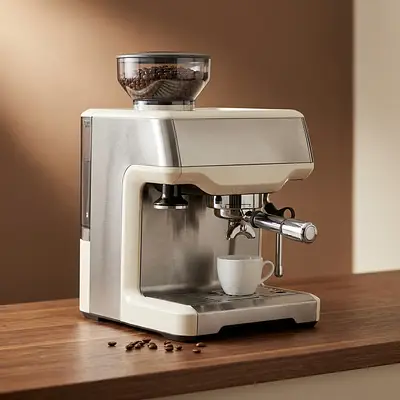
Before comparing anything, one fact that saves hours of reading: Sage and Breville are the same house. If you're weighing up De'Longhi vs Sage and half your search results talk about a "Breville Barista Express", you're reading about the machine sold under the Sage badge in Europe and the Breville badge outside it, the US and Australia included. Incapto puts it plainly: "the Sage brand, part of the well-known Breville group, is known for its expertise in manual coffee machines" (Incapto, updated 2 March 2026).
That settles the name. It still doesn't tell you which one to buy.
A word on scope, because the two questions blur together fast. What gets compared here is two brands, manual portafilter machines included, which a bean-to-cup guide doesn't cover. If your question is more like "which bean-to-cup machine should I buy in 2026", then our bean-to-cup comparison is the one that answers it, model by model.
Two different pedigrees, not two quality tiers
De'Longhi built its name on the automatic bean-to-cup machine: you fill the hopper, press a button, and the machine grinds, tamps, extracts and rinses. Its portafilter line exists, but it sits off to the side of that automatic core.
Sage does the opposite. The catalogue revolves around the portafilter machine, with or without a grinder in the chassis, and the promise is to hand you the controls rather than hide them. French retailer MaxiCoffee sums up the range philosophy in its buying guide: "little automation, these coffee machines are ideal for people who want to use their barista skills" (Coffee Spirit / MaxiCoffee, 18 July 2024).
None of the French sources consulted for this article calls one brand better than the other. They all describe the same trade-off. Incapto writes it this way: "De'Longhi is ideal for those looking for a simple, intuitive experience, while Sage asks for a bit more learning".
In practical terms: the question isn't "which one is better". It's "how long are you willing to stand in front of your machine every morning".
The table: what actually separates De'Longhi and Sage
| Criterion | De'Longhi | Sage (Breville outside Europe) |
|---|---|---|
| Core of the range | automatic bean-to-cup machine, plus a portafilter line | dedicated portafilter machine, with or without a built-in grinder |
| The promise | a decent coffee with nothing to adjust | manual control of the extraction |
| Advertised pump pressure | 15 bars on the Dedica EC685 and on the Magnifica S ECAM 22 (manufacturer's own figures, relayed by a retailer and by an independent test) | 15 bars on the Barista Express (manufacturer's own figure) |
| Target extraction pressure | roughly 9 bars at the group, a principle common to the whole category | 9 bars, stated by Sage on its own product page |
| Portafilter on the dedicated range | 51 mm on the Dedica (the majority figure; one retailer says 53 mm) | 54 mm, and 58 mm on the top-end Oracle |
| Grind settings | 8 on La Specialista Arte, 13 on the Magnifica S, 7 on the model tested by Une case en plus | 15 on the Barista Express according to Brewing With Dani, 16 advertised by Sage, 18 on the model tested by Une case en plus |
| Time before consistent shots | close to zero on the fully automatic | 2 to 3 weeks of dialling in according to Une case en plus |
| PID temperature control | not stated on the models cited here | PID advertised by Sage at 93 °C on the Barista Express |
| Prices checked on Amazon.fr, 08/08/2026 | €140 to €410 on the models in this article | €110 to €675 on the models in this article |
Prices in that last row move fast, and they move differently from one country to the next on the same reference. Read them as a dated order of magnitude, not as a price tag.
The 15 or 19 bars on the carton don't make the espresso
It's the number everyone looks at and the least useful line on the spec sheet.
A pump advertised at 15 or 19 bars describes a peak pressure. Espresso itself extracts a good deal lower. Sage writes this on its own French product page: its 15-bar Italian pump exists to "guarantee that the necessary pressure of 9 bars will always be reached" (Sage Appliances). A manufacturer explaining that its own marketing number serves to hit a smaller number is about the best source you could ask for on the subject.
And the principle goes well beyond Sage. Any serious machine brings its pressure back to around 9 bars at the group with an overpressure valve, whatever number is printed on the box (Clive Coffee). Two machines advertising 15 and 19 bars are therefore aiming at the same working pressure.
Even that 9-bar figure deserves a caveat. A domestic gauge reading 9 bars doesn't tell you what's happening at the coffee bed: pressure losses through the circuit can bring the figure at the puck down to about 6.5 bars (Pulled Shot, 27 June 2026). Both of those technical references put espresso at roughly 9 bars ± 1 on the basis of the industry standard. The Specialty Coffee Association's primary document is members-only, so what's cited here is the secondary sources, not the SCA directly.
In practice, if you're comparing two machines and the only visible difference is "15 bars" against "19 bars", you're comparing nothing at all. Grind, dose and temperature stability are what tell you something.
De'Longhi espresso machines: three ways in, three different uses
The De'Longhi espresso machine range covers three very different ways of making coffee, and mixing them up is the surest route to buying the wrong one.
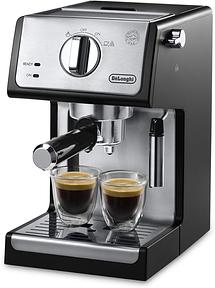
The Dedica Style EC685.W: the cheapest portafilter worth owning
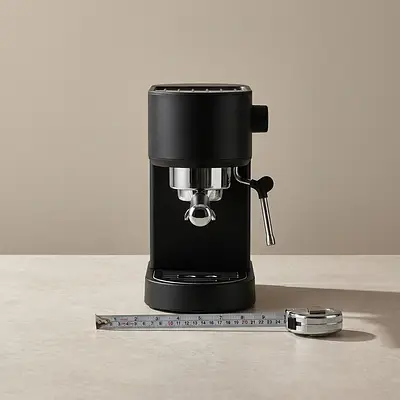
Small, narrow, barely 15 cm wide, the Dedica is the cheapest way into this comparison, around €140 on Amazon.fr (checked 08/08/2026). A specialist retailer describes it with a 15-bar pump, a fast-heating thermoblock, a warm-up of about 40 seconds and a removable 1 L tank (Whole Latte Love). Those values come from the manufacturer and are relayed by the retailer. They aren't an independent measurement.
The thing to know before you pay: there's no grinder. So the price on the tag isn't the price of your coffee. Add a grinder, and one capable of holding a consistent espresso grind often costs more than the machine itself.
Not available in your region — closest match
View at Amazon (as of Aug 14)Affiliate link. Buying through it earns us a commission; the price stays the same for you.
La Specialista Arte EC9155.MB: the portafilter with a built-in grinder
This is De'Longhi's head-on answer to the Barista Express: a portafilter machine with the grinder in the chassis, around €410 on Amazon.fr (checked 08/08/2026).
Home-barista instructor Dani Bordiniuc put the two machines side by side and isn't kind to the De'Longhi on two specific points. Its grinder offers only 8 settings, with an inner burr you can't adjust without taking the machine apart, and its brew group isn't heated, unlike the Sage's (Brewing With Dani). That verdict is his, not ours, and it covers those two models specifically.
An unheated group means less stable temperature at start-up, so the first espresso of the day won't taste like the third.
Not available in your region — closest match
View at Amazon (as of Aug 14)Affiliate link. Buying through it earns us a commission; the price stays the same for you.
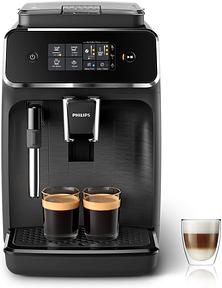
The Magnifica S ECAM11.112.B: the bean-to-cup that asks nothing of you
Here you leave the portafilter behind. Pour beans in, press, drink. Around €288 on Amazon.fr (checked 08/08/2026).
French site LaboMaison tested the Magnifica S ECAM 22 from the same family and published figures no manufacturer sheet gives you: 15 bars of pump pressure, 13 grind settings, a 1.8 L tank, a 250 g hopper, 1,450 W, and above all 66 dB(A) during grinding against 53 dB(A) during extraction (LaboMaison, updated 25 November 2025). Those are test measurements, not catalogue values.
A machine like this will never pull an espresso dialled in to the gram. But at 7am it makes a decent one in thirty seconds without you touching anything. If that's your actual need, the De'Longhi vs Sage debate is already settled.
De'Longhi Magnifica S ECAM11.112.B - Perfetto Machine à Café Automatique avec Mousseur à Lait Manuel
Not available in your region — closest match
Philips Série 2200 EP2220/10 - Expresso Broyeur avec Mousseur à Lait, Écran Tactile
View at Amazon (as of Aug 10)Affiliate link. Buying through it earns us a commission; the price stays the same for you.
Sage Barista Express and the rest of the range: paying for control
The Sage logic holds from one model to the next: you see the grind, you see the dose, you see the shot time, and you change all of them.
The Bambino: the cheapest Sage, and no grinder
Around €110 on Amazon.fr (checked 08/08/2026), this is the ticket into the brand. There's a trap in that number, though. It doesn't cover a grinder, exactly as with the Dedica. And the price of this reference swings hard between European marketplaces, which is one more reason to check at the moment you buy rather than trusting a dated figure.
The Bambino makes sense if you already own a decent espresso grinder, or if you'd rather buy a good one than settle for a mediocre built-in.
Not available in your region — closest match
View at Amazon (as of Aug 14)Affiliate link. Buying through it earns us a commission; the price stays the same for you.
The Barista Express: the model that defined the category
This is the one everybody cites, including under its Breville name, and it's around €400 on Amazon.fr (checked 08/08/2026).
Its French product page (manufacturer's own figures) lists a 15-bar Italian pump for extraction at 9 bars, a 54 mm stainless portafilter, 16 grind steps and PID-controlled Thermocoil heating at 93 °C (Sage Appliances).
The PID is the line that genuinely matters in that list. Electronics that hold the temperature at a setpoint instead of letting it swing are what make an espresso repeatable from one day to the next. It's also what's missing from the models above, where the figure simply isn't stated.
The downside is real. A French comparison published on 9 June 2026 puts the time needed to get consistent extractions at 2 to 3 weeks on a Sage (Une case en plus). Two or three weeks of mediocre coffees before the good ones. If that prospect irritates you just reading it, buy a bean-to-cup.
Not available in your region — closest match
View at Amazon (as of Aug 14)Affiliate link. Buying through it earns us a commission; the price stays the same for you.
The Barista Express Impress: assisted tamping
Around €675 on Amazon.fr (checked 08/08/2026), this is the most expensive model in the selection. What it adds over the Barista Express is assisted tamping, meant to remove the biggest source of inconsistency for a beginner: an uneven hand tamp, which carves a channel through the puck and lets water rush past.
We couldn't find an independent French test, dated and with numbers, measuring the real gap between the Impress and the standard Barista Express. The principle is clear. The size of the gain isn't, and we'd rather write that down than guess at it.
Not available in your region — closest match
View at Amazon (as of Aug 14)Affiliate link. Buying through it earns us a commission; the price stays the same for you.
The grinder decides the coffee, not the logo
If you take one thing from this comparison, take this one: between two machines at similar prices, it's almost always the grinder that explains the difference in the cup.
The pattern is clear across the sources. Sage's dedicated espresso range offers finer grind adjustment than De'Longhi's automatic range. But the exact numbers contradict each other from one test to the next, which means reading them per model and never per brand:
8 settings on La Specialista Arte against 15 on the Barista Express, according to Brewing With Dani
Sage itself advertises 16 steps for the Barista Express
LaboMaison counted 13 levels on the Magnifica S ECAM 22
7 against 18 on the two models Une case en plus tested in June 2026
Four readings, four pairs of numbers. Any page telling you "De'Longhi offers X settings" as a brand characteristic is inventing a precision that doesn't exist.
What counts more than the number of steps is access to the burr. On the Specialista Arte, the inner burr only adjusts once you've dismantled the machine, according to Brewing With Dani. On the Sage side, the hopper comes off and the adjustment stays reachable. On a machine you'll be re-adjusting every time you open a new bag of coffee, that difference weighs more than one step up or down.
And if you go for a machine with no grinder, the grinder budget becomes the real decision. That's a subject in its own right, covered in the bean-to-cup machine guide on the automatic side.
51 mm or 54 mm portafilter: the lock-in nobody mentions
One line on a spec sheet commits you for years, and it slips past almost everyone: portafilter diameter.
The dedicated Sage range works in 54 mm, with one exception near the top of the catalogue, the Oracle, which moves to the professional 58 mm format. The De'Longhi Dedica uses a proprietary 51 mm basket. That 51 mm figure is what the majority of sources and the community give; one specialist retailer states 53 mm on the same family of machines, so treat it as a strong consensus rather than a unanimous value.
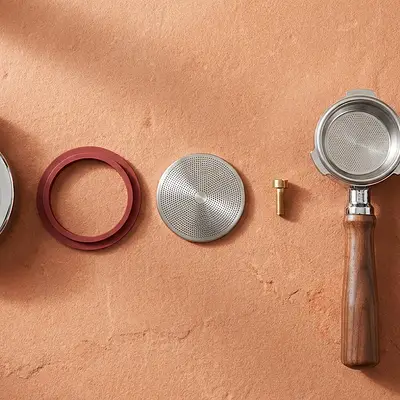
Why it matters: tampers, bottomless baskets, WDT funnels (the needle tool that breaks up grind clumps before tamping), tamping mats, all of it gets chosen by exact diameter. 58 mm is the professional café standard, so it's where the accessory choice is widest and cheapest. In 51 mm, the offering is a lot narrower.
Put another way, you aren't only buying a machine. You're buying an accessory ecosystem you'll keep longer than the machine itself.
What budget buys what result
Reference points taken from the Amazon.fr prices checked on 08/08/2026 across the six models cited, to be read as a range rather than a fixed tariff.
No grinder, €110 to €140 (Dedica or Bambino): add a decent grinder and the total often passes what a machine with a built-in grinder costs (our own arithmetic, not an observed price).
Around €290, a De'Longhi Magnifica S needs no adjustment at all for a decent coffee every morning. Best time-to-result ratio in the selection, not the best espresso.
The real duel plays out between €400 and €410: La Specialista Arte against the Barista Express, within a few euros of each other on Amazon.fr on 08/08/2026 (a 9 June 2026 comparison put that gap at €269 against €450 on its own models, which shows how much these prices move). The deciding factors stay the PID, access to the grinder, and whether the group is heated.
Above €600, only the Barista Express Impress adds tamping assistance: useful if the gesture puts you off, superfluous if you intend to learn to tamp anyway.
The verdict: De'Longhi vs Sage, who buys which
No "best brand" here. None of the sources consulted names one, and Novebar doesn't test these machines. What follows is a sort by constraint rather than a ranking.
Want coffee without thinking about it, or a machine shared between several people with no appetite for learning, or a total budget (grinder included) capping out around €300? Take the De'Longhi.
Sage wins you over if adjusting your grind appeals to you rather than annoys you, if two or three weeks of trial and error don't scare you, and if you plan to invest in accessories afterwards. The 54 mm opens a wider catalogue than 51 mm does.
Neither one, if your portafilter budget leaves nothing for a grinder. A €140 machine fed on pre-ground supermarket coffee will do worse than a €290 bean-to-cup.
One last reflex before you pay. Ignore the number of bars printed on the carton, open the spec sheet for the exact model rather than the range, and check three lines: portafilter diameter, PID regulation, and how the grind gets adjusted. The prices quoted here date from 08/08/2026 and will have moved.
All products from this post
The ones we named above are marked; the rest are alternatives in the same category.
Not available in your region — closest match
Philips Série 2200 EP2220/10 - Expresso Broyeur avec Mousseur à Lait, Écran Tactile
View at Amazon (as of Aug 10)
Affiliate notice: As an Amazon Associate, we earn from qualifying purchases. Product prices and availability are subject to change.
Frequently Asked Questions
Is Sage the same brand as Breville?
Same group, yes. Breville is the name used outside Europe, Sage the European one, and the engineering behind both is identical. In practice, a review of the "Breville Barista Express" is describing the machine sold in France with a Sage badge on it. That instantly doubles the pool of usable opinions before you buy, as long as you check the exact model reference really does line up from one region to the next.
How many grind settings do these machines have?
Depends on the model, and treat any figure presented as valid for a whole brand with suspicion. On the machines Brewing With Dani compared, the Sage Barista Express shows 15 settings against 8 on the De'Longhi La Specialista Arte. Sage itself advertises 16 steps for the Barista Express, and a French test of the Magnifica S counted 13. Three sources, three numbers. Always read the sheet for the exact model.
Does a 19-bar pump make a better espresso than a 15-bar pump?
No. The number on the carton is a pump peak, not the pressure the coffee extracts at. An overpressure valve brings it back to roughly 9 bars at the group, and that value is what decides the cup. Sage writes as much on its own French product page: its 15-bar pump is there to reach the necessary 9 bars. Grind, dose and temperature stability tell you far more.
De'Longhi or Sage for a first portafilter machine?
If you want a cheap way in and already own a grinder, the De'Longhi Dedica costs a lot less. No grinder yet, and planning to buy one? The arithmetic changes: a Sage Barista Express has its grinder built in, and a decent standalone espresso grinder often costs about what the price gap does. The Sage's weak point is the dialling-in time at the start.
Do 58 mm accessories fit a 54 mm Sage?
No. The dedicated Sage range uses a 54 mm portafilter, the professional café standard is 58 mm, and the De'Longhi Dedica drops to 51 mm on a proprietary fitting. Tampers, baskets and WDT funnels get chosen by exact diameter, with no reliable adapter. It's the most underrated point in this whole comparison, because it commits you to years of accessories.
Sources
- Incapto incapto.com
- Coffee Spirit / MaxiCoffee coffee-spirit.maxicoffee.com
- Sage Appliances sageappliances.com
- Clive Coffee clivecoffee.com
- Pulled Shot pulledshot.com
- Whole Latte Love wholelattelove.com
- Brewing With Dani brewingwithdani.com
- LaboMaison labomaison.com
- Une case en plus une-case-en-plus.com