The E61 group head: why this block of brass is on nearly every prosumer machine
 14 min read
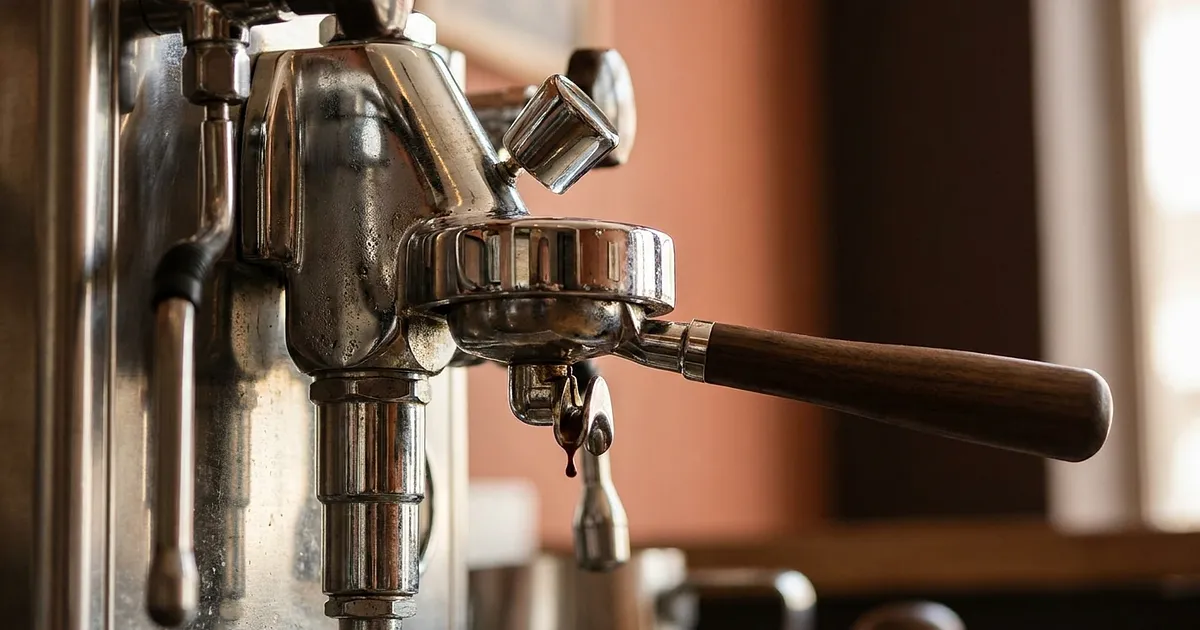
Open any espresso retailer's catalogue and the same part keeps appearing from one brand to the next: a heavy block of chrome-plated brass topped by a lever you lift with your hand. Machines that share neither price, nor manufacturer, nor heating architecture carry this component identically. That is not a marketing coincidence, and it is not nostalgia either. It is a design from 1961 that outlasted its successors because it solves one problem unusually well.
Who this article is for
Anyone who owns — or is considering — a portafilter machine. If your machine is a bean-to-cup superautomatic (a Vollautomat, in German), you will never meet an E61 group: those machines use a moving composite brew unit built on a completely different principle. None of what follows applies to them.
For everything else — 58 mm portafilter machines, from the entry-level prosumer model up to café equipment — the E61 is the component you are most likely to encounter, and understanding it changes how you use the machine.
What the E61 group actually is
The group head is the part of the machine where hot water meets coffee. It is the piece the portafilter locks into.
The E61 group is a particular design of group head, engineered and patented by the Italian engineer Ernesto Valente and introduced by the Milanese manufacturer Faema on its E61 machine in 1961 (Wikipedia, "E-61"). The name is short for the machine's own name, which is commonly reported as a nod to the solar eclipse of its launch year.
By the same source, the Faema E61 stacked up three firsts: the first automatic pre-infusion, the first electric pump in place of a manual lever, and the first thermosiphon for managing group temperature. It is that third one that explains why the part is still here sixty years later.
Physically it is a block of chrome-plated brass with a mass in excess of 4 kg (Wikipedia; Five Senses Coffee gives the same order of magnitude, "around 4 kg of chrome plated brass"). On a domestic machine weighing roughly 20 to 25 kg all in, that is a meaningful share of the total — and it is deliberate.
The thermosiphon: the mechanism everyone names and few describe
This is the heart of the design, and it is the part most often reduced to a single word without explanation.
The E61 group has no heating element of its own. It is connected to the boiler by two pipes: the upper pipe runs from the top of the boiler to the top of the group chamber, and the lower pipe runs from the bottom of the boiler to the bottom of that same chamber (Five Senses Coffee). Those two pipes and the group form a closed loop.
The rest is elementary physics. Water in the group, furthest from the heat source, cools slightly; as it cools it becomes denser, therefore heavier, and it sinks. It travels back to the boiler through the lower pipe. In the boiler it is reheated, expands, becomes less dense, rises, and returns to the group through the upper pipe. Once started, the loop runs on its own — no pump, no electronic control — for as long as the boiler is hot.
The result is that the group has water at working temperature passing through it permanently. It does not wait for you to pull a shot before heating up: it is already hot, and evenly so, from the top of the casting down to the shower screen. That is exactly the problem Valente set out to solve — keeping a group thermally stable without bolting the boiler directly onto it.
What the thermosiphon means in practice
Two consequences you do not always read about:
The machine draws power even when you are doing nothing. The loop never stops; the boiler continuously makes up for heat lost through the group and the pipework. That is why many owners put their machine on a timer switch rather than leaving it on all day.
On some architectures the first water out of the group is too hot. When the thermosiphon passes through a boiler held at steam temperature, water sitting in the loop can exceed the brew temperature you want. You purge it for a few seconds before pulling the shot — the well-known cooling flush. That routine depends on the machine's heating architecture, not on the E61 group itself: not every E61 machine needs one.
Four kilos of brass: thermal mass as a flywheel
The mass is not a styling decision. Brass conducts heat well and stores a great deal of it. A block of over 4 kg at working temperature is a reservoir of thermal energy.
During extraction, water passes through the group and carries heat away with it. On a light group, that loss shows up immediately in the temperature of the water reaching the coffee: it drops second by second. On a 4 kg block, the same amount of heat removed barely moves the metal's temperature, so it keeps warming the water passing through. The temperature seen by the coffee puck stays far steadier from the start of the shot to the end.
This is the flywheel principle: a mass that takes time to spin up, but that then absorbs the jolts. On a machine such as the Lelit MaraX, this group is paired with electronic regulation that drives the boiler according to how hard the machine is being worked — mass and electronics address two different problems and complement each other.
Lelit MaraX PL62X — machine expresso à groupe E61, acier inoxydable brossé
The downside is mechanical and unavoidable: whatever is slow to cool is slow to heat. There is no fast-warming version of this trade-off, because it is the same physical property seen from both sides.
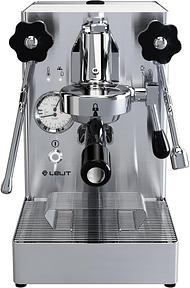
Lelit MaraX PL62X — machine expresso à groupe E61, acier inoxydable brossé
View at AmazonAffiliate link. Buying through it earns us a commission; the price stays the same for you.
The cam lever: mechanical pre-infusion, not programmed
The chrome lever on top of the group is not a decorative handle. It drives a cam acting on a piston, which opens or closes the water path to the coffee puck.
On most machines fitted with this group, the lever has a middle position: raised halfway, it opens the water path before triggering the pump. The puck then receives water at boiler or line pressure — a low pressure. It wets progressively instead of being hit straight away with 9 bar. You then lift the lever fully, the pump starts, and extraction begins.
This is physical pre-infusion: it depends on no program, no factory setting and no electronics. It depends on your hand and on how long you leave the lever at half travel. The group also incorporates a passive pre-infusion chamber with a small jet — typically around 1 mm in diameter or less — and a spring-loaded valve, which softens the pressure ramp even without any barista input (Five Senses Coffee).
That mechanical control also explains part of the attachment owners feel for this group: the movement is direct, it gives immediate feedback, and it makes visible a stage that automatic machines hide.
Lelit Mara PL62-W — machine expresso à groupe E61, poignées et levier en noyer
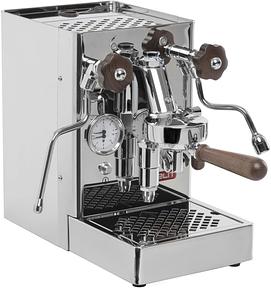
Lelit Mara PL62-W — machine expresso à groupe E61, poignées et levier en noyer
View at AmazonAffiliate link. Buying through it earns us a commission; the price stays the same for you.
Why it is everywhere: the patent is in the public domain
Here is the explanation you are looking for when you wonder why competing brands sell the identical part.
Valente filed his patent in Italy in 1960, then in the United States. That patent expired in 1996, and the design has been in the public domain since (Wikipedia, "E-61"). Any manufacturer may therefore produce this group, and many do: the same source lists Bezzera, Profitec, ECM, Rocket Espresso, La Nuova Era, Sanremo, Expobar, Lelit and La Pavoni among the brands that have used it.
The E61 thus became something no marketing department planned: an open, unbranded standard in a sector that has almost none.
Interchangeability is a genuine ownership advantage
This deserves saying plainly, because it is the point that weighs most on a machine's working life. The wear parts of an E61 group are standardised in practice. A group gasket, a shower screen or a 58 mm basket bought from a third-party maker fits machines from different brands.
In concrete terms:
you are not locked into one manufacturer's spare-parts network;
a machine whose brand disappeared would remain serviceable;
you can replace an original part with a better-made one, which is rarely possible on a sealed appliance.
Cafelat — joint de groupe E61 en silicone, 8 mm
That is a rare property in domestic appliances, and it descends directly from the patent expiring.
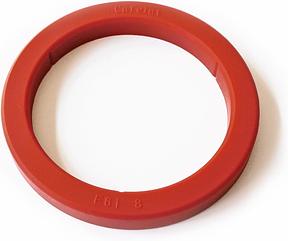
Cafelat — joint de groupe E61 en silicone, 8 mm
View at AmazonAffiliate link. Buying through it earns us a commission; the price stays the same for you.
What the E61 does less well
A design that lasts is not a perfect design, and presenting it as superior in every respect would be dishonest.
Warm-up is long. It is measured in tens of minutes, not seconds. The exact figure depends on the machine and is stated in its manual; the order of magnitude follows directly from the mass that has to be heated. Five Senses Coffee puts it bluntly: the group "takes a long time to heat up and cool down, but this is important for temperature stability".
Standby energy use is real. Holding 4 kg of brass and a loop of pipework at temperature all day costs energy that a thermoblock machine — which heats only what it uses — does not spend.
Weight and footprint. The group alone exceeds 4 kg; the complete machine is heavy, deep, and not meant to be moved often.
The cooling flush on some machines. Described above: not a flaw in the group, but an extra routine the owner inherits.
It has been surpassed for intensive professional use. Five Senses Coffee notes that the E61 "has been superseded for high-end commercial use", while remaining relevant in the domestic market.
E61 or saturated group: two answers to the same question
The main modern rival is the saturated group, which is not linked to the boiler by a loop but is part of the boiler: boiler water bathes the group body directly.
What the saturated group does better: the water temperature at the coffee is the boiler's, with nothing in between, so regulation is more direct and often quicker to settle. There is no loop to establish and no pipework to insulate.
What the E61 does better: it does not require the group to be integrated into a boiler, which leaves the manufacturer more architectural freedom; its mass absorbs variation during the shot; and it brings the mechanical pre-infusion and the interchangeability described above.
Neither is "the right one". They are two different answers to the same question — how to deliver water at a stable temperature to the coffee — and the choice turns on what else you want around it.
Maintenance: the parts that wear, and why it is simple
An E61 group is kept in shape with three consumables and one tool. That is the practical corollary of everything above.
The group gasket
This is the fastest-wearing part. It is the ring the portafilter clamps against; it hardens under heat and eventually leaks. The usual sign: the portafilter locks further and further to the right, and water seeps out of the side during extraction.
Watch one subtlety that trips up a lot of orders: there are two thicknesses, 8 mm and 8.5 mm, depending on the manufacturer. Thickness determines where the portafilter locks — ideally straight towards you, at the 6 o'clock position. Check the original thickness before ordering; changing thickness is in fact a known way to correct a lock position that has drifted.
Joint de groupe E61 en silicone alimentaire, Ø 73 × 57 × 8,5 mm
Food-grade silicone holds up better over time than conventional rubber, which hardens and picks up odours.
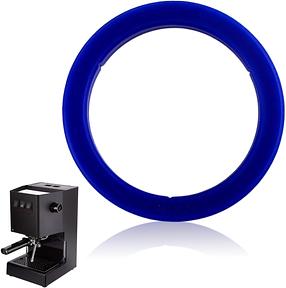
Joint de groupe E61 en silicone alimentaire, Ø 73 × 57 × 8,5 mm
View at AmazonAffiliate link. Buying through it earns us a commission; the price stays the same for you.
The shower screen
This is the perforated disc through which water arrives on the puck. It clogs with coffee oils and fines, and a partly blocked perforation waters the puck unevenly. It is one of the most ordinary causes of inconsistent extraction, and one of the least often suspected.
Replacement is one screw. So-called precision screens, with finer and more regular perforation, fit the same thread.
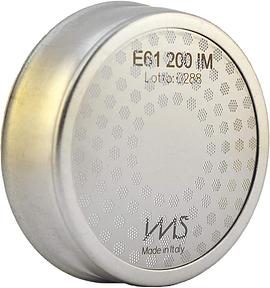
Douchette de précision IMS pour groupe E61
View at AmazonAffiliate link. Buying through it earns us a commission; the price stays the same for you.
The group brush
The daily ritual: portafilter out, brush around the gasket and the shower screen while the group purges. A brush with an angled head and a splash guard keeps your hand out of the hot water and reaches the gasket rim, where residue accumulates.
Brosse de groupe Pallo Coffeetool Grouphead
That is thirty seconds at the end of the day, and it pushes back the full strip-down considerably.
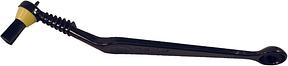
Brosse de groupe Pallo Coffeetool Grouphead
View at AmazonAffiliate link. Buying through it earns us a commission; the price stays the same for you.
The bottomless portafilter, for diagnosis
A bottomless portafilter removes the spouts and lets you see the underside of the basket during extraction. You read the fault directly: a jet firing sideways, one area running faster than the rest, a channel forming.
It is not a style accessory: it is the only way to observe what happens under the puck. In 58 mm it fits any E61 group, whatever the brand of the machine — the open standard doing its work.
Normcore Porte-filtre Nu Sans Fond 58 mm (panier 18 g inclus)
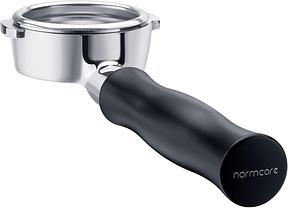
Normcore Porte-filtre Nu Sans Fond 58 mm (panier 18 g inclus)
View at AmazonAffiliate link. Buying through it earns us a commission; the price stays the same for you.
Flow control, for going further
The last stage, for anyone who wants to shape the extraction profile: a kit replacing the group's top cap with a knob that meters water flow mid-shot. Here too, interchangeability does the work — these kits are designed for "the E61 group", not for one specific machine.
Coffee Sensor — kit de contrôle de débit pour groupe E61
It is an optional and demanding addition: it asks you to understand what you are trying to change before you turn the knob.
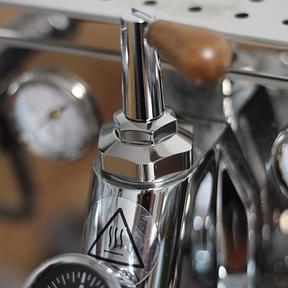
Coffee Sensor — kit de contrôle de débit pour groupe E61
View at AmazonAffiliate link. Buying through it earns us a commission; the price stays the same for you.
What to take away
The E61 group did not survive out of tradition. It survived because a thermosiphon that works without electronics, a mass of brass that steadies temperature during the shot, and purely mechanical pre-infusion still answer the problem competently — and because a patent falling into the public domain turned it into a standard nobody owns.
It will not suit anyone who wants coffee three minutes after switching on, nor anyone who wants the most frugal machine on the counter. For everyone else it is a legible, repairable part documented for sixty years — which, in an appliance you keep for a decade, counts at least as much as its spec sheet.
All products from this post
The ones we named above are marked; the rest are alternatives in the same category.
Affiliate notice: As an Amazon Associate, we earn from qualifying purchases. Product prices and availability are subject to change.
Frequently Asked Questions
What is a thermosiphon on an espresso machine?
It is a closed loop of two pipes between the boiler and the group. Water cooled in the group becomes denser, sinks back to the boiler, is reheated there, expands and rises again. The circulation sustains itself by convection, with no pump and no electronic control, and keeps the group at working temperature permanently.
How long does an E61 group take to be ready?
Considerably longer than a thermoblock machine: warm-up is measured in tens of minutes. The exact figure depends on the model and is stated in its manual. It is the direct price of the brass mass, which is also what steadies temperature during extraction.
Why is the E61 group called that?
It takes its name from the Faema E61 machine on which it was introduced, in 1961. The machine's name is commonly reported as a reference to the solar eclipse of that year. The group was patented by the engineer Ernesto Valente.
Are E61 group parts interchangeable between brands?
Largely, yes. The patent expired in 1996 and the design is in the public domain, so gaskets, shower screens, 58 mm baskets and portafilters fit machines from different manufacturers. Only check the group gasket thickness, which comes in 8 mm and 8.5 mm.
Does every E61 machine need a cooling flush?
No. That purge applies to machines whose thermosiphon passes through a boiler held at steam temperature, where water sitting in the loop can be too hot. It depends on the machine's heating architecture, not on the group itself.
Is an E61 group better than a saturated group?
Neither is superior across the board. A saturated group sits in the boiler and gives more direct regulation. The E61 brings thermal mass during the shot, mechanical lever pre-infusion, and parts that interchange between brands. The choice depends on what you want around it.