Barista Accessories: What to Buy First When You're Starting Out
 15 min read
You've just plugged in your first portafilter espresso machine, and the list of barista accessories everyone keeps recommending already runs to fifteen lines. Tamper, tamping mat, WDT tool, scale, precision basket, thermometer, brush, cleaner. Nobody tells you what order to buy them in, or which ones you can happily ignore for six months without the cup suffering for it. The pages that rank first for this search are retailer catalogues. Everything is in stock, nothing is prioritised.
This isn't a niche problem either. According to Gifam and NielsenIQ-GfK figures presented in February 2026, manual bean-to-portafilter espresso machines grew 53 % by volume in France over 2025, while classic automatics went backwards. And a Createst survey run for De'Longhi in February 2026 found that 62 % of French people drink at least two coffees a day and 55 % name espresso as their favourite drink. Those are the buyers, not the automatic-machine crowd, who end up staring at the same unranked list of fifteen accessories.
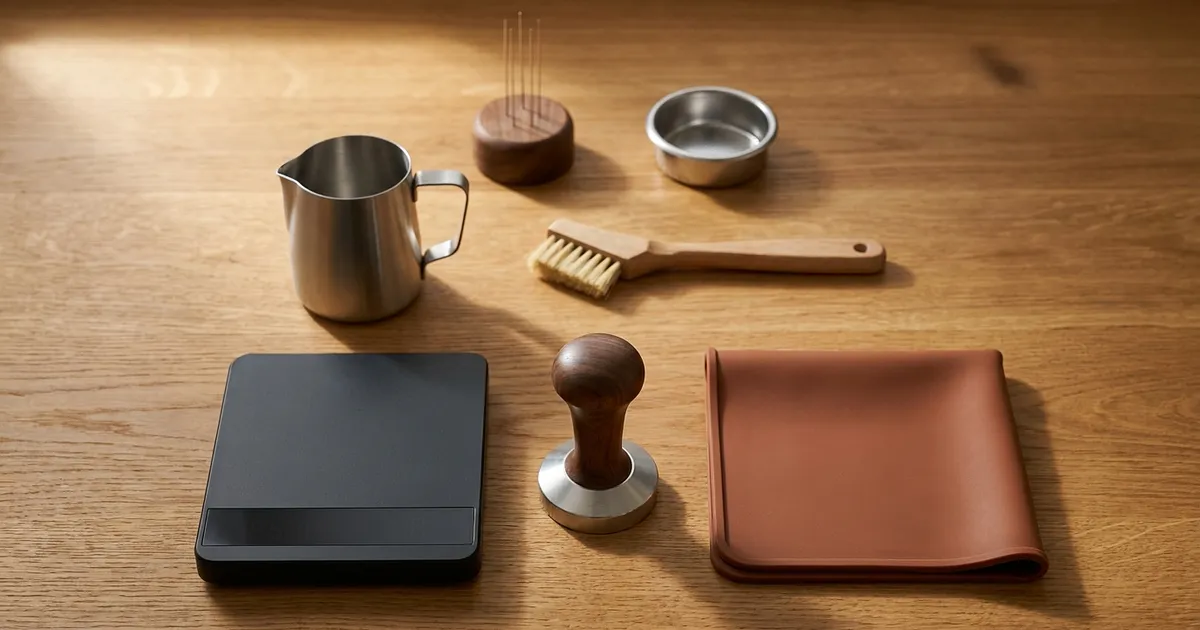
The three barista accessories to buy first
Your beginner barista kit is three pieces. Not more. The Coffee Spirit guide from MaxiCoffee (June 2026) splits espresso into three moments that decide the result: how the grounds are distributed, how they're tamped, and how clean the portafilter is. Your first tier serves those three moments and stops there.
The site Le Barista (May 2026) puts the scale, the pitcher, the brush and the descaler in its entry-level setup too, and holds the WDT tool and the distributor back for advanced builds. Same logic here, with one difference. This guide sequences the accessories on their own, without burying the budget under a machine and a grinder.
The scale that reads to a tenth of a gram
An espresso is a dose of grounds and a yield in the cup. The professional convention documented by Clive Coffee puts a double espresso at 18 to 20 g of grounds for 36 to 40 g in the cup, a 1:2 ratio, in 25 to 30 s. Without a scale you know neither the dose nor the yield, so you're adjusting the grinder blind.
A precision of 0.1 g is enough. Decent Espresso's analysis of James Hoffmann's second pass on coffee scales (March 2026) says it flatly: the hundredth-of-a-gram precision on high-end models is of no use in almost any home setup. What matters more is how fast the display refreshes, and whether it triggers falsely when coffee drips on it.
A built-in timer saves you holding a stopwatch in the other hand. Something like the BAGAIL Balance Numérique à Café avec Minuterie, Précision 0.1 g puts the dose in tenths and the shot time on the same screen, which settles the question.
The catch, since there is one: thin platforms cope badly with steam and moisture under the group. A saucer under the scale extends its life a lot.
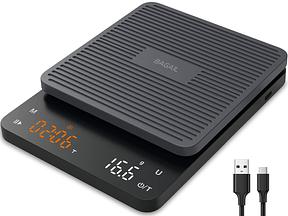
BAGAIL Balance Numérique à Café avec Minuterie, Précision 0.1 g
View at Amazon (as of Aug 10)Affiliate link. Buying through it earns us a commission; the price stays the same for you.
The tamper, and diameter comes before everything else
The beginner reflex is to push hard. Green Plantation lists that among the classic mistakes: past a certain puck density, extra pressure changes nothing about the extraction. Consistency of the gesture counts for more than force, and a calibrated tamper, which stops at a fixed pressure, takes exactly that variable out of the equation.
Diameter, though, is non-negotiable. A tamper that's too small leaves a ring of untamped grounds around the edge of the basket, and water escapes through the ring instead of travelling through the puck. There's a whole section on sizes further down, but the rule fits on one line: the tamper has to match the basket. Not roughly. Exactly.
In 58 mm, a calibrated model like the NEOUZA Tamper à Expresso Calibré 58 mm does the job without anyone needing to argue about how hard to press. Why uneven distribution creates channelling, water carving itself a preferred route through the puck, is the subject of a dedicated tamper and WDT guide.
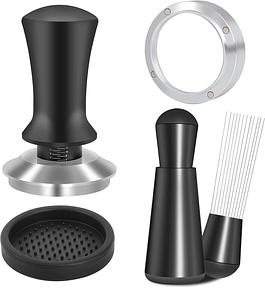
Not available in your region — closest match
View at Amazon (as of Aug 14)Affiliate link. Buying through it earns us a commission; the price stays the same for you.
The tamping mat, cheapest of the three
It changes nothing about your coffee. Genuinely nothing.
What it does is stop you tamping on the edge of the sink. It protects the portafilter spouts, holds everything still while you press, and catches the grounds that fall. A few euros of silicone that keeps you from wrecking a far more expensive portafilter. It's the only accessory here a folded tea towel replaces properly, and the only one nobody regrets buying.
The next tier: milk
If you drink your espressos straight and nothing else, skip this section. It doesn't apply to you. It's for people who steam milk, and that's where the gear starts to matter for real. Bad foam is obvious immediately, whereas a mediocre extraction can go unnoticed for months.
The milk pitcher, sized to what you actually drink
As Coffee Spirit from MaxiCoffee sets out, a 35 cl pitcher covers a single cappuccino, while a one-litre model becomes useful for serving several people or for practising latte art seriously. The working rule from that same source: pick a pitcher two to three times bigger than the cup you're aiming at, because milk roughly doubles in volume as it foams.
For one or two people a day, 35 cl covers it, and 60 cl takes over as soon as there are two drinks back to back. Stainless steel is the default, mostly because it tells your hand where the milk temperature has got to. An insulated pitcher won't.
Over at De'Longhi, the De'Longhi DLSC060 Pichet à Lait 350 ml, Acier Inoxydable matches that solo stainless format, the one that suits you if you're pulling one milk drink at a time.
A pitcher that's too big for your cup is the number one cause of failed foam among beginners. The milk never reaches the depth it needs for the whirlpool to form.
Not available in your region — closest match
View at Amazon (as of Aug 15)Affiliate link. Buying through it earns us a commission; the price stays the same for you.
The clip-on thermometer, useful for about two weeks
Milk works best around 60 to 65 °C according to Le Coin du Barista. Push past that and the texture collapses and the taste turns towards boiled milk.
It gives you that reference point, then becomes useless the day your hand can feel it through the pitcher wall. A learning accessory, not equipment. Buy the cheapest one.
Going further: advanced barista accessories
This tier only makes sense if you already own the first three and your grind is roughly dialled in. Bought too early it adds variables instead of removing them, which is the most common mistake among people who order the whole kit on machine day.
The WDT tool
WDT stands for Weiss Distribution Technique: a handful of fine needles you run through the grounds before tamping, to break up the clumps. The MaxiCoffee guide cited above puts distribution at the head of its three critical moments, ahead of tamping itself. It notes that grounds spread unevenly in the filter produce an uneven extraction.
That's all you need to know to decide whether to buy one. The mechanism, and why fine needles beat a kitchen fork, is the dedicated guide's job.
A Outil WDT 7 Aiguilles pour Distribution du Café fits in a drawer and rinses under the tap. Of everything in this third tier, it's the best value, and the only one whose effect shows on the very first shot.
Not available in your region — closest match
View at Amazon (as of Aug 14)Affiliate link. Buying through it earns us a commission; the price stays the same for you.
The precision filter basket
According to Perfect Daily Grind, precision baskets like IMS or VST correct real faults in standard baskets: holes of irregular size, and an exit area often smaller than the entry area, which held back the water. Between two different precision baskets, however, the same source judges the taste gap small and probably undetectable in a milk drink.
Translated into a buying decision: swapping the stock basket on a consumer machine for a calibrated one makes sense, while upgrading from one precision basket to another makes a lot less. A IMS Big Bang Panier de Filtre de Précision 58 mm, 18-20 g listed at 58 mm for 18-20 g matches the double espresso dose quoted above.
Check two things before ordering. The diameter, again, and the basket's stated dose, which needs to match what you actually pull.
Not available in your region — closest match
View at Amazon (as of Aug 15)Affiliate link. Buying through it earns us a commission; the price stays the same for you.
The bottomless portafilter
No spouts, so the extraction is visible from underneath. It's a diagnostic instrument. If water breaks through one side of the puck, you see it the second it happens, where a conventional portafilter hides everything.
It improves nothing by itself. It shows you what's wrong, which only helps once you can correct it, so after the WDT tool and the basket. And it's specific to your machine, often down to the model, which makes it the easiest accessory to order in the wrong size.
Cleaning, the part everyone skips
Accessory guides treat cleaning like an appliance chore, often on another page entirely. That's a filing error. A gummed-up group head gives you bitter coffee that neither the grind nor the dose will rescue.
The group head brush
After a run of shots, the shower screen holds onto fine grounds that go rancid where they sit. A short-bristled brush with an angled handle gets under there without you dismantling anything. Thirty seconds, machine hot, purge afterwards.
A set like the Brosse de Nettoyage de Tête de Groupe pour Machine à Café Espresso (Lot de 2) lasts years as long as you rinse it after use. Get two. One stays by the machine, the other always ends up disappearing into a drawer.
Not available in your region — closest match
View at Amazon (as of Aug 14)Affiliate link. Buying through it earns us a commission; the price stays the same for you.
Cleaner for the group and portafilter
Coffee oil settles everywhere and goes rancid. A powder cleaner made for espresso, used as a backflush with a blind basket where the machine allows it, and as a soak for the portafilter and baskets, removes what water alone leaves behind.
The Urnex Cafiza Poudre de Nettoyage pour Machine à Expresso, 566 g powder is the most widely stocked option for this job among roasters and specialist retailers. Don't confuse it with descaler. Cleaner goes after coffee oils, while an espresso machine descaler dissolves limescale in the water circuit and the boiler. You need both. They act in different places and neither substitutes for the other.
How often you descale depends on your water hardness and your machine. The manual gives the interval, and it's the only reliable number here. Filtered water spaces descaling out. It doesn't abolish it.
Not available in your region — closest match
View at Amazon (as of Aug 14)Affiliate link. Buying through it earns us a commission; the price stays the same for you.
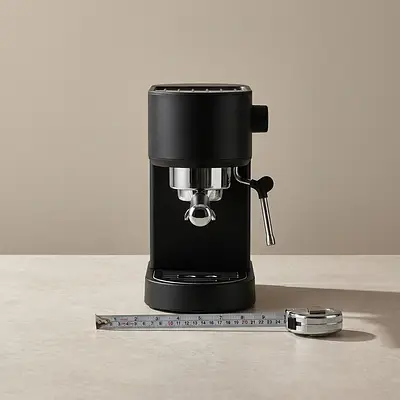
51, 53, 54 or 58 mm: measure before you order
This is the point almost no accessory guide bothers with, and it's the one that turns an order into an unusable accessory.
As the American guide Clive Coffee points out, 58 mm is "the global commercial standard": the machine sitting behind a café counter almost always has a 58 mm group. It's also the diameter where the accessory ecosystem is deepest and cheapest, tampers, distributors, bottomless portafilters, WDT tools and precision baskets included.
Except that a fair share of consumer machines break from it, per that same source: 51 mm on the De'Longhi Dedica, 53 or 54 mm on other ranges depending on the brand. A generic "58 mm" tamper bought for one of those simply doesn't fit.
Depends on diameter: the tamper, the precision basket, the bottomless portafilter, the distributor, the dosing funnel.
Doesn't depend on it: the scale, the milk pitcher, the thermometer, the brush, the cleaner, the tamping mat.
To measure, take the inside diameter of the basket, not the portafilter, which is always wider. On plenty of baskets the number is stamped onto the wall. And if you're torn between two close values, the manufacturer's spec sheet settles it faster than a kitchen ruler.
The buying order, recapped
Here's the order to buy your barista accessories in, from machine day through to the third tier.
| Order | Accessory | What it changes | When to buy it |
|---|---|---|---|
| 1 | 0.1 g scale with timer | Repeatable dose and shot time | Machine day |
| 2 | Calibrated tamper, exact diameter (51, 53, 54 or 58 mm) | Consistent tamping, no argument about force | Machine day |
| 3 | Silicone tamping mat | Protects the worktop and the portafilter spouts | Machine day |
| 4 | 35 cl stainless milk pitcher (or 60 cl) | Milk foam that holds | First milk drink |
| 5 | Group head brush | Fine grounds under the shower screen | First week |
| 6 | Espresso powder cleaner | Coffee oil going rancid in the group | First month |
| 7 | 7-needle WDT tool | Breaks up clumps before tamping | When extraction stays uneven |
| 8 | 58 mm precision basket, 18-20 g | Corrects an imprecise stock basket | After the WDT tool |
| 9 | Bottomless portafilter | Visual diagnosis of channelling | When you want to see the fault |
| 10 | Clip-on thermometer | Milk temperature reference, 60 to 65 °C | Optional, two weeks |
Rows 1 to 3 get ordered together on machine day. The following month, add rows 4 to 6. The third tier waits for a real question, so there's no point ordering it before you've worked out what's going wrong.
The verdict
Three barista accessories take your coffee from random to repeatable: the scale, the tamper in the right diameter, the mat. Everything else fixes a problem you haven't run into yet.
The commonest mistake is ordering the third tier at the same time as the machine. A WDT tool and a precision basket sitting on top of an unadjusted grind compensate for nothing. They add two variables to a setting you haven't found yet. And a thermometer has never once saved bad foam in an oversized pitcher.
If the machine itself isn't bought yet, start there rather than with coffee machine accessories. The grinder and the grind decide the cup long before the tamper does. Our bean-to-cup coffee machine comparison works through that budget by budget, and a separate guide will cover portafilter espresso machines for beginners.
All products from this post
The ones we named above are marked; the rest are alternatives in the same category.
Not available in your region — closest match
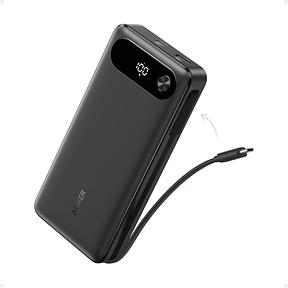
Anker Powerbank, 20.000mAh tragbares Ladegerät mit integriertem USB-C-Kabel, 87W Max Schnellladung, kompatibel mit MacBook, iPhone, Samsung und mehr
View at Amazon (as of Aug 15)
Not available in your region — closest match
Anker Powerbank, 20.000mAh tragbares Ladegerät mit integriertem USB-C-Kabel, 87W Max Schnellladung, kompatibel mit MacBook, iPhone, Samsung und mehr
View at Amazon (as of Aug 15)
Affiliate notice: As an Amazon Associate, we earn from qualifying purchases. Product prices and availability are subject to change.
Frequently Asked Questions
Which barista accessories should you buy first as a beginner?
A scale reading to a tenth of a gram with a built-in timer, a tamper matching your portafilter diameter exactly, and a tamping mat. Those three make your extraction repeatable, which is the condition for dialling in anything afterwards. A milk pitcher follows if you steam milk, then the brush and the powder cleaner. The rest waits until you can name a specific fault.
How do I know whether my tamper should be 51, 53, 54 or 58 mm?
Measure the inside diameter of your portafilter's basket, not the portafilter itself, which is always wider. 58 mm is the standard on professional machines, but several consumer machines use 51, 53 or 54 mm depending on brand and model. The number is sometimes stamped on the basket wall. A tamper that's too small leaves a ring of untamped grounds, and water runs through it.
Do you need a WDT tool as a beginner?
No. A WDT tool breaks up clumps of grounds before tamping and makes distribution more even, but it corrects a fault you can't identify yet while your dose and shot time are still unstable. Buy it at the third tier, once the scale and tamper are in place. After that, it's the best value purchase in that tier.
Will an ordinary kitchen scale do?
Not really. A kitchen scale reads in whole grams and often takes a second to react, which suits flour but not an espresso where 1 g of difference shows up in the cup. A tenth of a gram plus a built-in timer is the useful minimum. Hundredths of a gram, on the other hand, buy you nothing in a home setup.
What size milk pitcher should I choose?
35 cl for a single cappuccino, 60 cl if you're making two drinks back to back, one litre for entertaining or practising latte art seriously. The working rule: a pitcher two to three times bigger than the cup you're aiming at, because milk doubles in volume as it foams. A pitcher that's too big stops the whirlpool forming at all.
Cleaner or descaler, what's the difference?
Powder cleaner goes after the coffee oil deposited in the group, the portafilter and the baskets. Descaler dissolves limescale in the water circuit and the boiler. They act in different places and neither replaces the other. How often you descale depends on your water hardness, and your machine's manual gives the interval.
Does a precision filter basket really change the taste?
It corrects real manufacturing faults in standard baskets, irregular holes and a geometry that restricts water flow. The gain over an imprecise stock basket is clear. Between two different precision baskets, though, the taste gap is small and probably undetectable in a milk drink. Buy it after the WDT tool, not before.
Sources
- Gifam and NielsenIQ-GfK figures presented in February 2026 placesducafe.com
- Createst survey run for De'Longhi in February 2026 monde-epicerie-fine.fr
- Coffee Spirit guide from MaxiCoffee coffee-spirit.maxicoffee.com
- Le Barista lebarista.fr
- Clive Coffee clivecoffee.com
- Decent Espresso's analysis of James Hoffmann's second pass on coffee scales decentespresso.com
- Green Plantation greenplantation.fr
- Coffee Spirit from MaxiCoffee coffee-spirit.maxicoffee.com
- Le Coin du Barista lecoindubarista.fr
- Perfect Daily Grind perfectdailygrind.com
- Clive Coffee clivecoffee.com