Jura Coffee Machine: Is the Price Justified? Serious Alternatives at the Same Budget
 16 min read
Last updated 9 August 2026
Ten Jura models tested, across an advertised price band of €1,000 to €1,600. The verdict fits on one line of the comparison page run by UFC-Que Choisir, the French consumer organisation, updated on 13 January 2026: "machines from other manufacturers rank higher in our test". That's where any argument about the price of a Jura coffee machine has to start, because the sentence comes from a named consumer body, it carries a date, and it's public.
None of which makes the machine bad. It makes first place something you can't buy at the top of the price list.
Where the money goes: the machine
Three things are genuinely different on a Jura, and all three are manufacturer designations rather than independent measurements.
P.E.P. (Pulse Extraction Process) sends water through in pulses instead of one continuous flow, on short coffees. The stated idea is to stretch real contact time without drowning the grind. The variable brewing unit is a single part that adapts to the dose instead of working to a fixed volume. And the grinder changes with the range. Jura runs several systems: Aroma G3 on the mainstream ranges, the Professional Aroma Grinder further up, P.R.G. on the Z10, which adapts its grind depending on whether the drink is hot or cold, plus a twin grinder on the GIGA machines that can grind for two drinks at once. What isn't reliably documented model by model is the burr material. Outside the manufacturer's own spec sheets, the secondary sources contradict each other. If that detail matters to you, ask for the spec sheet of the exact model before you pay.
A word on pressure, because that's the number you'll be sold everywhere else. The bar figure printed on a box is a pump peak. It's a marketing value. Espresso extracts at around 9 bar at the puck, and it's that working pressure, the grind and the dose that decide what lands in the cup. Not one of the three items above can be judged on a pump number.
On manufacturing, the public answer isn't clean. Wikipedia says Jura has outsourced production since the 1990s and that the machines come out of Eugster/Frismag in Romanshorn, Switzerland, the same contract manufacturer used by Siemens, Bosch and AEG. Other pages claim assembly split between Switzerland and Portugal, with nothing verifiable behind it. Jura doesn't publish an assembly location per model. Honest conclusion: you can't check, model by model, what "Swiss" actually covers on that label. Which is itself worth knowing when you're paying a premium for "made in Switzerland".
Where the money goes: the brand
Jura is a private company. It publishes neither its marketing budget nor its R&D spend, and any article that hands you a percentage on that subject made the percentage up.
What we do have is a press figure. Several specialist outlets including Sportskhabri put the 2015 extension deal with Roger Federer, an ambassador since 2006, at roughly $2.3 million a year. Reported by the press, never confirmed by Jura. It doesn't measure the brand's marketing. It gives you an order of magnitude for one line of spending, which isn't the same thing.
Coffeeness, in a comparison updated on 20 July 2024, compares Jura to luxury cars without hedging: once a formal service becomes necessary, the site writes, it can get expensive. The same piece notes that De'Longhi puts the coffee ahead of the looks, precisely in order to hold a lower price.
What it actually costs to run
Here's the sum nobody does on this subject. One warning first: the frequency assumptions below are ours, and they don't come from Jura. Every euro figure in this table is a French-market observation.
| Line item, over 5 years | Amount | Where the number comes from |
|---|---|---|
| Machine, the range UFC-Que Choisir tested | €1,000 to €1,600 | UFC-Que Choisir, the French consumer organisation, updated 13 January 2026 |
| CLARIS Smart+ cartridges, our own assumption of 4 a year | €264.00 | €13.20 per cartridge, our own calculation from the €39.59 three-pack listed at French retailer Boulanger on 9 August 2026 |
| JURA descaler | not stated | the 36-tablet box is €60.00 at Boulanger in France, checked 9 August 2026, but the number of cycles it covers isn't published |
| One full service at an approved centre | €130 to €180 excl. VAT | Café Machine Pro, a French approved service centre |
| Partial total, excluding descaler and excluding coffee | €1,394 to €2,044 | our own calculation |
Look at the descaler row. It's blank on purpose. The box price is verified, but no descaling frequency is published anywhere citable, so handing you "around €40 a year" would be an invention dressed up as data.
And the cartridge row needs a correction, because this is the most stubborn myth on the market: a Jura machine runs without a CLARIS cartridge. The brand's manuals, readable for example on notice-facile, describe entering water hardness by hand, adjustable from 1 to 30 °dH (the German hardness degree, the scale the machine uses), after which the machine schedules its descaling cycles to that setting. The cartridge is recommended above 10 °dH. Recommended. Not mechanically compulsory. So the lock is a soft one, and the €264 on the second row is a choice rather than a tax.
What we couldn't verify: whether skipping the cartridge affects the warranty. No source either way. Get it confirmed in writing before you buy.
Repairability and service: the real ten-year question
The iFixit teardown of the Jura Impressa A9 lands on a mixed verdict, which is more useful than a clean pass or fail.
The good side is real. Standard Torx screws throughout, no glue, no one-way clips. That's a design decision that costs money and points the right way. The bad side is just as real. iFixit found a proprietary oval-head screw hidden behind the logo plate whose only job is to block unauthorised access. The report also notes the absence of official documentation for repairing internal components. Glass-fronted side panels get described as a nuisance even for an approved technician.
Practical translation: the machine comes apart, but it's built to come apart in the hands of the network rather than yours.
In France that network exists, as regional approved centres rather than a Jura shop on every corner. A full service, parts and labour, runs between €130 and €180 excl. VAT at an approved service centre, with a quote issued before any work. Warranty is 25 months on new models, according to that same centre. Both figures describe the French service network, and I wouldn't assume they transfer to another country without checking.
This is where the premium makes its best case. An approved network, parts you can actually get, and a machine that gets repaired instead of replaced. Over ten years, that's worth something concrete.
What we can't tell you
An honest guide has to list its holes too. Here are ours, and they're awkward ones.
Comparative reliability. Stiftung Warentest tests Jura machines regularly, but the quality verdicts sit behind a paywall. No free Swiss or French study, named and dated, on Jura's specific reliability came out of our research. So no, we won't tell you "a Jura lasts longer than a De'Longhi". That data isn't public.
Resale value. Everyone repeats that Jura holds its value second-hand. What actually exists is live listings on the platforms, not a published index. A listing isn't a sale price.
Repair cost fault by fault. The €130 to €180 excl. VAT figure covers a full service. No breakdown by type of fault was found anywhere.
Taste attributable to P.E.P. There's no independent blind test isolating the effect of P.E.P. at identical grind and dose against a machine without it. What exists is the manufacturer's description, and reviewers' impressions.
Those four lines are exactly the ones competing pages fill in with unsourced assertions.
Jura on Amazon: why you'll barely find any
Combing through the bean-to-cup category tree on amazon.fr, .de, .it and .es on 9 August 2026 turned up one genuine Jura listing. Sold by a third-party seller at around €153, a fraction of the retail price of an entry-level model, with a buyer review reporting that Jura France refused warranty cover because the seller isn't an approved reseller.
That's a parallel import, and it's the reason no Jura product is recommended further down this article.
It isn't a catalogue accident either. It's a distribution decision: Jura sells through approved specialist retailers and its own network, not through the marketplace. What that means for you is simple. The real Jura price isn't readable on Amazon. It's readable in the €1,000 to €1,600 band UFC-Que Choisir recorded in January 2026.
Serious alternatives at the same budget
Five machines, all available on amazon.fr, prices and ratings observed on 9 August 2026. Every price below is a French-market observation and prices shift from one Amazon marketplace to the next, so check the figure on your own store before buying. The table says what each one costs; the paragraphs underneath say what each one gives up, because that's the useful part.
| Model | Amazon.fr price, France (9 Aug 2026) | Rating | Reviews | Milk system | What it gives up |
|---|---|---|---|---|---|
| Siemens EQ700 classic TP715E17 | €1,329.00 | 4.4 / 5 | 63 reviews | not stated | buyer hindsight: 63 reviews is thin |
| Siemens EQ.6 plus s700 | €739.50 | 4.4 / 5 | 5,720 reviews | not stated | the screen and interface generation |
| Philips Series 5400 LatteGo EP5441/50 | €607.86 | 4.3 / 5 | 13,834 reviews | LatteGo, named in the model reference | the finish, very plasticky |
| De'Longhi Rivelia EXAM440.35.B | €525.00 | 4.3 / 5 | 376 reviews | not stated | time on the market |
| Melitta Purista F230-102 | €371.59 | 4.0 / 5 | 1,736 reviews | none | milk entirely, it's a single-drink machine |
Siemens EQ700 classic TP715E17, the only real price comparison
This is the machine to put opposite a Jura, because it's the only one on this list playing in the price band UFC-Que Choisir tested, at €1,329.00 on Amazon.fr in France on 9 August 2026.
One warning before you click. It carries just 63 reviews on amazon.fr, for a 4.4 out of 5 rating. An average over 63 reviews isn't a consensus. It's a sample. That's true across the high end of this category, where review volumes stay thin because buyers often go through specialist retailers instead. It's still a weakness in the data, not a virtue.
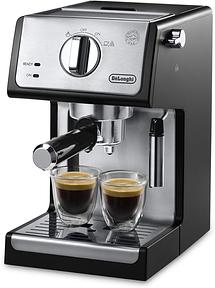
Not available in your region — closest match
View at Amazon (as of Aug 14)Affiliate link. Buying through it earns us a commission; the price stays the same for you.
Siemens EQ.6 plus s700, the same manufacturer for €590 less
€739.50 on 9 August 2026, against €1,329.00 for the EQ700 classic. Same manufacturer, same family of bean-to-cup machines, €589.50 apart. That gap is our own calculation from the two French-market prices observed on the same day.
What you give up is generational. The EQ.6 plus is an older model, with the screen and ergonomics of its era. In exchange it carries 5,720 reviews at 4.4 out of 5, which is a completely different level of hindsight than its big sister's 63. If coffee interests you more than the interface, the price gap is hard to justify in the other direction.
Not available in your region — closest match
View at Amazon (as of Aug 14)Affiliate link. Buying through it earns us a commission; the price stays the same for you.
Philips Series 5400 LatteGo EP5441/50, the biggest review count here
Across 13,834 reviews, the Philips Series 5400 LatteGo sits at 4.3 out of 5, at €607.86 on 9 August 2026 in France. That's by far the widest sample in this selection, and it's what makes it interesting. At that number, an average finally means something.
LatteGo is named in the product reference. It's Philips' own milk system, two parts, no tube. What you give up here is visible and tactile: the finish is very plasticky, and next to a Jura front panel you notice immediately. If the object matters as much as the cup, that's a genuine criterion.
Not available in your region — closest match
View at Amazon (as of Aug 14)Affiliate link. Buying through it earns us a commission; the price stays the same for you.
De'Longhi Rivelia EXAM440.35.B, the cheapest machine here with a screen
€525.00 on 9 August 2026, 4.3 out of 5, but across 376 reviews only. Same remark as for the EQ700 classic: the rating is good, the sample is short, and the Rivelia is a recent model that hasn't accumulated much hindsight yet.
It's the machine most comparisons put head to head against a Jura E8. The bet is a young model with no reliability history, against a brand with an approved network but no public reliability data either. Nobody wins that argument, which is information in itself.
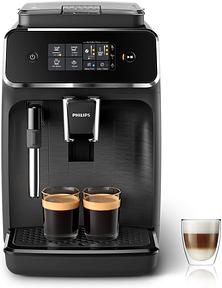
Not available in your region — closest match
Philips Série 2200 EP2220/10 - Expresso Broyeur avec Mousseur à Lait, Écran Tactile
View at Amazon (as of Aug 10)Affiliate link. Buying through it earns us a commission; the price stays the same for you.
Melitta Purista F230-102, the one that owns up to removing everything
At €371.59 on 9 August 2026, the Melitta Purista F230-102 carries the lowest rating in this selection, 4.0 out of 5 across 1,736 reviews. It's also the most honest machine here about what it is.
No milk system. No cappuccino, no latte macchiato, nothing. The Purista makes black coffee and short drinks, full stop. If nobody in your house drinks milk-based coffee, almost the whole budget of a Jura goes into functions you'll never touch. If someone does, this machine is beside the point.
For the whole category budget by budget, the criteria are set out in this guide to bean-to-cup coffee machines.
Not available in your region — closest match
View at Amazon (as of Aug 14)Affiliate link. Buying through it earns us a commission; the price stays the same for you.
Justified when, not justified when
The Jura premium holds up in these cases:
you pull several cups a day, every day, and the machine genuinely works for a living;
your household mostly drinks milk-based coffee, so the milk system earns its keep daily rather than once a month;
you want a machine the approved network repairs for ten years, and a €130 to €180 excl. VAT service reads as normal to you rather than shocking;
the object itself matters. The glass, the front panel, the finish. That's a legitimate reason, as long as you name it for what it is.
It doesn't hold up if:
your goal is the best cup per euro spent, because the only dated independent French test we found puts other brands ahead;
you drink black coffee only. A single-drink machine under €400 does the job there;
you're counting on resale to soften the cost. The residual value may well exist, but no published study measures it.
The worst purchase is a €1,300 Jura for two coffees a day in a house where nobody drinks milk. The best is the same machine in the hands of someone pulling eight and planning to keep it a decade. Same price, same machine, opposite verdicts. So the question isn't "Jura or not". It's how many cups, what kind, and for how many years.
Further reading
Next check scheduled on this page: the UFC-Que Choisir price band and the five amazon.fr prices. The descaler line stays marked not stated until a citable frequency turns up.
On the same subject, you can carry on with the full selection, budget by budget. Also coming: a De'Longhi Magnifica Evo review, a guide to machines under €500, a look at where French prices stand, and a Krups against De'Longhi comparison.
Prices observed on 9 August 2026 on amazon.fr and boulanger.com, both French-market sources, and they change often, so check the product page before buying. Novebar does not test machines in-house; every verdict quoted here points back to its named, dated source.
All products from this post
The ones we named above are marked; the rest are alternatives in the same category.
Not available in your region — closest match
Philips Série 2200 EP2220/10 - Expresso Broyeur avec Mousseur à Lait, Écran Tactile
View at Amazon (as of Aug 10)
Affiliate notice: As an Amazon Associate, we earn from qualifying purchases. Product prices and availability are subject to change.
Frequently Asked Questions
Why are Jura coffee machines so expensive?
Part of the price pays for real engineering. Pulsed P.E.P. extraction, a variable brewing unit, and grinders that change with the range. Another part pays for the brand, the finish and heavy marketing, including the Roger Federer partnership the press puts at roughly $2.3 million a year, never confirmed by Jura. According to the French consumer organisation UFC-Que Choisir, updated 13 January 2026, that premium doesn't buy first place in the test.
Will a Jura coffee machine work without a CLARIS cartridge?
Yes. Jura's manuals describe entering water hardness by hand, from 1 to 30 °dH, after which the machine schedules its own descaling to that setting. The cartridge is recommended above 10 °dH, not mechanically compulsory. The trade-off is more frequent descaling. One point we couldn't resolve for lack of any source: whether skipping the cartridge affects the warranty. Get that confirmed in writing by your retailer first.
How much does a Jura service cost in France?
Between €130 and €180 excluding VAT at an approved service centre, parts and labour included, with a quote before any work, according to prices published by Café Machine Pro. That same centre states a 25-month warranty on new models. Both are French service-network figures. No fault-by-fault price list is published, so the amount covers a full service rather than a specific repair.
Which Jura alternative should I pick under €700?
Three routes, depending on how you drink. Daily milk drinks: the Philips Series 5400 LatteGo at €607.86, with the biggest review count in the category. Tight budget but you want a screen: the De'Longhi Rivelia at €525.00. Black coffee only: the Melitta Purista at €371.59, with no milk system at all. All three are French-market prices from Amazon.fr on 9 August 2026, and they move fast.
Is a cheap Jura on Amazon a good deal?
Be careful. Jura is almost absent from the marketplaces, because the brand sells through approved retailers and its own network. A Jura listed well under retail by a third-party seller is very probably a parallel import, and the French approved network can refuse warranty cover on the grounds that the seller isn't approved. The reference price is still the €1,000 to €1,600 band recorded by UFC-Que Choisir.