Manual espresso machine: the 2026 beginner's guide
 16 min read
A manual espresso machine, the kind with a portafilter you lock in by hand, often costs less than a high-end capsule machine. What the box doesn't tell you is where the money actually goes: the grinder, the basket sitting inside that portafilter, and the big number printed on the front, which has nothing to do with the pressure your coffee is really extracted at.
What a manual espresso machine actually is
"Manual" doesn't mean there's no electricity involved. The pump is electric, so is the heater. What's manual are the jobs the machine won't do for you: grinding the coffee to the right fineness, dosing it into the basket, tamping the puck flat before you lock the portafilter into the group head.
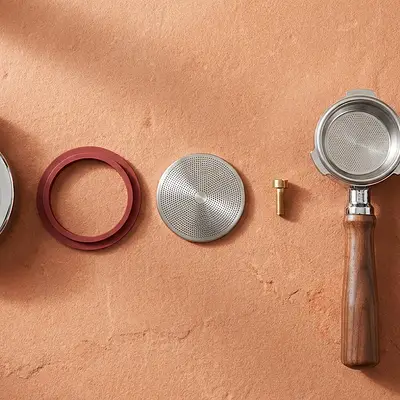
The portafilter is that metal handle with a spout. Inside it sits a basket, a perforated cup that holds the grounds. Standard diameters vary by machine: 51 mm on a De'Longhi Dedica, 54 mm on a Sage the Bambino, 58 mm on machines built to professional proportions. That diameter decides your accessories. A 58 mm tamper will never be any use in a 51 mm portafilter.
Espresso, in this category, is hot water pushed through a bed of tamped coffee for about twenty seconds. Nothing more. Everything else is settings, and settings are exactly where beginners come unstuck.
There's a different product that shares the name and shares almost nothing else: portable "manual" espresso makers, lever or hand-pump, the kind you take hiking. This guide isn't about those. We're staying with countertop machines, plugged into the wall, with a standard portafilter.
Portafilter, bean-to-cup or capsule: which one suits you
Three families fight over the same stretch of worktop, and they don't answer the same question.
| Machine type | Who controls grind, dose and tamp | Time per cup | Who it suits |
|---|---|---|---|
| Manual espresso machine (portafilter) | You, every single cup | 3 to 5 min at first, less later | Anyone who wants to dial in their own extraction |
| Bean-to-cup (automatic, grinder built in) | The machine | Under 1 min | Anyone who wants a decent cup without thinking about it |
| Capsule machine | Whoever made the capsule | Under 1 min | Anyone who wants no settings at all |
Put another way: the portafilter hands you control over the things that matter, and it hands you the ability to ruin every cup. Those two come as a pair. If weighing 18 g of coffee at 7 a.m. already sounds grim, you'll be happier with a bean-to-cup. No shame in that, just a different use case.
Torn between the two worlds? That's a separate question, and it's covered in the bean-to-cup machine comparison, which handles the automatic route properly. This guide stays on the portafilter.
The 15 bar on the box: what the number really means
Here's the part product pages prefer to skate over.
The bar figure on the packaging describes the maximum pressure the pump can produce, measured with no water flowing. It is not the pressure that reaches your coffee. According to Clive Coffee, home machines use an over-pressure valve (OPV) that brings group-head pressure back to 9 bar, whatever peak the pump is rated for.
This isn't forum theory. The official spec sheet for the Breville Barista Express says it in as many words: "15 bar Italian pump" alongside "9 bar extraction". Same story at another manufacturer. The official product page from Gaggia North America lists "9 bar OPV calibration (15 bar Italian Ulka pump)". Two makers, the same distinction, written by them.
So when an ad sets "15 bar" against "20 bar", it's comparing two pump peaks that neither machine applies to coffee. About as useful as choosing a car by the top number on the speedometer.
An aside, since the figure turns up everywhere: the Specialty Coffee Association does maintain a standard for espresso machines, SCA-350, listed on its Standards page. The full text is members-only. The numbers that circulate everywhere (9 ± 1 bar, 20 to 30 s, around 93 °C) come from secondary sources citing it rather than from the primary document, and I'd rather tell you that than present them as verified here.
What to take from this: on a manual espresso machine, a big pump number doesn't make the espresso better. It doesn't do anything at all. Look at the basket, the grinder and temperature stability instead.
The beginner trap: pressurized or non-pressurized basket
Most entry-level manual espresso machines ship with two baskets. They look almost identical and they make very different coffee. Nobody points this out while you're unboxing.
The non-pressurized basket (single wall) is a sieve: a hundred-odd holes, and the coffee puck itself creates all the resistance. If your grind is uneven or your tamp goes in crooked, water finds a preferred channel and the result is bad straight away.
The pressurized basket (dual wall) adds a small chamber and one calibrated orifice behind the holes. Per Breville, this basket creates back-pressure that compensates for an imperfect grind or tamp, at the cost of an espresso with less body than a non-pressurized basket gives.
Plain version: the pressurized basket is a fudge. Useful, honest about what it's doing, but a fudge. It produces handsome crema even from supermarket pre-ground, and that's also why so many people find their first machine "disappointing compared to the café" without ever working out why.
How do you tell which one is in your portafilter? Turn the basket over. One small hole in the centre of the underside means pressurized. An even grid of fine holes across the whole surface is single wall.
Starting out, run pressurized for a few weeks, learn the moves, then switch to non-pressurized the day you own a real grinder. Not before. Without a decent grinder, the single-wall basket will only give you failed shots.
The grinder decides the cup, not the machine
If you keep one line from this guide, keep this one.
As Clive Coffee puts it, a mid-range machine paired with an excellent grinder will produce far better cups than a high-end machine paired with a mediocre grinder. A French comparison site, familycoffee.fr, makes the same point from the other end: the grinder is what lets a portafilter machine reach its potential at all.
Why? Because espresso needs a fine grind and, above all, an even one. A blade grinder doesn't grind, it chops: you get a mix of dust and boulders. Water runs past the boulders without extracting them, then over-extracts the dust. The cup comes out bitter and sour at the same time, which makes no sense until you know where it's coming from.
A burr grinder crushes the bean between two surfaces at an adjustable gap. The output is sized. It's the only category of tool that counts here, and the serious entry point sits around €180.
The Baratza Encore ESP is a useful reference for what that buys you: 40 mm conical steel burrs, 40 adjustment steps with 20 of them inside the espresso range, roughly 20 microns per step, per the retailer's spec sheet. On Amazon.fr it's listed at €179.90 with a 4.4 out of 5 rating from 169 reviews (updated 8 Aug 2026).
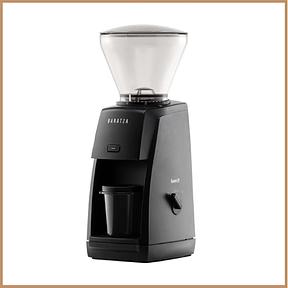
Baratza Encore ESP Moulin à Café à Meules Coniques
View at Amazon (as of Aug 11)Affiliate link. Buying through it earns us a commission; the price stays the same for you.
Compared: four manual espresso machines to start on
Prices and ratings below were read on Amazon.fr on 8 Aug 2026 and they move fast. Prices also vary from one Amazon marketplace to the next, and the figures here are the French storefront's, in euros; no verified pound or dollar figure exists for these listings, so none is given. Specifications are manufacturer figures, never measurements made here.
Look at the two pressure columns. Of the four models, exactly one states a pump pressure and none states its extraction pressure. That's the problem described above, in table form: the trade publishes the marketing number and stays quiet about the one that decides the cup.
| Model | Price (8 Aug 2026) | Amazon.fr rating | Stated pump pressure | Stated extraction pressure | Portafilter | Built-in grinder |
|---|---|---|---|---|---|---|
| Cecotec Cafelizzia Steel | €89.90 | 4.3 out of 5 (418 reviews) | not stated | not stated | not stated | no |
| Sage the Bambino | €127.00 | 4.3 out of 5 (364 reviews) | not stated | not stated | 54 mm | no |
| De'Longhi Dedica Style EC685.W | €139.99 | 4.2 out of 5 (13,264 reviews) | 15 bar (manufacturer figure) | not stated | 51 mm | no |
| De'Longhi La Specialista Arte EC9155.W | €464.74 | 4.2 out of 5 (1,457 reviews) | not stated | not stated | not stated | yes, burr |
The tight budget: Cecotec Cafelizzia Steel
Cheapest way in, at €89.90 with 4.3 out of 5 from 418 reviews (updated 8 Aug 2026, Amazon.fr price). At that money you can try the portafilter routine without committing real-equipment money to it.
My complaint here is documentary rather than technical: the listing states no portafilter diameter, no extraction pressure, no heating type. Hard to know what you're buying, and impossible to predict which accessories will fit it. Check those points on the seller's page before you order.
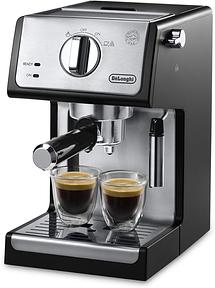
Not available in your region — closest match
View at Amazon (as of Aug 14)Affiliate link. Buying through it earns us a commission; the price stays the same for you.
The most common entry point: De'Longhi Dedica Style EC685.W
13,264 reviews on Amazon.fr, 4.2 out of 5, €139.99 (updated 8 Aug 2026, Amazon.fr price). This is the Dedica that France buys. Very narrow body, 51 mm portafilter, pump rated at 15 bar by the manufacturer, thermoblock heating.
Worth repeating: those 15 bar are a pump peak, exactly as on every other machine in this category. The number has nothing to do with why the Dedica is comfortable to learn on, which comes from its fast heat-up and a pressurized basket that forgives a great deal.
The downside arrives later. 51 mm is less standard than 54 mm or 58 mm, so the choice of baskets and tampers is narrower on the day you want to move on.
Not available in your region — closest match
View at Amazon (as of Aug 14)Affiliate link. Buying through it earns us a commission; the price stays the same for you.
A step up: Sage the Bambino
54 mm portafilter, a diameter far better served by accessories, at €127.00 with 4.3 out of 5 from 364 reviews (updated 8 Aug 2026, Amazon.fr price). That price is low for this model on the French market: check it still holds when you're reading this, and look at who's selling.
This is the machine I'd point someone at who already knows a burr grinder is coming. It was designed around a single-wall basket and a dialled-in grind, not around pre-ground coffee.
Not available in your region — closest match
View at Amazon (as of Aug 14)Affiliate link. Buying through it earns us a commission; the price stays the same for you.
All-in-one with a built-in grinder: De'Longhi La Specialista Arte EC9155.W
At €464.74 with 4.2 out of 5 from 1,457 reviews (updated 8 Aug 2026, Amazon.fr price), it's the only model in this comparison carrying its own burr grinder. The arithmetic is simple: a €139.99 machine plus a €179.90 grinder comes to €319.89, so roughly €145 less, but with two appliances on the worktop instead of one.
What you're paying for is the space saving and the integration. Not better extraction. And a built-in grinder can't be replaced independently of the machine on the day one of the two disappoints you.
Not available in your region — closest match
View at Amazon (as of Aug 14)Affiliate link. Buying through it earns us a commission; the price stays the same for you.
The real budget: machine plus grinder plus accessories
Manual espresso machine round-ups stop at the price of the machine. That's how a beginner buys a handsome €400 appliance and then ruins it with a €25 blade chopper.
Here's the honest arithmetic, built only from the dated prices in this guide.
| Item | Cheapest option | Most common option |
|---|---|---|
| Machine | Cecotec Cafelizzia Steel, €89.90 | De'Longhi Dedica EC685.W, €139.99 |
| Burr grinder | Baratza Encore ESP, €179.90 | Baratza Encore ESP, €179.90 |
| Machine + grinder total | €269.80 | €319.89 |
| Tamper in the right size, gram scale, milk jug | not stated | not stated |
Both totals are our own arithmetic from Amazon.fr prices read on 8 Aug 2026: no retailer advertises that total as a bundle price. The accessories stay at "not stated" because I have no dated price to give you for them, and inventing a round number would be precisely the habit this site is trying to correct. Count them as extra rather than optional. A scale that reads to the gram is what turns a random setting into a repeatable one.
Pulling your first shot: dose, grind, time, ratio
The values below are the parameters the specialty trade cites most often. They come from secondary sources citing SCA-350, whose full text is members-only, so treat them as a starting point and not as anything measured here.
| Parameter | Commonly cited value |
|---|---|
| Extraction pressure | around 9 bar (9 ± 1 bar) |
| Water temperature | 90.5 to 96 °C |
| Dose (double basket) | 16 to 18 g of ground coffee |
| Shot time | 20 to 30 s |
| Coffee-to-drink ratio | about 1:2, so 18 g in for 36 g in the cup |
On a manual espresso machine the method comes down to five moves. You grind fine, right before extraction, never the night before. You weigh the dose into the basket instead of guessing at it. You spread the grounds with a fingertip or a WDT needle tool to break up the clumps, then tamp flat, without leaning on it like a maniac. You lock in and start the pump immediately, because a loaded portafilter sitting in a hot group is already scorching the coffee. And you watch the scale: if your 36 g lands in 12 seconds, the grind is too coarse; if it takes 50 seconds, too fine.
One change at a time. Adjust the grind, pull another shot, write it down. It's repetitive, it's called dialing in, and it takes a few days.
Beginner mistakes that ruin the cup
Channelling. Water tunnels through the puck and comes out of one side of the spout only. Usual cause: uneven grind, clumps, or a crooked tamp. WDT fixes most cases.
Pre-ground coffee. An opened bag loses most of its aroma within days, and its grind is almost never fine enough for espresso.
No scale. Dosing by the spoonful means giving up on ever knowing why a shot was good. Cheapest useful accessory on the list, by a distance.
Changing three settings at once, then wondering which one worked.
Blaming the machine. Nine times out of ten, on a decent entry-level manual espresso machine, the problem is in the grinder or in the puck.
One more, rarer but expensive: forgetting to descale. On hard water a thermoblock scales up quickly and the temperature goes unstable, which makes any setting impossible to hold.
Where to go next
Beginners often pick their manual espresso machine on the bar figure printed across the front. Wrong instinct. Grinder first, a decent machine second, and money held back for a scale.
If the automatic route ends up appealing more than the portafilter, our full guide to bean-to-cup coffee machines covers that ground in detail. And if you're staying with the portafilter, read the prices yourself before you buy: the ones in this guide are dated 8 Aug 2026, and they move from one week to the next.
All products from this post
The ones we named above are marked; the rest are alternatives in the same category.
Affiliate notice: As an Amazon Associate, we earn from qualifying purchases. Product prices and availability are subject to change.
Frequently Asked Questions
How much pressure does good espresso actually need?
About 9 bar at the coffee. The 15 bar or 19 bar printed on the packaging is the peak the pump can hit with no water flowing, not the working pressure. An over-pressure valve, the OPV, brings group-head pressure back to around 9 bar. Two manufacturers, Breville and Gaggia, write that distinction into their own official product pages.
Is a manual espresso machine too complicated for a beginner?
The physical moves take about a week to learn. Grind adjustment takes longer: that's the dialing in, and you should count on a few days of trial before shots come out consistent. With a pressurized basket you get a respectable result on day one. The real learning starts when you move to a single-wall basket.
Do you really need a separate grinder?
Yes, if you want to improve. Grind consistency decides the extraction, and a blade grinder chops the bean instead of sizing it. Specialist retailers suggest budgeting at least as much for the grinder as for the machine. A serious burr grinder starts around €180 on the French market as of August 2026.
Pressurized or non-pressurized basket to start with?
Pressurized at first. The dual wall creates back-pressure that compensates for an imperfect grind or tamp, so it forgives the mistakes of the first few weeks. The trade-off is a cup with less body than a single-wall basket gives. Move to non-pressurized the day you own an adjustable burr grinder, not before.
What should I budget to start with a portafilter machine?
On Amazon.fr prices read on 8 Aug 2026, an entry machine starts at €89.90 and the best-selling model sits at €139.99. Add a burr grinder at €179.90 and you land somewhere between €269.80 and €319.89 for the pair, our own arithmetic. Scale, tamper and milk jug come on top of that.
Manual espresso machine or bean-to-cup?
With a portafilter you control the grind, the dose and the tamp, so you control the result, with the option of wrecking it. A bean-to-cup does those jobs for you in under a minute and hands you a consistent cup with no settings at all. It's a question of use, not of skill level: if you want fast coffee in the morning, the automatic is the right call.