Which Bean-to-Cup Coffee Machine to Choose Based on Cups per Day
 14 min read
Prices and ratings checked on Amazon.fr on 28 September 2026
Two cups. That's how much coffee the average French adult drinks a day, and 81% of them drink it daily, according to an OpinionWay survey for Delta Cafés run in June 2025. So before you ask which bean-to-cup coffee machine to choose, I'd start with a far less exciting question: how many coffees will actually come out of the machine in your home on a normal Tuesday?
Most comparisons sort machines by brand or by how many drinks sit on the menu. France's consumer association UFC-Que Choisir does start from your consumption in its buying guide, and it points out that water tanks and bean hoppers vary "from single to triple" between models (our translation). It even warns that people who like milky drinks or long coffees "will find it tedious to refill the tank every three cups". What it doesn't give you is a number.
For numbers you have to go to the specialists. The sizing guide from AuBonKawa, a French coffee retailer, reckons a 1 L tank covers up to about ten coffees a day, that 25 to 40 coffees need 2.5 L, 40 to 80 need 4 L, and anything beyond that wants a mains water connection. Standard hoppers hold 125, 250 or 350 g of beans, which the same guide puts at roughly 18, 35 or 50 espressos. For households, its ranges line up with those of French retailer Electrodépôt: 1.5 to 1.8 L for one or two people, 2 to 2.3 L for three or four. And for a small office pouring 10 to 20 coffees a day, Coffee-Webstore sets a floor of 250 g of beans and 1.5 L of water. Three sources, three ways of slicing it, but they agree almost perfectly. Here's where they line up.
How many coffees a day, what tank, what hopper?
None of the guides quoted here puts these figures side by side. So here they are, in one table.
| Profile | Coffees per day (rough range) | Recommended water tank | Recommended bean hopper | Hopper yield (AuBonKawa) |
|---|---|---|---|---|
| Living alone | 1 to 4 coffees (our estimate) | 1 to 1.5 L | 125 to 250 g | 125 g ≈ 18 espressos |
| Couple | 4 to 8 coffees (our estimate) | 1.5 to 1.8 L | 250 to 275 g | 250 g ≈ 35 espressos |
| Family (3 to 5 people) | 8 to 15 coffees (our estimate) | 2 to 2.3 L | 250 to 290 g | 250 g ≈ 35 espressos |
| Small office | 10 to 20 coffees (Coffee-Webstore) | 1.5 L minimum | 250 g minimum | 350 g ≈ 50 espressos |
| Busy office | 25 to 40 coffees (AuBonKawa) | 2.5 L | 350 g or more | 350 g ≈ 50 espressos |
| Heavy use | 40 to 80 coffees (AuBonKawa) | 4 L | 1,000 g | 1,000 g ≈ 140 espressos |
| Very high volume | over 80 coffees (AuBonKawa) | mains water connection | not stated | not stated |
Tank and hopper sizes for the household rows come from the AuBonKawa and Electrodépôt ranges above. The "coffees per day" column for households is our own arithmetic, though: 2 cups per person on average according to OpinionWay, plus some headroom for heavy drinkers and Sunday guests.
You'll probably spot a gap that needs explaining. AuBonKawa gets 35 espressos out of a 250 g hopper, while Electrodépôt only claims 15 to 20 "regular coffees". It comes down to the dose. A single espresso uses around 7 g of ground coffee and a double goes up to 14 g, as Electrodépôt and French roaster Les Torréfacteurs both explain. If you drink doubles, halve the yield.
A quick health aside, because that question tends to turn up in the same search. The EFSA considers up to 400 mg of caffeine a day safe for a healthy adult, and advises staying under 200 mg during pregnancy. This table is for sizing a machine. It isn't a nudge toward a fifth cup.
The six machines in this selection, in numbers
| Model | Aimed at | Water tank | Bean hopper | Amazon.fr price (28/09/2026) | Amazon.fr rating (28/09/2026) |
|---|---|---|---|---|---|
| Philips EP2220/10 Series 2200 | Living alone | 1.8 L (manufacturer figure) | 275 g (manufacturer figure) | €283.54 | 4.6/5 (349 reviews) |
| De'Longhi Magnifica S Smart ECAM230.13.B | Couple | 1.8 L (manufacturer figure) | 250 g (manufacturer figure) | €389.99 | 4.4/5 (1,768 reviews) |
| Philips Series 5400 LatteGo | Couple, milk drinks | not verified | not verified | €539.99 | 4.2/5 (11,942 reviews) |
| Krups Evidence EA891D10 | Family | 2.3 L (manufacturer figure) | 250 g (manufacturer figure) | €491.76 | 4.0/5 (543 reviews) |
| Siemens EQ.6 plus s500 TE655203RW | Family, premium | not verified | not verified | €651.07 | 4.2/5 (818 reviews) |
| De'Longhi Magnifica Start | Small office | not verified | not verified | €429.00 | 4.1/5 (963 reviews) |
"Not verified" means I don't have a reliable source for that figure, not that the manufacturer doesn't publish one. If capacity is your main criterion, it's worth checking the product page before you buy.
Which bean-to-cup coffee machine should you choose if you live alone?
An entry-level machine will do the job. AuBonKawa considers a 1 L tank fine for up to about ten coffees a day, and you probably drink a third of that. Your money is better spent on the grinder than on milk recipes.
The real trap when you live alone is an oversized bean hopper. Sounds backwards, right? Bigger should mean handier. Yet AuBonKawa warns that beans used too slowly lose their aroma, even behind the hopper's protective lid. At two espressos a day, a 250 g hopper filled to the brim (about 35 espressos by AuBonKawa's count) lasts a little over two weeks, by my own math. That's a long time for roasted coffee to sit waiting in a machine.
My rule is simple. Never fill the hopper with more than a week's worth.
Fanny, a bean-to-cup specialist at Coffee Spirit (MaxiCoffee), points the same way: when it's just you, there's no point paying for features you won't use. She keeps the more advanced machines for people who love milk drinks.
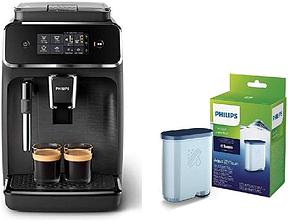
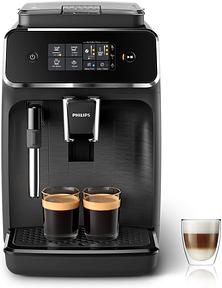
In this selection, the Philips EP2220/10 Série 2200 fits this profile best, at €283.54 on Amazon.fr on 28 September 2026 and rated 4.6/5 from 349 reviews. Philips lists a 1.8 L tank and a 275 g hopper for the Series 2200, per the maker's spec sheet. That's more than you need, and honestly it's not a flaw as long as you don't fill the hopper to the top. If kitchen space is really tight, the Jura ENA 8 goes down to 1.1 L and 125 g according to Jura, though it isn't part of this selection.
Affiliate link. Buying through it earns us a commission; the price stays the same for you.
Which bean-to-cup coffee machine should a couple choose?
What really separates the models for a couple, I think, isn't the tank. It's milk. Two people usually means 4 to 8 coffees a day depending on your habits, and a 1.5 to 1.8 L tank with a 250 g hopper save you from refilling every morning.
If you both drink espresso, pretty much any decent machine will be fine. If one of you starts the day with a cappuccino, that person gets to pick the machine. Fanny at Coffee Spirit puts it bluntly: "If you love milk drinks, you should rather look at the upgradeable machines" (our translation, Coffee Spirit calls that tier "Évolutives").
De'Longhi Magnifica S: the simple pick for two
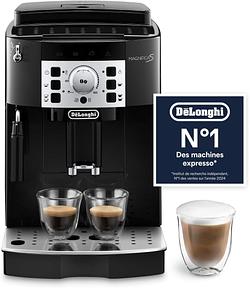
The De'Longhi Magnifica S Smart ECAM230.13.B - Machine à café à grain ticks both capacity boxes for a couple, with a 1.8 L tank and a 250 g hopper according to De'Longhi's spec sheet. It costs €389.99 on Amazon.fr on 28 September 2026 and holds 4.4/5 from 1,768 reviews. Milk is frothed by hand with the steam wand, which takes a bit of wrist work but won't bother two espresso drinkers.
For a couple who mostly drink black coffee, I don't see a reason to go higher.
Not available in your region — closest match
De'Longhi Magnifica S ECAM22.110.B
View at Amazon (as of Aug 11)Affiliate link. Buying through it earns us a commission; the price stays the same for you.
Philips Series 5400 LatteGo: when one of you lives on cappuccino
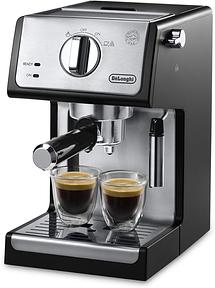
The Philips Série 5400 LatteGo EP5441/50 covers the other case, where milk comes first. The LatteGo system makes the froth without you holding a jug under a wand. It costs €539.99 on Amazon.fr on 28 September 2026, which is €150 more than the Magnifica S (a gap I worked out myself), and it's by far the most reviewed machine in the selection at 4.2/5 from 11,942 reviews.
One honest caveat. I couldn't find a reliable source for its tank and hopper capacity, so I'm not going to make up a figure. Check them on the product page, especially if more than two of you drink coffee at home.
Not available in your region — closest match
View at Amazon (as of Aug 14)Affiliate link. Buying through it earns us a commission; the price stays the same for you.
Which bean-to-cup coffee machine should a family choose?
Saved user profiles probably help a family more than a giant hopper, once everyone has their own drink. On the numbers: with three or more people, aim for a 2 to 2.3 L water tank, and a 250 to 290 g hopper is enough if you're happy to refill it every two or three days.
The tank is where it gets tricky, because 1.8 L looks like a lot on a spec sheet. French parenting site Foodies & Family treats 1.7 to 1.8 L as the bare minimum for a big family, not as a comfortable size. Add the teenagers' weekend lattes and a couple-sized tank empties fast.
Philippe, the other expert at Coffee Spirit, steers households that want per-person settings towards the top of the range: "what you need is a Premium coffee machine" (our translation). I'd only half follow him. Profiles are nice. But a family refilling the water three times a day will be more annoyed by the tank than delighted by the touchscreen.
Krups Evidence: large capacity without the premium price
The Krups Evidence EA891D10 is the large capacity bean-to-cup coffee machine of this selection, with a 2.3 L tank and a 250 g hopper according to Krups. It costs €491.76 on Amazon.fr on 28 September 2026.
Two reservations, though. Its rating of 4.0/5 from 543 reviews is the lowest of the six. And its hopper is no bigger than the Magnifica S's, so it's the tank that grows, not the bean supply. At 12 coffees a day, the 35 espressos in a 250 g hopper (AuBonKawa's figure) last about three days, if I do the math.
Not available in your region — closest match
Philips Série 2200 EP2220/10 - Expresso Broyeur avec Mousseur à Lait, Écran Tactile
View at Amazon (as of Aug 10)Affiliate link. Buying through it earns us a commission; the price stays the same for you.
Siemens EQ.6 plus s500: the premium option
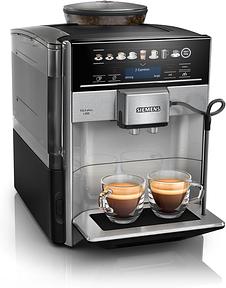
The Siemens EQ.6 plus s500 TE655203RW is the most expensive machine here, at €651.07 on Amazon.fr on 28 September 2026 and rated 4.2/5 from 818 reviews. It's the one that best matches Philippe's "Premium" argument.
I don't have a sourced figure for its tank or its hopper, so I can't tell you it copes with a busy household better than the Krups. If capacity is your only reason to trade up, the Krups Evidence does that job for €159.31 less (again, my own math).
Siemens EQ.6 plus s500 TE655203RW
View at AmazonAffiliate link. Buying through it earns us a commission; the price stays the same for you.
Bean-to-cup coffee machine for the office: when do you need a different class of machine?
The trap at the office is assuming a domestic bean-to-cup coffee machine will hold up indefinitely. Up to around twenty coffees a day, a bean-to-cup coffee machine for the office can cope if it has at least 1.5 L of water, 250 g of beans and an automatic cleaning programme. Above 25 coffees, AuBonKawa recommends 2.5 L. From 40 upwards you've left home appliances behind.
Coffee-Webstore, in its guide to offices pouring 10 to 20 coffees a day, calls an automatic cleaning programme "essential" whenever nobody is in charge of maintenance (our translation). In an office, nobody is ever in charge of maintenance.
Capacity isn't the whole story, and that's where small businesses tend to get caught out. Coffee Spirit describes its domestic Premium machines as designed for "5 to 10 coffees a day, on average" and for "family use only" (our translation). Refilling more often does nothing about mechanical wear. A case reported by French repair site Grain Expert shows it well: a home machine pulling around ten espressos a day died after 20 months with a clogged brew unit.
Limescale makes everything worse. According to Grain Expert's reliability study covering 31 models, 9 out of 10 repairs sent to after-sales service come down to limescale or poor maintenance, and limescale alone accounts for 38% of breakdowns. The harder the machine works, the more often it needs descaling. Put someone's name on that job. Seriously.
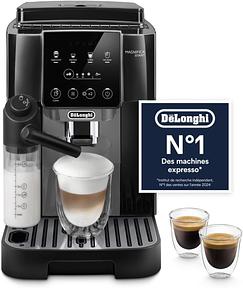
For a small office, the De'Longhi Magnifica Start is one of the models Coffee-Webstore lists for the 10 to 20 coffees a day bracket. It costs €429.00 on Amazon.fr on 28 September 2026 and is rated 4.1/5 from 963 reviews. I haven't verified its exact capacities, so it's worth confirming on the product page that it reaches the 1.5 L and 250 g floor. Above 25 coffees a day I wouldn't pick it, or anything else on this list. You'd need a professional machine, and that's beyond this guide.
Affiliate link. Buying through it earns us a commission; the price stays the same for you.
My verdict, profile by profile
Here's which bean-to-cup coffee machine to choose for each profile, in short. Living alone, go for an entry-level machine like the Philips Series 2200 and keep the hopper half full. As a couple, the Magnifica S is enough, unless one of you lives on cappuccino, and only then is the LatteGo worth its extra €150. For a family, look at the tank before anything else, and the Krups Evidence's 2.3 L is a sensible starting point.
At the office, the Magnifica Start works up to about twenty coffees. After that, change class.
The most useful thing you can do tonight? Jot down your coffees for a week, divide by seven and find your row in the first table. Amazon.fr prices move quickly, so check today's price on the product page for your row before you order.
Want to compare more models? Browse all our bean-to-cup coffee machine buying guides.
All products from this post
The ones we named above are marked; the rest are alternatives in the same category.
Not available in your region — closest match
De'Longhi Magnifica S ECAM22.110.B
View at Amazon (as of Aug 11)
Not available in your region — closest match
Philips Série 2200 EP2220/10 - Expresso Broyeur avec Mousseur à Lait, Écran Tactile
View at Amazon (as of Aug 10)
Affiliate notice: As an Amazon Associate, we earn from qualifying purchases. Product prices and availability are subject to change.
Frequently Asked Questions
How many cups of coffee a day are safe to drink?
The EFSA puts the safe limit at 400 mg of caffeine a day for a healthy adult and advises staying under 200 mg during pregnancy. Caffeine per cup varies with the coffee and the cup size. At an average of 2 cups (OpinionWay for Delta Cafés, June 2025), the typical French drinker is well below that ceiling, but heavy drinkers should keep count.
How many coffees can a bean-to-cup machine make before it needs refilling?
For beans, AuBonKawa counts about 18 espressos from a 125 g hopper, 35 from 250 g and 50 from 350 g. Electrodépôt, which works with stronger regular coffees, quotes 15 to 20 cups per 250 g. For water, it depends on cup size: UFC-Que Choisir notes that fans of long coffees may have to refill the tank every three cups.
Do you need a tougher machine if you drink a lot of coffee every day?
Yes, beyond roughly twenty coffees a day. Coffee Spirit describes its domestic Premium machines as designed for 5 to 10 coffees a day of family use. Grain Expert also links 9 breakdowns out of 10 to limescale or poor maintenance, so the more coffee you pull, the more regularly you need to descale.
What's the best value depending on how many cups you drink a day?
In this selection, checked on Amazon.fr on 28 September 2026: the Philips Series 2200 at €283.54 for one person, the De'Longhi Magnifica S at €389.99 for a couple and the Krups Evidence at €491.76 for a family, with the 2.3 L tank Krups lists. These are listed prices, not test results, so check today's price before buying.
Sources
- OpinionWay survey for Delta Cafés monde-epicerie-fine.fr
- UFC-Que Choisir quechoisir.org
- sizing guide from AuBonKawa aubonkawa.fr
- Electrodépôt electrodepot.fr
- Coffee-Webstore coffee-webstore.com
- Electrodépôt electrodepot.fr
- Les Torréfacteurs lestorrefacteurs.cafe
- EFSA efsa.europa.eu
- Coffee Spirit (MaxiCoffee) coffee-spirit.maxicoffee.com
- Foodies & Family foodiesandfamily.fr
- Grain Expert graindexpert.fr
- Grain Expert's reliability study graindexpert.fr