Brazil coffee tariffs: why Europe feels it too
 5 min read
Prices and figures checked on 3 September 2026
On 6 August 2025, Washington slapped a 50% surcharge on Brazilian coffee. Thirteen months later, those coffee tariffs are gone for green and roasted beans. And yet nobody in Europe has watched their bag of beans get cheaper.
Most of the coverage still ranking for this story is dated August 2025 and was never corrected. So here's the actual sequence, then the only question that matters: does any of it reach your cup?
Coffee tariffs in three dates, and a surcharge that no longer exists
On 6 August 2025, Brazilian coffee entered the United States under a combined 50% rate: 10 points of "reciprocal" tariff plus 40 points of additional surcharge, tied to the prosecution of Jair Bolsonaro.
Then the wind changed. Per KPMG, the 21 November 2025 executive order retroactively dropped the 40 points on green and roasted coffee, with refunds on duties collected since 1 August. That same day the arabica future fell roughly 16 cents a pound, to around $3.60, per Daily Coffee News.
Instant coffee stayed taxed for eight months longer: its 25% surcharge only fell on 16 July 2026, protecting $2 billion to $2.5 billion of annual exports per Reuters. Meanwhile, Global Coffee Report had already recorded a drop of nearly 30% in Brazilian soluble shipments during 2025.
How a US tax reaches your grinder
One thing to settle first: Europe doesn't pay this tariff, a US import duty collected at the US border. Nothing you buy from your local roaster is touched by that order.
But the effect is indirect: it runs through the world market.
From August 2025, a good number of American roasters cut or cancelled Brazilian orders and ran their stocks down while waiting for a trade deal, per a wire report carried by Boursorama. Brazil redirected volume toward Europe and China: buying competition shifts, benchmark prices move, and European roasters' supply contracts get renegotiated against those benchmarks, usually months later.
As analyst Laleska Moda (Hedgepoint Global Markets) put it in Cultivar Magazine, a 50% tax on a bean the US can't grow at home mostly changes how much gets bought, rather than the price tag itself.
What it does and doesn't do to your coffee budget
Here's where I'd rather stop than guess. No source found for this piece puts a number on the tariff's own effect on a European retail price. Not a roaster, not an institute, not the trade press. Writing "your kilo went up X% because of this tax" would be an invention, and honestly, that's the sort of line that makes a whole article untrustworthy.
What can be said: the pressure hasn't gone away. Even after the tariff relief, Brazil exported around 20.8 million 60 kg bags between January and July 2026 (down 12.2% year on year), for about $7.5 billion in revenue (down 16.3%), according to IndexBox.
And the increase you've been paying for two years has a bigger, separate cause: weather, the Brazilian and Vietnamese harvests, and supply contracts renewing at higher futures prices. That's the story in why your kilo of coffee beans stays expensive in 2026 and in arabica at a seven-month high. Two distinct causes stacking up, not one story told twice.
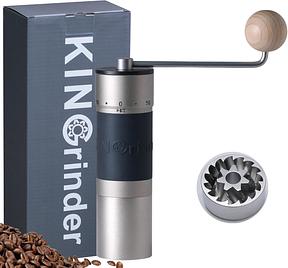
Besides, if beans are pricier, the grind is where you waste them fastest. An adjustable conical burr grinder gives a steadier dose than a blade one, for the cheapest change you can make. The KINGrinder K6 runs around €99 on Amazon.fr (price checked 3 September 2026).
Affiliate link. Buying through it earns us a commission; the price stays the same for you.
What about the machine?
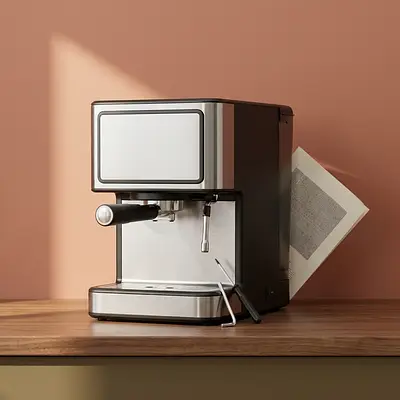
No point watching for a discount here: a bean-to-cup machine's price has no tie to green coffee's, two separate markets entirely. The KRUPS Harmony sits at roughly €269.99 on Amazon.fr (price checked 3 September 2026). Pump pressure aside, espresso still extracts at around 9 bar at the puck.
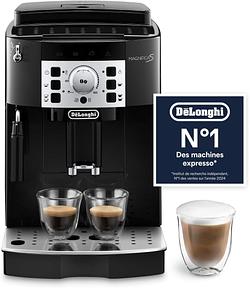
Not available in your region — closest match
De'Longhi Magnifica S ECAM22.110.B
View at Amazon (as of Aug 11)Affiliate link. Buying through it earns us a commission; the price stays the same for you.
All products from this post
The ones we named above are marked; the rest are alternatives in the same category.
Not available in your region — closest match
De'Longhi Magnifica S ECAM22.110.B
View at Amazon (as of Aug 11)Affiliate notice: As an Amazon Associate, we earn from qualifying purchases. Product prices and availability are subject to change.
Frequently Asked Questions
Does the US still tax Brazilian coffee?
No, not since 13 November 2025 for green and roasted coffee (order signed the 21st). Instant coffee stayed taxed longer, exempted only on 16 July 2026.
Why did Washington tax Brazilian coffee in the first place?
The 40-point surcharge (6 August 2025) was tied to the prosecution of former president Jair Bolsonaro, not a coffee trade dispute. The US grows almost no coffee, so it landed on American importers.
Does Europe pay these coffee tariffs?
No. This is a US import duty collected on goods entering the United States, not here. Coffee landing at Le Havre, Antwerp or Hamburg is entirely untouched.
Will coffee get cheaper again?
No source guarantees it. Weather currently weighs more on your shelf price than US trade policy does.
Was instant coffee treated separately?
Yes, and that's the trap in this story: the November 2025 order covered only green and roasted coffee. Soluble kept its surcharge until 16 July 2026. On green and roasted coffee, at least, these coffee tariffs are history now; what's left is the world market.