
Robusta coffee prices: why 2026 hinges on Vietnam
 6 min read
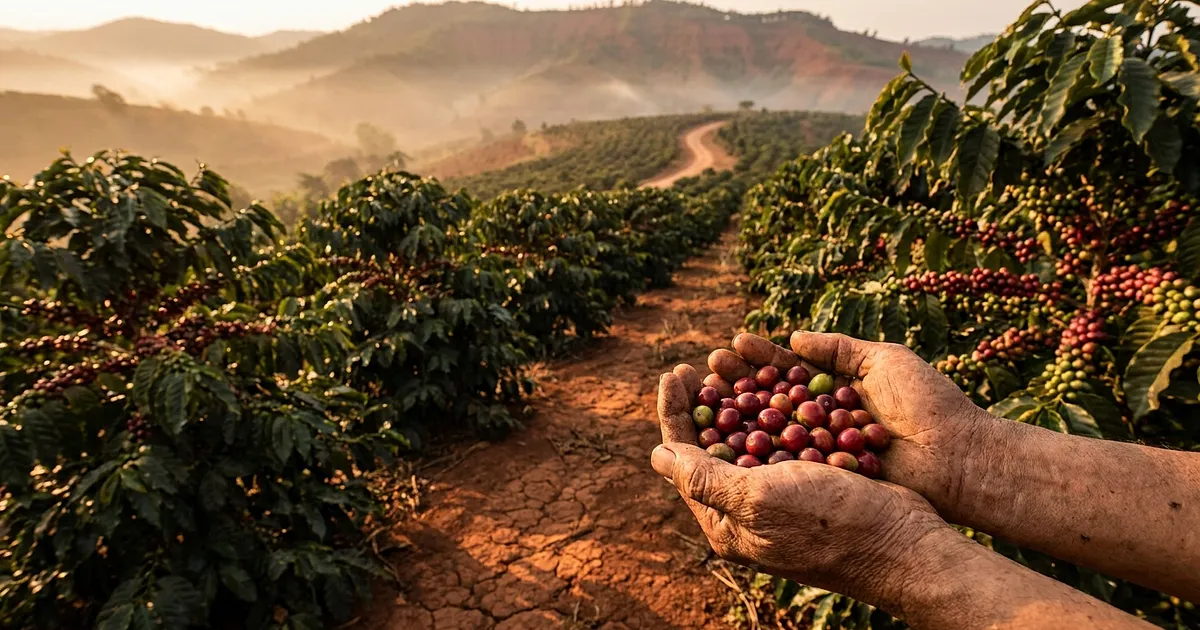
One country decides Robusta coffee prices, more or less on its own. Vietnam supplies around 45% of the world's Robusta harvest, almost all of it from the Central Highlands (Revista Cultivar). When the rain fails in Dak Lak, the number moves in London. As of 17 September 2026, that's exactly what's happening.
Vietnam, at the heart of Robusta coffee prices
Robusta accounts for roughly 95% of Vietnam's coffee production. The USDA's Coffee Annual, published in May 2026, forecasts a 2026/27 Vietnamese crop of 32.5 million 60-kg bags, 31.4 million of them Robusta (USDA FAS). That's an official forecast, not a result, and it was written before anyone had measured how bad the early-year dry spell got.
There's a trap buried in the export figures, though.
Vietnam shipped close to 1.7 million tonnes of coffee in the first eight months of 2026, up more than 10%, for a value down 11.2% (Coffee Geography). Volumes up, prices down. The two lines ran in opposite directions for most of the year, and reading "record exports" as "record prices" is probably the single most common mistake in coverage of this market. I've lost count of how many wire rewrites do it.
Why Robusta coffee prices turned back up
Short version: the market isn't looking at the crop being harvested. It's looking at the next one.
Rainfall has stayed below normal in the Central Highlands since January 2026, and that region carries almost all of Vietnam's supply (BeverageDaily). In early August 2026, Robusta coffee prices touched a multi-week high near $3,884 per tonne on the November contract in London (La Familia Café).
Worth putting that in proportion, because the scary headlines don't. Robusta went above $5,800 a tonne in February 2025, an all-time record, then fell hard through 2026 as Vietnam's bumper harvest reached the market (TradingSat/BFM Bourse). What we're seeing now is a recovery off a low. Not a new peak.
On the farm side, Kaldi Tai, founder of the Coffee Farmer Project, put the shift plainly to BeverageDaily: "Flooding, drought and irregular rainfall no longer feel like 'bad seasons', they are structural risks."
What it actually changes in your cup
Not all coffee is exposed the same way, and this is the bit the business press skips every time.
What takes the hit:
instant coffee, the most Robusta-dependent category there is, to the point where one Nescafé line sold in France is labelled 100% Robusta
capsules, where Robusta supplies body and crema at a lower raw-material cost
Italian-style espresso blends: Lavazza gives Super Crema as 60% Arabica and 40% Robusta, while Rossa leans further toward Robusta still
supermarket pre-ground sold by the kilo with no origin on the bag, which is very often Robusta in disguise
If you drink instant or a capsule in the morning, that's where you'll feel it first.
What barely moves: your single-origin Arabica from a specialty roaster. It didn't contain Robusta yesterday and it won't tomorrow. Its price tracks Brazil, Colombia, Ethiopia and your roaster's margin, not the rain in Dak Lak.
One caveat, because "Robusta equals bad" has become a lazy reflex. Some specialty roasters now build up to 30% fine Robusta into their blends deliberately, for body and crema rather than to save money (Perfect Daily Grind). The word "Robusta" on a bag tells you nothing about the quality of the lot. It tells you which market that bag is exposed to.
Arabica vs Robusta: two stories, two continents
Don't confuse this with the Arabica spike we covered here in late August. They're separate markets. Arabica is decided in Brazil and Colombia on a completely different harvest calendar, while Robusta is decided in Vietnam, where the new crop starts coming in around November. Both climbed, for reasons that have nothing to do with each other. "Coffee is getting more expensive" covers two mechanisms that don't fire at the same time, which is why an Ethiopian single-origin can sit flat while a capsule quietly gains fifteen cents.
And the part nobody mentions when Robusta coffee prices go up: trade press generally puts 12 to 24 months between a futures move and the shelf label, because of forward contracts and inventory (BeverageDaily). What trades in London this week you might pay for in 2027. Or never, honestly, if it rains in October.
Frequently Asked Questions
Why is Vietnam the world's biggest Robusta producer?
The climate and the altitude of the Central Highlands suit Robusta, which is hardier and higher-yielding than Arabica at low elevation. The country concentrated its coffee sector there from the 1990s onwards, to the point that Robusta is about 95% of national output. The result is a country supplying roughly 45% of the world's Robusta harvest. One country, in other words, and that's exactly why one bad season there can move prices everywhere else.
Why are Robusta coffee prices rising in 2026?
Robusta coffee prices aren't reacting to the crop being harvested, which was a big one, but to the next one. Rainfall in the Central Highlands has run below normal since January 2026, with an El Niño developing. The London futures market is pricing in a smaller 2026/27 crop and bidding prices up as a precaution.
Does Robusta contain more caffeine than Arabica?
Yes, roughly twice as much: about 2.2% to 2.7% for Robusta against 1.2% to 1.5% for Arabica. That's part of where its sharper bitterness comes from. It's also why blenders put it in espresso blends, since it brings body, a thicker crema and a shot that holds up in milk.
Which products get hit hardest by a Robusta shortage?
Instant coffee first, since it's the segment most exposed to the coffee shortage running through Robusta. Then capsules and Italian-style espresso blends, which often carry 20% to 40% Robusta for body and crema. Single-origin specialty Arabica is the least exposed, for the simple reason that it contains none at all.
Will the increase show up on the shelf straight away?
No. Trade press generally counts 12 to 24 months between a futures move and the price on the bag, thanks to contracts already signed and stock already bought. A rebound in September 2026 is an early signal, not a price rise for next week.