Descaling a coffee machine: how often, with what, and what it really costs
 10 min read
The short answer. Descaling a coffee machine is not a calendar job. Your machine counts, and what it counts depends on the hardness level you set on it. Out of the box, almost every bean-to-cup machine ships on the hardest setting, so it asks for a descale sooner than it needs to. Second point, and it is the expensive one to ignore: vinegar is named and banned by the manufacturers, warranty included. And the real cost is per treatment, not per bottle, which changes the ranking of the bottles on the shelf.
Why "every three months" is not an answer
Look at the listing for one of the best selling descalers in Europe, durgol swiss espresso. It recommends descaling "regularly and preventively every three months", then in the same breath adds: "follow the machine's instructions first" (Amazon.fr listing, checked 09/08/2026).
That half step back is the honest part. Three months is a commercial average for a bottle sold across a continent. It is not a setting for your machine, in your kitchen, with your water.
What a bean-to-cup machine actually does is count. De'Longhi puts it this way: descaling "is necessary after a preset period of operation which depends on the water hardness setting", and "the machine leaves the factory with the water hardness configured at level 4, the maximum hardness level" (see the De'Longhi FAQ on setting water hardness, French; translation ours).
Philips does the same. The manual for the EP4349/70 bean-to-cup machine states that "the default water hardness setting is 4: hard water" (EP4349/70 manual, PDF, French edition; translation ours).
So a new machine assumes your water is very hard. If it is not, and you have never touched that setting, you have been over-descaling since day one. It is the highest return two minutes you will ever spend on the machine.
An interval with no hardness assumption and no cups per day attached to it is not advice. It is a number.
Water hardness is the variable that decides everything
Hardness is the same physical quantity everywhere. The unit is not.
| Unit | Used in | 1 unit equals |
|---|---|---|
| ppm CaCO₃ (mg/L) | UK, US, most labs | the reference scale |
| gpg (grains per gallon) | US, some UK softener specs | 17.1 mg/L |
| °f (degré français) | France, Italy, Spain | 10 mg/L |
| °dH (deutsche Härte) | Germany, Austria | 17.8 mg/L |
Conversion factors from Water hardness (French Wikipedia).
This matters more than it sounds, because coffee machine documentation is written wherever the machine was designed. A German manual quoting 14 °dH is quoting roughly 250 ppm, and a French one quoting 25 °f is quoting roughly the same water. Copy the number across without converting and you set your machine two notches off.
| ppm CaCO₃ | gpg | °f | °dH | How fast it scales |
|---|---|---|---|---|
| 70 mg/L | 4.1 gpg | 7 °f | 3.9 °dH | very slowly |
| 150 mg/L | 8.8 gpg | 15 °f | 8.4 °dH | slowly |
| 300 mg/L | 17.5 gpg | 30 °f | 16.8 °dH | noticeably |
| 400 mg/L | 23.4 gpg | 40 °f | 22.4 °dH | fast |
Rounding in the table is ours, from the conversion factors above.
Finding yours
Your water supplier publishes hardness for your supply zone, usually on the annual water quality report or a postcode lookup on their site. Failing that, a test strip costs a few euros and answers in a minute, which is plenty when the machine only offers four or five levels anyway. Most machines ship with exactly one strip in the box, the one everybody has lost.
The Bandelettes de test de dureté de l'eau en °fH, 10 pièces emballées individuellement is graduated in °fH, so European readers can set a French or Italian machine without an extra conversion step.
Not available in your region — closest match
View at Amazon (as of Aug 15)Affiliate link. Buying through it earns us a commission; the price stays the same for you.
What your machine is actually asking of you
| Your water | What to set | What follows |
|---|---|---|
| under 150 ppm (15 °f, 8.4 °dH) | a low level on the machine's own scale | the prompt arrives much later than on the factory setting |
| 150 to 300 ppm | a middle level | the common European case |
| over 300 ppm (30 °f, 16.8 °dH) | a high level, often the factory setting | the prompt arrives quickly, and that is correct |
The number of cycles per year does not follow from hardness alone. The counter also counts drinks. Two households on the same hardness setting, one pulling two coffees a day and the other ten, will not see the prompt at the same time. That is exactly why no serious manufacturer publishes an interval in months.
Three practical consequences:
- Set the hardness before you ask how often to descale. The other order makes no sense.
- Do not postpone the prompt. It is not a comfort reminder. It is the output of a counter that has already run.
- On a manual portafilter machine with no counter, you are the counter. A fixed rhythm is defensible there, as long as you write the assumption next to it. Say one descale per quarter for water around 250 ppm and two or three shots a day, shortened if your water is harder or your consumption higher. That is a stated rule of thumb, not a manufacturer figure.
If you are still choosing the machine rather than maintaining it, our bean-to-cup coffee machine comparison covers the other half of the question.
Which product, and why vinegar is a trap
Vinegar comes up in nearly every forum thread. It is also the one product manufacturers name in order to forbid it.
Philips writes, in the manual for its bean-to-cup range:
Only use Philips descaler. Never use a descaler based on sulfuric acid, hydrochloric acid, sulfamic acid or acetic acid (vinegar), as this may damage your machine's water circuit and may not dissolve the limescale properly. Not using Philips descaler voids your warranty.
Philips EP4349/70 manual, "Descaling procedure", official PDF (French edition, translation ours)
De'Longhi says the same thing from the warranty side, in the Magnifica S manual:
It is recommended to use only a De'Longhi descaler. Using an unsuitable descaler, or descaling improperly, can cause faults that are not covered by the manufacturer's warranty.
De'Longhi ECAM22.110.SB manual, PDF (French edition, translation ours)
Two manufacturers, two wordings, one conclusion. Acetic acid attacks parts that the lactic or citric acid in a dedicated descaler leaves alone, and it leaves a smell that several rinse cycles do not always clear. The cheap bottle of vinegar gets very expensive on the day a service centre asks what you ran through the circuit.
On the dedicated side there is the manufacturer route and the universal route. The De'Longhi EcoDecalk Détartrant DLSC500, 5 doses de décalcification, 500 ml is De'Longhi's own, based on plant derived lactic acid, sold as a 500 ml bottle holding five 100 ml doses, which is exactly the dose the brand's manuals describe.
Philips works by whole bottle instead. The manual says to pour "the contents of a complete bottle" into the tank, so with the Philips Saeco CA6700/22 détartrant machine à café à grains, 2 x 250 ml, 2 cycles one 250 ml bottle equals one cycle.
If you have several machines of different brands at home, the durgol swiss espresso détartrant pour machines à café, 2 x 125 ml covers automatic, capsule and pod machines at one 125 ml dose per descale.
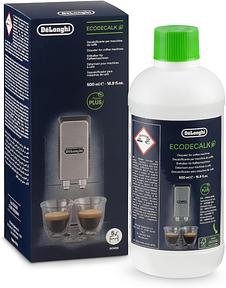
De'Longhi EcoDecalk Détartrant DLSC500, 5 doses de décalcification, 500 ml
View at Amazon (as of Sep 04)Affiliate link. Buying through it earns us a commission; the price stays the same for you.
Not available in your region — closest match
View at Amazon (as of Aug 14)Affiliate link. Buying through it earns us a commission; the price stays the same for you.
Not available in your region — closest match
View at Amazon (as of Aug 15)Affiliate link. Buying through it earns us a commission; the price stays the same for you.
The real cost, per treatment and not per bottle
This is where in-store comparison goes wrong every time. A €7.99 bottle can cost more than an €8.56 bottle, because what matters is how many descales are inside it.
| Product | Volume | Descales stated | Price seen | Cost per descale |
|---|---|---|---|---|
| De'Longhi EcoDecalk DLSC500 | 500 ml | 5 | €8.56 | €1.71 |
| durgol swiss espresso | 2 × 125 ml | 2 | €7.99 | €4.00 |
| Philips CA6700/22 | 2 × 250 ml | 2 | €9.40 | €4.70 |
Prices seen on Amazon.fr on 09/08/2026 and likely to have moved since. The "cost per descale" column is our own arithmetic: pack price divided by the number of doses the manufacturer states, excluding delivery and promotions.
At three cycles a year that is roughly €5.13 against roughly €14.10. On a machine costing €400 to €700, neither figure justifies improvising with vinegar. Both justify reading the dose count before reading the shelf price.
Budget the time too. Philips states around 30 minutes for the full procedure in the manual cited above, descaling cycle and rinse cycle included. It is not something you start five minutes before guests arrive.
A filter moves the frequency, it does not remove the rule
A water filter in the tank lowers the hardness of the water entering the machine and pushes the deadline out. It does not cancel it, and it has a life of its own. Philips says of its AquaClean filter that "after 95 litres of water have passed through the filter, the filter stops working", and asks for replacement "at least every three months" even without a prompt (EP4349/70 manual, cited above). The Philips Saeco AquaClean CA6903/22 filtre à eau anti-calcaire, lot de 2 is the matching cartridge.
Which water to put in the tank, and which cartridge suits which machine, is a separate subject and deserves its own article. Take only this from here: a filter changes the rhythm, never the fact that the machine will need descaling.
Not available in your region — closest match
View at Amazon (as of Aug 15)Affiliate link. Buying through it earns us a commission; the price stays the same for you.
Prices and product details taken from Amazon.fr on 09/08/2026. Amazon pricing moves constantly, so check the displayed price before buying. Manual quotations are translated from the French PDFs linked in the text.
All products from this post
The ones we named above are marked; the rest are alternatives in the same category.
Not available in your region — closest match
Anker Powerbank, 20.000mAh tragbares Ladegerät mit integriertem USB-C-Kabel, 87W Max Schnellladung, kompatibel mit MacBook, iPhone, Samsung und mehr
View at Amazon (as of Aug 15)
Not available in your region — closest match
Anker Powerbank, 20.000mAh tragbares Ladegerät mit integriertem USB-C-Kabel, 87W Max Schnellladung, kompatibel mit MacBook, iPhone, Samsung und mehr
View at Amazon (as of Aug 15)
Not available in your region — closest match
Anker Powerbank, 20.000mAh tragbares Ladegerät mit integriertem USB-C-Kabel, 87W Max Schnellladung, kompatibel mit MacBook, iPhone, Samsung und mehr
View at Amazon (as of Aug 15)Affiliate notice: As an Amazon Associate, we earn from qualifying purchases. Product prices and availability are subject to change.
Frequently Asked Questions
Can you descale a coffee machine with vinegar?
Not if you want to keep the warranty. Philips explicitly bans descalers based on acetic acid, which is vinegar, and states that not using its own product voids the warranty. De'Longhi says an unsuitable descaler can cause faults that the manufacturer's warranty does not cover. Vinegar attacks some internal parts and leaves a persistent taste. The saving is a few euros a year.
How often should you descale a coffee machine?
There is no correct answer in months alone. On an automatic machine an internal counter decides, and that counter depends on the hardness level set on the appliance and on the number of drinks made. Measure your water first, set the right level, then follow the prompt. On a portafilter machine with no counter, pick a rhythm and write down the hardness assumption it rests on.
Why does my machine ask for descaling so often?
Usually because it is still on its factory setting. De'Longhi and Philips both ship machines set to the maximum hardness level, the one that triggers the prompt earliest. If your water is softer than that, measure it and reprogram the level. The prompt will space out with nothing else changed.
What happens if you never descale?
Limescale builds up on the water circuit and the heating element, which degrades brew temperature, cuts flow rate and eventually damages parts. Philips adds that failing to descale the appliance also voids the warranty. So it is a cup problem, a hardware problem and a coverage problem at once.
Does one brand's descaler work in another brand's machine?
Technically, universal descalers are formulated for coffee machines in general, and durgol swiss espresso states so for automatic, capsule and pod machines. But Philips and De'Longhi both tie their warranty to the use of their own product. While the machine is under warranty, the in-house reference is the cautious choice.