Espresso brew ratio: how much ground coffee for how much espresso
 13 min read
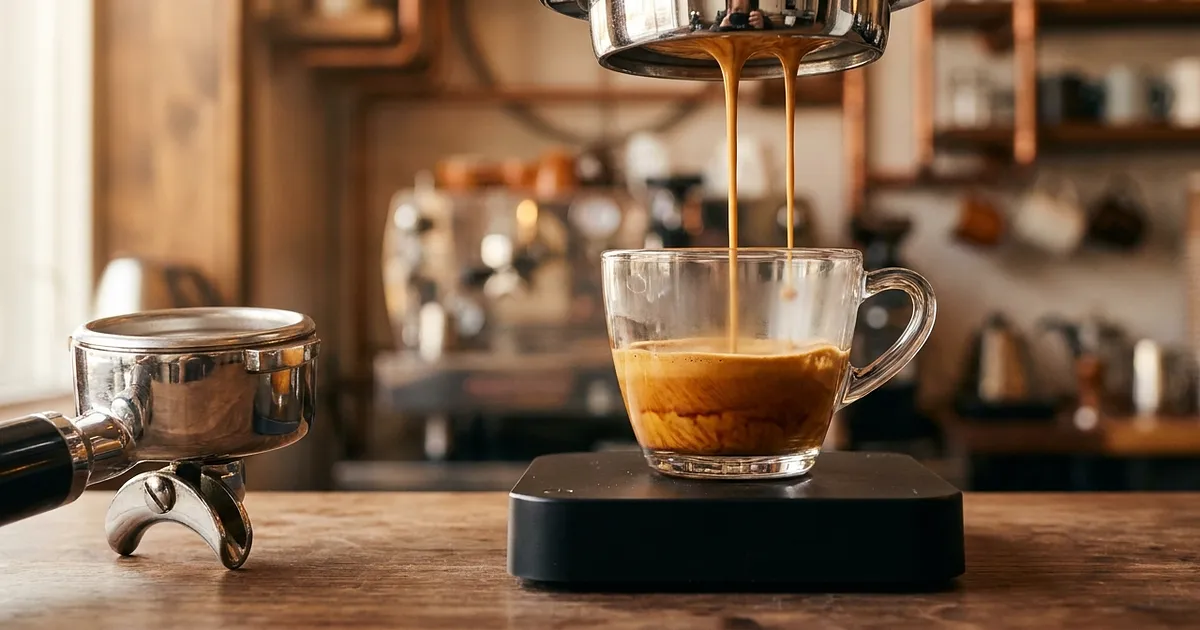
An espresso is two weights and a stopwatch. The weight of ground coffee going into the portafilter,
the weight of liquid landing in the cup, and how long that takes. The relationship between the first
two is the brew ratio — the single most useful number in home espresso, and the one almost every
machine hides behind a "one cup / two cup" button.
This guide covers what the ratio actually describes, why it is measured in grams rather than
millilitres or fluid ounces, and above all why ratio and shot time are two different levers —
the most expensive confusion there is when you start dialling in a machine.
The ratio is just a division
Brew ratio is the relationship between the mass of ground coffee (the dose, going in) and the mass
of beverage you end up with (the yield, coming out).
ratio = liquid mass in the cup ÷ ground coffee mass
18 g of grounds producing 36 g of espresso is a 1:2 ratio. The same 18 g producing 27 g is 1:1.5.
That is arithmetic and nothing more, which is exactly what makes it a dependable reference: it does
not care what brand your machine is, how big your basket is, or which country you drink in.
One vocabulary note, because it turns up everywhere: dose always means the input (dry grounds),
yield always means the output (liquid). When a roaster's recipe card reads "18 / 36 / 28 s", those
are dose, yield and time in that order.
Why you weigh the output and never the volume
This is the part people push back on, and it is the only item here worth changing a habit over: a
cup is not a unit of measurement.
Three reasons, in order of how much they cost you.
Crema is foam. What you see in the cup is liquid plus a layer of emulsified gas. That foam takes
up volume without weighing much, it collapses within a minute or two, and how much of it appears
depends mostly on how recently the beans were roasted. Two shots that are identical by mass can look
like different fill levels thirty seconds apart. Volume lies; a scale does not.
Espresso is not water. One millilitre of water weighs one gram, which makes the conversion
tempting. But espresso carries dissolved solids, so it is denser than water — the millilitre-to-gram
conversion is not neutral, and nobody does it correctly by eye. The same applies to fluid ounces,
with an extra trap: a US fluid ounce is a volume, not the 28.3 g weight ounce, and they are not
interchangeable here.
Cups are not standardised. The "1 oz" line moulded into a shot glass, the assumed capacity of a
demitasse, the mark on a measuring jug — every one of those assumes a geometry that is not yours. A
scale reading to 0.1 g removes the problem entirely.
That is also why the serious standards in this trade rest on measured quantities rather than a fill
line. The "Espresso Italiano Certificato" specification from the Istituto Nazionale Espresso
Italiano describes an Italian espresso with numeric tolerances: 7 g ± 0.5 g of ground coffee, about
25 ml ± 2.5 ml in the cup, a percolation pressure of 9 bar ± 1 bar, water at 88 °C ± 2 °C and a
percolation time of 25 s ± 2.5 s. Note the pressure figure in particular: 9 bar, not the 15 or 19 bar
printed on most pump cartons. That larger number is a pump peak, not the pressure at the puck.
TIMEMORE Black Mirror Basic 2 - Balance à café avec minuteur
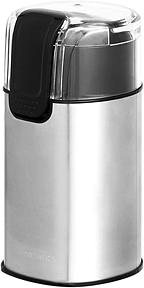
Not available in your region — closest match
View at Amazon (as of Aug 14)Affiliate link. Buying through it earns us a commission; the price stays the same for you.
The three reference ratios
These are the reference points specialty roasters use to describe a recipe. They are usage
conventions, not published standards — no body certifies "the 1:2". That distinction matters,
because half the pages covering this subject present these numbers as an official rule.
| Style | Ratio | From an 18 g dose | From a 14 g dose | What changes in the cup |
|---|---|---|---|---|
| Ristretto | 1:1.5 | 27 g out (≈ 0.95 oz) | 21 g out (≈ 0.74 oz) | Denser, sweeter, acidity forward, thick body |
| Espresso "normale" | 1:2 | 36 g out (≈ 1.3 oz) | 28 g out (≈ 1.0 oz) | The default balance point of most recipes |
| Lungo | 1:3 | 54 g out (≈ 1.9 oz) | 42 g out (≈ 1.5 oz) | More dilute, more potential bitterness, longer finish |
Two useful readings of that table.
A ristretto is not "an espresso that runs for less time". It is an espresso stopped earlier by
mass. If you stop earlier and change nothing else, you pull less material out of the coffee: the
cup is more concentrated but less extracted. That is a taste choice, not a superior version.
A lungo is not an americano. A lungo passes more water through the same puck; an americano is an
espresso with hot water added afterwards. Both end up with a comparable volume in the cup and taste
nothing alike, because the second one extracts nothing further from the coffee.
Ratio and time: two levers, not one
Here is the blind spot in most explanations, and the reason people change three settings at once and
never learn which one moved.
Ratio decides the concentration of the cup: how much water for how much coffee. Shot time
is an indicator of grind fineness and tamping — that is, of how much resistance the puck offers the
water. You do not set the time directly. You set the grind, and the time is what you observe back.
Put plainly:
Want a more concentrated cup? Change the ratio — stop the shot earlier.
Shot running too fast or too slow? Change the grind, not the ratio.
The test that makes the difference obvious: keep the grind exactly where it is and pull two shots,
one stopped at 36 g and one at 54 g. The second ran longer, necessarily — but you never touched the
grinder. Time followed the ratio; it did not cause it. Now go the other way: tighten the grind one
step and stop both shots at 36 g. Same ratio, different time, different cup.
A third quantity turns up in serious discussions: extraction yield, the percentage of the dry
coffee's mass that ends up dissolved in the cup. The Coffee Brewing Control Chart — descended from
E. E. Lockhart's work in the 1950s and still published by the Specialty Coffee Association —
places the target zone between 18 % and 22 % extraction. That chart was built for filter coffee, a
nuance too often dropped, and it remains the most-cited numeric reference in the trade. Measuring it
at home needs a refractometer, which is outside the scope of this guide — but it explains why ratio
alone does not fully describe a cup.
What you actually need to measure it
The list is short, and only one item is genuinely mandatory.
A scale that reads to 0.1 g
This is the tool the whole subject rests on. A normal kitchen scale reads to the whole gram: on an
18 g dose, one gram of imprecision is already over 5 % off, and on a 36 g yield it leaves you
guessing. Look for 0.1 g resolution, enough range to sit a cup and a portafilter on it, and ideally a
built-in timer so you can follow mass and time without looking away from the machine.
On a smaller budget, a pocket precision scale already handles the dose. Check its capacity before buying, though: a model capped at 500 g weighs grounds, not a cup sitting on the drip tray.
Balance de précision de poche 500 g / 0,01 g, écran LCD rétroéclairé
Form factor matters too: the scale has to fit on the drip tray, under the cup, without the
portafilter fouling it. Espresso-specific models are flat and narrow for exactly that reason.
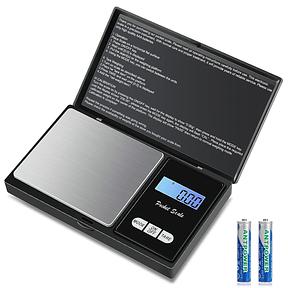
Balance de précision de poche 500 g / 0,01 g, écran LCD rétroéclairé
View at AmazonAffiliate link. Buying through it earns us a commission; the price stays the same for you.
A grinder you can adjust finely
The ratio is weighed, but it only holds if the grind is stable. A burr grinder produces a consistent
and — more importantly — repeatable particle size from one shot to the next; a blade grinder
chops randomly and makes any setting impossible to reproduce. It is the first upgrade that changes
anything in an espresso setup, ahead of the machine itself.
Baratza Encore ESP Moulin à Café à Meules Coniques
Keep the rule in mind: without a consistent grind, your scale is measuring a random result very
precisely.
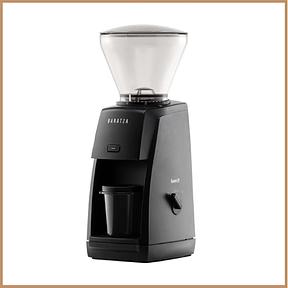
Baratza Encore ESP Moulin à Café à Meules Coniques
View at Amazon (as of Aug 11)Affiliate link. Buying through it earns us a commission; the price stays the same for you.
Something to tamp with
Uneven tamping creates channels through the puck: water runs where resistance is lowest, part of the
bed stays under-extracted, and your ratio becomes a number that no longer describes anything. A
tamper of the right diameter — 51 mm or 58 mm depending on your machine, check yours — and a
consistent motion are enough.
De'Longhi DLSC058, tasseur à café 51 mm en acier inoxydable, manche en bois
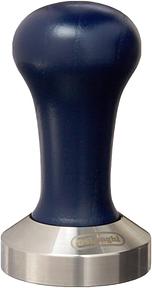
De'Longhi DLSC058, tasseur à café 51 mm en acier inoxydable, manche en bois
View at Amazon (as of Aug 10)Affiliate link. Buying through it earns us a commission; the price stays the same for you.
Dialling in your ratio over three shots
A simple routine, worth running once per new bag of beans.
Shot 1 — set the reference. Weigh the dose (say 18 g), start the shot, stop at 36 g of liquid in
the cup, note the time you got. Taste it. This shot is your zero point whatever it tastes like.
Shot 2 — correct the grind, not the ratio. If shot 1 gushed and tastes sour and hollow, tighten
the grind one step. If it crawled and tastes bitter and harsh, open it one step. Repeat exactly the
same dose and stop at the same output weight: 18 g in, 36 g out. You are now comparing two cups that
differ only by grind.
Shot 3 — adjust the ratio for taste. With the grind holding, finally move the output. Thin or
bitter at the end of the cup? Stop around 30 g instead of 36 g. Too thick, too dominant? Push to
40 g. You are moving along the concentration axis, knowing exactly what you changed.
Write the three numbers down every time — dose, yield, time. Three figures in a notebook beat any
number of half-remembered settings.
What about a bean-to-cup machine?
A fair question, because a super-automatic gives you no portafilter to weigh. You do not control the
dose directly: the machine grinds an amount it decides, usually adjustable on a "mild / strong" scale
with no grams displayed anywhere.
You still have two real handles.
The output is always measurable. Put the cup on your scale under the spout and tare before you
start. The cup-volume setting that nearly every model has then becomes a mass setting: you learn once
and for all what weight your factory "espresso" actually delivers, and you correct it toward the
target you prefer.
The dose can be inferred. Most manufacturers state a grounds-per-cup range in the manual. Treat
the manual figure as a manufacturer estimate rather than a measurement, and compute your approximate
ratio from it. It will be imperfect, but it will tell you whether you have been drinking a 1:2 or a
1:4 without knowing. Plenty of super-automatics ship on a setting considerably longer than 1:2.
De'Longhi Magnifica S ECAM11.112.B - Perfetto Machine à Café Automatique avec Mousseur à Lait Manuel
If you want full control of both weights instead, a portafilter machine is what gives it to you — at
the cost of a manual routine on every cup.
De'Longhi Stilosa EC260.W, machine expresso manuelle à porte-filtre 51 mm
To compare the two families in detail, our
bean-to-cup machine comparison works through the buying
criteria one by one.
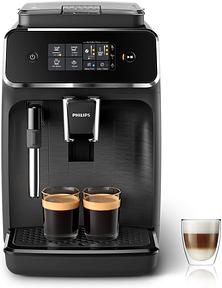
Not available in your region — closest match
Philips Série 2200 EP2220/10 - Expresso Broyeur avec Mousseur à Lait, Écran Tactile
View at Amazon (as of Aug 10)Affiliate link. Buying through it earns us a commission; the price stays the same for you.
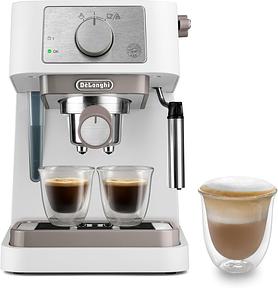
De'Longhi Stilosa EC260.W, machine expresso manuelle à porte-filtre 51 mm
View at AmazonAffiliate link. Buying through it earns us a commission; the price stays the same for you.
The mistakes that corrupt a ratio
Taring with the portafilter still resting on the scale. Tare with the empty cup on the
platform, never before you place anything on it.Counting crema as liquid you can see. It is included in the measured mass, which is correct —
what is wrong is judging the fill level by eye while it is still there.Changing two variables at once. Grind and dose and yield moved together: the result cannot
be interpreted.Borrowing another coffee's ratio. Every bean, every roast profile and every degree of freshness
shifts the balance point. A ratio is a recipe, not a constant.Confusing the displayed time with extraction time. On many machines the counter starts with the
pump, pre-infusion included. Pick a convention and keep it.Reading the carton's 15 or 19 bar as brew pressure. That is a pump peak. The pressure at the
puck targeted by the Italian certification cited above is 9 bar ± 1 bar.
Where to go from here
Ratio is the first setting worth holding steady because it is the only one entirely under your
control and entirely measurable. Grind needs a decent grinder, temperature depends on the machine,
real pressure is rarely displayed — but two weights are something anyone can record.
Start there: weigh the dose, weigh the yield, note the time. Three numbers and a notebook, and most
of the mysteries of home espresso turn into variables you can move one at a time.
All products from this post
The ones we named above are marked; the rest are alternatives in the same category.
Not available in your region — closest match
Amazon Basics Fast Electric Coffee Grinder for Home Use, Easy to Use Coffee Bean and Spice Grinder with Heavy-Duty Stainless Steel Grind Blades
View at Amazon (as of Aug 14)
Not available in your region — closest match
Philips Série 2200 EP2220/10 - Expresso Broyeur avec Mousseur à Lait, Écran Tactile
View at Amazon (as of Aug 10)
Affiliate notice: As an Amazon Associate, we earn from qualifying purchases. Product prices and availability are subject to change.
Frequently Asked Questions
What is the correct espresso brew ratio?
The most widely used convention among specialty roasters is 1:2 — 18 g of ground coffee for 36 g of liquid in the cup. It is not a published standard, it is a starting point. A ristretto sits near 1:1.5 and a lungo near 1:3. The final setting depends on the bean, its roast and your taste.
Should I measure in grams or fluid ounces?
Grams. Crema is foam: it takes up volume without weighing, and it collapses within a minute or two. Espresso is also denser than water, so volume-to-weight conversion is not neutral — and a US fluid ounce is a volume, not the 28.3 g weight ounce. A scale reading to 0.1 g removes the ambiguity.
Does the ratio replace shot time?
No, the two describe different things. Ratio fixes the concentration of the cup. Shot time is an indicator of grind fineness and tamping. You set the grind to get a sensible time, then adjust the ratio for taste.
How much ground coffee goes into one espresso?
It depends on your portafilter basket: common baskets run from about 7 g to 22 g. The "Espresso Italiano Certificato" specification from the Istituto Nazionale Espresso Italiano uses 7 g ± 0.5 g for a single Italian espresso, while double baskets on modern home machines sit nearer 14 to 18 g. Use your basket's stated capacity as the starting point.
Can you measure a ratio on a super-automatic machine?
Partly. You can weigh the output by putting the cup on a tared scale. The ground dose is not displayed, so you have to work from the range in the manufacturer's manual, which is an estimate rather than a measurement. The resulting ratio is approximate, but it is enough to see whether your machine is serving you a 1:2 or a 1:4.
Is a ristretto just a shorter shot?
No, it is a shot stopped earlier by mass. You get less liquid from the same dose, so the cup is more concentrated but less extracted. Cutting only the time without touching the grind amounts to the same gesture anyway: what matters is the weight in the cup.