Espresso flowing too fast or too slow: how to diagnose channeling
 13 min read
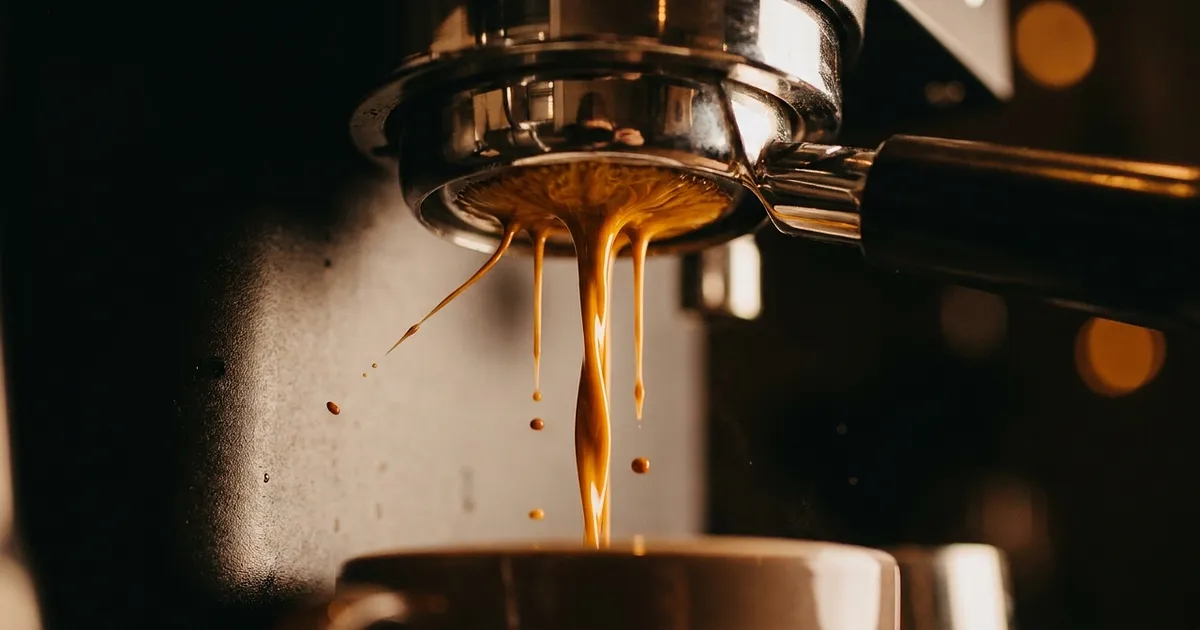
When a shot finishes in twelve seconds, or takes a full minute to fill the cup, the reflex is always the same: go back to the grinder. Sometimes that is the right answer. Often it is not — and adjusting the grind at that moment actively makes things worse. Flow rate is not a fault in itself. It is the visible symptom of what is happening inside the puck, and two very different problems produce shot times that look alike.
The distinction comes down to one question: is water moving through the whole coffee bed evenly, just too fast or too slow? Or is it ignoring most of the bed and carving itself a shortcut? The first case is solved at the grinder. The second — channeling — is never solved at the grinder, and that is exactly where most people get stuck in a loop that ends with "my machine is rubbish".
Two families of problem, two places to intervene
Before touching anything, sort what you are seeing into one of these two categories.
Global flow wrong, but even. The shot runs continuously and smoothly, with no spurting, and both spouts behave the same way. It is simply too fast (water is crossing a bed that is too permeable) or too slow (water is forcing its way through a bed that is too dense). Grind size, dose and brew ratio are the right levers here. This is ordinary dialling in, the ground covered by the seven settings that decide a home espresso.
Uneven flow. The stream squirts, sprays, fans out sideways, stalls and restarts, or one side runs blonde well before the other. The shot time can be short, long, or dead on target — it does not matter. The puck is faulty and water has found a shortcut. That is channeling, and it is a preparation problem, not a dialling-in problem.
Confusing the two is expensive, because the corrections point in opposite directions. Faced with a shot running too fast, instinct says "grind finer". If the real cause is a channel through the puck, grinding finer raises the resistance of the bed around the channel — and therefore the pressure driving water into it. The channel widens. Flow becomes even less predictable, the machine eventually chokes, and the conclusion is that the grinder or the machine is not good enough.
This is not forum folklore. A study published in Matter modelled espresso extraction and then measured what actually happens. The model, which assumes homogeneous flow through the bed, predicts extraction yield rising steadily as the grind gets finer. The measurements instead show a peak followed by a fall, with lower yields at very fine settings. The authors conclude that inhomogeneous flow takes over at fine grind settings, producing poor reproducibility and wasted coffee (Cameron et al., Matter, 2020). Past a certain point, grinding finer does not extract more — it makes your shots less repeatable.
Spotting channeling without taking anything apart
Five signs, from the obvious to the subtle.
Squirting jets. The shot does not fall as a steady stream: it shoots sideways, sprays the wall of the cup, or fans out from one spout. This is the most reliable sign there is.
One spout blonding before the other. On a double-spouted portafilter, if one side turns pale while the other is still running dark, water is not crossing the two halves of the puck at the same rate.
Shot times that jump around. Same beans, same setting, same dose, and yet 22 seconds followed by 38 seconds. The variability is itself the diagnosis: a well-prepared coffee bed behaves repeatably.
A pockmarked spent puck. Knock the puck out and look at it. Craters, holes, a hollow in the middle, one side turned to mush while the other stays firm — water went wherever it was easiest.
A shot that tastes sour and bitter at once. Part of the bed was over-extracted (water lingered there, so it tastes bitter), part was under-extracted (water went around it, so it tastes sour and green). An evenly under-extracted shot is sour; an evenly over-extracted shot is bitter. Both at the same time, in the same cup, means uneven extraction. The taste side of this is covered in our guide to the key espresso settings.
The one tool that actually shows you what is happening
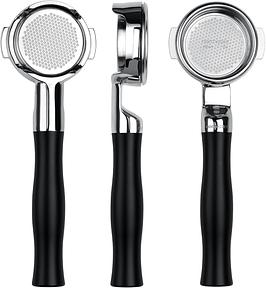
Every sign above is indirect: you are inferring the path of the water from what comes out. A bottomless portafilter — also called naked — removes the inference. The base of the basket is exposed, you watch the underside of the puck throughout the shot, and channeling becomes literally visible: one spot blonding early, a jet firing sideways, a patch that stays dry.
That is what makes it a diagnostic instrument rather than a gadget. It corrects nothing, it changes nothing about your coffee, and it does exactly one job: it tells you whether your problem comes from puck preparation or from somewhere else. That answer decides everything you do next.
Normcore Porte-filtre Slim Naked sans fond 58 mm (E61, ECM, Rocket) is a 58 mm example of the type, compatible with E61 groups and several lever machines. Two warnings before buying one: the diameter has to match your machine, and the first shots will make a mess — with no spouts to contain the flow, real channeling sends coffee across the counter. That is unpleasant, and it is precisely the point.
Normcore Porte-filtre Slim Naked sans fond 58 mm (E61, ECM, Rocket)
View at Amazon (as of Aug 11)Affiliate link. Buying through it earns us a commission; the price stays the same for you.
The real causes, all of them upstream of the water
A channel forms wherever the puck offers less resistance than the rest of the bed. So every cause comes back to unevenness created before the pump ever starts.
The grounds arrive in clumps
Coffee leaving a grinder is not an even powder. It carries static charge and agglomerates into small clumps, especially with light roasts and a domestic grinder. Those clumps are denser than the surrounding bed, so water goes around them. This is the number one cause, by a wide margin.
The tamp is not level
A tamper held even two or three degrees off leaves one side of the puck denser than the other. Water preferentially takes the loose side. How hard you press matters far less than how flat you finish: a firmly tamped but tilted puck channels, a moderately tamped but genuinely flat puck does not.
The dose does not match the basket
A basket designed for 18 g filled with 15 g leaves a gap between the puck surface and the shower screen. Under pressure the puck lifts, deforms, and water pools in that headspace before hitting the bed in a disorderly way. Too much coffee causes the opposite fault: the puck touches the screen, gets imprinted, and cracks when pressure is released.
The shower screen is clogged or worn
The shower screen distributes water across the surface of the puck. Scaled up, blocked with coffee oils or unevenly perforated, it delivers water at a few points instead of spreading it. The bed can be perfectly prepared and the attack will still be lopsided.
The fixes, in order of effort
The order is deliberate: each step costs more than the one before, and there is no point moving on until the previous one is genuinely in place.
1. Break up the clumps before you tamp
WDT (Weiss Distribution Technique) means stirring the dry grounds in the basket with fine needles before tamping. The technique did not come out of a laboratory: John Weiss describes developing it at home, starting with a dissecting needle and a cut-up yoghurt pot (Daily Coffee News, 2022).
Depth matters more than duration. An experiment run over 24 shots on an instrumented machine compared surface WDT — stirring only the top third — against deep WDT, needles driven all the way to the bottom of the basket. With surface WDT, peak puck resistance varied by roughly 40 % from shot to shot; deep WDT clearly reduced that spread (Coffee ad Astra, 2021). Raking only the top is close to doing nothing at all.
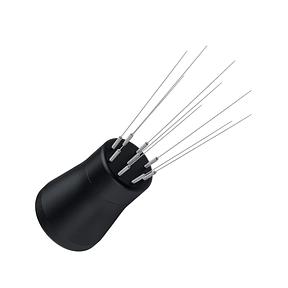
Normcore WDT Outil de Distribution V2 (9 aiguilles) is one such tool: nine fine needles on a holder, according to its Amazon.fr listing. Needle diameter is a secondary parameter — around 0.3 mm they pass through the grounds without pushing them into heaps — but none of the sources gathered here measures the effect of that diameter. Treat it as a comfort choice, not a decisive specification.
Normcore WDT Outil de Distribution V2 (9 aiguilles)
View at Amazon (as of Aug 10)Affiliate link. Buying through it earns us a commission; the price stays the same for you.
2. Tamp flat
Once the clumps are gone, the only goal of tamping is a level surface. A self-levelling tamper rests on the rim of the basket and enforces flatness mechanically, which removes a variable from the gesture. The author of the experiment cited above notes using a force-controlled tamper specifically to reduce variation caused by non-level tamping (Coffee ad Astra, 2021).
NEOUZA Tampeur Expresso Auto-Nivelant 58 mm is a 58 mm tamper of that family. A plain tamper held properly does the same job: rest the base on the basket with one hand, press with the other, and check the surface against the light before locking the portafilter in.
Not available in your region — closest match
View at Amazon (as of Aug 15)Affiliate link. Buying through it earns us a commission; the price stays the same for you.
3. Weigh the dose instead of guessing it
As long as the dose drifts, you cannot conclude anything from one shot to the next. The 2021 experiment gives a useful sense of scale: late in the shot, puck resistance varied by about 5 % between pulls, which the author compares to adding or removing 1 gram from an 18.0 g dose (Coffee ad Astra, 2021). One gram of slack is already the entire variation budget.
BAGAIL Balance Numérique à Café avec Minuterie, Précision 0.1 g is a bench scale with a built-in timer and a stated 0.1 g resolution, which is enough to dose grounds and follow the weight in the cup. Weigh what goes into the basket, not what you believe went in.

BAGAIL Balance Numérique à Café avec Minuterie, Précision 0.1 g
View at Amazon (as of Aug 10)Affiliate link. Buying through it earns us a commission; the price stays the same for you.
4. Check that basket and dose belong together
A precision basket states a dose range and holds a regular perforation pattern. Dose 18 g into a basket built for 14–16 g, or the reverse, and no amount of WDT will save the puck from deforming under pressure.
IMS Big Bang Panier de Filtre de Précision 58 mm, 18-20 g is a 58 mm basket rated for an 18–20 g range. The headspace test costs nothing: tamp, lock the portafilter in, unlock it immediately, and look at the puck. A sharp screen imprint means too much coffee; several millimetres of gap means too little.
Not available in your region — closest match
View at Amazon (as of Aug 15)Affiliate link. Buying through it earns us a commission; the price stays the same for you.
5. Clean the shower screen
Group-head cleaning is the least glamorous maintenance there is and the most commonly skipped. A screen loaded with rancid oils distributes water badly, and the resulting fault looks exactly like a preparation problem.
Brosse de Nettoyage de Tête de Groupe pour Machine à Café Espresso (Lot de 2) is an angled group-head brush, sold in a pack. A pass after the day's session is enough in most cases; descaling follows a different logic and a different calendar.
Not available in your region — closest match
View at Amazon (as of Aug 14)Affiliate link. Buying through it earns us a commission; the price stays the same for you.
Where to start if you only buy one thing
If you make only one change: WDT. It addresses the most common cause, it takes ten seconds per shot, and it is the cheapest tool on this list. HOTUT Outil de Distribution WDT is a basic seven-needle model, enough to establish whether clumping really is your problem before spending more.
And if you want to see the result rather than assume it, add the bottomless portafilter second. Those two objects together cover the diagnosis and the main fix.
Not available in your region — closest match
Normcore WDT Outil de Distribution V2 (9 aiguilles)
View at Amazon (as of Aug 10)Affiliate link. Buying through it earns us a commission; the price stays the same for you.
Superautomatic machines with a sealed brew group
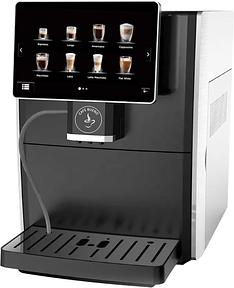
Everything above assumes you prepare the puck yourself. On a bean-to-cup machine with a sealed brew group, you do not: the machine doses, tamps and ejects the puck with no way in. There is no portafilter to watch, no tamp to correct and no WDT to perform.
The remaining levers are different and much narrower: grind fineness, coffee quantity per cup where the appliance allows it, cleanliness of the brew group — many pull out and rinse under the tap — and bean quality. If flow from a superautomatic turns erratic, or the coffee loses body, start with cleaning the brew unit and descaling rather than with settings. The relationship between pressure and flow obeys the same physics whatever the machine type, and we covered it in our article on why 9 bars.
What to take away
Flow rate is not the illness, it is the fever. Before touching the grinder, answer one question: is the flow evenly too fast or too slow, or is it uneven? Even but off-target flow is corrected at the grinder and in the dose. Uneven flow is corrected with your hands, in the basket, before the pump ever starts.
And if you keep only one sentence: grinding finer to fix a channel means pushing harder against a puck that is already faulty. The published measurements point that way, and so does experience at the counter.
All products from this post
The ones we named above are marked; the rest are alternatives in the same category.
Not available in your region — closest match
Normcore WDT Outil de Distribution V2 (9 aiguilles)
View at Amazon (as of Aug 10)
Not available in your region — closest match
Anker Powerbank, 20.000mAh tragbares Ladegerät mit integriertem USB-C-Kabel, 87W Max Schnellladung, kompatibel mit MacBook, iPhone, Samsung und mehr
View at Amazon (as of Aug 15)
Not available in your region — closest match
Anker Powerbank, 20.000mAh tragbares Ladegerät mit integriertem USB-C-Kabel, 87W Max Schnellladung, kompatibel mit MacBook, iPhone, Samsung und mehr
View at Amazon (as of Aug 15)
Affiliate notice: As an Amazon Associate, we earn from qualifying purchases. Product prices and availability are subject to change.
Frequently Asked Questions
How do I know if my espresso is channeling?
Three signs are usually enough: the stream squirts or fans out instead of falling as a steady rope, shot times swing widely between otherwise identical pulls, and the spent puck shows craters or a hollow centre. A bottomless portafilter makes the phenomenon directly visible, which is the only truly reliable observation.
Should I grind finer when the shot runs too fast?
Only if the flow is even and simply too quick. If it squirts or varies from shot to shot, grinding finer makes things worse: resistance rises around the channel, so the pressure driving water into it rises too. A study published in Matter in 2020 links very fine grind settings to inhomogeneous flow and poor reproducibility.
Does WDT actually do anything?
Yes, provided you work deep. An experiment over 24 shots measured roughly 40 % variation in peak puck resistance with WDT limited to the surface, a spread clearly reduced when the needles were driven to the bottom of the basket (Coffee ad Astra, 2021). Stirring only the top layer achieves close to nothing.
Does tamping harder prevent channeling?
No. What matters is levelness, not force. A firmly tamped but tilted puck channels; a moderately tamped and genuinely flat puck does not. Adding force to a tilted puck only widens the density gap between the two sides.
Can a bean-to-cup machine channel?
Flow can certainly turn uneven, but you cannot correct it the same way: the brew group is sealed and prepares the puck without you. The available levers are grind fineness, coffee quantity per cup, cleaning the brew unit and descaling.
Does a bottomless portafilter improve the taste?
No, it changes nothing about extraction itself. It is a diagnostic instrument: it removes the base of the basket so the path of the water becomes visible. Any improvement in taste comes from the corrections it lets you identify, not from the accessory.
Do I need a precision basket to avoid channeling?
It is not the first thing to change. A precision basket states a dose range and a regular perforation pattern, which removes a variable, but it compensates for neither a tilted tamp nor clumped grounds. Leave it until last, once distribution and tamping are stable.