Why 9 bars? The ideal espresso pressure explained
 14 min read
Figures as of 8 August 2026
Pull any espresso machine out of its box and you’ll read a number in big type: 15 bar, 19 bar, sometimes 20 bar. Then open a barista manual and you’ll hit a different number: 9 bar. Both are printed in black and white, neither one is wrong, and they aren’t talking about the same thing.
The second one decides what ends up in your cup. The first is a sales pitch. Here’s where the 9 bar rule came from, what brew pressure physically does to the coffee bed, and why a good part of the story everyone repeats about that number falls apart the moment you check it.
What does a bar actually measure?
One bar is about 100 kPa, roughly atmospheric pressure at sea level. So at 9 bar, the water pushes with nine times the pressure the air is putting on you right now.
In absolute terms, that’s not much.
What makes the number interesting is what it pushes against. A tamped coffee bed isn’t a passive filter: it resists, it deforms, its permeability changes during the shot. Pressure is a balance between what the pump pushes and what the coffee gives back.
Where does the number 9 come from? The story everyone repeats
Gaggia’s spring lever, late 1940s
Before Gaggia, Italian machines pushed water with steam, at far lower pressure, with the burnt taste that goes with it.
Achille Gaggia filed a first patent in 1938, no. 365726, known as the "Lampo", according to the official history published by Gaggia. That patent says nothing about 9 bars yet: its job was getting away from steam.
Nine years later, in the late 1940s, came the mechanism that matters here. A lever compresses a spring, the spring pushes a piston, the piston pushes hot water through the coffee. That same company history gives 8 to 9 atmospheres. A manufacturer’s figure about its own past, then, and not an independent period measurement.
On the exact year, the sources disagree: Gaggia writes 1947, other pages say 1946, others 1948, often mixing up the patent, the prototype and the commercial launch. You won’t find a precise date here, for want of any good reason to pick one.
The Faema E61 and the electric pump, 1961
The real shift came in 1961. The Faema E61 replaced the human arm with an electric volumetric pump and held around 9 bar at the group for the whole extraction, according to Wikipedia’s E-61 page, which draws on Edward Bramah’s book published in 1989 and on the US patent filed by Ernesto Valente in 1960.
The change goes further than convenience. A spring lever produces a curve: pressure climbs, peaks, then decays. An electric pump produces a plateau. From 1961 on, "the pressure" of an espresso became a single constant value, and that is the one the industry has been copying for sixty years.
What’s documented, and what isn’t
Here is the version you read everywhere: Gaggia’s lever produced 9 bars by accident, Faema took the number without thinking, the industry followed, end of story. It is told exactly like that by Clive Coffee and repeated almost word for word on dozens of blogs.
It has a serious problem. Not one of those pages cites a period document showing that the number was picked at random, or that Faema copied Gaggia rather than measuring something. Follow the links back and you always land on the same unsourced post.
What holds up: Gaggia did patent a spring-piston system, its own history gives 8 to 9 atmospheres, and the Faema E61 did make constant electric pressure around 9 bar the norm. The technical lineage is real. What’s missing is the explanation of the number, not the machines.
INEI, the Italian national espresso institute founded in 1998, publishes numbers for a certified espresso: a 7 g dose, 25 ml in the cup, 25 ± 5 seconds and 88 ± 2 °C at the group outlet, according to Wikipedia’s Espresso page. Its official site refuses automated requests, so those values are cross-checked between secondary sources rather than read at the source.
As for the 9 bar, it is widely cited as the Specialty Coffee Association’s reference point, at 9 ± 1 bar. Widely cited, and not quoted: the SCA-350 standard exists, but it is reserved for members. Writing "according to the SCA" would be more comfortable than true.
What pressure really does to the coffee bed
Flow stops following pressure at around 5 bar
Intuition says: more pressure, more water through the coffee, so more extraction. Physics says something else.
A team led by the University of Warsaw modelled the puck as a poroelastic material, meaning a porous medium that deforms under load. Their paper, published in Physics of Fluids in 2026 after a preprint posted in December 2025, describes a non-monotonic curve. Flow rises with pressure up to about 5 bar, then the grounds compress, their pores close up, and pushing harder no longer moves more water.
Read that threshold again. The turn happens around 5 bar; the trade convention sits at 9 bar. So a classic espresso already works, deliberately, in the zone where pressure has stopped speeding anything up.
What is the rest of it for? Saturating the puck fast and evenly, holding a short contact time, and keeping the dissolved gases that make crema in suspension. Pressure doesn’t "push" the aromatics out of the coffee: it sets how fast the water travels, and that speed decides what dissolves.
Channelling, or why pressure alone decides nothing
The real enemy isn’t the number on the pump. It is channelling: water finds a path of least resistance through the bed, rushes into it, over-extracts that one corridor and leaves the rest of the coffee barely wet.
High pressure makes the problem worse instead of correcting it. The harder you push on a badly distributed bed, the deeper you carve the channel.
The trap is that none of this shows. A cup over-extracted on one side and under-extracted on the other comes out at a normal volume, in a normal time, with crema that looks perfectly fine. The one simple way to watch it happen is to take the bottom off the portafilter: a bottomless portafilter, the "naked" kind, shows the jets and side sprays that the stainless steel usually hides.
Normcore Porte-filtre Slim Naked sans fond 58 mm (E61, ECM, Rocket)
The Normcore 58 mm bottomless sells for around €79 on Amazon.fr as of 08/08/2026, rated 4.3/5 from 256 reviews. Be clear about what it does: it makes the fault visible, it doesn’t correct it. The correction runs through the grind and through how the coffee is distributed in the basket, and that is the subject of our guide to the seven dial-in settings, not this article.
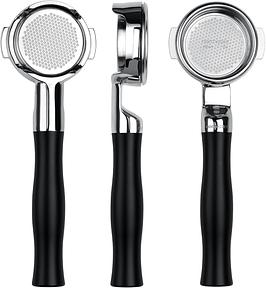
Normcore Porte-filtre Slim Naked sans fond 58 mm (E61, ECM, Rocket)
View at Amazon (as of Aug 11)Affiliate link. Buying through it earns us a commission; the price stays the same for you.
15, 19 or 20 bar: the pump’s number, not the cup’s
This is where the industry misleads you without ever lying.
A consumer vibratory pump is rated for a maximum pressure, measured at dead-head, zero flow. That is a pump catalogue spec, not a working pressure. Between that pump and your coffee sits a part worth a few euros that decides everything: the over-pressure valve, or OPV. As soon as its set point is passed, it opens a bypass and sends the excess back to the reservoir.
As CompleteHomeBarista explains, the 15 bar advertised on the box arrives at the group at around 9 bar. Moving from a 15 bar model to a 19 bar model therefore changes nothing in the cup: it is the same valve, set the same way, shaving off the difference.
| Machine type | Advertised pump pressure | Real brew pressure at the group | What regulates it |
|---|---|---|---|
| Vibratory pump, consumer | 15 bar to 20 bar | approx. 9 bar | over-pressure valve (OPV) |
| Rotary pump, prosumer | 9 bar to 12 bar | approx. 9 bar, adjustable | OPV and pump setting |
| Spring lever (Gaggia, late 1940s) | not applicable, no pump | 8 bar to 9 bar at peak, then falling | the lever’s spring |
| Current manual lever (Flair type) | not applicable, no pump | 6 bar to 9 bar depending on your arm | the arm, read on the gauge |
| Pressure profiling machine | not stated | 0 bar to 9 bar during the shot | a programmed curve |
Sources: OPV mechanism from CompleteHomeBarista; spring lever from Gaggia’s own history, manufacturer figure; profiling range from La Marzocco, manufacturer figure. Checked 08/08/2026.
If you are more at the stage of choosing a machine than dissecting a pressure curve, our roundup of the best bean-to-cup coffee machines starts from how you will use it and what you want to spend, rather than from advertised bars.
Reading the pressure instead of believing it
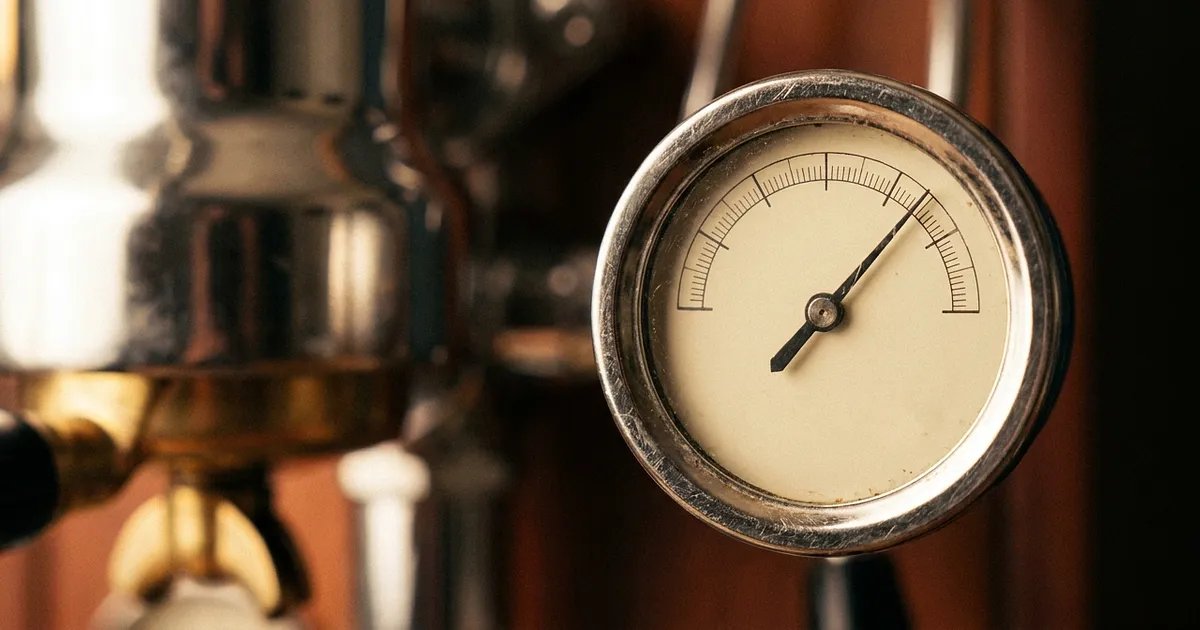
There is a simple way to settle it: look at the needle.
Most consumer machines have no gauge at all. The ones that do often place it after the pump and before the over-pressure valve, where the reading no longer means anything for your coffee. Manual lever machines, on the other hand, measure as close to the puck as it gets.
Flair PRO 3 – Machine à expresso manuelle à levier avec manomètre
The Flair PRO 3 has no pump at all. You push the lever yourself and the gauge mounted on the group shows, in real time, the pressure applied to the coffee. It sells for around €650 on Amazon.fr as of 08/08/2026, rated 4.5/5 from 548 reviews.
It is not a convenient machine, and that has to be said. No built-in steam, one cup at a time, and everything hangs on how steady your arm is. But for understanding what 9 bar means, nothing is more direct: you watch the needle climb and the resistance change.
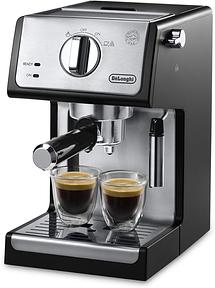
Not available in your region — closest match
View at Amazon (as of Aug 14)Affiliate link. Buying through it earns us a commission; the price stays the same for you.
Pre-infusion and pressure profiling: why start lower
If 9 bar were the right answer at every moment of the extraction, nobody would have invented pre-infusion.
It consists of wetting the puck at low pressure for a few seconds, before applying full pressure. La Marzocco describes profiling as varying pressure between 0 and 9 bar within a single extraction, and says its recent machines sense back pressure at the group to steer saturation. That is how the manufacturer says it works, not independently verified here.
The problem it solves is the one from the previous section. A dry puck hit at full pressure straight away cracks where it is weakest, and water carves that channel for the rest of the shot. Saturated gently first, it holds up better when the pressure climbs.
Which produces an interesting shift among serious practitioners: the argument is no longer really 9 against 6, but "does a fixed pressure, whatever its value, still make sense?".
9 bars: a useful standard, not a law
In January 2020, a team led by chemist Christopher Hendon (University of Oregon) and mathematician Jamie Foster (University of Portsmouth) published work in Matter, the journal edited by Cell Press, combining modelling and measurements. Their finding cuts against the convention: extraction turned out to be more consistent from cup to cup at 6 bar than at 9 bar, with the fines clogging the coffee bed less at lower pressure. The study is summarised by ScienceDaily and covered in detail by Daily Coffee News, both on 22 January 2020.
The original paper is paywalled. The exact yield percentages are therefore not repeated here, since they could not be read at the source; only the qualitative finding is.
This is not an isolated result. Perfect Daily Grind reported back in August 2015 that Maxwell Colonna-Dashwood, three-time UK barista champion, used a long pre-infusion followed by a flat 6 bar extraction in competition, and saw less channelling there than at 9 bar.
And yet, no: switching 9 to 6 on your machine tomorrow morning probably won’t fix anything.
Because that is not where the gap sits. Grind moves the cup infinitely more than pressure does, with dose right behind it. The current specialty coffee convention runs around 18 g/36 g, a long way from INEI’s 7 g. Two uses, two eras, and no law of physics behind either one.
The verdict
9 bars is a good default value. It is not a law.
The number comes from a real technical lineage, from Gaggia’s lever to the Faema E61’s pump. But the story of "9 bars found by chance" rests on no document anyone has ever produced, and it is better to say so than to copy it. Physics does settle one point: past about 5 bar, pushing harder no longer moves more water.
So if you want to improve your cup tomorrow morning, leave the pressure alone. Look at the grind, the dose and the distribution in the portafilter: the detail of those settings is the subject of our guide to the seven dial-in settings. And if your question is really which machine to buy, our guide to choosing a bean-to-cup machine answers that one.
All products from this post
The ones we named above are marked; the rest are alternatives in the same category.
Affiliate notice: As an Amazon Associate, we earn from qualifying purchases. Product prices and availability are subject to change.
Frequently Asked Questions
What is the ideal pressure for an espresso?
Around 9 bar at the group head, as close to the coffee as possible. It’s the trade’s reference value, widely cited as the Specialty Coffee Association’s benchmark of 9 ± 1 bar. That doesn’t make it a physical constant: the study published in the journal Matter in January 2020 measured more consistent extraction at 6 bar.
Why does my machine say 15 or 19 bar?
Because that’s the pump’s maximum pressure, measured at dead-head, not what reaches the coffee. An over-pressure valve, the OPV, opens a bypass as soon as its set point is passed and sends the excess back to the reservoir. What gets to the puck is around 9 bar, whatever number is printed on the box.
Does a 20 bar machine make better coffee than a 9 bar one?
No. Both extract at around 9 bar at the group, because the over-pressure valve shaves off the difference. A high pump number tells you nothing about temperature stability, the group or the grinder, which are what really decide the cup. Look at those specs, not the number in big type.
What is pre-infusion for?
To wet the puck at low pressure before applying full pressure. A dry puck hit hard from the start cracks where it’s weakest, and water carves that channel for the rest of the shot. By saturating it first, you get a more even bed that holds up better when the pressure rises.
Where does the 9 bar rule actually come from?
From a historical chain that’s only partly documented. Achille Gaggia’s spring lever, in the late 1940s, delivered 8 to 9 atmospheres according to the company’s published history, and the 1961 Faema E61 made an electric pump holding around 9 bar the norm. The story of the number found by accident is repeated everywhere, but no source backs it with a period document.
Can you pull a good espresso at 6 bar?
Yes. The study published in the journal Matter in January 2020 measured more consistent extraction at 6 bar than at 9 bar, and three-time barista champion Maxwell Colonna-Dashwood was already using a flat 6 bar extraction in competition in 2015. You then have to adjust the grind, or the flow runs away too fast.
Sources
- the official history published by Gaggia gaggiaprofessional.evocagroup.com
- Wikipedia’s E-61 page en.wikipedia.org
- Clive Coffee clivecoffee.com
- Wikipedia’s Espresso page en.wikipedia.org
- Physics of Fluids arxiv.org
- CompleteHomeBarista completehomebarista.com
- La Marzocco lamarzoccousa.com
- ScienceDaily sciencedaily.com
- Daily Coffee News dailycoffeenews.com
- Perfect Daily Grind perfectdailygrind.com