Espresso grind size: what the numbers actually tell you
 12 min read
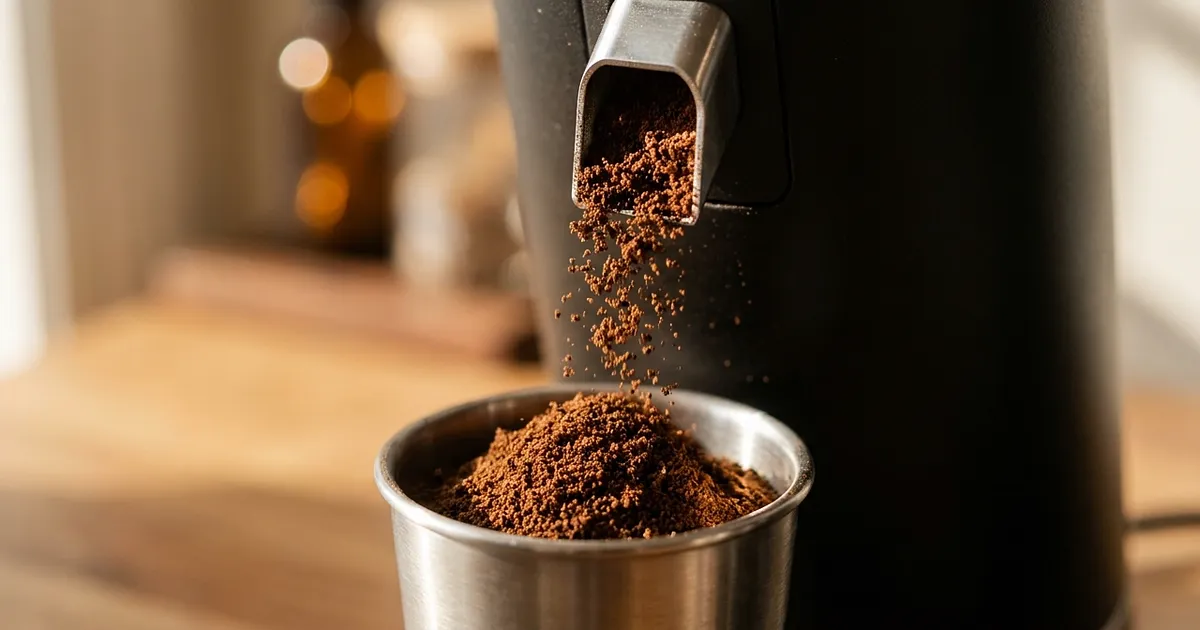
Ask what grind size espresso needs and someone will tell you to set it to 12. That is the one answer that cannot work, because a click number describes nothing universal — it describes where a collar sits on one specific grinder, with its own burrs and its own zero point. The question you actually have is which way to turn it, and how far.
Why "set it to 12" means nothing
Three reasons, none of them theoretical.
The zero point — where the burrs touch — is not identical between two units of the same model. It is set at the factory within a tolerance, and it moves: new burrs season over the first few kilos, which shifts the whole scale finer without you touching the collar.
Burr geometry changes particle distribution at the same gap. Conical and flat burrs do not produce the same mix of boulders and fines at the same opening, so two grinders set to the same gap do not give the same flow.
And the coffee itself moves the setting. A light roast is harder and denser than a dark one: at the same setting it grinds coarser and runs faster. A bag three days off roast does not behave like the same bag two weeks later.
A click number is a personal reference point — true for your grinder, your coffee, this week. Write it down. Do not lend it.
Grams, not ounces — and here is why that matters
If you think in fluid ounces, espresso is the one drink where the habit actively hurts you. A double is often quoted as roughly two ounces, and the SCA definition does give a volume: 25 to 35 ml from 7 to 9 g of coffee (14 to 18 g for a double), with clean water at 90.5–96.1 °C forced through at 9–10 atmospheres, "and where the grind of the coffee is such that the brew time is 20–30 seconds."
Read that last clause again. The reference definition of the trade gives no grind value at all. It defines grind by its result: the right grind is whatever produces that time, at that dose, on that machine.
The volume is the problem. Those 25 to 35 ml include crema, and crema is foam — its volume tracks how fresh the coffee is far more closely than how well the shot extracted. Two shots that taste completely different can fill the same line on a shot glass. Weighing the drink in grams removes that variable entirely. And the 7 to 9 g describes baskets smaller than what ships today: 58 mm portafilters are commonly supplied with 18 g baskets, and the 54 mm baskets on many home machines sold in the US and UK sit lower again.
TIMEMORE Black Mirror Basic 2 - Balance à café avec minuteur
A scale that reads to a tenth of a gram and starts a timer on its own changes the whole exercise. Without one you are comparing shots that share neither dose nor yield, and blaming the grinder for a difference that came from scooping.
Not available in your region — closest match
View at Amazon (as of Aug 14)Affiliate link. Buying through it earns us a commission; the price stays the same for you.
Microns exist. Your grinder is not calibrated in them
Particle size is measurable, in micrometres. The measurement is not the problem — the problem is that your collar is not marked in them.
No standard fixes a micron figure for espresso. The 200 to 400 µm range you see quoted everywhere is a trade convention, not a normalised value, and as you just read, the SCA definition does not mention microns at all.
A few manufacturers do publish what one click is worth, which turns dialling in from guesswork into arithmetic:
| Grinder | Stated value per click | Source |
|---|---|---|
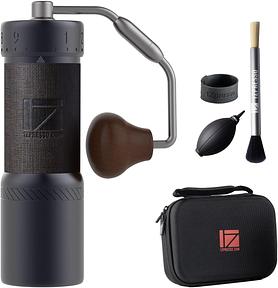
| 1Zpresso J-Ultra | 8 µm per click | manufacturer product page (1zpresso.coffee) |
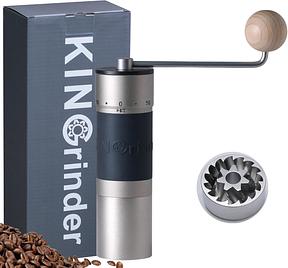
| KINGrinder K6 | 16 µm per click | manufacturer product page (kingrinder.com) |
| Most home grinders | not published | spec sheets give a number of clicks or positions, no µm value |
1Zpresso J-Ultra Moulin à Café Manuel Gris Fer, Fraise Conique
That is the exception, not the rule. Most grinders sold for espresso advertise "40 positions" or "25 levels" and stop there: you know how many clicks you have, not what one is worth. Hence the advice that follows, which needs no manufacturer figure at all — one click, taste, decide.
1Zpresso J-Ultra Moulin à Café Manuel Gris Fer, Fraise Conique
View at Amazon (as of Aug 11)Affiliate link. Buying through it earns us a commission; the price stays the same for you.
Affiliate link. Buying through it earns us a commission; the price stays the same for you.
Why one click does so much more on espresso than on filter
Here is the arithmetic, and it explains more than any analogy.
A click is an absolute step: the collar moves the burrs a fixed distance, say 16 µm, whatever the starting gap. But espresso lives right at the bottom of the range. If your espresso setting sits around 250 µm, those 16 µm are 6.4 % of the particle size. The same click at a filter setting near 800 µm is only 2 %.
The resistance of a packed bed to fluid flow follows the Kozeny-Carman relation, in which that resistance varies as the inverse square of particle diameter. Applied to both cases, as an order of magnitude:
| Starting setting | One 16 µm click | Effect on resistance | On a reference time | |
|---|---|---|---|---|
| Espresso | 250 µm | −6.4 % | ×1.14 | 27 s → about 31 s |
| Filter | 800 µm | −2.0 % | ×1.04 | 3 min 30 → about 3 min 39 |
On espresso a single click moves the shot four seconds and pushes you out the top of a window that is ten seconds wide. On filter the same click vanishes into the normal tolerance of a brew.
Two caveats. This is an order of magnitude, not a prediction: a real coffee bed departs from the model, because fines migrate downward during extraction and because a single channel through the puck short-circuits the whole calculation. And the practical consequence is a concrete buying argument. If you want to move a shot by about five seconds, you are looking for roughly 5 % of particle size — around a dozen microns at 250 µm. A grinder whose click is worth 80 µm cannot aim at twelve microns. It steps over the window, and you go from gushing to choking with nothing in between.
This is the case for stepless grinders: you can move by as little as you like. The trade-off is real and rarely stated — with no index, you have no reliable way back to yesterday's setting. A click is a constraint, but it is also a memory.
Affiliate link. Buying through it earns us a commission; the price stays the same for you.
Which way to turn: the decision table
Pull a reference shot first: fixed weighed dose, 1:2 ratio, timer started with the pump, drink weighed in grams. Then read the table.
| What the shot does | What it means | Do this |
|---|---|---|
| Hits target weight in under 20 s; sour, hollow, watery | bed too permeable, under-extracted | finer, 1–2 clicks |
| Runs well past 30 s, drips or chokes; harsh, drying, bitter | bed too restrictive, over-extracted | coarser, 1–2 clicks |
| Inside the 20–30 s window but clearly sour | grind slightly too coarse | finer, 1 click |
| Inside the window but bitter and drying | grind slightly too fine, or yield too long | coarser, 1 click, or stop the cup earlier |
| Very uneven flow, sideways jets, time varies shot to shot | channelling — this is not the grind | fix puck prep before touching the grinder |
That last row wastes more time than any other. A badly distributed bed opens a preferential path, water rushes through it, and the shot comes out short and sour — exactly the symptoms of too coarse a grind. So you correct the wrong way, go finer, make the channelling worse, and go round in circles for a whole bag.
Normcore porte-filtre sans fond 58 mm
A bottomless portafilter settles that diagnosis in one shot, because it makes the underside of the puck visible: a healthy extraction descends as an even cone, while channelling sprays off at an angle and you see it immediately. It is the most direct diagnostic tool on this list, ahead of any prep accessory.
For prep, the order is simple: break up clumps in the basket with a needle tool, then tamp level. A calibrated spring tamper does not improve flavour by magic — it makes pressure repeatable between shots, which is exactly what you need when you are trying to isolate the effect of one grind click.
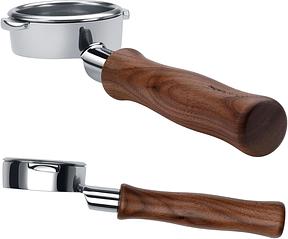
Normcore porte-filtre sans fond 58 mm
View at AmazonAffiliate link. Buying through it earns us a commission; the price stays the same for you.
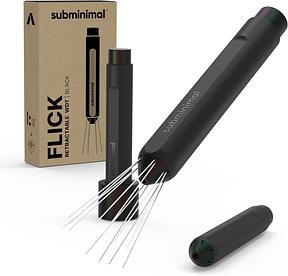
Affiliate link. Buying through it earns us a commission; the price stays the same for you.
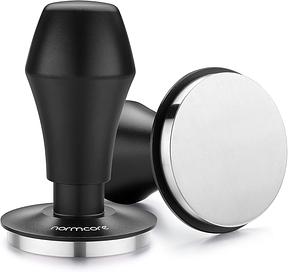
Affiliate link. Buying through it earns us a commission; the price stays the same for you.
The five-step protocol
- Lock the dose. Weigh it to a tenth of a gram and leave it alone until the grind is stable. A dose wandering by 0.5 g is enough to hide a click.
- Lock the ratio. 1:2 by weight is the most common starting convention: 18 g in, 36 g in the cup. Chase the weight, not a line on the glass.
- Change the grind by one click, and nothing else.
- Purge. If your grinder retains coffee between the burrs, the first shot after a change still contains the old grind. Throw a small dose through, or treat the first attempt as void.
- Taste, log, repeat. Write down the click number, the coffee, the date. That notebook is the only "setting 12" that ever meant anything: yours.
What moves your setting without you touching the grinder
Degassing. Very fresh coffee releases CO₂ during extraction, which disturbs flow. Behaviour settles over the days after opening, and the setting moves with it.
Roast level. Lighter, denser, harder to grind: it generally wants finer than the same dose in a dark roast.
Basket size. Moving from a 14 g to an 18 g basket changes bed depth, and therefore resistance, at an identical grind.
Machine temperature. An under-heated machine under-extracts, and the sourness that results is indistinguishable from too coarse a grind.
Burr wear. Slow but real: your setting drifts over months, not over a week.
If you are starting from a bean-to-cup machine rather than a portafilter, the vocabulary changes but the reasoning does not — our bean-to-cup comparison and beginner's guide go into what the built-in grinder is actually worth model by model.
TIMEMORE Chestnut C3s PRO - Moulin à café manuel
One last note if you are starting out: a manual conical-burr grinder is more than enough to learn dialling in, because it gives you clean clicks and a usable range. What you buy by moving up is not "better coffee" as such — it is a finer step and a repeatability that wastes less coffee while you are searching.
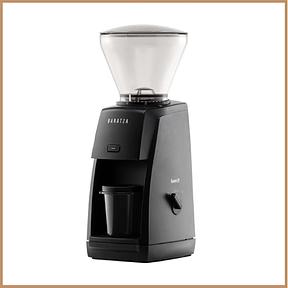
Not available in your region — closest match
Baratza Encore ESP Moulin à Café à Meules Coniques
View at Amazon (as of Aug 11)Affiliate link. Buying through it earns us a commission; the price stays the same for you.
All products from this post
The ones we named above are marked; the rest are alternatives in the same category.
Not available in your region — closest match
Baratza Encore ESP Moulin à Café à Meules Coniques
View at Amazon (as of Aug 11)
Not available in your region — closest match
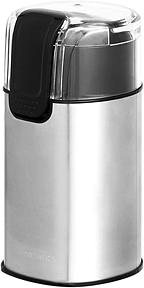
Amazon Basics Fast Electric Coffee Grinder for Home Use, Easy to Use Coffee Bean and Spice Grinder with Heavy-Duty Stainless Steel Grind Blades
View at Amazon (as of Aug 14)
Affiliate notice: As an Amazon Associate, we earn from qualifying purchases. Product prices and availability are subject to change.
Frequently Asked Questions
What grind size is espresso in microns?
No standard fixes a value. The 200 to 400 µm range quoted everywhere is a trade convention rather than a normalised figure, and the Specialty Coffee Association's espresso definition does not mention microns at all: it describes the grind as whatever gives a brew time of 20 to 30 seconds. In practice your collar is not marked in microns anyway, so the number is not directly actionable.
Which way do I turn the grinder if my espresso runs too fast?
Go finer, one or two clicks. A shot that reaches its target weight in under 20 seconds has passed through a bed that is too permeable: it is under-extracted, which tastes sour, hollow and watery. Tightening the grind raises resistance and lengthens the time. Check the flow is even first — sideways jets mean channelling, not a coarse grind, and going finer would make that worse.
How many clicks should I change at once?
One, two at most. On espresso a fixed step is a large percentage of particle size, because the grind is already very fine: a 16 µm click at a setting near 250 µm is already a 6.4 % change. The same click at a filter setting near 800 µm is only 2 % and passes unnoticed. That is why espresso reacts so violently to what looks like a tiny adjustment.
Can I reuse a click number from another grinder?
No, not even between two units of the same model. The zero point, where the burrs touch, is set at the factory within a tolerance and then moves as new burrs season. Burr geometry also changes particle distribution at an identical gap. A click number is a personal reference: note it for yourself, do not transpose it.
Do I need to re-dial for every new bag of coffee?
Expect to, yes, by at least a click or two. Roast level, bean density and time since opening all change how the coffee grinds and flows: a light roast generally wants finer than a dark one, and very fresh coffee is still releasing CO₂, which disturbs flow for the first few days. Pull a weighed reference shot, then adjust.