Milk pitcher size and shape: how the jug changes your latte art
 13 min read

The milk pitcher is the accessory people buy last and choose worst. You take the biggest one "to keep your options open", or the one with the sharpest spout because every latte art video features one. Both reasons pick the wrong criterion.
A pitcher has exactly one parameter that really decides how it behaves, and it is not the capacity printed on the box: it is the level the milk sits at while the steam wand is working. Everything else — spout shape, wall thickness, internal markings — is read afterwards, and it is read differently depending on whether you are making one cappuccino or two large drinks.
This guide does not re-teach the steaming technique. It explains the vessel: which capacity for which drink, what the spout shape actually changes at the moment you pour, and which build details are worth checking before you buy.
Size is dictated by fill level, not by ambition
The capacity printed on a pitcher does not tell you how much milk to put in it. It tells you how much it can hold. Those are two different things, and the gap between them is where most bad purchases come from.
Two physical constraints bracket the fill level, and they pull in opposite directions.
From above: milk gains volume while it is being textured. The Istituto Nazionale Espresso Italiano puts a number on it in its certification sheet The Certified Italian Espresso and Cappuccino (supplement to L'Assaggio no. 16, December 2006): 100 ml (3.4 fl oz) of cold milk at 3–5 °C is steamed until it reaches a volume of roughly 125 ml (4.2 fl oz) at a temperature of about 55 °C. That is roughly a quarter more volume, plus the clearance you need so nothing spills while the wand churns. A pitcher filled three-quarters full overflows; filled to the brim, it overflows before the foam even forms.
From below: the wand has to be deep enough in the milk to set it spinning. Pour 100 ml (3.4 fl oz) into a one-litre jug and the milk column is too shallow: the tip ends up too close to the surface or to the base, the whirlpool never starts, and you get large bubbles instead of tight microfoam. This is the point most guides skip, because they reason as though a big pitcher contained a small one.
Hence the single rule, visual and transferable to any model: the cold milk should reach roughly the base of the spout — the point where the wall starts to pinch inwards to form the pour. Below that, the wand has too little to work with; above it, there is nowhere left for the expansion to go.
Turning that into a capacity
The table starts from the certified cappuccino specification (25 ml espresso and 100 ml milk) and applies the roughly 25 % expansion measured in the same document. The rows below it are orders of magnitude: measure the milk with your own cup rather than mine, by filling it with water and pouring that water into the pitcher.
| Drink | Cold milk (order of magnitude) | Volume after steaming (≈ +25 %) | Sensible pitcher capacity |
|---|---|---|---|
| 1 cappuccino (INEI spec: 25 ml espresso + 100 ml milk) | 100 ml (3.4 fl oz) | ≈ 125 ml (4.2 fl oz) | 350 ml (12 fl oz) |
| 1 large milk drink (flat white, latte) | 150 to 200 ml (5 to 7 fl oz) | ≈ 190 to 250 ml (6.4 to 8.5 fl oz) | 500 to 600 ml (17 to 20 fl oz) |
| 2 drinks back to back | 300 to 350 ml (10 to 12 fl oz) | ≈ 375 to 440 ml (13 to 15 fl oz) | 750 ml to 1 L (25 to 34 fl oz) |
| 1 macchiato / a small splash of milk | 50 to 80 ml (1.7 to 2.7 fl oz) | ≈ 60 to 100 ml (2 to 3.4 fl oz) | 350 ml (12 fl oz), no smaller |
That last row deserves a comment. Below roughly 100 ml (3.4 fl oz), no domestic pitcher will give you clean foam: there simply is not enough milk for the rotation to establish itself. Steaming 150 ml (5 fl oz) and pouring half of it away is more reliable than steaming 60 ml (2 fl oz) — wasteful, but that is the mechanical reality.
For a household making one drink at a time, 350 ml (12 fl oz) is the balance point. The stainless-steel Motta Europa is the long-standing reference at that size, with the tapered spout the range is known for.
Motta Europa 0901/03 — pichet à lait inox 350 ml
If your cups are larger — breakfast mug, latte, generous flat white — the next step up is 500 to 600 ml (17 to 20 fl oz). The same Motta exists at 500 ml, and this bracket also holds jugs whose spout is specifically shaped for latte art, such as the 600 ml black pitcher from Barista Legends.
Motta Europa 0901/04 — pichet à lait inox 500 ml
Barista Legends — pichet à lait inox noir 600 ml, bec latte art
Two drinks back to back change the calculation: you have to steam once for both, or the first cup is served lukewarm. That is the territory of 750 ml and one-litre jugs.
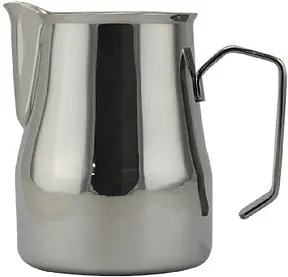
Motta Europa 0901/03 — pichet à lait inox 350 ml
View at AmazonAffiliate link. Buying through it earns us a commission; the price stays the same for you.
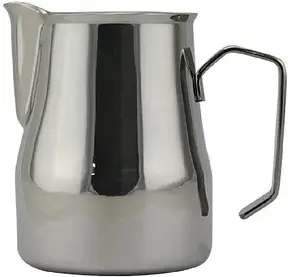
Motta Europa 0901/04 — pichet à lait inox 500 ml
View at AmazonAffiliate link. Buying through it earns us a commission; the price stays the same for you.
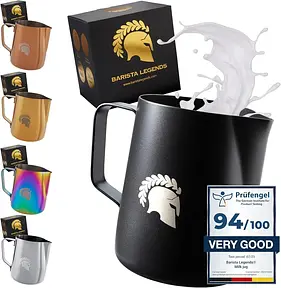
Barista Legends — pichet à lait inox noir 600 ml, bec latte art
View at AmazonAffiliate link. Buying through it earns us a commission; the price stays the same for you.
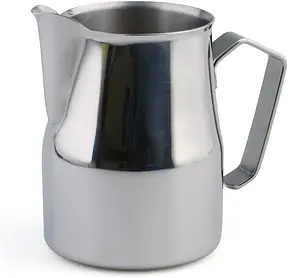
Motta Europa 901/75 — pichet à lait inox 750 ml
View at AmazonAffiliate link. Buying through it earns us a commission; the price stays the same for you.
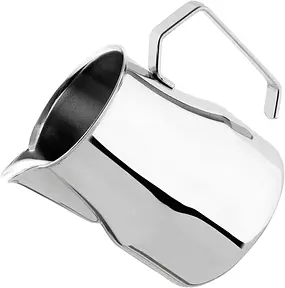
Motta Elegante — pichet à lait inox 1 L
View at AmazonAffiliate link. Buying through it earns us a commission; the price stays the same for you.
Sharp spout or wide spout: control traded against forgiveness
The spout shape does not decide the quality of the foam — that is already settled by the time you pour. It decides what you can do with that foam once it is in the cup.
A narrow, pointed spout concentrates the flow into a small width. The line laid on the surface is fine and sharply defined, which is exactly what drawing needs: a rosetta requires lines that stay separable. The trade-off is mechanical. The more concentrated the flow, the more a stray wrist movement shows. A sharp spout forgives nothing — not an uneven flow rate, not a hesitation at the end of the pour.
A rounder, wider spout spreads the flow out. The pattern is more diffuse and the contrast softer, but a shaky hand is absorbed: the milk spreads instead of tracing a crooked line. It is also the spout that forgives foam that came out slightly too stiff, because it lets it leave without sculpting it.
Neither is better in the abstract. The choice depends on who is pouring.
| If you are… | Spout to pick | Why |
|---|---|---|
| A beginner, aiming for a clean heart | wide / rounded | forgives an uneven flow rate |
| Comfortable, aiming for rosettas and tulips | narrow / pointed | separable lines, sharp contrast |
| An occasional user just pouring milk in | wide / rounded | no definition needed |
| Making two drinks in a row | either | capacity outranks shape |
One practical detail goes unnoticed: on a very tapered spout, the last portion of milk is hard to pour cleanly, because the pour lip holds part of the flow back once the jug is nearly empty. That does not matter if you dosed correctly to begin with — which takes us back to the first chapter.
Entry-level pitchers generally use an intermediate, rounder spout and offer several capacities under the same listing, which is a cheap way to find the size that suits you before committing.
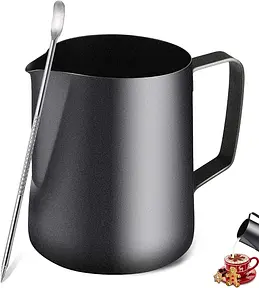
TechKen — pichet à lait inox 350 / 600 / 900 ml
View at AmazonAffiliate link. Buying through it earns us a commission; the price stays the same for you.
Material, thickness, coating: what your hand can feel
Uncoated stainless steel dominates for one precise reason: it conducts temperature. Plenty of people steam without a thermometer, holding the pitcher by its wall and stopping when the contact becomes uncomfortable. That cue exists only if the wall conducts heat.
Thickness modulates that feedback. A thin wall heats quickly and signals the temperature change almost immediately; it is livelier and more nervous to read. A heavy pitcher buffers: it climbs more slowly, your hand registers the change later, and a second of inattention costs more. A heavy pitcher is not worse — it is steadier in the hand and holds its shape longer — but it forgives less if you rely on touch rather than an instrument.
A non-stick or coated interior is a drawback, which often surprises people. Two reasons. First, the coating insulates: it adds a layer between the milk and your fingers, exactly where you are looking for information. Second, it degrades — repeated contact with a hot wand, a spoon or a scourer eventually marks it, and a chipped coating inside a food container is not a cosmetic detail. Jugs that are coloured on the outside and bare inside do not have this problem: the interior surface is the one that counts.
If you would rather not depend on touch — or if your pitcher is thick-walled — a clip-on thermometer attaches to the rim and can be read during the operation. This one shows a reference band of 55 to 68 °C on its dial, per the manufacturer's specification; the lower end matches the roughly 55 °C the Istituto Nazionale Espresso Italiano gives for the milk in a certified cappuccino.
Thermomètre à Lait Barista - Sonde Inox 127 mm, Cadran 45 mm avec Zone Verte 55-68 °C
Internal volume markings are useful and limited. Useful: they save you eyeballing the dose when you always make the same drinks. Limited: they are hard to read in a moving jug, they give a volume rather than a mass, and milk is not as dense as water. They do not replace a scale if you are after repeatability — the same reasoning as for ground coffee, covered in our guide to the tamper, WDT and scale.
One last, prosaic point: milk dries fast on steel and on the wand. A dedicated cloth, reserved for that job and changed often, does more for the life of your equipment than any accessory.
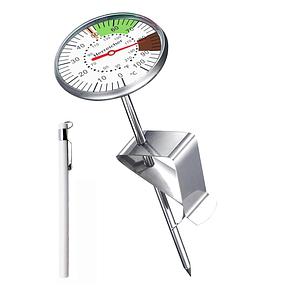
Thermomètre à Lait Barista - Sonde Inox 127 mm, Cadran 45 mm avec Zone Verte 55-68 °C
View at AmazonAffiliate link. Buying through it earns us a commission; the price stays the same for you.

Barista Legends — chiffons microfibre 30 x 30 cm, lot de 4
View at AmazonAffiliate link. Buying through it earns us a commission; the price stays the same for you.
What a pitcher will not do for you
This needs saying plainly, even in an article that recommends pitchers: the vessel does not create latte art, it removes obstacles.
If your foam is full of large bubbles, if it separates from the liquid within seconds, if it is too stiff to blend into the coffee, a different pitcher will fix none of that. Those faults come from the steaming itself — wand position, how long air is introduced, how the milk is set spinning — and a finer spout will only make the problem more visible, by exposing lines the foam cannot hold.
So the useful order is: first decent foam in any sensibly sized jug, and only then a pitcher whose shape serves your intention. Buying in the other order is the most common way to spend money without improving. If you are still assembling your kit, our guide to the barista accessories to buy first sets out the full order of priority.
How to choose, in three questions
- What is the largest drink you make regularly? Fill that cup with water, pour the water into a measuring jug, add a quarter: that is your working volume. The pitcher's spout base needs to sit above that level.
- One drink or two at a time? Two drinks force the larger size, no exceptions: two consecutive steamings always serve one lukewarm cup.
- Are you trying to draw? If yes, tapered spout and a fairly thin wall. If not, a rounded spout and a capacity that fits will serve you better and cost less.
One counter-intuitive closing note: if you are torn between two sizes, take the smaller of the two that still leaves room for expansion. A slightly tight pitcher forces you to dose correctly. An oversized one lets you believe you already do.
All products from this post
The ones we named above are marked; the rest are alternatives in the same category.
Affiliate notice: As an Amazon Associate, we earn from qualifying purchases. Product prices and availability are subject to change.
Frequently Asked Questions
What size milk pitcher for a cappuccino?
A 350 ml (12 fl oz) jug. The Istituto Nazionale Espresso Italiano's certified cappuccino specification is 25 ml of espresso and 100 ml of milk, with that milk growing to about 125 ml after steaming. In a 350 ml pitcher that volume sits roughly at the base of the spout, which is the fill level you want. A 500 ml jug works too; a one-litre jug does not, because the milk would be too shallow for the wand to set it spinning.
Can you do latte art with a large pitcher?
Yes, provided you fill it accordingly. The problem with a big jug is not its size but the fact that people put too little milk in it. Pour 400 ml of cold milk into a one-litre pitcher and the milk column is fine and everything works. Pour 100 ml in for a single cappuccino and the wand is working in too thin a layer, so the foam comes out uneven.
Do you need a sharp spout for latte art?
No. A tapered spout gives finer, better separated lines, which helps for a rosetta or a tulip. It is also less forgiving: every wobble of the wrist shows up in the pattern. A rounder spout spreads the flow, forgives more and is entirely enough for a clean heart. The spout never compensates for badly textured foam.
Should a milk pitcher have a non-stick interior?
Preferably not. The coating insulates the wall, which costs you the thermal feedback through your hand — the cue many people use instead of a thermometer. It also degrades under repeated contact with the wand and with utensils. A coloured exterior is no problem at all: it is the interior surface, the one touching the milk, that should stay bare steel.
Are the markings inside a pitcher reliable?
They are handy for repeating a familiar dose, not for measuring precisely. They are hard to read while the milk moves, they give volume rather than mass, and milk differs from water in density. For repeatability a scale is still the reference tool; the markings are a convenience cue.
Thin steel or thick steel?
Thin steel conducts heat faster: your hand feels the temperature climb almost in real time, which helps when steaming without a thermometer. Thick steel buffers that signal, sits more solidly in the hand and holds its shape longer, but delays the thermal feedback. If you use a thermometer, thickness becomes a question of comfort and durability rather than precision.