Plant Milks That Actually Froth — And Why the Others Don't
 13 min read

You picked up a carton of oat milk, dropped the steam wand in, and got lukewarm liquid with three big bubbles floating on top. The following week, a different carton from the same family gave you dense, glossy microfoam. Nothing changed in your technique. It wasn't you — it was what was in the carton.
Most guides rank plant milks by taste, which is no help at all in front of a shelf you don't know. This guide does the opposite: it explains what in the composition makes a foam hold. Once you understand that mechanism, you can judge a carton you have never tried simply by reading the label.
Why a foam holds: protein first, fat second
Milk foam is air trapped in a liquid. For the bubbles not to merge and collapse within fifteen seconds, something has to sit at the boundary between air and liquid and form a film there. That something is protein.
The mechanism is described precisely in a review published in Foods in April 2023: plant proteins are mostly globular — folded in on themselves — and they unfold under mechanical stirring. As they unfold, they expose their hydrophobic sections, which then adsorb at the air-liquid interface. That is exactly what your steam wand does: it injects air and it stirs violently. The stirring is not a side effect of texturing, it is half the job.
Fat does not build the structure — it weights it. It gives body, the creamy mouthfeel, and a foam that stays velvety instead of dry and soapy. A drink that is high in fat but low in protein produces a foam that feels pleasant and collapses fast. A drink that is high in protein but very lean produces a foam that holds but reads as cardboardy.
Stabilisers and emulsifiers (gums, lecithins, phosphates) play the third role: they thicken the liquid phase, which slows drainage between the bubbles, and they keep the fat from separating under heat. In a plant drink they are not cheating — they compensate for what the raw material does not supply on its own.
The same 2023 review flags a counter-intuitive detail that is very useful in practice: dairy milk froths better than plant-based beverages at 4 °C (39 °F), but the properties become comparable at 65 °C (149 °F). In other words, "start with milk straight from the fridge" is dairy advice. With plant drinks the gap closes as the temperature climbs — which is not a licence to overheat, as we'll see below.
Family by family: what froths, and why
Before the detail, one honesty note that governs this whole section. Compositions published in the literature usually describe the raw material — the bean, the grain, the nut — not the finished drink, which is that raw material diluted in a lot of water and often fortified. The reference review on plant-based milk alternatives published in the Journal of Food Science and Technology in September 2016 gives roughly 40% protein for the soybean, 11–15% protein and 5–9% lipids for oats, and about 25% protein for almonds. Those figures rank the families correctly against each other, but they do not tell you what is in your carton. The only number that matters for your carton is on the back of the pack, in grams of protein per 100 ml. That is the first habit to build in the shop.
| Family | Frothing ability | What explains it |
|---|---|---|
| Soy | Very good, closest to dairy | The most protein-rich of the common families; dense foam, long hold |
| Oat | Good to very good, but heavily formulation-dependent | Little protein, but added fat and stabilisers; creamy texture, less structured foam |
| Pea | Good | Real protein content, profile close to soy; more assertive flavour |
| Almond | Poor, unless reformulated | Very dilute drink, low in both protein and fat; big bubbles, fast collapse |
| Hazelnut / cashew | Poor to moderate | Slightly more fat than almond, protein still low |
| Coconut | Moderate, fatty foam | Plenty of lipids, very little protein; soft foam that falls back |
| Rice | Very poor | Almost entirely sugars; next to nothing to stabilise the interface |
Oat: the family where formulation decides everything
Oat has become the default in cafés across Northern Europe and the UK, and it is also the family where two cartons can differ most violently. A standard, unreformulated oat drink is low in protein: its foam is fine and pleasant to taste, but it separates from the liquid in about thirty seconds. A version built for coffee adds fat and stabilisers, and holds markedly better.
Oatly Boisson d'Avoine Barista Edition - Paquet de 6 (6 x 1 litre)
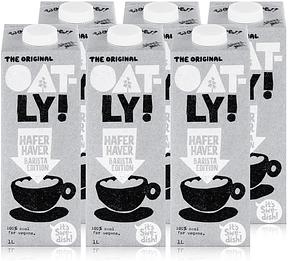
Oatly Boisson d'Avoine Barista Edition - Paquet de 6 (6 x 1 litre)
View at AmazonAffiliate link. Buying through it earns us a commission; the price stays the same for you.
Soy: the best hold-to-effort ratio, if you manage acidity
Soy is the only common family whose protein content genuinely stands comparison with dairy. The foam is dense, you can cut it with a knife, it survives a latte-art pour. Its weakness is not frothing but sensitivity to coffee acidity, covered in detail below.
Alpro Soja Barista - Boisson 100 % végétale, 1 L
View at AmazonAffiliate link. Buying through it earns us a commission; the price stays the same for you.
Almond: buy it reformulated or not at all
A standard almond drink is essentially water, a little fat and very little protein. Under a steam wand it produces a coarse-bubbled foam that is gone before the cup reaches the table. Versions built specifically for coffee correct this by adding what the raw material does not supply, and that is the only branch of this family worth steaming.
Alpro Spécial pour Café Amande - Boisson végétale amande barista, 8 x 750 ml
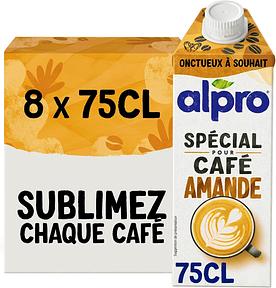
Alpro Spécial pour Café Amande - Boisson végétale amande barista, 8 x 750 ml
View at AmazonAffiliate link. Buying through it earns us a commission; the price stays the same for you.
What the word "barista" actually changes in the carton
"Barista" is not a regulated term. So it guarantees nothing — but it is not pure marketing dressing either, because the contents of these cartons differ in reproducible ways. A formulation aimed at coffee is trying to survive two stresses the standard version never meets: steam heating, and contact with a hot, acidic liquid.
In practice, three levers show up on the ingredient list:
More fat. Usually an added vegetable oil, which supplies body and stops the foam from being dry.
More protein, where the raw material allows it — the main axis for soy and pea versions, less so for oat.
Acidity regulators and stabilisers. The most common is dipotassium phosphate, often listed under the additive name E340; it acts as a buffer, meaning it limits the pH drop when the drink meets coffee. Gums (gellan, guar) that thicken the water phase are common too.
The buffer is the most interesting part, because it explains why a barista carton splits far less than a standard one in the same espresso. It is not the foam being protected: it is the protein, prevented from reaching the pH at which it precipitates.
The practical corollary is simple: read the ingredient list, not the word on the front. A carton that says "barista" with no added oil, no stabiliser and the same protein content as the standard version is barista in name only. A professional-range carton with no barista claim on the front can easily do better.
The logic of the large format
An opened plant drink gets used quickly, and the carton keeps only a few days once opened. If you pull several milk drinks a day, the multi-carton format has real consumable logic — and it is the cheapest way to test a formulation over time rather than over a single cup.
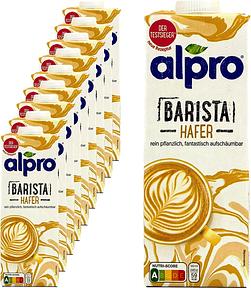
Alpro Boisson à l'Avoine Barista - Lot de 10 x 1 L
View at AmazonAffiliate link. Buying through it earns us a commission; the price stays the same for you.
The "for professionals" ranges
Alongside consumer barista cartons sits a category aimed at cafés, formulated for heavy use and cup-to-cup consistency. These are often the most protein-rich references on the shelf, which makes them a useful benchmark when you want to know how far a family can actually go.
Alpro Soya for Professionals - 1 L
View at AmazonAffiliate link. Buying through it earns us a commission; the price stays the same for you.
Milk that splits: it isn't the carton, it's the pH
This is probably the most useful thing in this guide, because it moves the solution: when your plant milk goes grainy in coffee, it is almost never a faulty or expired carton.
A protein carries an electrical charge that depends on pH. At one particular pH, called the isoelectric point, that charge cancels out. The proteins stop repelling each other, clump together and become barely soluble — that is what the flecks on top of your latte are. A study published in Foods in January 2023 measured this behaviour on plant and dairy proteins and found minimum solubility around pH 5.0, with protein agglutination as the isoelectric point is approached.
And filter coffee or espresso sits precisely in that zone. A study published in Scientific Reports in October 2018 measured the pH of hot-brewed coffees and reports values between 4.85 and 5.10 depending on origin, with the Ethiopian sample the most acidic of the set. Pouring a plant drink into an espresso therefore drops its proteins straight into their precipitation window.
Three factors make the reaction worse, and you can act on all three:
- Coffee acidity. A light, floral, high-acidity coffee — typically an African origin at a light roast — pushes the mixture deeper into the critical zone than a darker roast does. If one milk splits every time, try that same milk on a different coffee before blaming the carton.
- Temperature. Heat denatures proteins and accelerates clumping. That is why a plant milk that behaves in a warm coffee can split in the same coffee served scalding.
- Thermal shock. Pouring fridge-cold milk into a very hot espresso creates, right at the point of contact, a zone that is both hot and acidic. Pouring slowly, in a thin stream, down the side of the cup cuts the effect noticeably.
One detail from the same 2023 study is worth knowing because it is counter-intuitive: the foaming capacity of the proteins tested was higher in acidic conditions (pH 3.0) than at neutral pH, while it was lowest near the isoelectric point (pH 5.0). Acidity as such is not the enemy of foam — the narrow band around the isoelectric point is. Which also explains why the acidity regulators added to barista formulations work: they do not remove the acidity, they stop the mixture settling in the wrong window.
Adapting your steaming technique to plant drinks
The settings that work on dairy do not transfer as they are. Three differences matter.
The cut-off temperature is lower and far less forgiving. With dairy, going past target degrades flavour. With plant drinks, overheating also destroys the structure: proteins coagulate, the foam separates, and the whole thing is unrecoverable. A target of 55–65 °C (130–150 °F) is a sensible starting point for most plant drinks, and it is better to stop early than late — foam that is slightly cool can be rescued, cooked foam cannot.
The aeration phase is shorter. The characteristic tearing sound — the stretch during which you introduce air — should be briefer than with dairy, especially on high-fat drinks. Too much air on a low-protein base gives a coarse foam that will not smooth out afterwards.
Whirling matters more. Because globular proteins unfold through mechanical agitation, the vortex phase — wand submerged, no more air going in, milk spinning — is not optional. That phase is what turns big bubbles into microfoam. A pitcher whose shape sustains that vortex makes the movement far more repeatable; our essential barista accessories guide covers the selection criteria, size and spout included.

Not available in your region — closest match
View at Amazon (as of Aug 15)Affiliate link. Buying through it earns us a commission; the price stays the same for you.
Measure rather than guess, while you're learning
The hand-on-the-pitcher method is a decent instrument once calibrated, but it gets calibrated on dairy and misleads you on plant drinks, whose behaviour changes more abruptly in the last few degrees. A clip-on thermometer for two or three weeks is enough to anchor the reference point, after which it ends up in a drawer — which is exactly as it should be.
Thermomètre à Lait Barista - Sonde Inox 127 mm, Cadran 45 mm avec Zone Verte 55-68 °C
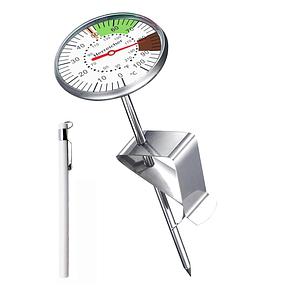
Thermomètre à Lait Barista - Sonde Inox 127 mm, Cadran 45 mm avec Zone Verte 55-68 °C
View at AmazonAffiliate link. Buying through it earns us a commission; the price stays the same for you.
Which milk for which drink
There is no single winner, because the three common uses do not demand the same thing.
Latte art and a structured cappuccino: soy, or an oat explicitly formulated for coffee. This is the case where protein content decides the outcome.
A flat white or a morning latte with no design ambitions: a barista oat gives the best compromise between creamy texture and a flavour that stays neutral against coffee.
A long black or a barely-foamed drink: here the choice becomes purely a matter of taste, and almond or hazelnut regain all their appeal.
And if a milk splits, work the problem in order: temperature first, then coffee acidity, and only last the carton. Our espresso dial-in settings guide covers the extraction side, which is often the real variable when only one of your drinks misbehaves.
All products from this post
The ones we named above are marked; the rest are alternatives in the same category.
Not available in your region — closest match
Anker Powerbank, 20.000mAh tragbares Ladegerät mit integriertem USB-C-Kabel, 87W Max Schnellladung, kompatibel mit MacBook, iPhone, Samsung und mehr
View at Amazon (as of Aug 15)
Affiliate notice: As an Amazon Associate, we earn from qualifying purchases. Product prices and availability are subject to change.
Frequently Asked Questions
Which plant milk froths best?
Soy, in the vast majority of cases: it is the most protein-rich of the common families, and protein is what structures foam. An oat drink formulated for coffee comes in just behind, with a creamier texture but a foam that holds less well. Almond, hazelnut, coconut and rice froth poorly in their standard versions, for want of enough protein.
Why does my oat milk curdle in coffee?
Because coffee is acidic, around pH 5, and plant proteins reach their minimum solubility at exactly that pH: they clump instead of staying dispersed. Heat speeds the reaction up. So it is not a sign that the carton has gone off. Pour slowly, lower the milk temperature, or change coffee before you change brand.
What is the difference between a barista carton and a standard one?
Three differences recur on ingredient lists: more added fat, often more protein, and above all acidity regulators such as dipotassium phosphate that limit the pH drop on contact with coffee. The claim is not regulated, so it guarantees nothing on its own — the ingredient list on the back is what settles it.
What temperature should I stop plant milk at?
Between 55 and 65 °C (130–150 °F) for most plant drinks, which is lower than the usual dairy range. Past that, proteins coagulate, the foam separates from the liquid, and the result cannot be rescued. With plant drinks it is better to stop slightly too early than slightly too late.
Can rice milk froth?
Only with great difficulty. A rice drink is almost entirely sugars, with very little protein and very little fat: there is next to nothing left to stabilise the interface between air and liquid. The bubbles you get are large and vanish within seconds. It is a drink to keep for unfoamed coffees.
Should I start with plant milk very cold, as with dairy?
Less so than with dairy. A 2023 review notes that dairy milk froths markedly better than plant-based beverages at 4 °C (39 °F), but that the properties become comparable at 65 °C (149 °F). The advantage of starting very cold is therefore mostly a dairy advantage. With plant drinks, what matters more is keeping the aeration phase short and the vortex clean.
Sources
- they unfold under mechanical stirring pmc.ncbi.nlm.nih.gov
- roughly 40% protein for the soybean, 11–15% protein and 5–9% lipids for oats, and about 25% protein for almonds pmc.ncbi.nlm.nih.gov
- minimum solubility around pH 5.0, with protein agglutination as the isoelectric point is approached pmc.ncbi.nlm.nih.gov
- reports values between 4.85 and 5.10 depending on origin pmc.ncbi.nlm.nih.gov