Ceramic vs steel burrs: which material should your coffee grinder have?
 14 min read
Updated September 28, 2026
Search for "ceramic vs steel burrs" and read the first few results back to back. One retailer tells you ceramic lasts far longer. The next one says steel is much tougher. A third adds that ceramic doesn't heat up at all. You close the tab fairly sure at least one of them is making things up.
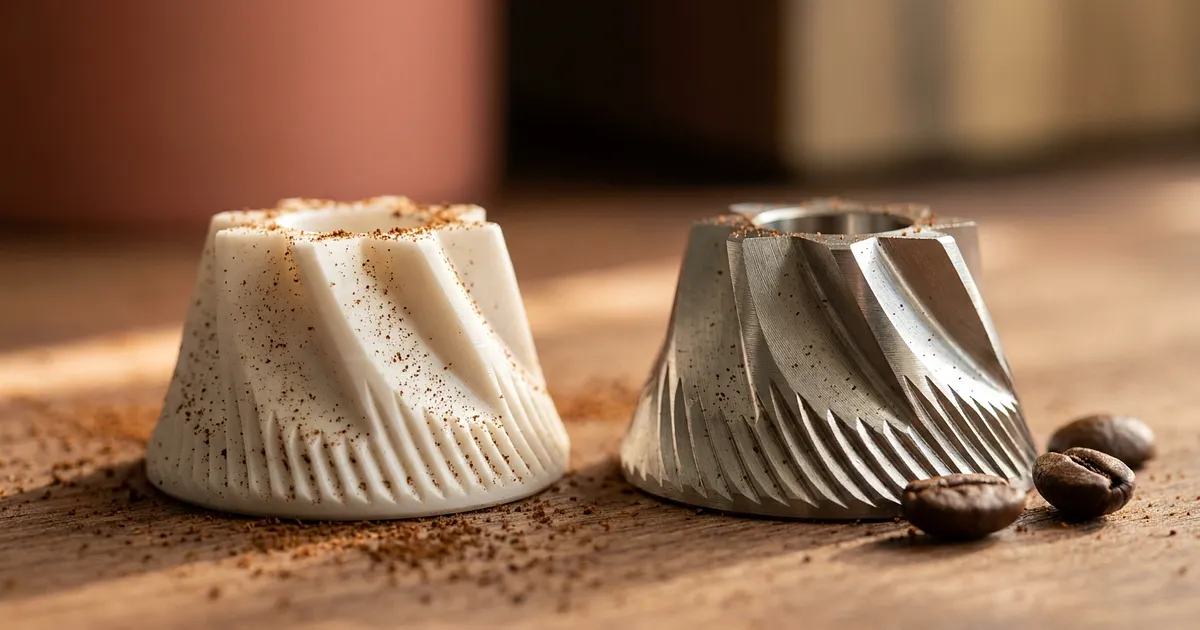
They aren't, really. They're describing two different properties of the material, and none of them bothers to say so. Ceramic handles wear better, steel handles impacts better. In materials science those are two separate measurements (hardness on one side, toughness on the other), and they don't contradict each other. Once that clicks, choosing between ceramic and steel burrs gets a lot simpler.
Ceramic or steel: what are we actually comparing?
The burr is the part that crushes the bean. In a burr grinder it's made either of technical ceramic, usually zirconia, or of steel, stainless or hardened. The motor and the housing have nothing to do with this choice, and neither does the adjustment ring.
A quick vocabulary note, because product listings mix everything up. In a bean-to-cup machine the grinding unit is built in; a standalone grinder is its own appliance, manual or electric. And a blade grinder has no burr at all: a spinning blade chops the beans, so the material question never comes up. If you're still torn between blades and burrs, get burrs. That debate is short.
You'll also run into two hardness scales on spec sheets. Rockwell (HRC) for steel, Vickers (HV) for ceramic. You can't convert one to the other in your head, which makes comparing two spec sheets genuinely annoying. Steel makers talk HRC, ceramic makers talk HV, and each stays in its own lane.
Do ceramic burrs really last longer than steel?
Yes, against normal wear. Zirconia is much harder than stainless steel, so its edges round off far more slowly as beans pass through. The "ceramic lasts longer" claim is correct, as long as you're clear it's about wear.
The numbers back it up. According to AZoM, zirconia's hardness sits between 5,500 and 15,750 MPa. Mapped onto SAMaterials' comparison charts, that's roughly 1,200 to 1,500 HV for the ceramic, against 200 to 300 HV for a common stainless steel.
Why does that matter? A roasted bean isn't very hard, but it is abrasive, and a burr sees an enormous amount of it. Over time a steel edge dulls and starts crushing instead of cutting, so the grind gets less even. Ceramic takes much longer to get there.
That doesn't mean steel gives up quickly. On the Home-Barista forum, regulars measure a steel burr's life in coffee ground rather than in years: somewhere around 500 to 1,000 lb. For someone going through a bag a week, that's several years before a burr swap. It's enthusiast consensus, not a lab measurement, and we're presenting it as such.
So yes, on wear, ceramic wins. For home use, though, steel already lasts long enough that this probably won't be what decides it for you.
Are ceramic burrs more fragile than steel burrs?
Against a hard knock, yes. Ceramic is brittle: when it meets something harder than itself, it doesn't bend, it cracks or chips. Steel gives a little and almost always comes through.
That's down to toughness, not hardness. Morgan Technical Ceramics, a technical ceramics manufacturer, classes ceramics as low-toughness materials that fail with little deformation, while steel is ductile and soaks up impact energy by deforming. For zirconia, Syalons puts fracture toughness at roughly 3 to 10 MPa√m depending on the formulation. Pretty good for a ceramic. Still nowhere near a metal.
The nightmare scenario is always the same one: a small stone or a staple left in a bag of beans (bits of bark turn up too). A steel burr grinds against it and carries on. A ceramic burr can lose a chip or split clean through. It's rare. But it's exactly what the "ceramic is fragile" pages are thinking of.
Here are the two properties side by side, with heat thrown in:
| Property | Ceramic (zirconia) | Stainless steel | What it means for you |
|---|---|---|---|
| Hardness, i.e. wear resistance | 1,200 to 1,500 HV (SAMaterials) | 200 to 300 HV (SAMaterials) | ceramic keeps its edge longer |
| Toughness, i.e. impact resistance | low, 3 to 10 MPa√m depending on formulation (Syalons) | high, ductile material (Morgan) | steel survives a stone, ceramic can crack |
| Thermal conductivity | 1.7 to 2.7 W/m·K (AZoM) | 16 to 25 W/m·K depending on grade (EngineeringToolbox) | ceramic passes on less friction heat |
Two measurements, two winners. Nobody's lying. Everybody's oversimplifying.
One tip from the enthusiast crowd works for both materials. On Home-Barista, the most common defence against a broken burr isn't switching materials, it's looking at your beans before they go into the hopper. Takes a few seconds, and it protects ceramic and steel alike.
Why does De'Longhi only put steel burrs in its bean-to-cup machines?
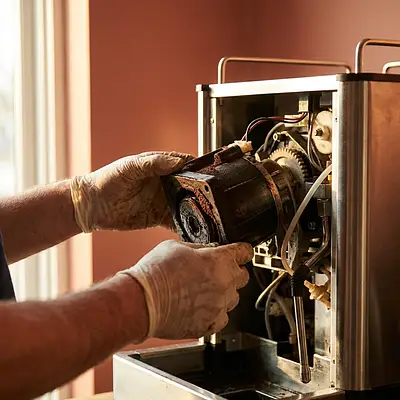
Because a bean-to-cup machine grinds beans nobody sorts. As De'Longhi explains in its official FAQ (a French-language page), every one of its bean-to-cup machines is fitted with steel burrs paired with a slip clutch, precisely because a ceramic burr would break on contact with a foreign object. The brand sums it up in one line: "a steel grinder doesn't break."
The clutch does the rest. When the burr hits something hard, it disengages the drive belt, so neither the motor nor the burr takes the full hit. With a ceramic burr, that same stone could crack it before the clutch even kicks in.
We think it's a sensible call, and we don't read it as cost-cutting in disguise. With a bean-to-cup machine you tip a whole bag into the hopper without looking, and a cracked burr buried inside the appliance means a trip to the service centre. Steel is the reasonable answer to that.
One caveat: this is a manufacturer explaining its own product, so it's bound to favour its own choice. The physics above does back it up, though. For Jura, Krups or Philips we didn't find an equally clear statement, and that's actually a question we settle in our Krups vs De'Longhi comparison and in our look at whether the Jura price is worth it. If the material matters to you, look for the burr line on the spec sheet, or ask customer service before you buy. For the full picture beyond just the burr, see our full bean-to-cup machine comparison.
Do ceramic burrs run cooler, and does it change the taste?
Ceramic conducts heat much less readily than steel, so less friction heat makes it into the grounds. For a single espresso dose at home, we suspect the difference in the cup is modest. For a grinder running all day in a café, it matters more.
Here are the orders of magnitude. EngineeringToolbox's tables put stainless steel at about 17 W/m·K. By grade, you get 16.2 W/m·K for 304 stainless (TheWorldMaterial) and 24.9 W/m·K at 100 °C for 420 stainless (MechDatum), a grade close to cutlery and burr steels. Zirconia sits between 1.7 and 2.7 W/m·K (AZoM).
Even pitting the least conductive steel against the most conductive ceramic, 16.2 against 2.7, steel moves heat six times better. Depending on the grades you compare, the gap can pass ten times (our own arithmetic from the figures above).
Be careful what these numbers actually say, though. They're bulk material properties measured under standard conditions, not a temperature taken inside a grinder mid-grind. You'll probably find temperature gaps quoted online down to the degree, credited to "a study" that's never properly named. We went looking for that study and couldn't find it. So no degrees here.
The most useful testimony comes from a company that works in steel. In a 2022 interview with Perfect Daily Grind, Giulia Bagato and Chiara Nalin of Italian grinder maker Fiorenzato acknowledge that steel burrs hold on to more of the heat produced while grinding, which can cost aroma and encourage clumping. Fiorenzato makes its own burrs from M340 steel and 16NiCr4 case-hardening steel. Coming from them, that admission carries weight.
What about grind consistency?
Here too, the sources disagree. The same two Fiorenzato staff say steel gives the most even particle size distribution. Some French retail sites claim the opposite, with no numbers behind it.
Our read: consistency depends first on burr geometry and alignment, much more than on material. A new, well-cut steel burr grinds at least as evenly as a ceramic one. Over the years the advantage may drift toward ceramic, since it dulls more slowly. That's reasoning, not a measurement, and we're labelling it that way.
Which is quieter, ceramic or steel burrs?
Several retailers claim ceramic is quieter. We found no sourced measurement that isolates the effect of the burr material alone, so we're not going to invent a decibel figure for you.
What makes an electric grinder loud is mostly rotation speed and the motor, then how well the housing is insulated. Burr material probably plays a small part, but it comes after all that. If noise bothers you first thing in the morning, compare the stated speed and what user reviews say about volume. Or switch to a hand grinder, which is still the quietest option there is.
Who uses what? Burr material, brand by brand
There's no rule by price or by type of appliance. Some entry-level hand grinders use ceramic, while the hand grinder enthusiasts treat as the benchmark uses steel. Commercial café grinders? Steel. The spec sheet is the only way to know.
| Brand or model | Appliance type | Burr material | Source |
|---|---|---|---|
| De'Longhi bean-to-cup range | bean-to-cup machine | steel, with slip clutch | De'Longhi FAQ |
| Mahlkönig E65S, E80S, EK43 | commercial grinder | hardened steel, 64 to 66 HRC | Mahlkönig |
| Fiorenzato | commercial grinder | M340 and 16NiCr4 steel | Perfect Daily Grind, 2022 |
| Comandante C40 | premium hand grinder | high-nitrogen stainless steel, conical | Comandante |
| Hario Skerton | hand grinder | ceramic, conical | Javry |
| Kyocera | hand and electric grinders | ceramic | Kyocera |
| Jura, Krups, Philips | bean-to-cup machines | not disclosed | no source retained |
Mahlkönig's commercial burrs are a useful marker: none of them comes in ceramic. In a café, a grinder runs all day and has to survive the odd mishap without breaking. Ceramic mostly lives in home and hand grinders, where throughput is low and flavour matters more than endurance.
Kyocera, one of the big names in technical ceramics, sells its burrs on one point in particular: they'll never rust and won't alter the taste of the grounds. That's a manufacturer's pitch, and a fairly predictable one from a company that built its name on ceramics.
Ceramic options: the Hario hand grinders
If you want a hand grinder with ceramic burrs, the two Hario models are the easiest to find. The Hario Mini Moulin à café PLUS Céramique is the compact one and slips into a drawer without fuss. The Hario Ceramic Coffee Mill Skerton MSCS-2TB is bigger: it's the Skerton from the table above, with its conical ceramic burr, sold in a 100 g version by Javry. If you want to compare other hand grinders before deciding, see our guide to manual grinders, ceramic and steel alike.
Just keep in mind that a brittle burr doesn't love being dropped. A hand grinder rolling off the counter onto a tiled floor is not a test you want it to take.
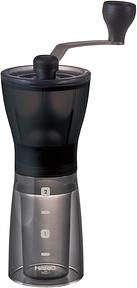
Hario Mini Moulin à café PLUS Céramique
View at AmazonAffiliate link. Buying through it earns us a commission; the price stays the same for you.
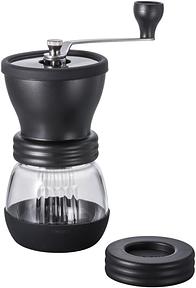
Hario Ceramic Coffee Mill Skerton MSCS-2TB
View at AmazonAffiliate link. Buying through it earns us a commission; the price stays the same for you.
Steel options: one manual, one electric
For a hand grinder with a steel burr that isn't premium-priced, the SILBERTHAL Moulin à Café Manuel en Inox 6 Niveaux is sold with a stainless steel burr. On the electric side, the OXO Brew Conical Burr 18/8 Stainless Steel Coffee Grinder uses conical steel burrs. Both suit people who grind every day, or who buy loose beans and don't always look at them closely. For more on the electric side, our electric grinder guide, burr angle included covers other criteria beyond material alone.
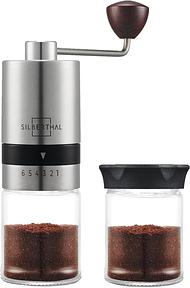
SILBERTHAL Moulin à Café Manuel en Inox 6 Niveaux
View at AmazonAffiliate link. Buying through it earns us a commission; the price stays the same for you.
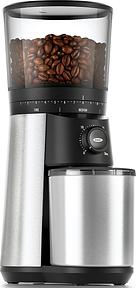
OXO Brew Conical Burr 18/8 Stainless Steel Coffee Grinder
View at AmazonAffiliate link. Buying through it earns us a commission; the price stays the same for you.
Conical or flat: a separate question
Burr shape (conical or flat) and burr material (ceramic or steel) are two independent choices. You'll find conical burrs in ceramic and in steel, and flat burrs in both materials too.
Two hand grinders prove it neatly. The Comandante, the benchmark premium hand grinder, uses a conical burr in stainless steel developed in-house (Comandante). The Hario Skerton, an entry-level best-seller, also uses a conical burr, but a ceramic one (Javry). Same shape, same job, opposite materials, and prices in completely different leagues.
Choosing a shape is its own discussion with its own trade-offs. For the material question, just remember that the shape tells you nothing.
So, ceramic or steel burrs? The verdict by use case
For a bean-to-cup machine, or for anything that works hard or travels, steel. For a hand grinder that stays at home and that you fill yourself, ceramic is a very good pick.
| Your use | Our pick | Why |
|---|---|---|
| Bean-to-cup machine | steel | hopper filled without sorting, slip clutch designed around steel |
| Electric grinder for daily espresso | steel | survives mishaps, even grind according to Fiorenzato |
| Hand grinder at home, for filter or French press | ceramic | wears slowly and doesn't rust |
| Hand grinder for travel or camping | steel | a grinder that gets knocked about doesn't pair well with a brittle burr |
| You never look at your beans before grinding | steel | that stone will get through eventually |
Before you buy, look for one line on the spec sheet: burr material. If it isn't listed, ask the seller. And whichever you pick, glance at your beans before filling the hopper. It's the only protection that works for both materials.
The rest comes down to burr geometry, your grind setting, how fresh the beans are and how carefully you dose, far more than ceramic versus steel. Honestly, that's pretty good news.
All products from this post
The ones we named above are marked; the rest are alternatives in the same category.
Affiliate notice: As an Amazon Associate, we earn from qualifying purchases. Product prices and availability are subject to change.
Frequently Asked Questions
What's the difference between ceramic and steel burrs?
Ceramic is much harder, so it wears more slowly, and it conducts less heat. Steel is tougher: it takes a knock, like a small stone in the beans, without cracking. The two claims you keep reading are both true. They just describe two different properties of the material.
Can you replace a cracked ceramic burr?
It depends on the model. On a hand grinder the burr is usually removable, but not every manufacturer sells it separately, so check spare-part availability before you buy. On a bean-to-cup machine, a damaged grinder goes back through the service centre.
Does burr material really change how coffee tastes?
A little, mostly through heat. Steel conducts it better, and grinder maker Fiorenzato acknowledges that its steel burrs hold more grinding heat, at some cost to aroma. For a home dose, we think grind setting and bean freshness matter far more than the material.
How long do steel burrs last?
Several years with home use. Regulars on the Home-Barista forum talk about 500 to 1,000 lb of coffee ground before a replacement, which works out to several years at a bag a week. That's enthusiast consensus, not a lab figure.
Can ceramic burrs rust?
No. Ceramic doesn't rust, and Kyocera uses that as a selling point for its grinders. Stainless steel holds up well too, as long as you don't leave the burrs damp after cleaning.
Should I look for a bean-to-cup machine with a ceramic grinder?
Not necessarily. De'Longhi uses only steel in its bean-to-cup machines, with a slip clutch that protects the burr from foreign objects. Other brands don't always list the material on the spec sheet. Ask the manufacturer if it matters to you, but check grind fineness and ease of cleaning first.
Sources
- SAMaterials samaterials.com
- AZoM azom.com
- Home-Barista home-barista.com
- Morgan Technical Ceramics morgantechnicalceramics.com
- Syalons syalons.com
- EngineeringToolbox engineeringtoolbox.com
- De'Longhi explains in its official FAQ delonghi.com
- TheWorldMaterial theworldmaterial.com
- MechDatum mechdatum.com
- Perfect Daily Grind perfectdailygrind.com
- Mahlkönig mahlkoenig.us
- Comandante comandantegrinder.com
- Javry javry.com
- Kyocera cutlery.kyocera.com