The quietest bean-to-cup coffee machines: grinder noise, measured in decibels
 20 min read
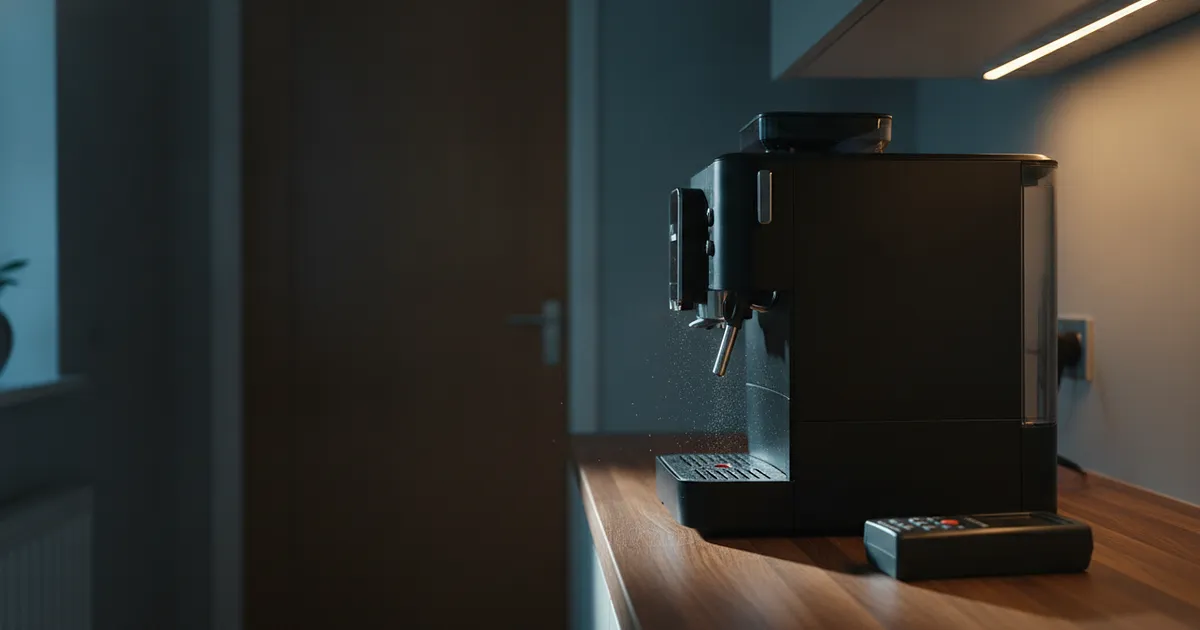
It's 6:10 a.m. You want coffee, and between you and that coffee sit eight seconds of grinder a few metres from a room where someone is asleep. It's a completely ordinary buying constraint — open-plan kitchen, thin wall, flatshare, baby — and it's also the one almost no roundup addresses, because it needs a number nobody wants to publish.
Updated 09/08/2026. The decibel values quoted here come from three third-party publications, named on every line; none were measured by Novebar.
This article rests on no in-house testing. We did not buy, measure or time these machines. What follows collects the measurements published by three third-party sources, naming each time who measured, at what distance, and on what date — because without those three facts a decibel means nothing.
First finding: manufacturers don't publish decibels
That's the starting point, and it's more absolute than you'd expect. On a bean-to-cup spec sheet you'll find pump pressure, wattage, tank capacity, the number of programmed drinks. You will not find a sound level. Not "rarely": not at all, from any of the major consumer brands.
The clearest case is Miele. The CM 5 range is literally called Silence. The product name is the acoustic claim. And yet Coffeeness's review of the Miele CM 5310 Silence — a review titled "Silence Is Golden", which insists page after page on how quiet the grinder is — contains no figure at all. Not from Miele, not from the reviewer. A machine sold on its discretion, tested by a specialist on its discretion, and zero decibels in between.
Two attempts exist to fill that gap, and neither produces a number.
Quiet Mark certification. This is an independent British body that runs acoustic lab tests and awards a badge to the quietest models in a category. It's serious work, and its list of certified coffee machines is public: several Philips LatteGo models (S2300, S3300), several KitchenAids, and on the Melitta side the Barista T Smart, Barista TS Smart and CI Touch. The problem: Quiet Mark publishes no value per model. It's a binary badge. You learn that a machine cleared a threshold, never which one, nor by how much it beats its uncertified neighbour.
Philips's "SilentBrew" marketing. Philips says its SilentBrew technology makes its machines "40% quieter" than its previous models. No decibels, no named reference model. And above all: 40% of what? If it's 40% less acoustic power, that's −2.2 dB. If it's 40% less perceived loudness — which is what a reader instinctively understands — that's −7.4 dB. Those are two completely different machines behind one percentage. A relative figure with no reference quantity isn't a specification, it's a headline.
What was actually measured, by whom, and at what distance
Three publications got out a sound level meter and published their method. Here they are, with their protocols, because the protocol is part of the number:
| Source | Distance | Stated protocol | Date |
|---|---|---|---|
| Grain d'Expert | 30 cm | sound level meter, during grinding, closed room | March 2026 |
| Coffeeness | 1 m | sound level meter, grinding / pump / frother measured separately | updated February 2025 |
| coffee-tasters.de | 1.50 m | average across the whole grind cycle, bean hopper closed | undated |
And here is what they find. An empty cell means that source did not measure that model — not that it's quiet.
| Machine | Grain d'Expert (30 cm) | Coffeeness (1 m) | coffee-tasters (1.50 m) |
|---|---|---|---|
| Siemens EQ.9 | not measured | 59.6 dB | 59.0 dB |
| Siemens EQ.700 | not measured | not measured | 61.2 dB |
| Jura E4 | 62 dB | not measured | not measured |
| Melitta Barista TS Smart | not measured | not measured | 62.5 dB |
| Siemens EQ.500 | not measured | not measured | 62.7 dB |
| Jura E6 | 63 dB | not measured | 66.5 dB |
| Philips 3300 LatteGo | not measured | 63 dB | not measured |
| Siemens EQ.900 | not measured | 63 dB | not measured |
| Melitta CI Touch | not measured | not measured | 63.1 dB |
| Jura W8 | not measured | 63.6 dB | not measured |
| Nivona NICR 825 | not measured | 64 dB | not measured |
| Jura E8 | not measured | not measured | 64.5 dB |
| Siemens EQ.300 | not measured | not measured | 65.0 dB |
| Philips 5400 LatteGo | 65 dB | not measured | not measured |
| De'Longhi Eletta Explore | not measured | not measured | 66.1 dB |
| Saeco Xelsis Deluxe | not measured | 67 dB | not measured |
| De'Longhi Magnifica Evo | not measured | not measured | 67.7 dB |
| De'Longhi Dinamica | 70 dB | not measured | 67.8 dB |
| Philips 3200 LatteGo | 68 dB | not measured | 71.3 dB |
| Philips 2200 series (EP2220) | not measured | not measured | 71.0 dB |
| De'Longhi Magnifica S | 72 dB | 71.5 dB | 71.0 dB |
| Krups Evidence One | not measured | not measured | 73.4 dB |
| Gaggia Magenta Milk | not measured | 81.7 dB | not measured |
The machines missing from this table are not missing by accident: nobody has measured them. The Miele CM 5 Silence, almost every entry-level Krups, the Smegs, the Sages — no figure published by anyone. For those machines the honest answer is "not published", and it's more useful than an invented number.
Why you cannot compare these three columns with each other
This is where most roundups go wrong, and it's what makes the table above interesting rather than disappointing.
Take the De'Longhi Magnifica S, the only model measured by all three sources: 72 dB at 30 cm, 71.5 dB at 1 m, 71.0 dB at 1.50 m. One decibel of spread across a fivefold change in distance.
In a free field, though, for a point source, doubling the distance removes 6 dB. Going from 30 cm to 1.50 m — a factor of five — should therefore remove roughly 14 dB. We observe 1 dB. Physics isn't at fault: a kitchen is not an anechoic chamber. Beyond the critical distance the reverberant field dominates, walls and worktop return the energy, and the measured level almost stops depending on how far you stand from the grinder.
Two consequences, and the second is the one that matters:
- The stated distance matters less than it looks for this kind of closed-room measurement. That's no reason to ignore it — a source that doesn't give it gives you nothing — but it isn't a conversion key between the columns either.
- The room, the furnishings and the microphone position dominate, and they change from one publication to the next. So the columns are not commensurable. You can only compare values within the same column.
The contradictions in the table confirm it, and they don't even all point the same way:
Jura E6: 63 dB at 30 cm, but 66.5 dB at 1.50 m. The closest measurement gives the lowest value — the opposite of what distance would predict.
Philips 3200 LatteGo: 68 dB at 30 cm, 71.3 dB at 1.50 m. Same inversion, 3.3 dB apart.
De'Longhi Dinamica: 70 dB at 30 cm, 67.8 dB at 1.50 m. Here the order is "normal".
Three shared models, three different behaviours. There is no correction to apply, no factor to extract: you simply read one column at a time.
And that forces an honest concession about the one result that seemed to vindicate Philips. The Philips 3300 LatteGo, fitted with SilentBrew, is measured at 63 dB by Coffeeness; the older Philips 3200 LatteGo at 71.3 dB by coffee-tasters. The 8.3 dB gap is spectacular and would land exactly where the manufacturer's claim says it should — except that it spans two different publications, which is precisely the comparison we just ruled out. That comparison proves nothing. It is merely consistent with what Philips claims.
68 dB versus 71 dB is not "a bit noisier"
The decibel is logarithmic, and reading the table as a linear scale is the mistake you make without noticing, right as you write the concluding sentence.
Two anchors are enough:
−3 dB is roughly half the acoustic power.
+10 dB is roughly twice as loud to the ear.
Those two rules do not say the same thing, and that's normal: physical power and auditory sensation are not the same quantity.
Apply them within one column. At coffee-tasters, at 1.50 m, the De'Longhi Magnifica S sits at 71.0 dB and the Jura E8 at 64.5 dB. That 6.5 dB gap is about 4.5 times the acoustic power, but only 1.6 times as loud to the ear. In other words: the Jura is clearly more discreet, and that's not nothing — but it is not "twice as quiet".
At the other end, at Coffeeness, at 1 m, between the Siemens EQ.9 (59.6 dB) and the Gaggia Magenta Milk (81.7 dB), that 22.1 dB gap is worth 162 times the power and roughly 4.6 times as loud to the ear. There, you're dealing with a different class of object.
The useful zone, in practice, is where nearly everything happens: between 63 and 68 dB, the entire middle of the table fits inside five decibels, a loudness ratio of about 1.4. It's audible if you listen for it. It is not what decides whether somebody wakes up.
Level isn't the whole story: timbre and duration
This is the honest limit of the whole article, and it deserves a paragraph rather than a footnote: a machine with a lower peak level can be the more irritating of the two.
Nobody measures duration. A grinder that runs four seconds at 70 dB and a grinder that runs ten seconds at 67 dB: the second one ranks better everywhere, and it is nonetheless the one your neighbour across the landing hears. None of the three publications reports a grind time. It's the widest hole in the entire available body of data, and there is no source to fill it.
Nor does anyone measure timbre. A steel burr spinning fast produces a high whine; a ceramic burr at lower revs produces a duller rumble. A-weighting — the "(A)" in dB(A) — already deliberately boosts the 2–5 kHz band where that whine lives, so it partly accounts for it. But it says nothing about tonality: a noise with a pronounced tonal component is perceived as more aggressive at the same level, so much so that neighbourhood-noise standards add a penalty of a few decibels for exactly that case. A 67 dB whine and a 67 dB rumble are not equivalent.
On burr material, the only quantified claim available comes from Grain d'Expert, which puts ceramic burrs on average 5 to 7 dB below steel ones, attributing the gap to lower rotation speed and less metallic friction. The table broadly agrees — Jura and Philips low, De'Longhi and Krups high — but "broadly" is not "always", and that figure remains one source's estimate, not a result the other two reproduced. At Siemens the technical argument is different: a grinder driven by a speed-regulated servo motor rather than directly coupled — which would explain why the EQ.9 and EQ.700 sit at the very bottom of both rankings they appear in.
Small does not mean quiet
This needs saying plainly, because the association is instinctive: footprint and noise are two independent constraints.
The table shows it without ambiguity. The Philips 3200 LatteGo, a narrow machine designed for small kitchens, is measured at 71.3 dB — high in the ranking. The Siemens EQ.900, a distinctly bulkier block, is at 63 dB. The Philips 2200 series, the most compact of the lot, is at 71.0 dB.
That's no accident: internal volume is exactly what lets you isolate the grinder, mount it on anti-vibration blocks and move it away from the panels. A compact machine has less room for all of that. If your main constraint is worktop width, that's a different trade-off with different winners — and this page won't settle it.
What actually works for a 6 a.m. coffee
Four levers, from most to least effective. The first is the only one that guarantees silence, and it costs nothing.
1. The pre-ground chute. Almost every bean-to-cup machine has a hatch for pre-ground coffee. It bypasses the grinder entirely: no grinder, no grinder noise. What remains is the pump and the brew unit, far below. It is the only reliable "quiet mode" that exists, it is already on your machine, and its cost is grinding the night before — so a coffee slightly duller in aroma. For a single espresso at 6 a.m., that trade is easy to defend.
2. Mechanical decoupling. All three publications measure airborne noise, in a room. They do not measure what travels through the cabinetry. A machine sitting on a hollow worktop or pushed flat against a party wall transmits vibration into the structure, and that path appears in no table anywhere. A thick silicone mat under the feet and a few centimetres of clearance from the wall are free, and they change something audible in your home that no published decibel will predict.
3. Keeping the bean hopper lid shut. coffee-tasters specifies that it measured with the hopper closed, and that's a methodological precaution precisely because it matters. Lid open, the hopper becomes a horn.
4. Total duration. Grinding lasts a few seconds. Across a whole night, the real nuisance is a short event, not a background hum. That doesn't make the problem imaginary — a brief, sharp noise wakes people very effectively — but it does mean that moving the machine one room over, or shutting a door, often achieves more than winning three decibels on the spec sheet.
Noise, neighbours and quiet hours
The rules here are set locally, and they are not the same country to country — so treat this as orientation, not legal advice.
In England and Wales, domestic noise is handled as a statutory nuisance under the Environmental Protection Act 1990, with the Noise Act 1996 defining "night hours" as 23:00 to 07:00 for the specific case of noise from dwellings. In a rented flat, the tenancy agreement and any building rules usually bite long before any of that does.
The detail worth carrying across every jurisdiction: domestic noise complaints do not generally turn on a decibel threshold. What counts is the disturbance caused, judged where the neighbour is standing. Your 63 dB machine is not "compliant" because it slipped under a line — there is no line.
That is exactly why the table above should stay a tool for comparing machines, never a certificate of conformity.
The machines: what to take away
This ranking is sorted by noise, and by nothing else. It does not reproduce the order of our general bean-to-cup coffee machine comparison, which weighs milk, maintenance and value — three criteria that play no part here. A machine can perfectly well be the better buy and the louder one.
Siemens EQ900 TQ903D03 — the only one here with a low measurement AND an explicit claim
Coffeeness measures the Siemens EQ.900 at 63 dB at 1 m, and its Amazon.fr listing is the only one of the seven carrying a named acoustic argument: "SuperSilent — significant noise reduction". The two agree, which is rare. Siemens's technical point is a grinder driven by a speed-regulated servo motor rather than directly coupled — the same architecture as the EQ.9 and EQ.700, which sit at the bottom of both rankings they appear in. At €1,518.18 (Amazon.fr, checked 09/08/2026) it is also by far the most expensive: quiet isn't free, and here it arrives bundled with everything else a flagship carries.
Siemens Machine à Café Automatique EQ900 TQ903D03, SuperSilent
Not available in your region — closest match
Philips Série 2200 EP2220/10 - Expresso Broyeur avec Mousseur à Lait, Écran Tactile
View at Amazon (as of Aug 10)Affiliate link. Buying through it earns us a commission; the price stays the same for you.
De'Longhi Magnifica Evo — mid-table, and actually measured
67.7 dB at 1.50 m at coffee-tasters: three and a half decibels below the Magnifica S, in the same column, so the gap is real and readable. That's the typical position of a modern bean-to-cup machine at €399.99. No quiet claim on the listing, no burr material stated, no dB figure — but at least somebody measured it.
De'Longhi Magnifica Evo - Perfetto Machine à Café Automatique (ECAM292.33.SB)
Not available in your region — closest match
Philips Série 2200 EP2220/10 - Expresso Broyeur avec Mousseur à Lait, Écran Tactile
View at Amazon (as of Aug 10)Affiliate link. Buying through it earns us a commission; the price stays the same for you.
Philips 2200 series EP2220 — the counter-example that settles the ceramic debate
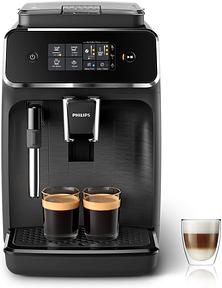
This is the most instructive product on the list, and not because it's good on this criterion. Its Amazon.fr listing announces "100% ceramic burr", in so many words, in the product title itself. And coffee-tasters measures it at 71.0 dB at 1.50 m — high in the table, neck and neck with the De'Longhi Magnifica S and its unspecified burrs.
Ceramic, then, is not enough. The 5-to-7 dB rule Grain d'Expert advances is an average, not a guarantee: the insulation of the grinder block, how it's mounted and the volume available around it clearly weigh as much as the burr material. At €262.99 it's the cheapest of the group and an excellent buy in other respects — just not for this one.
Philips Série 2200 EP2220/10 - Expresso Broyeur avec Mousseur à Lait, Écran Tactile
Philips Série 2200 EP2220/10 - Expresso Broyeur avec Mousseur à Lait, Écran Tactile
View at Amazon (as of Aug 10)Affiliate link. Buying through it earns us a commission; the price stays the same for you.
De'Longhi Magnifica S Perfetto — the loudest one measured, and yet the best equipped
Three sources, three measurements, a rare consensus: 72 dB at 30 cm, 71.5 dB at 1 m, 71.0 dB at 1.50 m. That's the top of the table, no argument.
And yet it is the only one of the seven whose spec table explicitly confirms a pre-ground coffee chute. That happens to be the single most effective lever in this entire article: the hatch bypasses the grinder, and therefore removes all 71 of those decibels. A loud machine with a reliable escape route at €287.99 can quite easily beat, in real 6 a.m. use, a machine three decibels quieter with no escape route. That's exactly the kind of trade-off a decibel-only ranking cannot express.
De'Longhi Magnifica S ECAM11.112.B - Perfetto Machine à Café Automatique avec Mousseur à Lait Manuel
Not available in your region — closest match
Philips Série 2200 EP2220/10 - Expresso Broyeur avec Mousseur à Lait, Écran Tactile
View at Amazon (as of Aug 10)Affiliate link. Buying through it earns us a commission; the price stays the same for you.
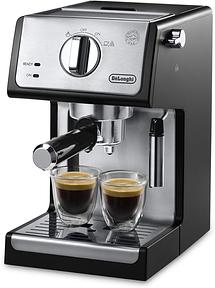
Melitta Purista F230-102 — "quiet grinder", with nothing behind it
The Amazon.fr listing says "quiet grinder" and even "ultra-quiet grinder". None of the three publications measured this model, and it is not among the Melittas certified by Quiet Mark either — the Barista T Smart, Barista TS Smart and CI Touch carry that badge, not the Purista.
That doesn't mean the machine is loud. It means that at €371.59, the acoustic argument rests on an advertising adjective and nothing else. If quiet is your main constraint, that is precisely the situation to avoid: paying for a promise nobody has checked.
Not available in your region — closest match
View at Amazon (as of Aug 14)Affiliate link. Buying through it earns us a commission; the price stays the same for you.
KRUPS Essential — unmeasured, and the neighbourhood isn't reassuring
Nobody has measured this model. The only Krups appearing in any of the three tables is the Evidence One, at 73.4 dB at 1.50 m — the highest value in the whole coffee-tasters column. It would be dishonest to derive a figure for the Essential from that: different block, different grinder, different range. But it is the only indication available, and it doesn't point towards quiet. At €299.99, buy it for its footprint and its value, not on an acoustic assumption.
KRUPS Essential Compacte - Machine à Café à Grain Automatique 15 bars
Not available in your region — closest match
Philips Série 2200 EP2220/10 - Expresso Broyeur avec Mousseur à Lait, Écran Tactile
View at Amazon (as of Aug 10)Affiliate link. Buying through it earns us a commission; the price stays the same for you.
Sage The Barista Express — a different category, to be treated as one
A portafilter machine with an integrated steel conical burr grinder, not a bean-to-cup automatic. Not measured by the three sources, and hard to compare anyway: you trigger the grinder yourself, when you choose, without the automatic cycle that chains grinding straight into extraction. The noise is the same kind of noise, but you control when it happens — which, for a 6 a.m. coffee, changes more than three decibels do. At €399.99.
One last point, verified rather than assumed: the product listings for all seven machines above were scanned on 9 August 2026 for a dB value. Not one of the seven carries one, including the one claiming a 100% ceramic burr and the one claiming "SuperSilent". It's the shortest demonstration in this whole article: on this criterion, the spec sheet will not help you.
Not available in your region — closest match
View at Amazon (as of Aug 14)Affiliate link. Buying through it earns us a commission; the price stays the same for you.
All products from this post
The ones we named above are marked; the rest are alternatives in the same category.
Not available in your region — closest match
Philips Série 2200 EP2220/10 - Expresso Broyeur avec Mousseur à Lait, Écran Tactile
View at Amazon (as of Aug 10)
Not available in your region — closest match
Philips Série 2200 EP2220/10 - Expresso Broyeur avec Mousseur à Lait, Écran Tactile
View at Amazon (as of Aug 10)
Not available in your region — closest match
Philips Série 2200 EP2220/10 - Expresso Broyeur avec Mousseur à Lait, Écran Tactile
View at Amazon (as of Aug 10)
Not available in your region — closest match
Philips Série 2200 EP2220/10 - Expresso Broyeur avec Mousseur à Lait, Écran Tactile
View at Amazon (as of Aug 10)
Affiliate notice: As an Amazon Associate, we earn from qualifying purchases. Product prices and availability are subject to change.
Frequently Asked Questions
What is the quietest bean-to-cup coffee machine?
On published data, the Siemens EQ.9 sits at the bottom of both rankings it appears in: 59.6 dB at 1 m at Coffeeness and 59.0 dB at 1.50 m at coffee-tasters. Next come the Siemens EQ.700 at 61.2 dB, the Jura E4 at 62 dB and the Melitta Barista TS Smart at 62.5 dB. A caution: these values come from different protocols and are strictly comparable only within a single source.
How many decibels is a bean-to-cup coffee machine?
Published values run from about 59 dB for the most discreet models to 81.7 dB for the loudest one measured, a Gaggia Magenta Milk. The large majority of machines sit between 63 and 72 dB while grinding. Grinding is the loudest phase of the cycle; the pump and the milk frother stay well below it.
Is a ceramic burr quieter than a steel burr?
On average yes, but the gap is more modest than the marketing implies. Grain d'Expert puts it at 5 to 7 dB, attributing it to lower rotation speed and less metallic friction. The rankings broadly agree without it holding model by model, and that quantified estimate has not been reproduced by the other two sources.
Why don't manufacturers state a noise level?
No regulation requires it for this category, unlike washing machines or dishwashers, which carry a value on their energy label. The result is that no major consumer manufacturer publishes decibels. Miele goes as far as naming an entire range "Silence" without ever giving a number, and Quiet Mark certification validates models without publishing a per-product value.
Is a 3 decibel difference actually audible?
Three decibels is roughly half the acoustic power, but only a modest difference to the ear: it takes about 10 dB to perceive a sound as half as loud. A 3 dB gap between two machines is real and audible in direct comparison, but it is almost never what decides whether somebody wakes up in the next room.
How can I make my current machine quieter?
The most effective lever is the pre-ground coffee hatch, present on most machines: it bypasses the grinder completely. After that come mechanical decoupling — a thick silicone mat under the feet, a few centimetres between the machine and the wall — and keeping the bean hopper lid shut. None of these three appears in any decibel table, and all three are audible in your own kitchen.