Your machine's pressure gauge: what the needle is actually telling you
 11 min read
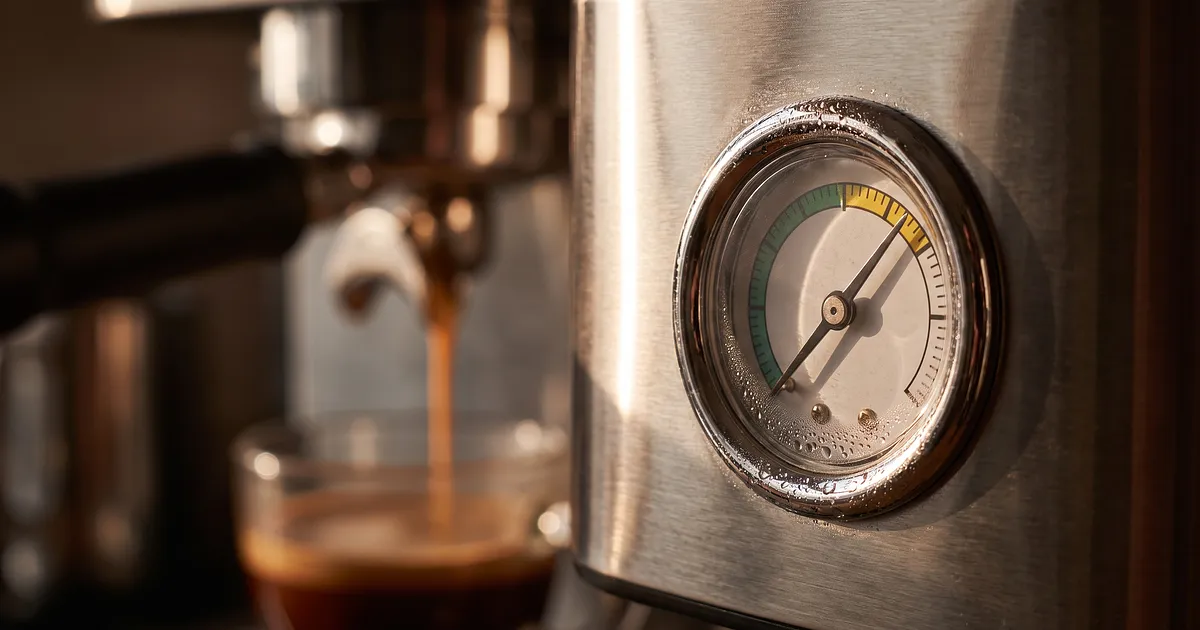
The little round dial on the front panel is the most-watched and least-understood part of a home espresso machine. You stare at it for twenty-five seconds, the needle settles into the green band, and you conclude the shot was good. That is not what the dial is telling you. It carries real, useful information — about something other than what most people assume.
That 9 bar is the target is settled: the Specialty Coffee Association places espresso extraction at 9 bar ± 1 in its standards. This guide does not re-argue that — it is covered in Why 9 bars? The ideal espresso pressure explained. The question here is different and more practical: while the coffee is running, what is the needle actually showing you?
What the gauge really measures, and it is not your coffee
On a home machine the gauge is almost always plumbed on the hydraulic side of the pump, before the group. It reads the pressure the pump develops in the circuit. Between that measuring point and the coffee puck sit tubing, a solenoid valve, a group chamber and a shower screen, and every one of them consumes some of that pressure. What reaches the coffee is always lower than what the dial displays, and the gap is not constant — it depends on how much water is flowing at that instant.
That is the mechanical reason a "correct" number guarantees nothing. Retailer Clive Coffee sets out the distinction in its explainer on brew pressure versus pump pressure: the vibratory pump in a consumer machine is typically rated for 15 bar, and an over-pressure valve — the OPV — dumps the excess back to the tank to bring the circuit toward target. The dial is watching that circuit, not the puck.
A machine like the De'Longhi La Specialista Arte EC9155.W puts its gauge front and centre with a marked extraction band. That is genuinely useful for dialling in — as long as you know the green band describes the state of the hydraulic circuit, not the quality of what is landing in the cup.
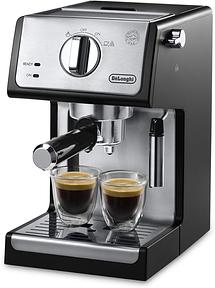
Not available in your region — closest match
View at Amazon (as of Aug 14)Affiliate link. Buying through it earns us a commission; the price stays the same for you.
The four movements of the needle, and what each one means
The information is not in where the needle ends up. It is in how it moves. A shot lasts around thirty seconds, and the dial tells that story in four beats.
1. The rise during pre-infusion
At the start the needle climbs slowly while the puck wets and swells. That gradual ramp is normal and desirable: it means the coffee is offering increasing resistance as it saturates. A near-instant jump with no lag usually means the puck is already too dense for water to pass through it.
2. The plateau
The needle steadies and sits more or less still through the body of the shot. This is the behaviour you want: the coffee's resistance and the pump's output have balanced out. A clean, stable plateau is a better signal than any exact number.
3. The needle pinned at maximum
If the needle slams to the stop and stays there while a few drops struggle out, the message is unambiguous: the puck is choking. Three causes, in order of frequency — grind too fine, dose too high for the basket, tamp crushing the bed. On a machine with a clearly readable gauge such as the Cecotec Barista Power Espresso 20 Barista Maestro, that stall is visible within the first few seconds, before you have even looked at the cup.
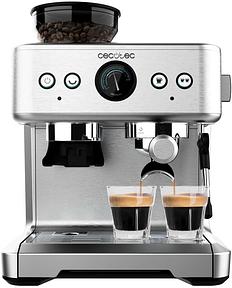
Cecotec Barista Power Espresso 20 Barista Maestro
View at AmazonAffiliate link. Buying through it earns us a commission; the price stays the same for you.
4. The needle that never climbs
The opposite symptom: pressure struggles to build, the needle floats low, and the coffee runs fast and pale. The water has found a path. Grind too coarse, dose too low, or — the nastiest case — a channel has opened through the bed and is short-circuiting the rest of the coffee. Late in the shot, a rapid fall as flow accelerates often says the same thing: the puck is eroding and giving way.
The blind basket test measures the machine, not the coffee
There is one situation in which the gauge becomes a reliable diagnostic instrument, and it is precisely when there is no coffee involved.
Put a blind basket — a solid basket with no perforations — in the portafilter and start the pump, and you remove flow entirely. The water has nowhere to go, the pump pushes against a wall, and the needle settles on the OPV's set point. Unlike the reading during a real shot, that number depends on neither grind nor tamp. It describes the machine.
This is the test to run before blaming your coffee: if the no-flow reading sits well away from target, no grind adjustment will compensate for it. A basket like the Filtre aveugle 58 mm en inox pour rétrolavage serves both this check and routine backflush cleaning. One tool, two jobs.
Two honest caveats. First, no-flow pressure is always higher than the pressure measured during a real shot, because nothing is escaping — the two readings are not directly comparable. Second, consumer manufacturers do not publish the factory OPV setting or a calibration tolerance for their gauges in their manuals, so there is no official figure to check your reading against.
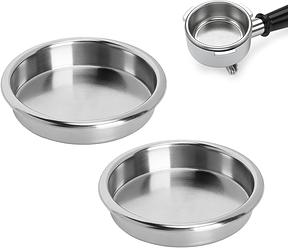
Filtre aveugle 58 mm en inox pour rétrolavage
View at AmazonAffiliate link. Buying through it earns us a commission; the price stays the same for you.
Measuring closer to the basket: a portafilter gauge
To get nearer the puck there is a dedicated instrument: a gauge that screws into the portafilter in place of the spout. A unit like the EDESIA ESPRESS — Manomètre pour porte-filtre therefore reads pressure at the basket outlet, downstream of the group and the shower screen — far closer to the coffee than the factory dial.
It still is not "pressure inside the puck", which no consumer instrument can measure: what you get is pressure at the basket outlet. But the gap between that figure and the front-panel dial is informative in itself. It is also the tool that lets you set an OPV deliberately rather than by guesswork.
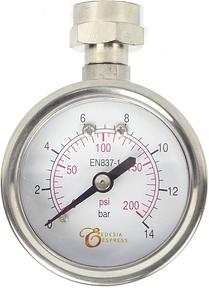
EDESIA ESPRESS — Manomètre pour porte-filtre
View at AmazonAffiliate link. Buying through it earns us a commission; the price stays the same for you.
What the gauge will never show you
A dial reports one quantity. Three decisive things escape it completely.
The channel running through the puck
Channelling is the fault pressure hides best: the needle can sit in the right band while a thread of water races through a preferred route and leaves the rest of the bed under-extracted. Work by Cameron and co-authors published in Matter in 2020 — Systematically Improving Espresso — shows that uneven flow degrades extraction independently of applied pressure. To see it you need a bottomless portafilter such as the Normcore Porte-filtre Slim Naked sans fond 58 mm (E61, ECM, Rocket): the underside of the basket becomes visible, and a jet firing sideways or a patch staying dry is obvious at once.
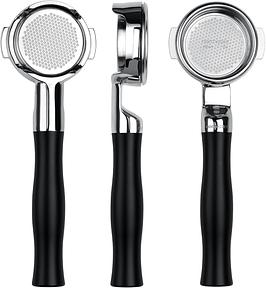
Normcore Porte-filtre Slim Naked sans fond 58 mm (E61, ECM, Rocket)
View at Amazon (as of Aug 11)Affiliate link. Buying through it earns us a commission; the price stays the same for you.
Flow rate and weight in the cup
Pressure says nothing about the ratio between dry coffee and liquid produced, which is the parameter most closely tied to taste. A scale under the cup — something like the TIMEMORE Black Mirror Basic 2 - Balance à café avec minuteur — gives real yield and real time, and it is that pair of numbers, not the needle's position, that lets you repeat a good shot tomorrow. The full set of variables is worked through in the 7 settings that decide the shot.
Not available in your region — closest match
View at Amazon (as of Aug 14)Affiliate link. Buying through it earns us a commission; the price stays the same for you.
Taste
No instrument replaces the sip. Bitterness, acidity, astringency: none of it travels through a dial.
The pressurised basket trap
This is the most common blind spot on entry-level machines, and it makes the gauge frankly misleading. A pressurised basket — dual wall, with a single small outlet hole — creates its own back pressure independently of the coffee. The result: the needle lands in the green band whatever the grind, including with supermarket coffee ground far too coarse. The dial is measuring the basket's restriction, not the puck's resistance.
For as long as you are using a pressurised basket, the gauge has no diagnostic value regarding your coffee. Swapping in a single-wall basket is the precondition for reading the needle seriously; the accessories that matter first are listed in what to buy first when you're starting out.
What if your machine has no gauge?
That is the case for most bean-to-cup machines. A unit like the De'Longhi Magnifica S ECAM22.110.B shows no dial at all, and that is not an omission: on that kind of machine pressure is not a parameter the user can change in the first place. The levers you do have sit elsewhere — grind fineness, dose, volume in the cup.
The substitute indicators are available on every machine, dial or no dial: shot time, weight in the cup for a given dose, and taste. Those three are enough to diagnose an extraction, which is another way of saying the gauge is a convenience rather than a necessity.
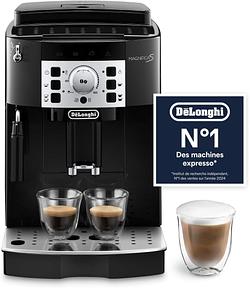
De'Longhi Magnifica S ECAM22.110.B
View at Amazon (as of Aug 11)Affiliate link. Buying through it earns us a commission; the price stays the same for you.
The lever machine is a different case
On a manual lever machine, pressure does not come from a pump but from a spring or directly from the operator's arm. The gauge changes role: it is no longer monitoring a machine, it is steering a movement in real time. A model such as the Flair PRO 3 – Machine à expresso manuelle à levier avec manomètre shows the pressure you are applying at that very moment and lets you deliberately shape a profile — gentle ramp, peak, controlled decline at the end. It is the one home context in which the needle is a driving instrument rather than a witness.
Not available in your region — closest match
View at Amazon (as of Aug 14)Affiliate link. Buying through it earns us a commission; the price stays the same for you.
The real risk: chasing a number
The classic failure mode of this dial is not breakage, it is fixation. You adjust the grind until the needle lands exactly on the marked graduation, then serve a coffee you do not enjoy, and conclude the machine is at fault.
The correct order is the reverse. The gauge exists to explain a shot — why it ran fast, why it stalled — not to define one. The target is not a needle position: it is a cup that tastes balanced, produced with a time and a yield you can repeat. The dial is an instrument reading, not the goal.
Key points
A home machine's gauge measures the pump, not the coffee. Its value is in the needle's movement — the pre-infusion ramp, the plateau, the pinned stall, the failure to build — not in the number reached. At zero flow, with a blind basket, it becomes a genuine machine diagnostic. It will never see a channel, a yield or a taste, and it lies outright behind a pressurised basket. Read that way it is a useful instrument; read as a grade awarded to your espresso, it is a source of mistakes.
All products from this post
The ones we named above are marked; the rest are alternatives in the same category.
Not available in your region — closest match
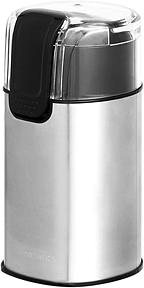
Amazon Basics Fast Electric Coffee Grinder for Home Use, Easy to Use Coffee Bean and Spice Grinder with Heavy-Duty Stainless Steel Grind Blades
View at Amazon (as of Aug 14)
Affiliate notice: As an Amazon Associate, we earn from qualifying purchases. Product prices and availability are subject to change.
Frequently Asked Questions
My gauge reads 9 bar but the espresso is bad — why?
Because the dial measures pump pressure upstream of the group, not the pressure actually applied to the coffee. Between the measuring point and the puck, tubing, a solenoid valve and the shower screen absorb part of it. A channel through the bed can also let water pass without the circuit pressure moving. The needle's position says nothing about taste: judge on time, weight in the cup and tasting.
What is a blind basket for, in relation to the gauge?
It blocks all flow. The pump pushes against a closed circuit and the needle settles on the over-pressure valve's set point. That figure describes the machine rather than the coffee, since neither grind nor tamp is involved. It is the one simple test that tells you whether the pump is correctly set before you start blaming your beans.
Why does the needle sit at maximum with almost no coffee coming out?
The puck is offering too much resistance. In order of frequency: grind too fine, dose too high for the basket in use, or excessive tamping. A clogged basket or shower screen produces the same symptom. Open the grind one step, then check the dose before changing anything else.
Is a portafilter gauge more accurate than the machine's own?
It measures closer to the coffee, at the basket outlet, downstream of the group and shower screen, so it is a more relevant reading than the front-panel dial. It still does not give pressure inside the puck, which no consumer instrument can measure.
Is a gauge reliable with a pressurised basket?
No. A dual-wall basket creates its own back pressure through its outlet hole, independently of the grind. The needle lands in the green band in almost every case, including with badly ground coffee. Move to a single-wall basket before giving the reading any diagnostic weight at all.
Is a machine without a gauge worse?
No. On a bean-to-cup machine pressure is not a user-adjustable parameter, and a dial would offer no action you could take. Shot time, weight in the cup and taste are enough to diagnose an extraction on any machine.