Light, medium or dark roast for espresso: which one should you buy?
 16 min read
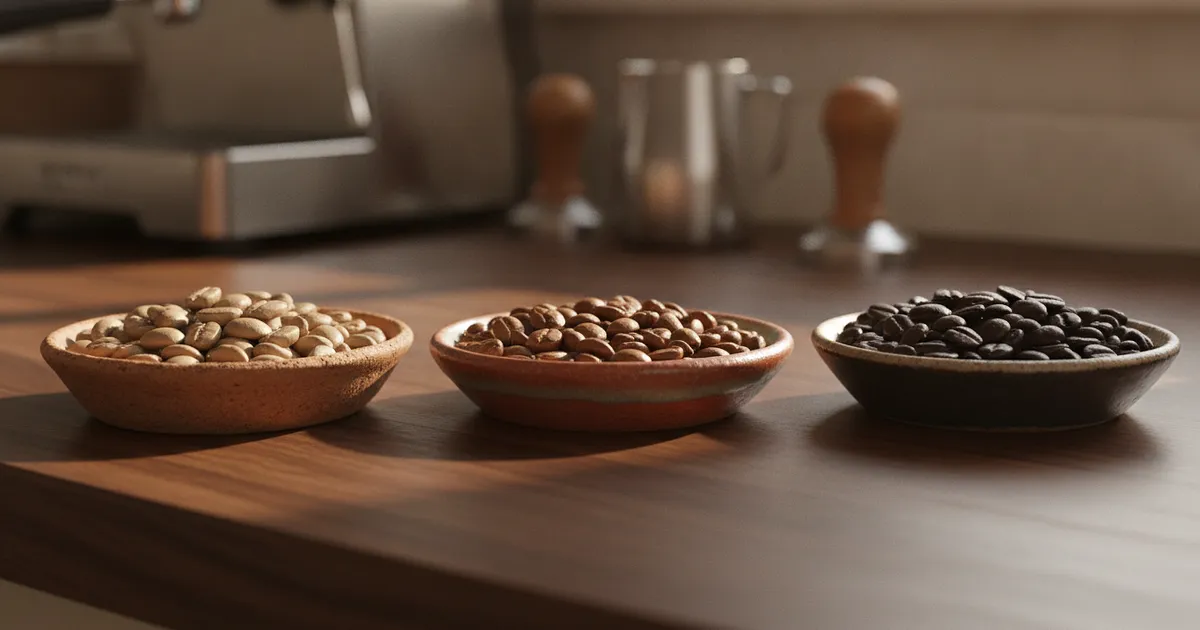
Roast level is almost always framed as a taste question. Light if you like acidity, dark if you like body, medium if you would rather not commit. That is true, and it is the least useful half of the answer, because it says nothing about what happens inside the grinder and the basket.
The useful half is mechanical. Roasting does not only change how a bean tastes: it changes its physical structure and its solubility. A dark bean is more brittle and gives up soluble material faster than a light one. At the same grinder setting, the two do not produce the same particle size, the same flow rate, or the same extraction.
Which is where the most common kitchen mishap comes from. You finish a bag, you open another one, and your espresso is unrecognisable overnight. Nothing is wrong with the machine. The coffee changed, and the setting did not follow.
What roasting actually does to the bean
Green coffee is dense, damp and almost insoluble. Roasting drives off its water, triggers Maillard and caramelisation reactions, and rebuilds its internal structure. In Espresso Coffee: The Science of Quality (Illy and Viani, Elsevier, 2005), the roasted bean's matrix is described as a network of evacuated cells 20 to 40 µm across, framed by cell walls: a rigid sponge where there used to be a solid block.
Three consequences matter for espresso, and they all pull in the same direction.
The bean becomes brittle. The further the roast goes, the weaker the cell walls get. A dark bean fractures more easily than a light one — visibly so, since it crushes between two fingers where a light bean resists.
The bean becomes more soluble. Polysaccharides are partly broken down into simpler compounds that hot water mobilises quickly. A dark roast surrenders its soluble material faster, which is a genuine advantage in espresso, where water is in contact with the coffee for only a few dozen seconds.
The acid profile collapses. Chlorogenic acids, largely responsible for perceived acidity and astringency, degrade under heat. Fuller and Rao (Scientific Reports, 2017) measured markedly higher chlorogenic acid concentrations in lightly roasted coffee than in the same coffee roasted darker. How much is lost depends on origin and roast profile — there is no single published figure that settles it.
The roasted bean also retains CO₂ in those evacuated cells, and both the quantity retained and the degassing rate depend on roasting conditions (Wang and Lim, Food Research International, 2014). That is why a very fresh, very dark coffee can produce spectacular crema and unstable extraction for its first few days in the hopper.
The three levels, and what they actually give you
Here is what each family delivers in the cup, bearing in mind that the boundaries are fuzzy and no two roasters mean the same thing by "medium".
| Level | Perceived acidity | Body / bitterness | Solubility | Demand on the grinder | Margin for error when dialling |
|---|---|---|---|---|---|
| Light | high, often fruity or citric | light body, low bitterness | low | high: a fine, consistent grind is mandatory | narrow |
| Medium | moderate, often dried fruit or caramel notes | medium body, restrained bitterness | medium | moderate: within reach of most decent grinders | wide |
| Dark | low to almost none | thick body, pronounced bitterness, roasty notes | high | low: forgives an average grinder | moderate, but tips quickly into burnt |
The column that matters most is neither acidity nor body: it is the margin for error when dialling in. A light roast punishes an imprecise grinder. A medium roast is the one that gives an acceptable result across the widest range of setups, and that — far more than flavour — is why it is almost always the right starting point.
Why changing roast level breaks your dial-in
This is the most concrete point in the article, and the one that explains most of the "my machine is broken" posts on forums.
The two effects described above stack instead of cancelling out:
- Brittleness changes the grind. At the same grinder setting, with the same burr gap, a dark bean fractures more readily and produces a finer grind with more very fine particles. The puck therefore resists water more.
- Solubility changes the extraction. That same dark bean also gives up its material faster. For the same contact time, you extract more.
So what happens when you go from a light bag to a dark bag without touching the setting: the shot slows down and the extraction rises. The cup arrives late, dark, bitter, sometimes ashy. The natural reflex — "it's the machine" — is wrong. The correct move is to open the grinder coarser.
The other way round, going from dark to light with nothing changed: the grind is effectively coarser, the puck resists less, the shot gushes, and the less soluble coffee has not had time to give up much of anything. Sour, short, watery. The correct move is to tighten the grinder finer.
The rule fits on one line: open up as you go darker, tighten as you go lighter. And this is not a cosmetic tweak — on many machines the gap between the right setting for a light roast and the right setting for a dark one is several clicks.
One clarification that heads off a common piece of faulty reasoning: the fact that a dark bean "grinds finer" is not an argument for grinding it finer. It is the exact opposite. It already grinds finer on its own, and it already extracts faster: both push toward over-extraction, so you compensate by opening up. The full method for finding a stable setting after a bag change is in our guide to dialling in espresso at home.
The honest trade-off: light roast demands a real grinder
This is where a lot of specialty-coffee advice goes wrong the moment it leaves the world of high-end machines.
A light roast is dense and poorly soluble. To get anything out of it in 25 to 30 seconds you need a substantially finer grind — and above all a consistent one. A grinder producing a wide particle distribution (lots of very fine particles alongside coarse ones at the same time) creates preferential paths through the puck: water runs through the least dense zones, over-extracts the fines and leaves the rest untouched. In the cup that gives you coffee that is sour and bitter at once, which is the single most reliable sign of a grind problem rather than a recipe problem.
The built-in grinders in entry-level bean-to-cup machines are designed for a broad brief: long coffee, lungo, milk drinks. Many do not go fine enough for a light-roast espresso, and those that do often get there at the cost of poor consistency.
The practical conclusion is uncomfortable: recommending a specialty light roast to somebody with an entry-level bean-to-cup machine is bad advice. The coffee will be expensive and disappointing, and the owner will conclude they do not like specialty coffee when in fact they never had the equipment to extract it. On that class of machine, a well-made medium roast beats a badly extracted light roast comfortably.
If the grinder is what is actually holding you back, we compared standalone models in our guide to the best electric burr grinders, and we covered the built-in-versus-separate question in a dedicated article.
"Italian roast", "espresso roast": marketing words, not a scale
On a bag of coffee, the labels "Italian roast", "French roast", "espresso roast" or "full city" carry no normative definition. They are not measured categories, they are commercial descriptions. Two bags carrying the same label can be several minutes of roasting apart.
A standardised scale does exist. The Specialty Coffee Association established a colour classification system with Agtron: eight reference discs numbered from 95 ("very light") to 25 ("very dark"), in steps of 10. A roaster who publishes an Agtron number is saying something verifiable; a roaster who writes "intense" is saying nothing measurable.
The catch is simple: that number is almost never printed on a consumer bag. It circulates between professionals, on spec sheets and at competitions, not on shelves. For a buyer, that means falling back on indirect clues:
Bean colour, compared against a bag you already know.
Surface oil. Glossy beans mean the oils have migrated outward, which happens in longer roasts, generally past second crack.
The flavour descriptors. A bag promising "cocoa, toasted hazelnut, spice" is almost always darker than one promising "citrus, red fruit, floral".
The roaster's own scale, where they publish one. It is only comparable to itself, but it is at least consistent across that roaster's range.
Burnt coffee is a bean problem, not a technique problem
A meaningful share of supermarket "espresso" coffee is taken very far in the roast. The beans arrive glossy, nearly black, and smell of smoke before they are even ground. There is an industrial logic to it: a very long roast flattens out heterogeneous lots, masks raw-material defects, extends perceived stability and delivers a bitterness that reads immediately as "strong coffee".
What that implies in the cup needs saying plainly: once a bean is carbonised, no setting rescues it. The bitterness is not an over-extraction you could dial away, it is already in the bean. You can soften it by opening the grind, shortening the ratio, dropping the temperature if the machine allows — and you then get a coffee that is less bitter and hollower, because you are extracting less from a bean that had little left to give anyway.
The test is easy to run at home: if a coffee stays acrid and ashy at every setting, and another bag in the same machine at roughly the same setting gives you something drinkable, the problem was never your technique.
None of which makes dark bad. A controlled dark roast, stopped short of carbonisation, is a perfectly legitimate choice — it is the historical norm for Italian espresso, often on arabica-robusta blends, and there is no reason to treat it as a defect. The line is not "dark", it is "burnt", and only people who have never tasted a well-made dark roast confuse the two.
Choose for your machine, not for the trend
The simplest way to decide is to start from the equipment rather than the marketing.
Entry or mid-range bean-to-cup machine — aim for a medium to medium-dark roast, on a blend built for espresso. This is where these machines do their best work: soluble material readily available, wide margin for error, no dependence on an ultra-fine grind.
Portafilter with a decent grinder — a medium roast is the best learning ground. Soluble enough to forgive, expressive enough that your adjustments actually show up in the cup. This is the level to learn to dial in on.
Portafilter with a good dedicated burr grinder — specialty light becomes playable, and this is where it makes sense. Budget a longer dial-in phase, a substantially finer grind, and accept wasting a few shots while you find the window.
Classic Italian espresso drinker — commit to a dark roast, but pick a roaster who handles it well rather than the darkest bag on the shelf. Robusta in the blend is not a flaw: it brings body and crema, and it is a stylistic choice rather than a shortcut.
Concrete reference points, bag by bag
One field observation before the list, and it confirms the section above: across the best-selling whole-bean coffees in the French market, the word "light" barely appears at all. Mainstream brands communicate through an in-house numbered intensity scale and through words like "amber", "medium" or "brown". The light / medium / dark vocabulary everybody uses to talk about roast is not even the vocabulary of the shelf.
So the reference points below quote what each product listing states about itself. Where a listing declares no roast level at all, that is written as such rather than guessed.
Dark roast, declared
Café en grains Kimbo Espresso Napoletano, torréfaction foncée, 1 kg
The listing explicitly states a "dark roast" and an intensity of 10 out of 12 on the brand's own scale. The arabica/robusta ratio is not given on the page. This is the classic Neapolitan profile: thick body, unapologetic bitterness, highly soluble — so it wants a coarser grind than whatever you run for a lighter coffee.
Carte Noire Café en Grains Espresso, Intensité 10, 100% Arabica, Torréfaction Brune, 1 kg
Declared as a "brown roast", intensity 10, and 100% arabica from South America and South-East Asia according to the listing. Useful for understanding that a dark roast does not necessarily imply robusta: here the intensity comes from how the roast was taken, not from the species.
LAVAZZA - Café Grain Lavazza Qualità Oro - 100% Arabica - Paquet de 1 kg
"Medium roast", intensity 5, 100% arabica across six varieties per the listing. It is the most-reviewed reference in the whole-bean category, and it is a defensible starting point for exactly the reason set out above: a wide margin for error when dialling in.
Café en grains Kimbo Espresso Classico, torréfaction moyenne, 1 kg
"Medium roast", 80% arabica and 20% robusta, a ratio stated explicitly on the listing. Its value here is comparative: it is the same roaster as the Neapolitan above, at a different roast level. Buying both and running them through the same machine is the cleanest way to taste in the cup — and see at the grinder — what this article describes.
Carte Noire Café en Grains Classique, Pur Arabica, Torréfaction Ambrée, 2 x 1 kg
"Amber roast", pure arabica from Central and South America. Note that this brand distinguishes its "amber" from its "brown", meaning it places this reference one step lighter than its own espresso SKU. A good example of a roaster's in-house scale: coherent inside the range, incomparable with anyone else's.
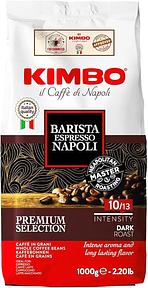
Café en grains Kimbo Espresso Napoletano, torréfaction foncée, 1 kg
View at AmazonAffiliate link. Buying through it earns us a commission; the price stays the same for you.
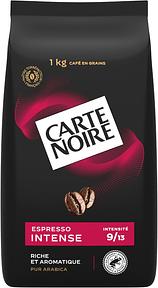
Carte Noire Café en Grains Espresso, Intensité 10, 100% Arabica, Torréfaction Brune, 1 kg
View at AmazonAffiliate link. Buying through it earns us a commission; the price stays the same for you.
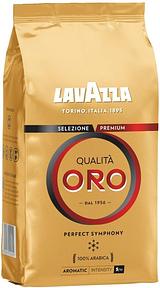
LAVAZZA - Café Grain Lavazza Qualità Oro - 100% Arabica - Paquet de 1 kg
View at Amazon (as of Aug 11)Affiliate link. Buying through it earns us a commission; the price stays the same for you.
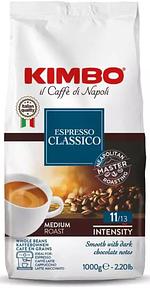
Café en grains Kimbo Espresso Classico, torréfaction moyenne, 1 kg
View at AmazonAffiliate link. Buying through it earns us a commission; the price stays the same for you.
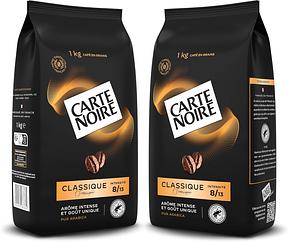
Carte Noire Café en Grains Classique, Pur Arabica, Torréfaction Ambrée, 2 x 1 kg
View at AmazonAffiliate link. Buying through it earns us a commission; the price stays the same for you.
Specialty coffees with no declared roast level
Incapto Café en Grains de Spécialité, Origine Colombie, 100% Arabica, 84 points SCA, 1 kg
Colombian single origin (Huila), 100% arabica, with an 84-point SCA score claimed on the listing. The page talks about "artisanal roasting" but states no level. That is typical of the specialty segment: the communication is about origin and score, not about colour.
Origeens Café en Grains Bio, Single Origin Colombie Fernando, 1 kg
Colombian single origin, 100% arabica, organic, with a slow twenty-minute roast claimed on the listing. Again, no level declared — the page mentions "Italian artisanal roasting", which describes a method and a style rather than a position on a scale.
Alter Eco Café en Grains Bio & Équitable, Origine Éthiopie, Arabica, 500 g
Ethiopian arabica, organic and fair trade, described as "delicate and floral" and low intensity. Point of honesty: its listing positions it for filter and French press, not for espresso. It is cited here to illustrate a light aromatic profile, not as an espresso recommendation — running it through a portafilter will demand a grinder that goes very fine, and it will probably show better as filter.
The most useful way to use this list is not to hunt for "the best" one. It is to take two of them at different levels, run them through the same machine, and count how many clicks you have to move the grinder to get a sane flow rate back. That number, specific to your kit, is worth more than any table.
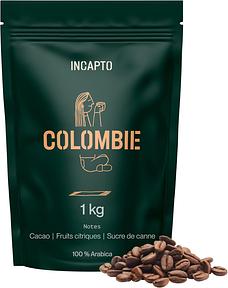
Incapto Café en Grains de Spécialité, Origine Colombie, 100% Arabica, 84 points SCA, 1 kg
View at AmazonAffiliate link. Buying through it earns us a commission; the price stays the same for you.
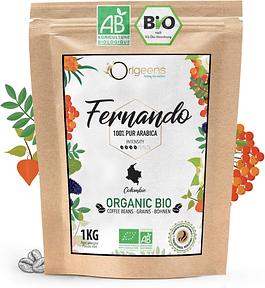
Origeens Café en Grains Bio, Single Origin Colombie Fernando, 1 kg
View at AmazonAffiliate link. Buying through it earns us a commission; the price stays the same for you.
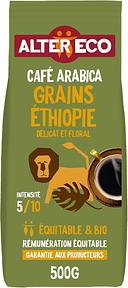
Alter Eco Café en Grains Bio & Équitable, Origine Éthiopie, Arabica, 500 g
View at AmazonAffiliate link. Buying through it earns us a commission; the price stays the same for you.
What to take away
Roast level is not a quality slider running from bad to good. It is a slider of solubility and brittleness, and it moves the flavour and the dial-in at the same time.
Three ideas are enough to navigate it. First: every change of roast level demands a fresh grind adjustment — open up as you go darker, tighten as you go lighter. Second: light roast is not "better", it is simply more demanding, and it only rewards equipment capable of keeping up. Third: the labels on bags are not a scale, and the one standardised scale that exists is almost never printed.
The rest is preference, and on that ground there is nothing to correct in anybody.
Sources cited: Illy and Viani, Espresso Coffee: The Science of Quality, 2nd edition, Elsevier, 2005; Fuller and Rao, Scientific Reports, 2017; Wang and Lim, Food Research International, 2014; Specialty Coffee Association / Agtron roast colour classification system.
All products from this post
The ones we named above are marked; the rest are alternatives in the same category.
Affiliate notice: As an Amazon Associate, we earn from qualifying purchases. Product prices and availability are subject to change.
Frequently Asked Questions
Which roast level should a beginner buy for espresso?
A medium roast, on a blend sold as espresso-suitable. It offers the widest margin for error: soluble enough to give a decent result even at an approximate setting, expressive enough that grind corrections show up in the cup. A specialty light roast is a poor first purchase unless the grinder is up to it.
Should I grind finer or coarser with a dark roast?
Coarser. A dark bean is more brittle, so at the same setting it already produces a finer grind, and it is also more soluble, so it extracts faster. Both effects push toward over-extraction and bitterness. Open the grinder up as you go darker, and tighten it as you go lighter.
Why did my espresso change overnight when I changed nothing?
Because something did change even if no setting did: usually a new bag, at a different roast level or a different freshness. A darker bean slows the flow and amplifies bitterness at the same setting; a lighter one makes the shot gush and turn sour. Re-dialling the grind is the first thing to do before suspecting the machine.
Is light roast better than dark roast?
No. It retains more acidity and more origin-linked aroma, which suits some drinkers, but it is denser, less soluble and far more demanding on the grinder. A controlled dark roast, stopped short of carbonisation, is a perfectly defensible stylistic choice, and it is the historical norm for Italian espresso.
How do I tell how dark a coffee is when the bag does not say?
Without an Agtron number, which is almost never printed on a consumer bag, you fall back on indirect clues: bean colour compared against a reference you know, surface oil that signals a long roast, and the flavour vocabulary on the bag. Citrus and red fruit signal a lighter profile; cocoa, toasted hazelnut and spice signal a darker one.
Does bitter coffee always mean a bad extraction?
No. Bitterness can come from an over-extraction you can dial away, but it can also already be in the bean when the roast was taken to carbonisation. The test is simple: if another bag gives you something drinkable in the same machine at roughly the same setting, the problem was the coffee and not the technique.