Krups vs De'Longhi: Which Bean-to-Cup Coffee Machine Brand Should You Choose?
 18 min read
Krups or De'Longhi. The question comes up in nearly every bean-to-cup buying conversation, and it does have an answer: De'Longhi if you want to pull the brew unit out and rinse it yourself, Krups if you plan to keep the machine for ten years and be able to get it repaired. Between €280 and €500, neither brand objectively makes better coffee than the other, and that is the first thing most "Krups vs De'Longhi" comparisons forget to say. What actually separates them is maintenance and after-sales service.
This guide covers bean-to-cup machines only, the ones with a built-in grinder. The Nespresso and Dolce Gusto units both brands also build under licence are a different product, with different mechanics and a different failure history. Confusing the two wrecks half the rankings floating around.
If you want a ranking across all brands rather than a head-to-head, our roundup of the best bean-to-cup coffee machines covers the rest of the market.
Krups vs De'Longhi: who is actually who
Two received ideas weigh heavily on this decision. Both are wrong.
Krups is a German brand founded in 1846 by Robert Krups, originally in a forge in Wald, in North Rhine-Westphalia, before his son moved the business to Solingen. It has belonged to the French Groupe SEB since 2001, after passing through Moulinex and then the Italian El.Fi. Its bean-to-cup machines are designed and manufactured today by Groupe SEB. That is a plain statement of fact about where the engineering sits, not a flag to wave: the "German engineering" label many buyers still attach to the name describes the company's history, not the industrial group building the machine now.
De'Longhi, on the other side, really is Italian. Founded in 1902, headquartered in Treviso, listed on the Milan stock exchange. But "Italian" does not mean "made in Italy" across the whole range. According to the company profile, the group also produces in Romania and China depending on the product line, with design remaining largely Italian. It bought Swiss professional machine maker Eversys in 2021 for 150 million Swiss francs, then grouped it with La Marzocco in early 2024. Real industrial weight, which tells you nothing about the machine sitting on your worktop.
A third point is worth putting on the table right away. Krups and De'Longhi both build Nespresso machines under licence, alongside Breville and Magimix, near-identical appliances that differ mostly in styling. So when a reliability ranking scores "Krups" or "De'Longhi" without naming the range, it is blending capsule machines and bean-to-cup machines that share neither the mechanics nor the fault history. More on that below, because it is exactly the trap in the most-cited French ranking.
For market context, and this figure is French: 5.3 million coffee machines were sold in France in 2025, with automatic bean-to-cup units down 6% while portafilter machines with a grinder jumped 53% to 660000 units, per figures from Gifam and NielsenIQ-GfK. Thirteen percent of French households own a bean-to-cup machine.
What really separates the two brands
On paper, four things divide them. Only one genuinely changes the buying decision.
The brew unit: removable on De'Longhi, fixed on Krups
The brew unit, sometimes called the brew group, is the part that tamps the ground coffee and pushes water through it. It is also where oils and grind residue build up.
On De'Longhi's Magnifica, Dinamica, Primadonna and Rivelia ranges, it comes out without tools and rinses under the tap. Open the side hatch, press two tabs, the part slides free. On Krups' Essential and Intuition ranges it is fixed: the machine runs an automatic rinse cycle, and any deep clean goes through an approved repairer.
This is the real tipping point between the two brands, more than the number of programmed recipes or the look of the display. The removable unit is not free, mind you. It is one more part to seat correctly, one more thing not to leave drying in a heap, and a seal that eventually gives up. The fixed unit asks less of you day to day. It simply leaves you dependent on a workshop the day the automatic rinse stops being enough.
One honest caveat: this split holds for the ranges named above, not for every reference in either catalogue. Check the spec sheet for the exact model.
The grinder and how far it adjusts
A bean-to-cup machine is only as good as its grinder. Both brands fit conical burrs on the relevant ranges, and the gap sits in the number of grind settings: De'Longhi quotes up to 13 positions on some models, Krups offers 3 to 5 across its common ranges. Manufacturer figures, not independent measurements.
Should that decide anything? Depends on your coffee. If you buy the same bag from the same roaster forever, three settings are plenty to find the right point and never touch it again. If you switch roasters monthly, or alternate between a classic blend and a light single origin, a narrow range gets frustrating fast. You hit the end stop without ever finding the balance point.
More settings does not mean a better grinder. It means finer control over the setting. Grind consistency, the thing that actually matters, appears on neither brand's spec sheet.
The milk system
Here the badge decides nothing. The real choice is manual steam wand versus automatic milk carafe, and both makers offer both depending on the tier.
The manual wand takes about ten minutes to learn and gives finer foam once the movement clicks. The automatic carafe produces a cappuccino at the press of a button and rinses itself, at the cost of a bulky accessory living in your fridge. The model name will not always settle the question either: two references in the same line can carry different systems. Read the product sheet for the exact reference before you pay.
Day-to-day upkeep
Both brands ask for the same things:
regular descaling, at a frequency that depends on your water hardness
emptying the grounds bin often
rinsing the milk circuit after every use
and the one everybody skips, wiping the grinder chute before it cakes
The difference shows up around year two. With a removable unit, a weekly rinse under clean water pushes back the gunk, and you can see the state of the part with your own eyes. With a fixed unit, you trust the internal cycle, and the day the coffee comes out lukewarm or sour for no obvious reason, you have no way to go and look. That is a genuine flaw in the Krups approach, and nobody here is going to pretend otherwise.
The head-to-head by price bracket
The two catalogues cross over the whole €280 to €500 band, and that is where most purchases happen. Three tiers, six machines, one model from each brand at each tier: around €300, around €350 to €365, then around €390 to €400.
| Model | Price on 8 Aug 2026 | Brew unit | amazon.fr rating |
|---|---|---|---|
| Krups Essential Compact YY8125FD | €299.99 | fixed | 4.2 out of 5 (5,702 ratings) |
| De'Longhi Magnifica S Perfetto ECAM11.112.B | €287.99 | removable | 4.1 out of 5 (7,587 ratings) |
| Krups Essential Compact LCD YY8135FD | €349.99 | fixed | 4.3 out of 5 (4,441 ratings) |
| De'Longhi Dinamica ECAM350.15.B | €365.00 | removable | 4.3 out of 5 (2,174 ratings) |
| Krups Sensation EA910810 | €389.00 | fixed | 4.0 out of 5 (543 ratings) |
| De'Longhi Magnifica Evo Perfetto ECAM292.33.SB | €399.99 | removable | 4.0 out of 5 (1,952 ratings) |
Prices and ratings observed on amazon.fr on 8 August 2026, in EUR. Prices in this segment move by tens of euros from one month to the next, and they are not the same in every market.
Around €300: the Krups Essential Compact bean-to-cup machine
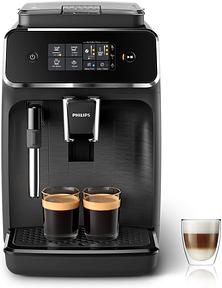
The entry ticket to the Krups range, at €299.99 on 8 August 2026 on amazon.fr, rated 4.2 out of 5 by 5,702 buyers. Compact, plain, a manual steam wand, a fixed brew unit.
This is the machine to pick if you want a decent espresso in the morning and would rather never think about the mechanics. What it will not give you: the ability to inspect the brew unit yourself, or a wide grind range.
KRUPS Essential Compacte - Machine à Café à Grain Automatique 15 bars
Not available in your region — closest match
Philips Série 2200 EP2220/10 - Expresso Broyeur avec Mousseur à Lait, Écran Tactile
View at Amazon (as of Aug 10)Affiliate link. Buying through it earns us a commission; the price stays the same for you.
Around €290: the De'Longhi Magnifica S Perfetto
The cheapest of the six, at €287.99 on 8 August 2026 on amazon.fr, rated 4.1 out of 5 by 7,587 buyers. It also carries the largest review count of the group, which says something about how widely it has sold.
Removable brew unit at this price point already. At €12 less than the Krups facing it, that is the argument that decides: you get the most wear-prone part back in your own hands without paying a cent extra.
De'Longhi Magnifica S ECAM11.112.B - Perfetto Machine à Café Automatique avec Mousseur à Lait Manuel
Not available in your region — closest match
Philips Série 2200 EP2220/10 - Expresso Broyeur avec Mousseur à Lait, Écran Tactile
View at Amazon (as of Aug 10)Affiliate link. Buying through it earns us a commission; the price stays the same for you.
Around €350: the Krups Essential Compact with LCD screen
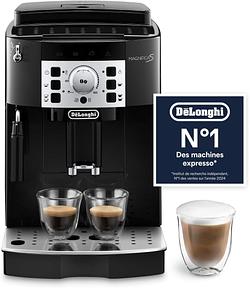
Same compact chassis as the YY8125FD, with an LCD screen and more settings reachable directly, at €349.99 on 8 August 2026 on amazon.fr.
It is the best-rated of the six machines in this comparison, 4.3 out of 5 across 4,441 ratings, level with the Dinamica but on nearly double the sample. If one number is going to reassure you about the Krups range, it is that one. The brew unit is still fixed.
Not available in your region — closest match
De'Longhi Magnifica S ECAM22.110.B
View at Amazon (as of Aug 11)Affiliate link. Buying through it earns us a commission; the price stays the same for you.
Around €365: the De'Longhi Dinamica
€365.00 on 8 August 2026 on amazon.fr, 4.3 out of 5 across 2,174 ratings. The Dinamica is the tier where De'Longhi spends its money on grind latitude rather than on recipe count.
It suits the buyer willing to give thirty seconds a week to upkeep in exchange for real control over the grind. If that trade does not appeal, the Magnifica S at €287.99 makes the same coffee for €77 less.
Not available in your region — closest match
Philips Série 2200 EP2220/10 - Expresso Broyeur avec Mousseur à Lait, Écran Tactile
View at Amazon (as of Aug 10)Affiliate link. Buying through it earns us a commission; the price stays the same for you.
Around €390: the Krups Sensation
€389.00 on 8 August 2026 on amazon.fr, 4.0 out of 5 across 543 ratings, by far the thinnest track record here.
Stock was very limited on amazon.fr on 8 August 2026.
A machine that can vanish from sale week to week is not a solid recommendation, whatever its qualities. Check availability before you put it at the top of your list.
Krups Sensation Machine à Café Grain Automatique Compacte (EA910810)
Not available in your region — closest match
Philips Série 2200 EP2220/10 - Expresso Broyeur avec Mousseur à Lait, Écran Tactile
View at Amazon (as of Aug 10)Affiliate link. Buying through it earns us a commission; the price stays the same for you.
Around €400: the De'Longhi Magnifica Evo Perfetto
The top of this selection, at €399.99 on 8 August 2026 on amazon.fr, 4.0 out of 5 across 1,952 ratings. This is the generation that replaced the Magnifica S in De'Longhi's mid-range.
It has its own review on this blog, with the detail of its settings and its limits; this comparison only places it against Krups. At this tier, the €11 gap with the Krups Sensation means nothing. What splits them is the removable unit on one side, the spare-parts commitment on the other.
De'Longhi Magnifica Evo - Perfetto Machine à Café Automatique (ECAM292.33.SB)
Not available in your region — closest match
Philips Série 2200 EP2220/10 - Expresso Broyeur avec Mousseur à Lait, Écran Tactile
View at Amazon (as of Aug 10)Affiliate link. Buying through it earns us a commission; the price stays the same for you.
Reliability and repairability: what the data shows, and what it does not
Start with what is unknown, because that is the part other pages skate over.
No serious public study compares the lifespan of Krups and De'Longhi bean-to-cup machines. A lifespan gap expressed in years circulates on several French blogs; the page publishing it cites no source, no protocol, no sample size. It will not be repeated here, not even reworded. A number with no origin is worth less than no number at all, because it gives the illusion of an informed decision.
What can be checked comes down to three things, and only one of them is a firm, dated commitment.
First, that commitment. Since 1 January 2022, Krups guarantees spare-parts availability for 15 years, up from 10 years previously, backed by more than 6,200 approved professional repairers and 8.3 million parts in stock. Read the scope carefully: this is published by Groupe SEB on its French site, and the repairer network it names is the French one, so treat it as a French-market commitment and check your own country's Krups site before counting on it. It is a voluntary commercial pledge, not a legal score. There is no documented De'Longhi equivalent: one De'Longhi product sheet consulted for this research showed 10 years under the French AGEC disclosure, but that figure could not be reconfirmed directly and applies to one model, not to the brand. Treat it as an indication, not a policy.
A word on the legal framework, since it causes permanent confusion, and note that all of it is French law rather than anything that travels. The French repairability index does not cover coffee machines: neither Krups nor De'Longhi shows the score out of 10 you see on a washing machine or a smartphone. What France's AGEC law does require is a declaration of how long parts will stay available, product by product. That line is worth reading on each sheet, and it varies from one reference to the next. Outside France, no such disclosure is guaranteed at all.
Second, a consumer panel, also French. In September 2023 the French consumer magazine 60 Millions de Consommateurs surveyed roughly 6,000 people and gave Krups 14.6 out of 20 against 13.8 out of 20 for De'Longhi. Advantage Krups, then. Except that the two best Krups scores in that ranking belong to Nespresso and Dolce Gusto units, which is to say capsule machines, not the bean-to-cup range this article is about. Carrying that 14.6 over as a verdict on bean-to-cup machines is a misreading, and several comparisons online do exactly that.
Third, the only genuinely useful longevity figure, and it does not separate the brands: UFC-Que Choisir finds that six years after purchase, only half of espresso machines are still working, all brands combined. The per-brand breakdown sits behind a subscription.
So the one hard data point in this comparison is about spare parts, not about lifespan. That is uncomfortable, and it is what exists: anyone trying to maximise their odds of keeping a machine ten years is buying a repairability pledge, for want of being able to buy a proven life expectancy.
Pump pressure in bars: what the number on the box leaves out
The 15 bars or 19 bars printed on the packaging describes the maximum pressure the pump can build. It is not the pressure that reaches the coffee.
An internal pressure relief valve brings the water back to around 9 bars by the time it crosses the puck, a standard inherited from the pump machines of the 1960s and 1970s. That regulation exists on Krups and De'Longhi alike, on the six models above as on the rest.
Put plainly: a machine advertised at 19 bars does not extract harder than one advertised at 15 bars. The number on the box separates two pumps, not two cups. What actually decides the coffee is the grind, the dose, and how consistently the burrs cut. If a comparison ranks machines by pump pressure, you now know it is ranking a figure that never leaves the machine.
Verdict: which one for which buyer
So, which bean-to-cup machine should you choose? Here are the profiles, each with a named model.
You keep appliances for ten years and want to be able to get them fixed: Krups. The 15-year parts pledge and the 6,200 approved repairers are the only official, dated promise in this whole comparison, and they are a French-market promise. Model: the Krups Essential Compact LCD (YY8135FD) at €349.99, the best-rated of the six.
You want to clean the brew unit yourself and dial in the grind: De'Longhi. Model: the De'Longhi Dinamica (ECAM350.15.B) at €365.00, or the Magnifica Evo Perfetto (ECAM292.33.SB) at €399.99 if you change roasters often and want the widest adjustment range of the six.
Tight budget, first bean-to-cup machine, one coffee in the morning and that is it: the De'Longhi Magnifica S Perfetto (ECAM11.112.B) at €287.99. Cheapest of the six, and it still carries the removable unit. At that price, the Krups Essential Compact at €299.99 costs €12 more for a wear part you will never get to inspect.
No desire to dismantle anything, no desire to think about upkeep at all? The Krups Essential Compact (YY8125FD) at €299.99 is built for exactly that. The fixed unit turns into an advantage the moment you just want to press a button.
Aiming at the top of the Krups selection here: the Krups Sensation (EA910810) at €389.00 exists, but its stock was very limited on amazon.fr on 8 August 2026 and its review history is thin, 543 ratings. Do not build a decision on it without checking it is still for sale.
Four things should decide nothing here:
the bar count, for the reason just covered
the assumed country of origin, given that Krups is French by ownership and German by history, and De'Longhi produces across three countries
a reliability ranking that never says whether it means capsules or beans
and the recipe count on the display, which is a menu, not a machine
For the rest: if your question is about espresso purism rather than convenience, our De'Longhi versus Sage comparison takes that angle. If you are torn between a built-in grinder and a separate one, that is another article on this blog, as is the state of bean-to-cup pricing in France in 2026. And if you have not narrowed it down yet, head for the full picture of the bean-to-cup market.
Prices, customer ratings and availability observed on amazon.fr on 8 August 2026, in EUR; these values move quickly and differ by market, so recheck them before buying. Novebar earns a commission on some links, at no cost to you.
All products from this post
The ones we named above are marked; the rest are alternatives in the same category.
Not available in your region — closest match
Philips Série 2200 EP2220/10 - Expresso Broyeur avec Mousseur à Lait, Écran Tactile
View at Amazon (as of Aug 10)
Not available in your region — closest match
Philips Série 2200 EP2220/10 - Expresso Broyeur avec Mousseur à Lait, Écran Tactile
View at Amazon (as of Aug 10)
Not available in your region — closest match
De'Longhi Magnifica S ECAM22.110.B
View at Amazon (as of Aug 11)
Not available in your region — closest match
Philips Série 2200 EP2220/10 - Expresso Broyeur avec Mousseur à Lait, Écran Tactile
View at Amazon (as of Aug 10)
Not available in your region — closest match
Philips Série 2200 EP2220/10 - Expresso Broyeur avec Mousseur à Lait, Écran Tactile
View at Amazon (as of Aug 10)
Not available in your region — closest match
Philips Série 2200 EP2220/10 - Expresso Broyeur avec Mousseur à Lait, Écran Tactile
View at Amazon (as of Aug 10)Affiliate notice: As an Amazon Associate, we earn from qualifying purchases. Product prices and availability are subject to change.
Frequently Asked Questions
Krups or De'Longhi, which is the better bean-to-cup brand?
Neither makes objectively better coffee between €280 and €500. De'Longhi wins if you want to pull the brew unit out and rinse it yourself, with a wider grind range. Krups wins on service: since 1 January 2022 the brand has committed, on the French market, to keeping spare parts available for 15 years. Choose on your appetite for cleaning, not on the badge.
What is the real difference between a Krups and a De'Longhi bean-to-cup machine?
The brew unit. On De'Longhi's Magnifica, Dinamica and Primadonna ranges it comes out without tools and rinses under the tap. On Krups' Essential and Intuition ranges it is fixed: deep cleaning goes through an internal automatic cycle, then an approved repairer. A smaller second gap: De'Longhi quotes more grind settings on several models.
Does a De'Longhi last longer than a Krups?
Nobody knows publicly. No serious study compares the lifespan of the two brands' bean-to-cup machines, and the year figures circulating on French blogs cite no source. What is verifiable: the Krups 15-year spare-parts pledge on the French market, and the fact that a removable De'Longhi brew unit can be cleaned without a trip to a workshop.
Krups or De'Longhi, which gives better value for money?
Of the six models here, the De'Longhi Magnifica S Perfetto (ECAM11.112.B) was the cheapest at €287.99 on 8 August 2026 on amazon.fr, removable brew unit included. On the Krups side, the Essential Compact with LCD screen (YY8135FD) at €349.99 held the best customer rating of the group, 4.3 out of 5. Prices in this segment move fast and vary by market, so recheck before buying.
Does a 19 bars machine make better espresso than a 15 bars one?
No. The 15 bars or 19 bars printed on the box describes the pump's maximum pressure. A pressure relief valve brings the water back to around 9 bars as it crosses the coffee, on Krups and De'Longhi alike. What decides the cup is the grind, the dose and how consistently the burrs cut, not the number on the packaging.
Are Krups bean-to-cup machines made in Germany?
No. Krups was founded in 1846, first in Wald and then in Solingen, in Germany, but the brand has belonged to the French Groupe SEB since 2001. Its bean-to-cup machines are designed and manufactured today by Groupe SEB. The "German engineering" label still attached to the name describes the company's history, not the industrial group building the machine now.
Sources
- Groupe SEB groupeseb.com
- the company profile en.wikipedia.org
- Eversys in 2021 dailycoffeenews.com
- near-identical appliances applianceretailer.com.au
- 5.3 million coffee machines were sold in France in 2025 placesducafe.com
- Krups guarantees spare-parts availability for 15 years rowenta.fr
- repairability index economie.gouv.fr
- 60 Millions de Consommateurs 750g.com
- UFC-Que Choisir quechoisir.org
- brings the water back to around 9 bars greenplantation.fr