Single Origin or Blend: Which Is Better for Espresso?
 10 min read
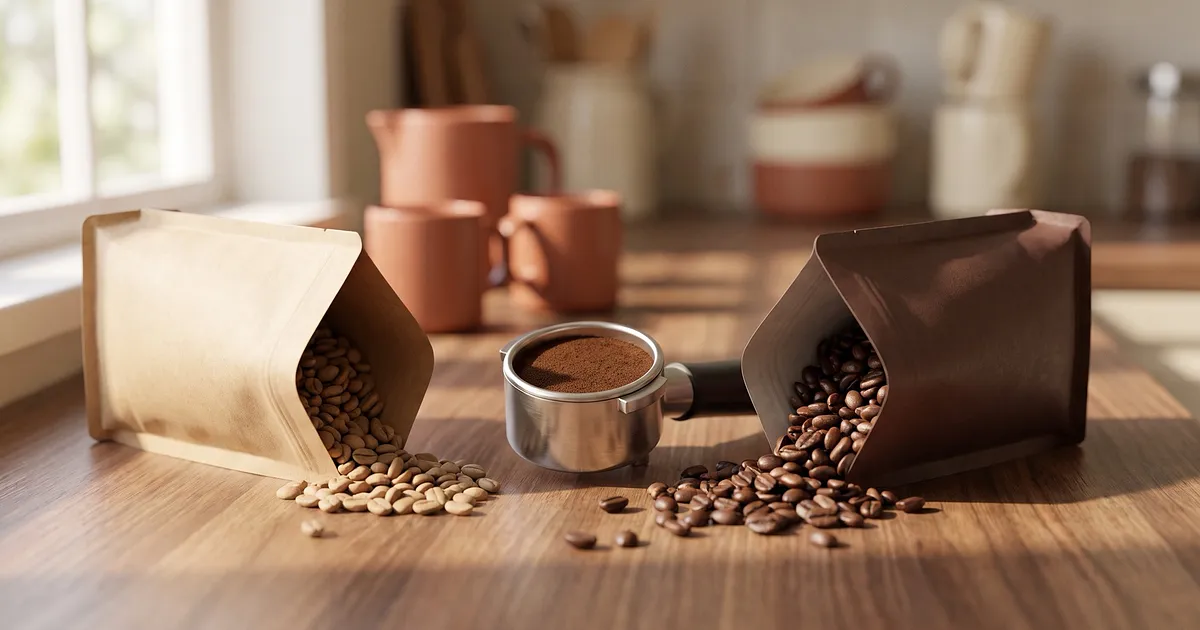
Specialty coffee has quietly settled on a hierarchy: single origin is the discerning choice, a blend is a commercial compromise. Applied to espresso, that hierarchy does not hold up. A blend solves three concrete problems a single origin cannot — consistency, body, and tolerance for grind error — and a single origin offers things a blend cannot. Which one is right depends on your machine and your grinder as much as on the bag.
Two words describing two methods
Single origin means coffee from one country, sometimes from one region, cooperative or farm. The further traceability goes, the more specific the profile — and the more fragile it is.
A blend combines several coffees, usually from several countries and sometimes from more than one species. A roaster does not build a blend to hide something; they build it to hit a target profile and hold it over time. That is a difference in method, not in quality.
The confusion comes from the bottom of the market: plenty of cheap blends really are mediocre. But their flaw is the quality of the lots and the age of the roast, not the principle of blending.
What a blend solves
Consistency from one crop cycle to the next
This is the strongest argument, and the one least often made.
A given coffee does not carry the same profile from one production cycle to the next. The effect is structural: the Coffee: World Markets and Trade report from the USDA Foreign Agricultural Service (July 2026) describes the biennial cycle of Brazilian arabica, in which an on-year crop can move production by 5 to 10 million bags relative to the following off-year; according to the same report those swings account for most of the year-to-year variation in global arabica output, and Brazil represents nearly 40 percent of world production.
In practice: the single-origin bag you loved may taste noticeably different next time, and that is not the roaster cheating. A blend, by contrast, can be reformulated — proportions shifted, a component swapped — so the cup stays recognisable. That is precisely what Italian roasting houses have been selling for decades: a stable signature, not a snapshot of one lot.
Lavazza Espresso Super Crema, café en grains, 1 kg is the textbook example of that goal — a blend built to repeat, rather than to tell the story of a single farm.
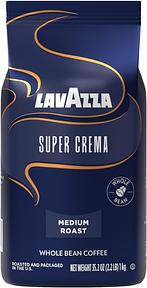
Lavazza Espresso Super Crema, café en grains, 1 kg
View at AmazonAffiliate link. Buying through it earns us a commission; the price stays the same for you.
Body and crema
Espresso is not only an aroma profile; it is also a texture. A blend's components are chosen for what they contribute in the mouth and for how they behave under pressure: body, density, foam stability.
That is where robusta enters the Italian tradition — not as filler, but as a functional ingredient. No public standard quantifies how much crema a given robusta percentage adds, and roasters do not publish those curves; what is verifiable is that the choice is deliberate and stated on the pack.
Café en grains Kimbo Espresso Napoletano, torréfaction foncée, 1 kg belongs to the Neapolitan school: dark roast, thick body, dense crema, a reading of espresso that is not chasing acidity.
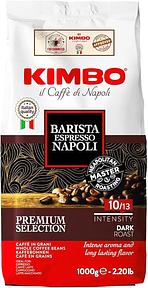
Café en grains Kimbo Espresso Napoletano, torréfaction foncée, 1 kg
View at AmazonAffiliate link. Buying through it earns us a commission; the price stays the same for you.
Tolerance for error
A well-built blend forgives more. Two clicks off on the grind, a group temperature that drifts, an uneven tamp: the shot stays drinkable. The same deviation on a light, acidic single origin often produces a plainly failed cup — sour, hollow, aggressive.
If your grinder lacks particle consistency, this point outweighs everything else. Our electric burr grinder comparison covers what a grinder actually changes.
What a single origin really gives you
Three things, and all three are real.
Traceability. One country, one region, sometimes one farm and one varietal. You know what you are drinking, and you can find it again.
Character. A washed Ethiopian does not share a profile with a natural Brazilian. In espresso that distinction is harder to read than in filter — concentration flattens some nuance — but on strongly characterised coffees it stays audible.
Seasonal interest. Following production cycles, revisiting the same terroir from another angle, comparing two processing methods: that is a pleasure for the curious, not a guarantee in the cup.
Incapto Café en grains de spécialité, origine Éthiopie, 1 kg represents the category well: a declared single origin, a specialty score printed on the pack, and a floral, acid-forward profile that demands a clean extraction.
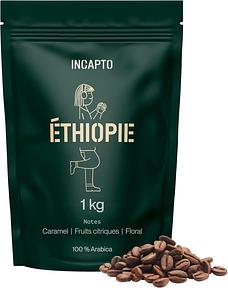
Incapto Café en grains de spécialité, origine Éthiopie, 1 kg
View at AmazonAffiliate link. Buying through it earns us a commission; the price stays the same for you.
A more forgiving single origin
Not every single origin is demanding. Some South American origins, roasted a little longer, stay soft and round in espresso and cope better with approximation.
illy Arabica Selection Colombie, café en grains, 6 x 250 g belongs to that family: a single origin chosen to stay approachable in the cup rather than an experimental lot.
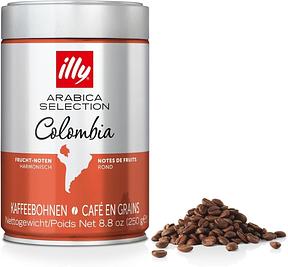
illy Arabica Selection Colombie, café en grains, 6 x 250 g
View at AmazonAffiliate link. Buying through it earns us a commission; the price stays the same for you.
"100% arabica" is a species claim, not a quality claim
This is the most useful misconception to clear up.
"100% arabica" tells you exactly one thing: no trace of Coffea canephora. It says nothing about lot quality, altitude, sorting, roast freshness or processing method. A weak, poorly sorted arabica roasted eight months ago is still 100% arabica.
The reverse holds too: the claim does not rule out blending. A blend can bring together five arabicas from five countries and legitimately carry the label.
Pellini Top 100 % Arabica, café en grains, 1 kg is exactly that case — declared as a blend and 100% arabica at the same time. Both statements sit together without contradiction.
If you want a quality signal rather than a species signal, look instead for a readable roast date (not a best-before date), the origin of the lots, and where available a score produced under a formal protocol such as the Specialty Coffee Association's Coffee Value Assessment.
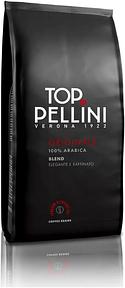
Pellini Top 100 % Arabica, café en grains, 1 kg
View at AmazonAffiliate link. Buying through it earns us a commission; the price stays the same for you.
Robusta is not a manufacturing defect
Robusta has a poor reputation because cheap robusta genuinely is poor: bitter, rubbery, flat. But a selected robusta — often washed, roasted on its own terms — does a job arabica does badly: it brings body, a structuring bitterness and a more persistent crema.
That is why a share of historic Italian espresso blends contain it, and say so. The percentage is often printed on the bag.
Lavazza Crema e Aroma Blue, 40 % arabica / 60 % robusta, 1 kg states its composition plainly, with robusta as the majority share. That is an owned profile decision, not concealment — and a good starting point if your shots come out thin or too sour.
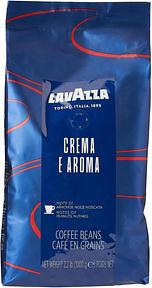
Lavazza Crema e Aroma Blue, 40 % arabica / 60 % robusta, 1 kg
View at AmazonAffiliate link. Buying through it earns us a commission; the price stays the same for you.
Your equipment decides as much as the bag
Here is the part most comparisons skip: a light single origin run through an imprecise grinder or a thermally unstable machine often gives a worse result than a decent blend in the same setup.
Grinder with no fine adjustment: blend, without hesitation. You do not have the resolution to rescue a demanding coffee.
Machine without thermal stability: blend again, or a single origin taken further into the roast.
Adjustable burr grinder and a stable machine: single origin becomes viable, and worth doing.
If your basic parameters are not stable yet, start there rather than with the coffee: our guide to espresso dial-in settings at home covers dose, ratio and shot time. And if you are starting from scratch on the machine, the manual espresso machine beginner's guide lays the groundwork.
Comparison table
| Criterion | Blend | Single origin |
|---|---|---|
| Consistency bag to bag | High: profile reformulated to hold steady | Variable: depends on the production cycle |
| Body and crema | Often the blend's explicit objective | Entirely dependent on the origin |
| Tolerance for grind error | Good | Low on light profiles |
| Traceability | Partial, sometimes absent | Complete, down to the farm |
| Tasting interest | Repeatable signature | Marked, shifting character |
| Suits an entry-level grinder | Yes | Rarely |
How to choose, by situation
You are starting out with a built-in or entry-level grinder. Take a medium-roast blend. You need to learn to move one variable at a time, not to compensate for three problems at once.
You mostly drink milk-based coffee. The blend wins almost every time: milk covers floral notes and brings out body and cocoa, which is exactly what an espresso blend is engineered to deliver.
You drink espresso straight and your parameters are stable. Try a single origin. This is where traceability and character become audible in the cup.
You want both. That is the most sensible option: a blend as the daily coffee, a single origin alongside it to explore. "Which is better" has no general answer; "which one this morning" does.
What matters more than the debate itself
Two factors outweigh the blend-versus-single-origin choice, and both are within your control.
Freshness. A readable roast date is worth more than any marketing claim. Coffee degasses after roasting, then oxidises; both phases change the cup.
Storage. An open bag left in air loses its appeal within days. A container that pushes air out solves that better than a decorative jar.
Airscape Boîte de conservation café en acier inoxydable, couvercle hermétique à piston works on exactly that principle: a lid that forces air out of the remaining volume rather than merely sealing it in.
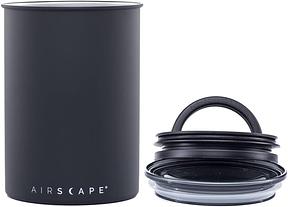
Airscape Boîte de conservation café en acier inoxydable, couvercle hermétique à piston
View at AmazonAffiliate link. Buying through it earns us a commission; the price stays the same for you.
Weigh it, do not eyeball it
Comparing two coffees is meaningless if the dose changes between attempts. A scale with tenth-of-a-gram resolution turns an impression into an observation.
TIMEMORE Black Mirror Basic 2 - Balance à café avec minuteur does that job with a built-in timer, so dose and shot time can be read together.
Not available in your region — closest match
View at Amazon (as of Aug 14)Affiliate link. Buying through it earns us a commission; the price stays the same for you.
All products from this post
The ones we named above are marked; the rest are alternatives in the same category.
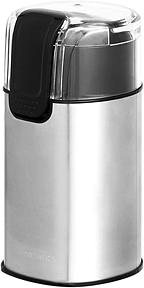
Not available in your region — closest match
Amazon Basics Fast Electric Coffee Grinder for Home Use, Easy to Use Coffee Bean and Spice Grinder with Heavy-Duty Stainless Steel Grind Blades
View at Amazon (as of Aug 14)Affiliate notice: As an Amazon Associate, we earn from qualifying purchases. Product prices and availability are subject to change.
Frequently Asked Questions
Is single origin better than a blend for espresso?
No, not inherently. They are two composition methods with different objectives. A blend targets a stable, repeatable profile with body and error tolerance. A single origin targets traceability and pronounced character. Quality depends on the lots, the freshness and the roast, not on whether one coffee or several are in the bag.
Does "100% arabica" mean the coffee is good?
No. The claim only tells you there is no robusta in it. It says nothing about altitude, sorting, processing, roast freshness or lot quality. A mediocre arabica is still 100% arabica. And a blend of several arabicas can carry the claim entirely legitimately.
Does robusta ruin an espresso?
Cheap robusta does. A selected robusta deliberately built into a blend does not: it contributes body, a structuring bitterness and a more stable crema, and it is a declared component of the Italian espresso tradition. The problem is not the species but the quality of the lot and the intent behind using it.
Why does my favourite single origin taste different now?
Because it comes from a new crop. A single-origin coffee follows agricultural cycles: weather, altitude, processing and sorting all vary from one cycle to the next, and the cup profile follows. A blend can be reformulated to compensate; a single origin, by definition, cannot.
Do I need to re-dial when switching from a blend to a single origin?
Almost always. A lighter roast is denser and generally calls for a finer grind at the same ratio. Change one variable at a time — grind first, holding your target dose and time — then adjust the ratio if the balance is still off.