Flushing Before the Shot: The Routine Most Machines Actually Ask For
 14 min read
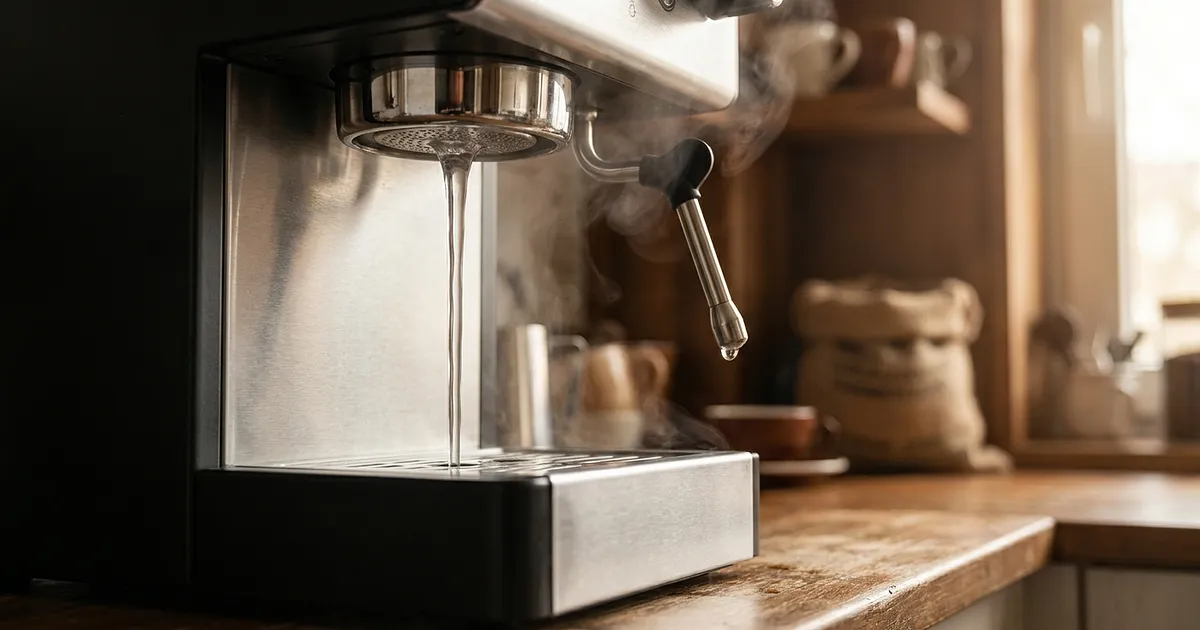
"Flush for five seconds before you pull." The advice is everywhere, and it is wrong about half the time — not because the action is bad, but because the word "flushing" covers three operations with different purposes, different effects, and wildly different importance depending on which machine is sitting on your counter.
On a heat-exchanger machine, skipping the flush ruins the cup, full stop. On a single boiler, that same flush held too long does the exact opposite of what people credit it with. And on a bean-to-cup machine the question barely arises: the machine handles it twice a day without asking you.
Here is how to separate the three, and which one applies to your machine.
Three different actions all called "flushing"
| The action | When | What it does | Where it actually matters |
|---|---|---|---|
| Group flush | Right before the shot | Clears grounds left under the shower screen; on some machines, brings the group to temperature | All machines, to wildly varying degrees |
| Cooling flush | Right before the shot | Dumps the overheated water stored in the heat exchanger | Only heat-exchanger (HX) machines — and there it is mandatory |
| Steam wand purge | Before and after steaming | Before: clear condensate. After: blow milk out before it dries inside | Every machine with a steam wand |
The table already contains the main misunderstanding: these three share a verb and nothing else. The first is hygiene plus, sometimes, a thermal effect. The second is a compulsory extraction technique on one specific class of machine. The third is a cleaning habit with real food-safety consequences.
The group flush: what it actually removes
Between shots, the group's shower screen holds onto coffee fines. They sit there in residual hot water and go rancid — coffee oil on warm metal. The next cup runs straight through it.
A short flush with the portafilter removed carries them into the drip tray. That is the primary job of the action, and it holds on essentially every portafilter machine.
Knock the puck out first
Order matters here, and it is more mundane than it sounds: puck out, then flush. Do it the other way round and you are running clean water through a spent puck you are about to bin anyway, and re-wetting a basket you will have to dry before you redose.
This is where a knock box earns its counter space. Something like the Knock Box Bac à Marc de Café avec Barre de Frappe Amovible et Base Antidérapante absorbs the knock without walking away from you, which a kitchen bin does not: the knock bar is damped and the non-slip base stops the whole thing sliding. The real gain is not comfort, it is consistency — a step with a fixed home eventually gets done every time.
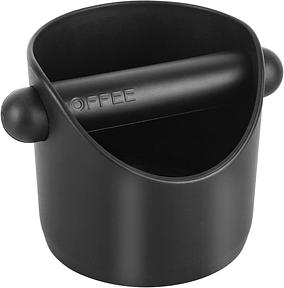
Knock Box Bac à Marc de Café avec Barre de Frappe Amovible et Base Antidérapante
View at AmazonAffiliate link. Buying through it earns us a commission; the price stays the same for you.
The shower screen, the part you never see
A flush carries away what is loose. What is stuck, it leaves. After a few days the underside of the shower screen carries a greasy film that water alone no longer lifts, and no grind adjustment will rescue the bitterness that follows.
A short-bristled brush with an angled handle reaches underneath without any disassembly. A pack like the Brosse de Nettoyage de Tête de Groupe pour Machine à Café Espresso (Lot de 2) lasts years as long as you rinse it after use — and buy two, because one lives by the machine and the other always ends up at the back of a drawer. Machine hot, thirty seconds, then a flush to carry off whatever the brush loosened.
Not available in your region — closest match
View at Amazon (as of Aug 14)Affiliate link. Buying through it earns us a commission; the price stays the same for you.
Your counter absorbs all of this
A flush means spray. A knock into the box means fines jumping out. Add the two together several times a day and the countertop keeps the record.
A silicone mat like the Tapis de Tassage à Café en Silicone Antidérapant pour Espresso defines the zone: spray stays on it, it rinses under the tap, and it cushions tamping as well. It is not an extraction accessory — it changes nothing in the cup — but it is what keeps a routine sustainable instead of turning it into a cleaning chore.
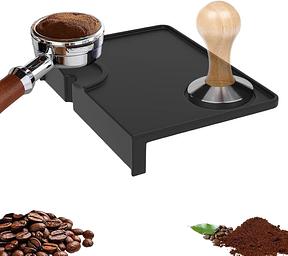
Tapis de Tassage à Café en Silicone Antidérapant pour Espresso
View at AmazonAffiliate link. Buying through it earns us a commission; the price stays the same for you.
The cooling flush on a heat-exchanger machine: the only compulsory one
This is the case where flushing is not hygiene but extraction technique, and where skipping it spoils the cup in a perfectly reproducible way.
A heat-exchanger (HX) machine has one boiler, and that boiler runs at steam temperature. A tube passes through that hot volume: that is the exchanger, and the water inside it heats by contact. The upside is genuine — you can brew and steam at the same time, with no wait. The downside is mechanical: when the machine has been idling, the water sitting still inside the exchanger has had all the time it needs to climb to boiler temperature, far above anything espresso tolerates.
The order of magnitude is easy to pin down. The Specialty Coffee Association puts recommended brew temperature between 90.5 °C and 96.1 °C in its brewing standards. A steam boiler, meanwhile, sits above 120 °C at normal working pressures. The water that comes out of an idle exchanger first is not "a bit hot": it is out of range, and you taste it immediately — scorched, harsh, a bitterness that flattens everything else.
The cooling flush simply means letting that water go until fresh reservoir water arrives behind it, tempered on the way through.
How to judge the duration without inventing a number
No universal duration is published, and for a precise reason: it depends on exchanger volume, boiler pressure, flow rate, and how long it has been since the last shot. A machine that has just been working has almost nothing to dump; the same machine after two idle hours has plenty.
The usable cue is sensory, and it is reliable because it measures the right thing:
- Portafilter out, open the group.
- For the first few seconds the water sputters and flashes to steam as it hits the air: it is above 100 °C and boiling off on the way out.
- Keep going until the stream turns steady and quiet. That is the signal: the superheated water has passed.
- Let it run a moment longer, close, lock in the portafilter and brew without dawdling — the group cools while you deliberate.
The specialty community calls managing that moment temperature surfing, and that is exactly what it is: you have no group thermostat, so you read the machine. A machine with group PID or a dual boiler does not have this problem and therefore does not need this flush at all.
If you are not sure which type you own, that question is better settled before buying than over the drip tray: our beginner's guide to portafilter machines covers what each heating architecture changes.
Single boiler: a long flush cools instead of stabilising
This is the most common inversion, and it comes from HX advice applied to the wrong machine.
On a single boiler there is no superheated water to dump: the boiler is regulated for brewing. What a long flush actually does is pull cold water from the reservoir into a small boiler — and a small boiler copes badly. The result is under-extraction, sour and short in the mouth, while you believe you have "stabilised" something.
The correct routine there is shorter:
One brief burst, enough to rinse and re-wet the shower screen.
Then wait for recovery before brewing, a few dozen seconds while the controller returns to setpoint.
If your shots taste sour and the grind has not moved, the flush is the first suspect: shorten it before you touch the grinder. Every other variable is worked through in our espresso settings at home.
The same logic, put differently: on HX you flush to bring the temperature down; on a single boiler an over-long flush brings it down too — except it was already right.
The steam wand: purge before and after
Two purges, two completely different reasons. The second is the one everybody skips, and it decides how long the wand lasts.
Before: clearing the condensate
Between uses, steam condenses inside the wand and turns back into water. Open the steam valve without purging and that water goes in first, straight into the milk.
That is not a detail: the water dilutes the milk, it drops the starting temperature, and above all it disturbs the air-incorporation phase — the one that decides texture. A one-to-two-second purge into the tray is enough: the moment the jet goes from droplets to dry steam, you are there.
One small point that explains why the action so often goes unnoticed: in a narrow pitcher, a few millilitres of hot water visibly change how the whirlpool behaves. A pitcher matched to the volume you actually make, like the De'Longhi DLSC060 Pichet à Lait 350 ml, Acier Inoxydable, makes the effect legible — in an oversized jug the same water disappears into the mass and you never work out why your foam is uneven.
Not available in your region — closest match
View at Amazon (as of Aug 15)Affiliate link. Buying through it earns us a commission; the price stays the same for you.
After: the step everybody skips
This is the important part of the whole section. The moment milk has been textured, there is milk in and on the wand — and the metal is scalding.
Purge immediately, one second, before you even put the pitcher down. Pressure blows out what was drawn up into the channel; without it, that residue dries inside and hardens over the holes, blocking them one at a time. A wand with one hole in three blocked no longer textures properly, and the fix at that point is disassembly.
Wipe immediately, with a cloth dedicated to this and nothing else. Milk on a hot tube is not just an unsightly mark: it is a protein- and fat-rich substrate held at warm temperature — literally bacterial growth conditions. That is why in professional use the wand is wiped after every drink, not at the end of service.
The important word is dedicated. A tea towel that has been round the counter brings back to the wand whatever it picked up elsewhere. A pack like the HARY Lot de 4 Chiffons Barista en Microfibre Absorbants et à Séchage Rapide lets you keep one for the wand alone, swap it daily and wash it hot — it is a consumable, not an accessory.
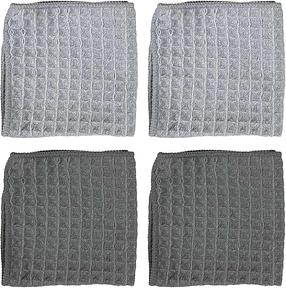
HARY Lot de 4 Chiffons Barista en Microfibre Absorbants et à Séchage Rapide
View at AmazonAffiliate link. Buying through it earns us a commission; the price stays the same for you.
On a bean-to-cup machine, most of this is already done
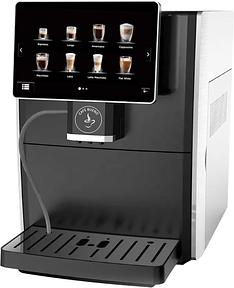
If you are on a bean-to-cup machine, most of the above is not yours to do: the machine runs its own circuit rinse at power-on and at power-off. That little squirt into the drip tray at start-up is exactly the group flush described above, automated and, on most models, not switchable off.
What you actually control comes down to three things, and they matter more than any manual flush:
- The brew unit. On models where it is removable, take it out and rinse it under clean water, with no washing-up liquid. It is the exact equivalent of cleaning a portafilter machine's shower screen, and it is the part that collects the most greasy residue.
- The milk circuit. If there is a carafe or a tube, run the milk rinse after every session, not at the end of the day — the same hygiene reasoning as a steam wand, with internal tubing no cloth can reach.
- How you switch it off. Use the button, never the plug or a switched power strip: cutting the supply robs the machine of its shutdown rinse, and the circuit dries out full of coffee.
Everything else — temperature, pressure, sequence — is not in your hands on this type of machine, and that is precisely the deal you sign when you buy one.
What flushing does not replace: backflushing
One confusion comes up constantly, and it is expensive in parts. Flushing moves water in the direction of extraction. It cleans nothing upstream of the shower screen, and in particular not the three-way valve or the hidden face of the group, where oils accumulate.
The blind basket
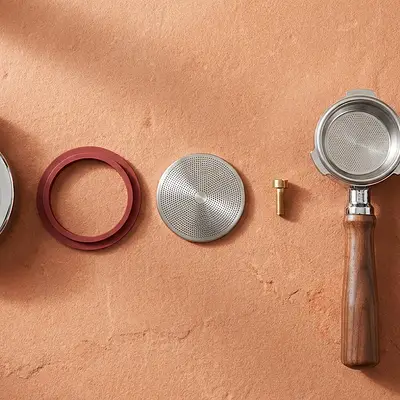
Backflushing reverses the path. You put an unperforated basket in the portafilter — a blind filter, for instance the Filtre Aveugle Métallique 58 mm pour Rétrolavage de Machine à Espresso — so that water can no longer leave through the bottom. Pressure builds, then dumps through the relief valve, dragging out whatever was sitting in the circuit.
Two caveats worth knowing before you order: the operation assumes a machine fitted with a three-way solenoid valve (many entry-level machines have none, and backflushing there is pointless or explicitly discouraged by the manufacturer), and the diameter must match your portafilter — 58 mm is the most common size on home portafilter machines, but 51 mm and 54 mm exist depending on the brand.
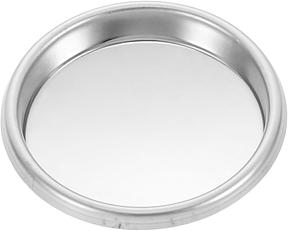
Filtre Aveugle Métallique 58 mm pour Rétrolavage de Machine à Espresso
View at AmazonAffiliate link. Buying through it earns us a commission; the price stays the same for you.
The detergent
With water alone, backflushing rinses. With an espresso cleaning powder such as Urnex Cafiza Poudre de Nettoyage pour Machine à Expresso, 566 g, it dissolves the oils — which is the difference between postponing the problem and treating it. A very small dose is enough, followed by far more clean-water cycles than you think you need.
And it does not replace descaling either, which attacks a deposit of an entirely different nature inside the water circuit: different schedule, different product, covered in our article on descaling a coffee machine. Three distinct maintenance jobs, three frequencies, none interchangeable.
Not available in your region — closest match
View at Amazon (as of Aug 14)Affiliate link. Buying through it earns us a commission; the price stays the same for you.
Which routine for which machine
| Your machine | Before the shot | After the shot | Steam wand |
|---|---|---|---|
| Single boiler | Brief burst, then wait for temperature recovery | Knock the puck out, wipe the screen | Purge before, purge + wipe after |
| Heat exchanger (HX) | Cooling flush until the stream turns steady and quiet | Same | Same |
| Dual boiler / PID | Short flush, hygiene only | Same | Same |
| Bean-to-cup | Nothing — automatic rinse at power-on | Nothing — rinse at power-off, do not cut the supply | Milk rinse after every session |
If you take one thing away: the only flush that changes the cup is the cooling flush on a heat-exchanger machine. The others protect the machine and your hygiene, which is reason enough to do them — but they will not rescue a grind that is off, and a flush will never replace a backflush or a descale. The rest of the kit that makes these habits sustainable day to day is reviewed in our essential barista accessories.
All products from this post
The ones we named above are marked; the rest are alternatives in the same category.
Not available in your region — closest match
Anker Powerbank, 20.000mAh tragbares Ladegerät mit integriertem USB-C-Kabel, 87W Max Schnellladung, kompatibel mit MacBook, iPhone, Samsung und mehr
View at Amazon (as of Aug 15)
Affiliate notice: As an Amazon Associate, we earn from qualifying purchases. Product prices and availability are subject to change.
Frequently Asked Questions
Do I need to flush before every espresso?
It depends on the machine. On a heat exchanger, yes: without a cooling flush the superheated exchanger water scorches the coffee. On a single boiler or dual boiler, a brief hygiene burst is enough, and a long flush there is counterproductive. On a bean-to-cup machine, the machine handles it at power-on.
How many seconds should I flush on an HX machine?
No universal figure exists: the duration depends on exchanger volume, boiler pressure and how long it has been since the last shot. The reliable cue is audible and visual — flush while the water sputters, stop when the stream turns steady and quiet, then brew without waiting.
Why purge the steam wand after frothing milk?
Because milk is drawn up into the wand's channel during aeration. On scalding metal it dries and hardens over the holes, blocking them progressively. An immediate purge blows it out while it is still liquid. The wipe that follows is hygiene: warm milk on a metal surface is a bacterial growth medium.
Is flushing the same as backflushing?
No. Flushing moves water in the direction of extraction and never reaches the circuit upstream of the shower screen. Backflushing uses a blind basket to block the outlet, build pressure and push oils back out through the three-way valve. Two different jobs, two frequencies, and backflushing assumes a machine fitted with that valve.
Can a long flush damage the machine or waste water?
It will not damage it, but it is not neutral: on a single boiler it pulls in cold water and drops brew temperature, and on any machine it empties the reservoir faster than you would think. Flush for as long as the cue above takes, not by the clock.