Group gasket and shower screen: the two wear parts nobody replaces
 15 min read
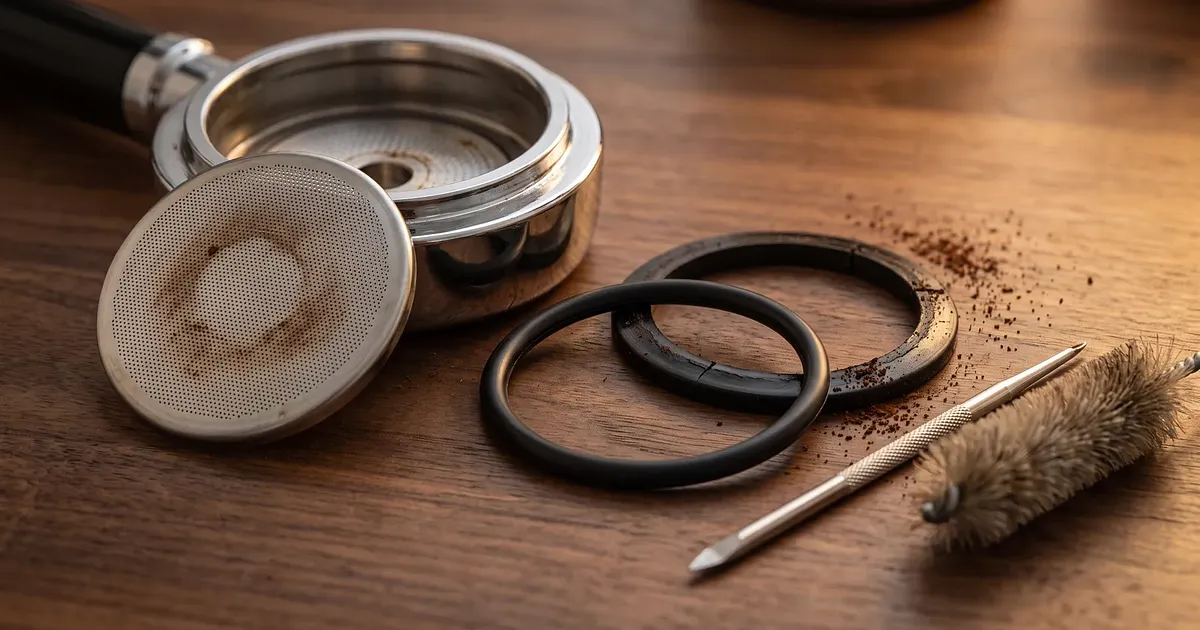
On a portafilter machine, two parts work on every single shot, age without ever announcing it, and appear on no maintenance sticker anywhere on the housing: the group gasket and the shower screen. They look like permanent hardware. They are consumables.
Two consumables disguised as permanent parts
The group gasket is a rubber or silicone ring sitting in a groove at the bottom of the group head. It takes the full brew pressure, the constant heat of the group, and the friction of the portafilter on every shot. The shower screen, directly above the basket, is a metal plate that spreads water across the whole surface of the puck instead of letting it arrive at one point.
Neither one fails outright. They degrade slowly, over months, and the coffee slides down the same slope. That is exactly why they go unnoticed: your reference point is yesterday's cup, not the one from day one.
The practical consequence is annoying. Most people who notice their coffee getting worse go looking at their settings first — new beans, finer grind, harder tamp. The fault is mechanical, and it sits ten centimetres higher up.
The group gasket: three symptoms that don't lie
1. The portafilter travels further and further
This is the most reliable sign, and the easiest to track. On a new machine the portafilter locks at a given position — often somewhere near the centre, handle facing you. Over the months the gasket compresses and takes a set: the portafilter has to swing a little further to clamp. Then a little further again.
When the handle ends up clearly past its original position, or past the centre line entirely, the gasket has lost its usable thickness. Simple trick: on the day you fit a new gasket, note where the handle sits. That's your reference for the next couple of years.
2. It leaks or hisses at the rim
Under pressure, a worn gasket no longer seals. Two possible symptoms: droplets beading around the edge of the portafilter during the shot, or a thin hiss, like a steam leak, as the pump comes up to pressure. Both mean the same thing.
One caveat: overflow can also come from a puck sitting too high and touching the screen, or from an overfilled basket. If dropping the dose by two grams makes the leak go away, it wasn't the gasket.
3. The rubber goes hard and shiny
A healthy gasket is matte and slightly grippy under a fingertip. An end-of-life gasket is hard, smooth, glossy, sometimes cracked on the face the portafilter meets. Press it with a fingernail: if it no longer gives at all, it isn't sealing any more, it's just a spacer.
That's also the point where the ring starts sticking to its groove, which makes removal harder — more on that below.
The shower screen: what it does, and how it fails
The shower screen has one job: turn a single jet into an even shower across the whole surface of the puck. When its perforations partly block with fines and baked-on coffee oils, water stops coming out evenly. It favours whichever holes are still open, carves a path through the grounds, and you get channelling — flow concentrating in a few places while the rest of the puck stays under-extracted.
Signals worth watching:
Channelling that shows up on beans and settings that used to run fine. That's the key point: it isn't a new-grind problem, it's a drift.
A puck that comes out soggy, loose, or dug out on one side where it used to knock out compact.
Visible pitting on the underside: the surface goes from smooth to dull and pockmarked, and holds residue all the more.
Stubborn brown staining that no longer brushes off.
Grinding finer will fix neither of them
This is the honest part of the article, and it's worth reading before you touch the grinder. A collapsed gasket or a clogged screen create a sealing fault and a distribution fault. Neither is a particle-size problem.
Tightening the grind to compensate for flow that has gone too fast raises the puck's resistance — which raises the pressure actually seen by a gasket that already isn't holding. Tamping harder changes nothing about how the water arrives on the puck. In both cases the symptom moves and the fault stays.
The order of checks that saves time: mechanics first (gasket, screen, basket cleanliness), then the extraction settings. Doing it the other way round burns weeks.
When to replace them: what the manufacturers actually say
There is no universal interval, and be wary of any article that hands you one without a source.
The most explicit figure comes from La Marzocco Home, which publishes a preventative maintenance card for its domestic machines. It says in as many words: "It is important to change out your gasket, shower screen and screw once every 6 months" — on the grounds that these parts sit in contact with coffee and get coated in old oils that hurt the taste (La Marzocco Home, "Preventative Maintenance" card).
Two things to keep in mind about that number:
It's a manufacturer recommendation for its own machines, calibrated on regular domestic use. It does not transfer as-is to an entry-level machine used twice a week.
The same brand, in its group gasket replacement tutorial, gives no figure at all and simply calls the gasket the most frequently replaced item, to be folded into an annual service. Two documents from one manufacturer, two levels of precision: a good reminder that the interval is indicative.
On the Sage / Breville side, no interval is published in the consumer support material: the part exists in the catalogue as a consumable, with no frequency attached. If your machine is another brand, the only source that counts is its own manual.
In practice, usage decides. A machine pulling ten shots a day wears its gasket out far faster than a weekend machine, and a machine whose group gets flushed after every shot fouls its screen far more slowly. Trust the three symptoms above rather than the calendar — and if you want a calendar anyway, take your own manufacturer's, not somebody else's.
Sizes: it all comes down to millimetres
A gasket isn't chosen "for an espresso machine". It's chosen on two dimensions: the group diameter and the thickness.
Diameter follows the portafilter format:
58 mm: the standard on semi-professional portafilter machines and E61 groups, plus the Sage/Breville 900 series (BES900, 920, 980, 990).
54 mm: the Sage/Breville Barista family (Express, Pro, Touch, Bambino Plus, Infuser).
51 mm: compact De'Longhi machines such as the Dedica (EC680, EC685) and several neighbours.
Thickness is the dimension people forget, and it's the one that decides where the handle ends up. On 58 mm groups you'll commonly find 8 mm, 8.5 mm and 9 mm. A thicker gasket brings the handle back to the left; a thinner one sends it further right. If your portafilter was already clamping too far round on a brand-new gasket of the same spec, stepping up a thickness is the classic fix.
Joint de groupe silicone E61 8,5 mm (lot de 2)
For an E61 group or a 58 mm semi-pro machine, a two-pack of 8.5 mm silicone gaskets covers today's swap and the next one — buying in pairs stops you being caught out on the day the leak arrives.
NEOUZA Lot de 2 Joints en Silicone pour Tête de Groupe 58mm
On Sage/Breville 900-series machines the group really is 58 mm, and the part is a silicone ring specific to those models. Check your machine's reference before ordering: within the same brand, the Barista range is 54 mm and the gaskets are not interchangeable.
Joint torique silicone pour De'Longhi EC680/EC685/EC820/EC850/EC860
On compact De'Longhi machines (EC680, EC685, EC820, EC850, EC860) the sealing part is a smaller-diameter silicone O-ring. Same logic, different dimensions: the model reference decides, never the general look of the machine.

Joint de groupe silicone E61 8,5 mm (lot de 2)
View at AmazonAffiliate link. Buying through it earns us a commission; the price stays the same for you.
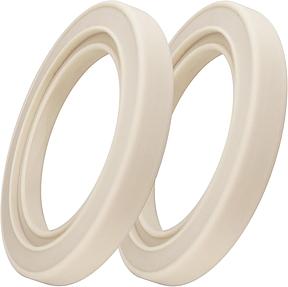
NEOUZA Lot de 2 Joints en Silicone pour Tête de Groupe 58mm
View at AmazonAffiliate link. Buying through it earns us a commission; the price stays the same for you.
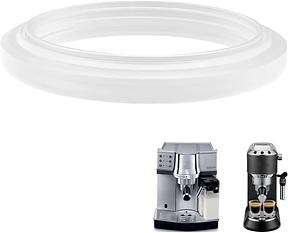
Joint torique silicone pour De'Longhi EC680/EC685/EC820/EC850/EC860
View at AmazonAffiliate link. Buying through it earns us a commission; the price stays the same for you.
Rubber or silicone
The original gasket is very often rubber (NBR). Silicone is the most common replacement alternative, and the makers who sell it advance two arguments: it hardens less as it ages, and it comes out more easily because it sticks less to its groove. Those are manufacturer claims, not the result of independent testing — Novebar compares and explains, it does not test.
What is checkable, though: a silicone gasket stays soft to the touch for longer, which removes one of the three wear symptoms described above. On silicone, go by handle position and sealing, less by hardness.
A puck screen is not a spare shower screen
The puck screen — the thin metal disc you place on top of the puck, inside the basket — arrived recently in the mainstream accessory drawer, and it gets confused with the shower screen regularly. They are two different parts, in two different places, doing two different jobs.
The shower screen is fixed under the group, machine side, and is part of the water circuit. The puck screen sits in the portafilter, coffee side, and is optional. It flattens the water arrival just above the grounds and keeps the shower screen cleaner, since it intercepts some of the fines at knock-out.
Puck screen 58,5 mm inox 316, 150 µm (lot de 2)
A 58.5 mm puck screen in 316 stainless at 150 µm is the most common format for 58 mm portafilters. Useful, easy to rinse, quick to inspect. But it does not compensate for a pitted or blocked shower screen: the water already arrives badly distributed before it gets there. Treat it as a maintenance supplement, never as a way to postpone a replacement.

Puck screen 58,5 mm inox 316, 150 µm (lot de 2)
View at AmazonAffiliate link. Buying through it earns us a commission; the price stays the same for you.
Replacing the shower screen
On most machines the shower screen is held by a central dispersion screw. The sequence is short: undo the screw, take the screen out, clean the recess, fit the new part.
One precise point, and it comes from the La Marzocco card quoted above: the dispersion screw is tightened by hand, not with a screwdriver. Over-tightened, it warps the screen — and a warped screen distributes water even worse than a clogged one.
Douchette de précision IMS pour groupe E61
For an E61 group, a machined precision screen is a direct replacement for the original part. It's also the moment to check the screw itself: if its thread has suffered, changing it at the same time saves a second teardown.
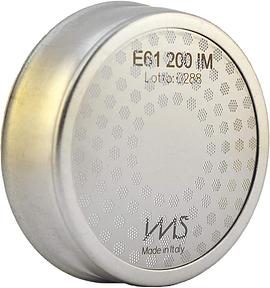
Douchette de précision IMS pour groupe E61
View at AmazonAffiliate link. Buying through it earns us a commission; the price stays the same for you.
Removing the gasket: where people damage their machine
A gasket is a consumable you replace without thinking about it. A gouged group seat is not repairable.
The worn gasket is tight in its groove, often glued in by baked-on oils. The reflex is to reach for a flat screwdriver. That is exactly how people slip and cut into the aluminium or brass seat the gasket has to press against. A nick there creates a permanent leak that no new gasket will rescue.
The right method is the manufacturer's: a gasket pick, driven into the side of the gasket to pull it down and out, then used the other way round to push the new one home. La Marzocco describes that sequence exactly: puncture the side, pull, then push back in.
Jeu de 8 crochets extracteurs de joints toriques
A set of O-ring extraction hooks does that job very well. They're workshop tools rather than coffee accessories — which is precisely why they come in several profiles and attack the gasket without attacking its housing.
Kit joints de groupe silicone multi-marques avec outil de pose
There are also kits that pair the silicone gaskets with the fitting tool in one package, for the most common groups. Handy for a first replacement: you don't find out mid-teardown that you're missing the tool.
Once fitted, lock the portafilter in several times to seat the gasket: that's what gives it its final position and its bearing surface. A handle that clamps a bit stiffly on the first few goes is normal on a new gasket. A handle that won't engage at all is not — that's a thickness too great for your machine.
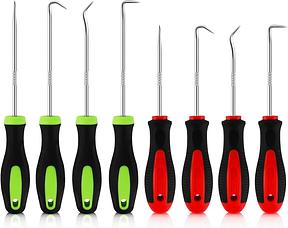
Jeu de 8 crochets extracteurs de joints toriques
View at AmazonAffiliate link. Buying through it earns us a commission; the price stays the same for you.
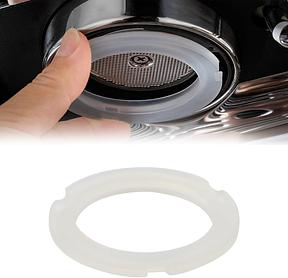
Kit joints de groupe silicone multi-marques avec outil de pose
View at AmazonAffiliate link. Buying through it earns us a commission; the price stays the same for you.
The maintenance that pushes both replacements back
None of this makes the parts eternal, but the gap between a maintained machine and a neglected one is measured in months.
Flush the group for a few seconds after pulling the portafilter, to clear the fines left on the screen before they bake on.
Brush the screen and the gasket groove regularly, while warm, when residue is still soft.
Descale according to your machine's manual: scale doesn't attack the gasket directly, but it degrades the whole circuit upstream. That subject has its own method, set out in our guide to descaling a coffee machine.
Wipe the rim of the group before locking the portafilter in: grounds trapped between gasket and basket create a leak that has nothing to do with wear.
Brosse de groupe Pallo Coffeetool Grouphead
An angled group brush is the dedicated tool for this: the handle is shaped to reach under the group, and the bristles get into the gasket groove without you dismantling anything. It's the maintenance accessory that asks the least effort for what it prevents, and it earns its place among the essential barista accessories.
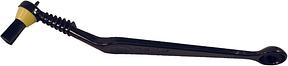
Brosse de groupe Pallo Coffeetool Grouphead
View at AmazonAffiliate link. Buying through it earns us a commission; the price stays the same for you.
What if you have a bean-to-cup machine?
The situation is different, and it deserves saying plainly: on an automatic bean-to-cup machine there is no user-accessible group gasket and no shower screen to unscrew. There's no portafilter to lock in, so there's no sealing ring at that point.
What these machines have is a brew unit: a complete mechanical assembly, with its own internal seals, that presses and rinses the puck for you. On many De'Longhi, Philips and Melitta models this assembly comes out through a side hatch. On other brands — Jura, and part of the Siemens and Miele ranges — it's fixed and only comes out on a technician's bench.
User maintenance is therefore limited to removing the brew unit and rinsing it under clear water, with no detergent, then lubricating it with the food-safe grease the manufacturer specifies. The frequency is whatever your model's manual states: it varies between brands and there is no general rule on the subject.
The brew unit's internal seals do get replaced — but that's a part-by-part job on the removed assembly, or a whole-unit swap, not a two-minute consumable like a group gasket. If your bean-to-cup coffee is getting worse, the diagnostic path runs through the grinder, the brew unit and descaling, not through a shower screen.
If you're weighing a move to a portafilter machine to take back control of these settings, our manual espresso machine guide sets out what actually changes.
Sources
La Marzocco Home, "Preventative Maintenance" card (document published on the brand's own site): read the card
La Marzocco Home, "How to Replace the Group Gasket": see the tutorial
Gasket compatibility and dimensions: the spare-part manufacturers' own product listings cited in this article
All products from this post
The ones we named above are marked; the rest are alternatives in the same category.
Affiliate notice: As an Amazon Associate, we earn from qualifying purchases. Product prices and availability are subject to change.
Frequently Asked Questions
How do I know my group gasket is worn out?
Three signs are enough. The portafilter locks further and further round compared with its original position. Water beads or steam hisses at the rim during the shot. The rubber has gone hard, smooth and glossy instead of staying matte and slightly grippy. Any one of the three justifies replacement on its own: they rarely all appear at once.
How often should a group gasket be replaced?
There is no universal interval. La Marzocco recommends six months for its domestic machines in its preventative maintenance card. Sage and Breville publish no frequency at all. So the rule is twofold: follow your own machine's manual, and above all watch the symptoms, because wear depends on shots per day far more than on the calendar.
Which gasket thickness should I pick in 58 mm?
You'll commonly find 8 mm, 8.5 mm and 9 mm. The right one is your machine's original spec first. Thickness decides where the handle ends up: thicker brings it back to the left, thinner sends it further right. If the portafilter was already clamping too far round on a new gasket, moving up one thickness is the usual fix.
Can a puck screen replace a damaged shower screen?
No. The shower screen is fixed under the group and is part of the water circuit; the puck screen sits in the portafilter, on the puck, and stays optional. A puck screen keeps the shower screen cleaner and smooths the water arrival just above the grounds, but water already arrives badly distributed if the screen is pitted or blocked. It's a supplement, not a replacement.
Can I remove a group gasket with a screwdriver?
It's a bad idea, and it's the classic cause of damage to a group. The gasket is tight in its groove and often glued in by baked-on oils, so the screwdriver slips and cuts into the metal seat the gasket has to press against. A nick there creates a permanent leak that no new gasket will rescue. Use a gasket pick or an extraction hook.
Does my bean-to-cup machine have a group gasket to change?
No. An automatic bean-to-cup machine has no portafilter to lock in, no accessible group gasket and no shower screen to unscrew. It has a brew unit with its own internal seals. On De'Longhi, Philips or Melitta it comes out for a rinse under clear water without detergent; on Jura and part of the Siemens and Miele ranges it's fixed and comes out on a technician's bench.