How to Store Coffee Beans: What Actually Ruins Them (and the Habits That Backfire)
 16 min read
Learning how to store coffee beans comes down to limiting four attacks — oxygen, moisture, heat and light — and they do not carry anything like the same weight. Oxygen dominates the ranking by a wide margin, which is why so much storage advice misses the point: it fixates on the dark cupboard while leaving the bag open to the air. A badly resealed bag in a dark cupboard degrades faster than a properly sealed bag standing in daylight.
One point of vocabulary before we start: storing is not resting. Freshly roasted coffee needs a few days to degas before it is at its best, and it eventually passes its peak — that is a question of timing, covered elsewhere, and treated here as settled background. This page is about something else: what physically degrades the beans while they wait in your kitchen, and which popular habits work against you.
The four enemies, in the right order
The ranking is not a barista hunch; it has been measured. In a study published in LWT — Food Science and Technology in 2001, Cardelli and Labuza stored coffee under controlled oxygen partial pressure, water activity and temperature, then determined the end of shelf life with a consumer panel — the point at which half the tasters find the coffee unacceptable (Cardelli & Labuza, LWT 34(5), 2001).
The three measured effects, in order of magnitude:
| Factor | Range tested | Effect on the rate of deterioration |
|---|---|---|
| Oxygen | 0.5 to 21.3 kPa (ambient air) | × 20 |
| Moisture | water activity + 0.1 | + 60 % |
| Temperature | + 10 °C (18 °F) | + 15 to 23 % |
The gap is overwhelming. Removing air acts on a factor of twenty; gaining ten degrees acts on a factor of well under a quarter. Every storage decision should be arbitrated in that order.
Two honest caveats about those numbers. First, they were obtained on ground coffee, whose exposed surface is incomparably larger than that of whole beans: whole beans stale far more slowly, and these values do not transfer as durations. What does transfer is the hierarchy of levers, because the mechanisms are identical — oxidation of lipids and aroma compounds, reactions accelerated by available water, kinetics accelerated by heat. Second, light was not part of that protocol. It remains a real but secondary factor, which only bites through transparent containers and direct sunlight, as the National Coffee Association notes in its storage guidance.
There is a fifth factor no table quantifies: odours. Coffee is porous and oily, and it absorbs what surrounds it. The NCA puts it plainly: coffee absorbs and retains moisture, as well as odours and tastes, from the air around it. That point becomes decisive in two minutes.
Why the original bag usually beats the container you are about to buy
This is the least commercial conclusion on the page, and probably the most useful: a well-made roaster's bag is an excellent storage container.
It combines three properties a kitchen canister almost never has all at once:
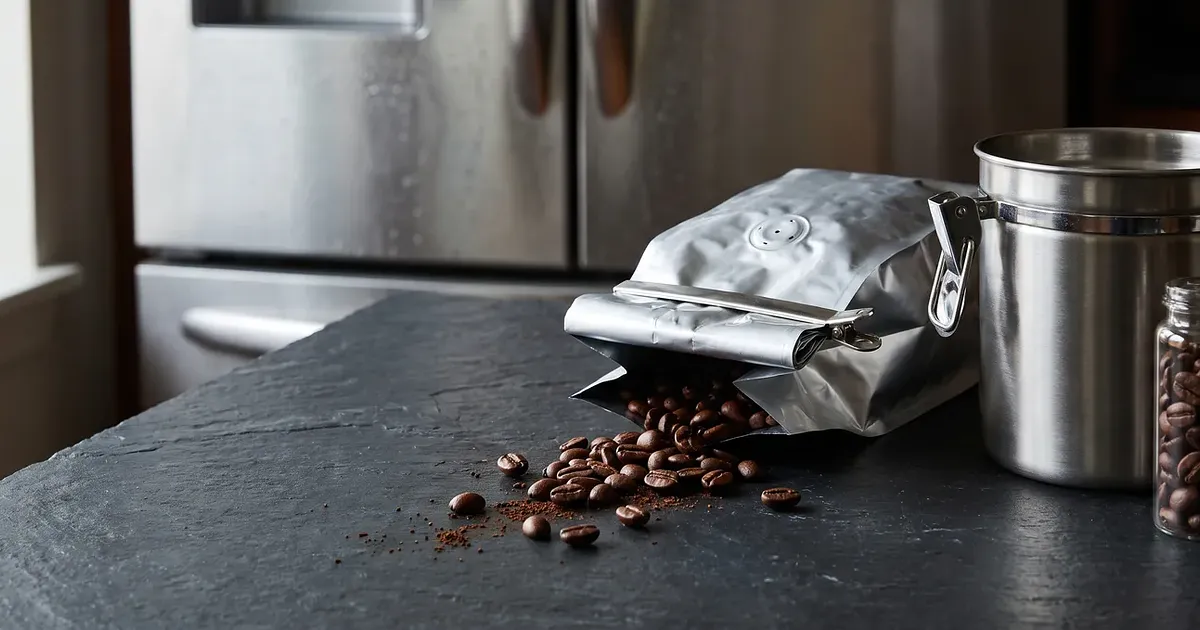
A multilayer barrier, usually with an aluminium film, effectively impermeable to oxygen and water vapour — considerably tighter than a glass jar sealed by a silicone gasket nobody ever replaces.
A one-way valve, the small raised disc on the face of the bag: it lets the CO₂ produced by the beans escape without letting air in. That is exactly the behaviour you want.
A volume that shrinks with the contents. Rolling the top down before clipping expels the air; a rigid canister always holds the same volume, and the space freed above the beans refills with air at every opening.
The correct routine fits in one sentence: expel the air by rolling the bag, clip it firmly, and store it in the coolest, driest cupboard, away from the oven and the dishwasher.
You will find a selection of containers further down, and they have genuine uses — a torn bag, a bag with no valve, a bulk purchase to split, an organised single-dose system. But they are not a default upgrade. Decanting an intact valve bag into a jar you open several times a day is a step backwards, not forwards.
Backfiring habit #1: the refrigerator
This is the classic mistake, and it deserves better than a flat prohibition, because the mechanism is instructive.
The starting logic is sound: cold slows chemical reactions. The problem is the price paid for that gain.
The gain is small. Going from a 22 °C (72 °F) kitchen to a 5 °C (41 °F) fridge is about 17 °C (31 °F) of difference — which, on the figures above, is a reduction of roughly 25 to 35 % in the rate of deterioration. Real, but modest.
The cost is large, and it lands on the two heavier factors. A domestic refrigerator is a humid environment saturated with odours: cheese, leftovers, respiring vegetables. Coffee, porous and oily, picks up both. And above all, every time you take the bag out, beans at 5 °C meet kitchen air at 22 °C: if that air is above the corresponding dew point, water condenses on the surface of the beans. You then return beans that are now wet on the surface to the cold, and repeat the next morning.
Put bluntly: you trade the weakest lever (temperature, +15 to 23 % per 10 °C) for the middle one (moisture, +60 % per 0.1 water activity), and you add aroma contamination that nothing undoes. It is a bad trade, and it is bad for a quantifiable reason rather than by tradition.
A fridge only becomes acceptable in a configuration almost nobody applies: a genuinely airtight container, taken out and opened once, after it has fully returned to room temperature. At that point the cupboard is simpler.
Backfiring habit #2: the handsome glass jar on the worktop
Aesthetically, it is unbeatable. Technically, it stacks three penalties.
The jar is transparent: this is the one case where light genuinely counts. It sits on the worktop, so often against a machine that heats up, next to the hob, or in the afternoon sun. And above all, it is opened several times a day, which renews the air inside every time — the factor of twenty.
The order of the objections matters: the real problem is not the glass, it is the air. An opaque jar opened ten times a day is not much better than a clear jar opened ten times a day.
There is a usable version of the idea: keep the main stock sealed in a cupboard, and leave only two or three days' worth in the jar on the worktop. You keep the pleasant ritual and expose only a small fraction of the stock.
Backfiring habit #3: filling the hopper to the top
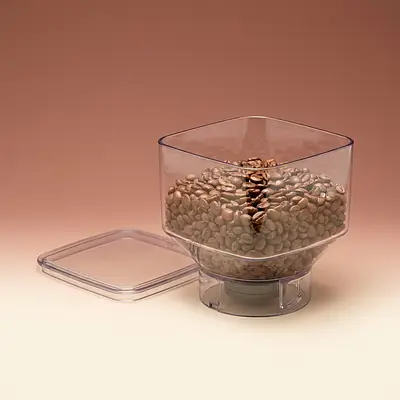
On a bean-to-cup machine, the hopper is the most hostile container in the entire kitchen: usually transparent plastic, warm because it sits on an appliance that heats, and closed by a lid with no pretension to being airtight.
Loading a kilo of beans into a hopper means storing your coffee in the worst available place for two or three weeks. Put in what you drink over a few days and keep the rest sealed elsewhere. The minor nuisance of refilling more often is repaid many times over.
This detail rarely appears on a spec sheet, yet it matters more than several of the specification differences between models we compare in our bean-to-cup machine round-up.
Backfiring habit #4: "my cupboard is cool anyway"
Check that before believing it. A cupboard above the oven, against the dishwasher, or behind the espresso machine regularly runs several degrees above the room. And a poorly ventilated flat can sit at 27–30 °C (81–86 °F) for weeks in high summer — a completely different storage regime from 20 °C (68 °F).
The useful criterion is not "dark", it is cool, dry and stable. A low cupboard away from heat sources, on an internal wall, beats a high cupboard next to the hob. If your kitchen turns into an oven in summer, another room will do a better job than the cabinet closest to the machine.
The freezer: a separate case, and a genuine debate
The freezer is often filed alongside the refrigerator on the banned list. That is a simplification, and a misleading one: the two mechanisms are not the same.
At −18 °C (0 °F) or below, available water is immobilised and chemical kinetics collapse. Degassing itself slows sharply: Specialty Coffee Association work relayed by Perfect Daily Grind in September 2025 places that marked slowdown around −25 °C (−13 °F). The weak point of freezing is therefore not the chemistry, it is condensation — precisely the refrigerator's flaw, except that here it is avoidable by method.
The conditions that make the practice defensible, as described by the professionals who use it:
- Single doses, weighed in advance, in genuinely airtight containers, ideally vacuum-sealed.
- One opening per dose. You never reopen the main stock in a warm kitchen: that is where the water lands.
- No refreezing of a thawed dose.
- Grind straight from frozen, a practice several roasters quoted in the article above stand by — or, failing that, let the dose come back to room temperature before opening its container.
Point 4 rests on published observation: Uman and co-authors showed in Scientific Reports in 2016 that grinding chilled beans yields a narrower particle size distribution (Uman et al., Scientific Reports 6:24483). Read that result precisely: the effect is clear at laboratory extremes (liquid nitrogen, dry ice) and much fainter between −19 °C and 20 °C, where the published values overlap within their uncertainties. A domestic freezer is not liquid nitrogen, and nobody should promise laboratory gains in a kitchen.
What is actually agreed is narrower than either camp claims: freezing correctly preserves better than a cupboard over long periods, freezing badly is worse than anything, and the effect in the cup remains contested. If you drink a bag in three weeks, the freezer buys you nothing. If you bought four bags of a lot you love, it becomes a serious option.
The routine that solves 90 % of the problem
- Buy the quantity you drink, not the one that lowers the price per kilo. It is the most effective storage measure available, and it is free.
- Keep the original bag sealed, air expelled, valve intact, in a cool dry cupboard — away from the oven, the dishwasher and the afternoon sun.
- Keep only a few days' worth in the hopper or the worktop jar.
- Grind immediately before brewing. Ground coffee exposes a surface area beyond any comparison with whole beans: it is by far the leading cause of aroma loss at home, ahead of any container choice. Our electric burr grinder comparison covers that point.
- Dose by weight, not by volume. The same scoop does not hold the same mass across roast levels and settling, and weighing is what lets you build consistent doses if you freeze. Our guide to tamper, WDT and scale explains the scale's real role.
- Clean the container between bags. Oils deposited on the walls go rancid and contaminate the next lot. Hot water, washing-up liquid, and dry it completely.
If you genuinely need a container
The criteria that matter, in order:
| Criterion | Why |
|---|---|
| Verifiable seal | A gasket you can compress, a valve, or a vacuum pump — not just a lid that "closes well" |
| Headspace management | A container far bigger than your stock is an air reservoir; pick the right size, or a lid that descends onto the beans |
| Opacity or cupboard storage | Light is only a problem if the container is transparent and exposed |
| Capacity matched to 1–2 weeks | Two small containers beat one large one opened twice a day |
| Easy to clean | Coffee oils go rancid on the walls |
Our guide to essential barista accessories puts these objects back into the context of a full setup.
The reference: the plunging-lid canister
The principle is simple and effective: an inner lid descends to the level of the beans and pushes air out through a two-way valve, removing the headspace instead of sealing it in. It is the closest behaviour to a bag you roll down.
Airscape Boîte de conservation café en acier inoxydable, couvercle hermétique à piston
Stainless steel also settles the opacity question and holds no odours, unlike many plastics.
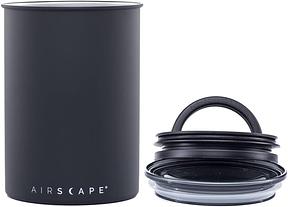
Airscape Boîte de conservation café en acier inoxydable, couvercle hermétique à piston
View at AmazonAffiliate link. Buying through it earns us a commission; the price stays the same for you.
The same principle in a large format
If you buy in one-kilo lots, the large format saves you splitting across mismatched containers — while keeping the plunging lid that does the actual work.
Airscape XL — boîte de conservation 1,1 kg de grains, couvercle plongeant à valve bidirectionnelle
Beware the inverse reasoning, though: a large container left half empty, with no plunging lid, is worse than a small container filled to the top.
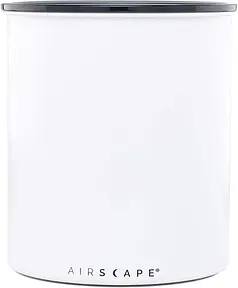
Airscape XL — boîte de conservation 1,1 kg de grains, couvercle plongeant à valve bidirectionnelle
View at AmazonAffiliate link. Buying through it earns us a commission; the price stays the same for you.
With a built-in date dial
A simple dial on the lid to record the opening or roast date, plus a degassing valve. The benefit is not mechanical, it is behavioural: you only store well what you know the age of.
Coffee Gator — boîte à café hermétique acier inoxydable avec valve de dégazage et cadran dateur
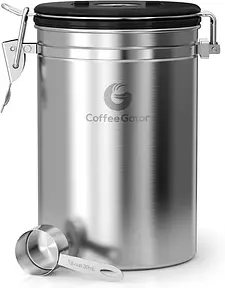
Coffee Gator — boîte à café hermétique acier inoxydable avec valve de dégazage et cadran dateur
View at AmazonAffiliate link. Buying through it earns us a commission; the price stays the same for you.
Vacuum sealing
Actively removing the air, rather than merely enclosing it, attacks the factor of twenty head on. It is the option most consistent with the storage data — and the most demanding, since the vacuum has to be re-drawn after every scoop.
Fellow Atmos 1,2 L verre — récipient sous vide avec pompe intégrée
The benefit-to-effort ratio depends entirely on how often you open it: strongly favourable for a stock opened once a week, arguable for coffee served three times a day.
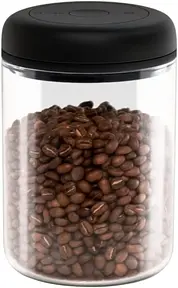
Fellow Atmos 1,2 L verre — récipient sous vide avec pompe intégrée
View at AmazonAffiliate link. Buying through it earns us a commission; the price stays the same for you.
Two small containers instead of one big one
The underrated strategy: separate the "in use" stock from the "waiting" stock, so that most of your beans never meet room air before their turn.
Dosenritter — lot de 2 boîtes métal hermétiques à joint silicone et fermeture mécanique, 500 g
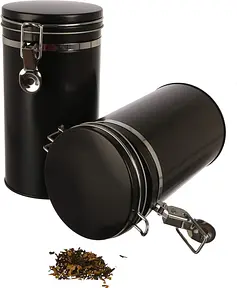
Dosenritter — lot de 2 boîtes métal hermétiques à joint silicone et fermeture mécanique, 500 g
View at AmazonAffiliate link. Buying through it earns us a commission; the price stays the same for you.
Single doses, especially for the freezer
This is the container that makes freezing defensible rather than risky: one weighed dose per tube, one opening, and no handling of the remaining stock.
KNODOS — lot de 10 tubes de dose unique en verre avec couvercles, présentoir et entonnoir
Glass tolerates sub-zero temperatures and cleans without holding odours; this format is also what lets you take a dose out and grind it immediately.
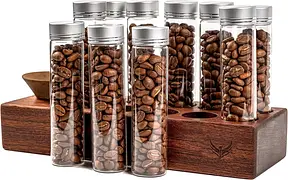
KNODOS — lot de 10 tubes de dose unique en verre avec couvercles, présentoir et entonnoir
View at AmazonAffiliate link. Buying through it earns us a commission; the price stays the same for you.
The accessory that changes more than any container
If you were to buy one object from this page, it would not be a canister. A scale reading to 0.1 g earns its place daily, lets you build consistent doses, and finally makes two successive extractions comparable.
TIMEMORE Black Mirror Basic 2 — balance à café 2 kg / 0,1 g avec minuteur
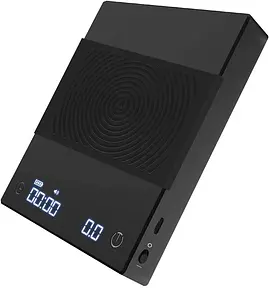
TIMEMORE Black Mirror Basic 2 — balance à café 2 kg / 0,1 g avec minuteur
View at AmazonAffiliate link. Buying through it earns us a commission; the price stays the same for you.
Key takeaways
Oxygen is by far the leading degradation factor; moisture comes next, heat after that, and light last — and only if the container is transparent.
The roaster's valve bag, air expelled and firmly clipped, beats most of the containers bought to replace it.
The refrigerator is the textbook bad trade: a small temperature gain paid for with a large moisture and odour penalty.
The clear jar on the worktop fails mainly on the number of openings, not on the glass.
The freezer is not the fridge: done properly — single doses, airtight, no refreezing — it is a defensible option for long-term stock, and the topic remains debated.
Buying less at a time and grinding just before brewing still beat any accessory.
All products from this post
The ones we named above are marked; the rest are alternatives in the same category.
Affiliate notice: As an Amazon Associate, we earn from qualifying purchases. Product prices and availability are subject to change.
Frequently Asked Questions
Should coffee beans go in the refrigerator?
No. Cold does slow the reactions slightly, but fridge air is humid and full of odours, and every removal condenses water on the surface of cold beans. You gain on the weakest factor — temperature — and lose on moisture, which weighs far more, plus aroma contamination on top. A cool, dry cupboard does better with no effort at all.
Is the original bag really good enough?
In most cases, yes. A roaster's bag combines a very tight multilayer film, a one-way valve that vents CO₂ without letting air in, and a volume that shrinks when you roll it down. You simply have to expel the air, clip it firmly, and keep it away from heat. Decanting into a jar you open several times a day is usually a downgrade.
Can you freeze coffee beans?
Yes, provided you follow the method: single doses weighed in advance, genuinely airtight containers, one opening per dose, and never any refreezing. The enemy is not the cold but condensation, which appears when you open and reclose cold stock in a warm kitchen. The practice remains debated as far as its effect in the cup is concerned.
How much coffee should I buy at a time?
Enough for two to three weeks of drinking. It is the most effective storage measure and the only one that costs nothing. Buying five kilos to lower the price per kilo usually means drinking degraded coffee for two months, which wipes out most of the saving.
Is a vacuum canister better than a plain airtight one?
On paper yes, because it removes the air instead of enclosing it, and oxygen is the leading degradation factor. In practice it depends on discipline: the vacuum has to be re-drawn after every scoop. For stock opened once a week the benefit is clear; for coffee served three times a day the gap over a good airtight canister narrows considerably.
Is badly stored coffee dangerous?
No, unless there is visible mould or a frankly abnormal smell, which signal excess moisture and mean the batch should be thrown out. Merely oxidised coffee is not a food-safety issue: it loses its aromatics, develops cardboard and rancid notes, and brews flat. That is a quality loss, not a health risk.