Worn grinder burrs: how long they really last and how to tell it is time
 15 min read
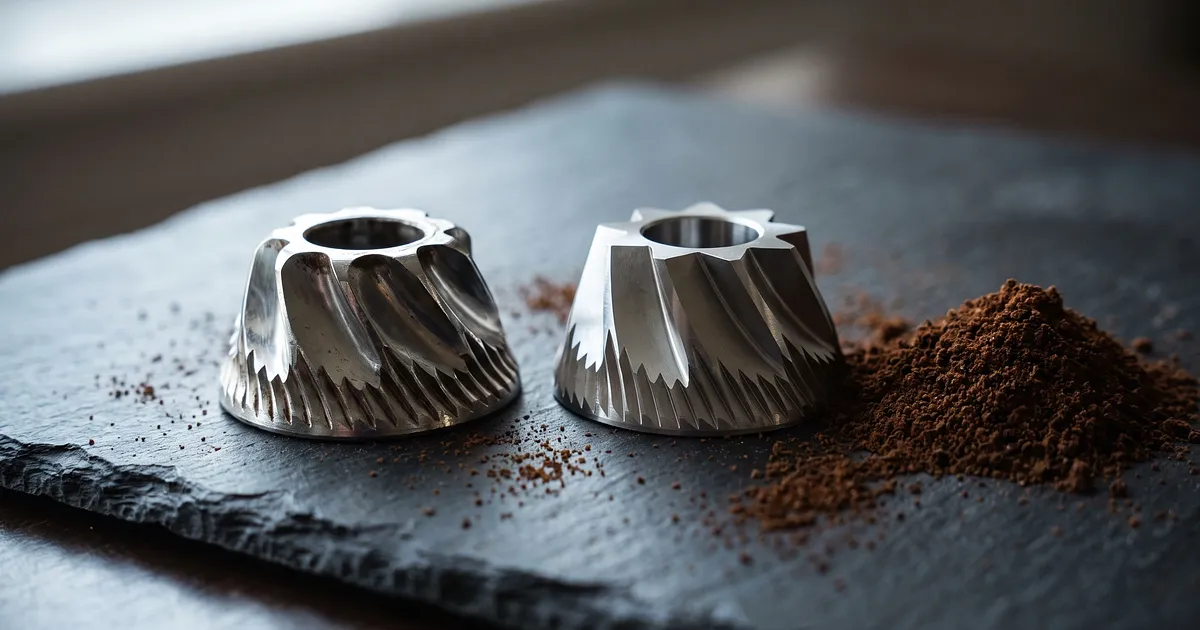
A grinder does not fail on the day its burrs wear out. It degrades slowly, over months, and the most common symptom looks so much like a dialling-in mistake that most people blame their beans, their tamping or their machine long before they suspect the two pieces of steel doing all the work.
Why burr life is counted in kilos, not years
A burr wears by cutting. What tires it is not time passing but the number of beans that go through its teeth. Two identical grinders bought on the same day can therefore be in wildly different states five years later: the one in a café pushing five kilos a day grinds in a few weeks what a household takes a decade to drink.
That is why professional manufacturers state their recommendation in pounds or kilos and never as a duration. The table below collects published figures for commercial grinders, compiled by Espresso Parts in its burr-replacement guide dated 4 August 2020. The kilo column is a rounded conversion, not an extra manufacturer claim.
| Grinder | Burrs | Published life | ≈ in kilos |
|---|---|---|---|
| Mazzer Mini | 58 mm flat | 660 lb | ≈ 300 kg |
| Mazzer Super Jolly | 64 mm flat | 880 lb | ≈ 400 kg |
| Mazzer Major | 83 mm flat | 1,300 lb | ≈ 590 kg |
| Mazzer Kony | 63 mm conical | 1,640 lb | ≈ 745 kg |
| Mazzer Robur | 83 mm conical | 1,800 lb | ≈ 815 kg |
| Nuova Simonelli MDX | 64 mm flat | 1,200 lb | ≈ 545 kg |
| Nuova Simonelli Mythos | 75 mm flat titanium | 1,500 lb | ≈ 680 kg |
| Fiorenzato F64 EVO PRO | — | 1,300 lb | ≈ 590 kg |
| Fiorenzato F83 E PRO | — | 2,000 lb | ≈ 905 kg |
| Mahlkönig K30 / E65S | — | 1,600 lb | ≈ 725 kg |
| Mahlkönig E80 Supreme | — | 3,300 lb | ≈ 1,500 kg |
| Mahlkönig EK43 | — | 14,300 lb | ≈ 6,500 kg |
| La Marzocco Swift | 64 mm ceramic | 3,300 lb | ≈ 1,500 kg |
Two things jump out. First, diameter matters enormously. An 83 mm set grinds two to three times as much coffee as a 58 mm set before it is called finished, because at the same throughput each tooth sees fewer beans per revolution. Second, these numbers are written for cafés. They do not transfer directly to a home grinder, whose burrs are often 38 to 40 mm and turn far more times per gram ground.
What home-grinder makers publish — and what they do not
Honesty requires a caveat here. Most consumer brands publish no official lifespan figure at all. The page Baratza devotes to the life expectancy of its grinders gives none, and there is no manufacturer spec sheet quoting "X kilos" for an Encore or a Virtuoso.
The numbers in circulation therefore come from support channels and specialist retailers, and they do not agree:
around 500 lb (≈ 225 kg) for the steel burrs in Baratza's home models, with ceramic versions lasting "even longer", per the replacement guide KLLR Coffee published on 26 March 2019;
750 to 1,000 lb (≈ 340 to 450 kg) for 50–65 mm steel burrs, according to Clive Coffee's "When to Replace Your Espresso Grinder Burrs".
A factor of two between two serious sources is not noise: it is the sign that no universal number exists. The bean itself matters — density, roast level, how fine you grind — and KLLR says so explicitly. Treat these values as an order of magnitude, not as an odometer.
Steel, ceramic, coated: three different behaviours
Material changes how long burrs last, but it also changes how they die, which is arguably more useful to know.
Steel is the baseline. It wears gradually and predictably: the edges round over, cutting turns into crushing, and the decline is so slow it disappears into habit. It is the material behind every figure in the table above.
Ceramic resists abrasion better — Clive Coffee describes it as lasting "considerably" longer than steel — but it is brittle. A stone in a bag of beans, a paperclip dropped into the hopper, and a tooth chips. A chipped ceramic burr does not wear faster: it has to be replaced immediately, because it produces an uneven grind from the very next dose.
Coatings (titanium, TiAlCN-type nitrides) are the interesting option for anyone grinding a lot. Eureka rates its 65 mm titanium-coated burrs at 1.6 tonnes of coffee, and "at least three times longer" than traditional steel, according to the product listing published by Clive Coffee. That is a manufacturer claim relayed by a retailer rather than an independent test, but the order of magnitude matches what other coated-burr makers promise.
Worth remembering: a coating does not change cutting geometry, only its resistance to abrasion. Coated burrs do not grind "better" when new; they simply stay new for longer.
The symptoms you will notice long before you count kilos
Almost nobody keeps a log of kilos ground. In practice wear is detected through its symptoms — and they are distinctive enough to recognise.
You keep going finer, and finer. This is the most reliable and most frequently described sign. To hit the same shot time you managed six months ago you have to go finer, then finer again. Clive Coffee calls it grind creep: "adjusting your grinder finer and finer over weeks to hit the same shot time". Dull burrs cut less and crush more; the grind loses cohesion, water rushes through it, and you compensate by tightening.
The cup goes flat. Worn burrs produce more fines and more boulders at the same time — a wider distribution. The fines over-extract and bring bitterness, the boulders under-extract and bring sourness, and the result is a muddled shot no adjustment fixes. If you can no longer tell one fault from another, our espresso dial-in guide will help you rule out the settings first.
Grinding takes longer. A burr that cuts poorly keeps the motor running longer for the same weight. If your 18 g dose used to take twelve seconds and now takes eighteen, that is not your imagination.
It runs hotter and louder. Energy not spent cutting is dissipated as friction, which means heat and noise. A rasping note that was not there before is a clue.
Channelling appears despite careful puck prep. An uneven grind creates preferential paths through the puck even with a WDT tool and a level tamp. If you recently added those tools with no improvement, our article on the tamper, WDT and scale explains what they can — and cannot — fix.
The classic end-of-life pattern is the first two combined: "I keep grinding finer and it keeps getting worse." It is counter-intuitive, which is exactly why it gets blamed on something else for so long.
Worn, dirty or misaligned: all three look alike, only one is fixed by new burrs
This is the part most articles skip, and the only one that can save you a purchase. Three different causes produce exactly the same symptom — a soft, uneven grind that refuses to dial in.
1. Cleaning first, because it costs almost nothing
Coffee oils polymerise on the burrs and inside the chamber. The layer is thin, brown and sticky, and it changes the effective cutting geometry exactly as wear would. It is the first hypothesis to eliminate, and Clive Coffee recommends doing so explicitly before any purchase: run a cycle of cleaning tablets, brush the chamber, then pull a few shots with a fresh bag.
Grinder cleaning tablets are designed to be ground like coffee, with no disassembly: they carry residue off the burrs and out of the chute. Urnex Grindz — comprimés de nettoyage pour moulin à café, 430 g is the long-standing reference here — the granules pass through the grinder, after which you sacrifice a small dose of beans to purge whatever is left.
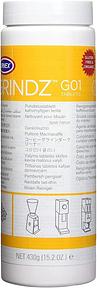
Urnex Grindz — comprimés de nettoyage pour moulin à café, 430 g
View at AmazonAffiliate link. Buying through it earns us a commission; the price stays the same for you.
2. Then the brush, for what tablets cannot reach
A dry brush finishes the job on the hopper, the adjustment thread and the exit chute, where granules never travel. Brosse de Nettoyage de Tête de Groupe pour Machine à Café Espresso (Lot de 2) handles those areas; never wet steel burrs, because water and residual grounds form a corrosive paste.
Not available in your region — closest match
View at Amazon (as of Aug 14)Affiliate link. Buying through it earns us a commission; the price stays the same for you.
3. Then alignment, before reaching for your card
Two burrs that are not rigorously parallel only cut on part of their circumference. The result — a wide distribution, excess fines, unstable shot times — is indistinguishable from wear, but the cause is mechanical: bearing play, a loose screw, a washer refitted wrongly after a strip-down. On many grinders alignment can be checked by reading the wear pattern on the teeth: if the polished contact band appears on one sector only, the burrs' age is not the problem.
The order matters, and it is also the cheapest: clean, check alignment, and only then replace. The same logic applies to the machine itself — a healthy grinder feeding a scaled-up espresso machine will not save the cup either, and our descaling guide covers that half of the problem.
Do the arithmetic: how long for you?
The maths is simple, and it reframes the whole question.
Two espressos a day at 18 g per dose is 36 g a day, a little under 13 kg a year. Against the 400 kg quoted for a Mazzer Super Jolly, that is several decades — long enough that the grinder will die of something else first.
Now apply the most conservative home figure, roughly 225 kg: that still gives about fifteen years at the same rate. At the other end, a café grinding 5 kg a day reaches 400 kg in eighty days. Same burr set; only throughput changes.
Three honest corrections to that calculation:
home burrs are small (38 to 40 mm is common), so probably closer to the bottom of the range than the top;
espresso, the finest grind, wears burrs faster than filter;
a light roast, denser and harder, wears them faster than a dark one.
Practical conclusion: for a household, the question "are my burrs worn?" comes up far less often than the internet suggests. Before answering yes, reread the previous section.
Bean-to-cup machines: the burrs are inside, and that changes things
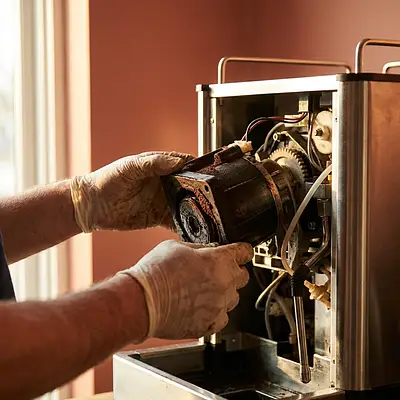
In a bean-to-cup machine the burrs are not a visible accessory but a part buried inside the grinding unit. The good news: they genuinely are wear parts, and on many brands they can be replaced. The less good news: getting to them means taking the machine apart.
On the conical grinding units used by several bean-to-cup manufacturers, the assembly is a grinding ring and a grinding cone, sold as a set. Kit de remplacement anneau et cône de broyage pour broyeur de machine à café à grain illustrates that kind of kit, listed as compatible with grinding units from several automatic-machine brands; as always with a spare part, compatibility has to be checked against your exact model reference before ordering, never against the brand alone.
Three things to weigh before you start:
- Warranty. Opening a machine still under cover can void it. While it runs, the service centre is the right call.
- Grind calibration. On many bean-to-cup machines the dial position is calibrated against the original burrs. After replacement you have to re-dial gradually, with the grinder running, in the direction the manufacturer specifies.
- Relative cost. On an older machine, a burr set plus disassembly time can be a large share of the residual value. That is not a reason to give up, it is a reason to decide with the numbers in front of you.
If you are still choosing between a bean-to-cup machine and a separate grinder, this replaceability question belongs in the decision, and our built-in versus separate grinder comparison covers it in detail.
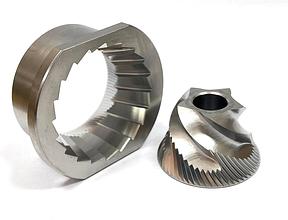
Kit de remplacement anneau et cône de broyage pour broyeur de machine à café à grain
View at AmazonAffiliate link. Buying through it earns us a commission; the price stays the same for you.
When replacing the burrs stops making sense
Let us be direct: on some grinders, burrs are not a realistic spare part.
Entry-level grinders
On many very affordable models no replacement burr set is listed, the grinding assembly is integral to the body, and the cost of an intervention would exceed a new grinder. Krups GVX242 Moulin à Café Électrique à Meules, 17 Niveaux belongs to that category of simple, popular appliances: perfectly good for discovering freshly ground coffee, but designed as a whole rather than as a platform to maintain for fifteen years. When a grinder like this starts showing its age, replacing the appliance is usually the rational decision.
Not available in your region — closest match
Baratza Encore ESP Moulin à Café à Meules Coniques
View at Amazon (as of Aug 11)Affiliate link. Buying through it earns us a commission; the price stays the same for you.
Grinders designed to be repaired
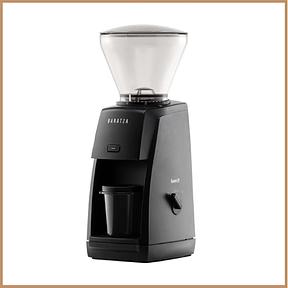
At the opposite end, some manufacturers treat burrs explicitly as a consumable and sell the parts individually. Baratza Encore — moulin à café électrique à meules coniques is the best-known example of that philosophy on the home side: replaceable conical burrs, spare parts listed in the catalogue, documented disassembly. A grinder from that family gets repaired rather than binned, and that is what justifies its positioning.
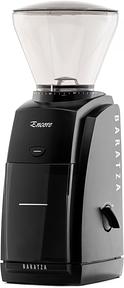
Baratza Encore — moulin à café électrique à meules coniques
View at AmazonAffiliate link. Buying through it earns us a commission; the price stays the same for you.
The espresso version of the same chassis
On the same architecture, Baratza Encore ESP Moulin à Café à Meules Coniques narrows the adjustment range for the portafilter, where the base model aims more at filter and French press. The point that matters here is identical: the burrs are a listed part, not an element welded into the body.
The distinction is not about price but about design. Before buying a grinder meant to last, one check is worth the detour: does the manufacturer list a replacement burr set in its catalogue? If the answer is no, the appliance is a consumable, whatever it costs. Our selection of electric burr grinders says where each model stands.
Baratza Encore ESP Moulin à Café à Meules Coniques
View at Amazon (as of Aug 11)Affiliate link. Buying through it earns us a commission; the price stays the same for you.
What to take away
Burrs wear out in kilos, and a household grinds few of them. The published figures — a few hundred kilos for small steel, up to more than a tonne for large or coated sets — put most home users many years out, often more than a decade.
The real trap, then, is not wear: it is diagnosing it too early. The "I keep going finer and it keeps getting worse" pattern is real and meaningful, but it is produced just as readily by clogged or misaligned burrs as by finished ones. Clean, check alignment, retest with a fresh bag. If the problem survives those three steps, then and only then is a burr set the right answer — and you should confirm, before ordering, that your grinder takes one.
All products from this post
The ones we named above are marked; the rest are alternatives in the same category.
Not available in your region — closest match
Baratza Encore ESP Moulin à Café à Meules Coniques
View at Amazon (as of Aug 11)
Affiliate notice: As an Amazon Associate, we earn from qualifying purchases. Product prices and availability are subject to change.
Frequently Asked Questions
How long do coffee grinder burrs last?
It depends on volume ground, not on age. Professional manufacturers quote anything from a few hundred kilos for small steel burrs to over a tonne for large diameters or coated sets. For a household pulling two espressos a day, roughly 13 kg a year, that usually means more than ten years. Consumer brands rarely publish an official figure at all.
How do I know my burrs are worn?
The most reliable sign is having to grind progressively finer to hit the same shot time. Add to that a flat cup that is bitter and sour at once, a grind cycle that takes longer, more heat and noise, and channelling despite careful puck prep. None of these is conclusive alone: they count when several appear together and keep getting worse.
Do dirty burrs behave like worn burrs?
Yes, and that is the main diagnostic trap. Polymerised oils change the effective cutting geometry exactly as wear does, producing the same soft, uneven grind. Misalignment gives the same result again. Clean with tablets and then a brush, check alignment, and retest with a recent bag: those three steps cost little and resolve a good share of cases.
Do ceramic burrs last longer than steel?
They resist abrasion better and so last longer at equal use. They are also brittle: a foreign object in the beans can chip a tooth, and a chipped burr must be changed immediately whatever its mileage. Steel wears slowly and predictably; ceramic lasts longer but fails abruptly.
Can the burrs in a bean-to-cup machine be replaced?
Often yes: the grinding ring and cone are wear parts and are sold as sets for many automatic machines. But access means dismantling the machine, the job can void a running warranty, and you then have to recalibrate the grind setting. Check compatibility against your exact model reference, never against the brand alone.
Should I replace the burrs or buy a new grinder?
It depends on the design. If the manufacturer lists a replacement burr set and documents the strip-down, replacing is almost always right: it restores original performance for a fraction of the appliance's value. If no part is available and the grinding assembly is integral to the body, the grinder is a consumable and replacing it outright is the rational call.