Commercial vs home espresso machine: useful lessons
 6 min read
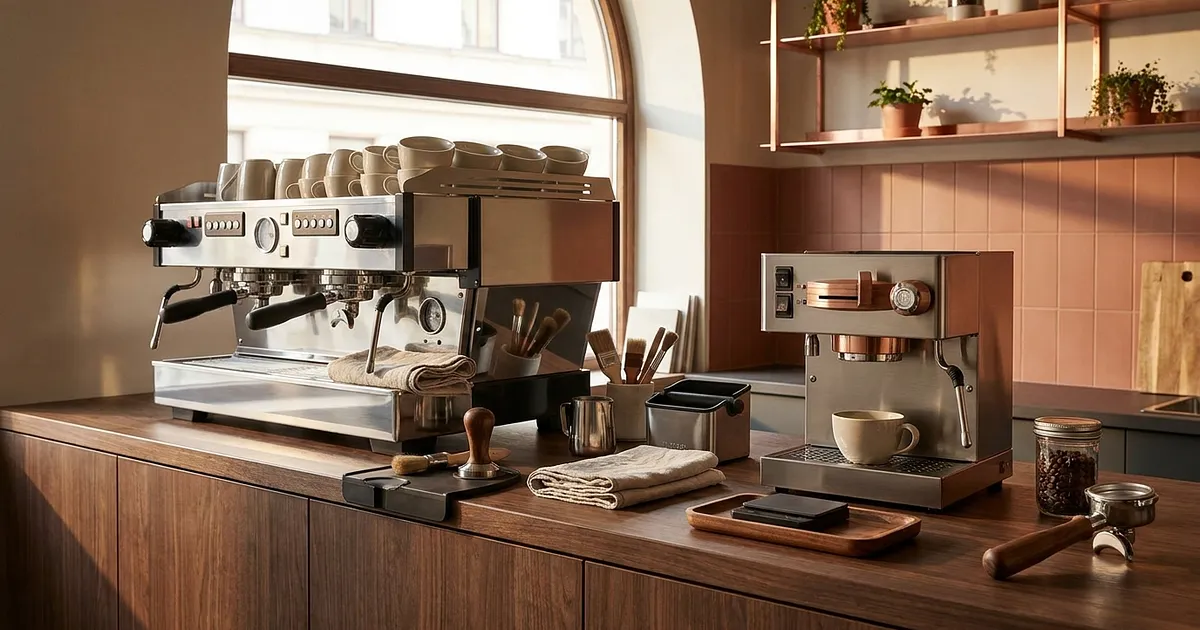
The question commercial vs home espresso machine often starts in the wrong place. Commercial hardware does not guarantee a tastier single shot. It is built to keep brewing, steaming and rinsing while orders overlap. Most kitchens do not need that capacity, but the service discipline is worth borrowing.
Updated 22 October 2026. Capacities below are manufacturer specifications accessed on that date, not independent measurements.
A cafe machine serves a queue
“Commercial” often sounds like a promise of better flavour. The specification sheets tell a plainer story. They describe availability. According to La Marzocco, the Linea Classic S comes with one to four groups. Across those versions, its coffee boilers range from 1.8 L to 6.8 L and its steam boilers from 3.5 L to 15 L.
The domestic Linea Micra still keeps dual boilers, PID control and an integrated group. Yet its job is different. La Marzocco lists one group, a 0.25 L coffee boiler, a 1.6 L steam boiler and a self-contained 2 L reservoir. Comparing two machines from one maker strips away much of the prestige talk. One scales for overlapping service. The other puts serious controls into a kitchen-sized package.
Those figures don't support a coffees-per-hour claim. Grinder speed, milk drinks, recipes and staffing all affect output. Nor do boiler volumes prove that the Classic S produces a tastier espresso. They document working reserve.
| Question | Commercial machine | Home machine | Worth copying at home |
|---|---|---|---|
| Parallel work | Several groups on some models | Usually one group | Nothing, unless shots genuinely overlap |
| Coffee and steam reserve | Sized for repeated service | Smaller volumes | Separate brew and steam only if milk workflow needs it |
| Water | Fixed supply is common, with exceptions | Tank is common | Suitable water and predictable refilling |
| Dose stop | Programmable controls are common | Manual or programmed | Check beverage mass with a scale |
| Reset | Built-in cycles and counters vary by model | Machine-specific routine | A short clean after each session |
Groups, water and steam solve service problems
Two groups don't make the water stronger. They let two portafilters brew in parallel. A large steam boiler doesn't guarantee finer microfoam either. Its main value is keeping steam available when milk orders stack up. For technique rather than capacity, Novebar's guide to steaming milk keeps those two questions separate.
Plumbing follows the same logic. A direct water connection saves someone from carrying and filling a tank during service. It isn't a taste upgrade by itself. Rancilio even documents a useful exception on the Classe 5: its one-group Tank version doesn't require a fixed water connection. Exact inlet and drain requirements belong to each model's installation manual.
At home, water composition matters more than whether a pipe feeds the machine. Hardness, filtration and scale deserve a considered choice, covered in our guide to espresso-machine water. Commercial plumbing won't rescue unsuitable water or a poor grind.
Volumetric doesn't mean weighed in the cup
This is the easiest cafe feature to misunderstand. Nuova Simonelli documents the Appia Life in volumetric versions with programmable doses, shot timers, counters and cleaning controls. A barista can start a dose and turn attention to the grinder, milk or another order.
But volumetric stopping uses a water-volume signal. It doesn't necessarily hold the final beverage mass constant when coffee, grind or flow changes. Victoria Arduino makes the distinction unusually clear. The company says Gravitech on the Black Eagle Maverick reads the weight of coffee in the cup on the group display.
The sensible home equivalent is a small scale. A programmed button can still be convenient, but beverage mass checks the recipe you chose. Our espresso brew-ratio guide explains that calculation without turning this piece into another dosing tutorial.
Copy the service, not the sizing
The useful cafe idea is almost boring: every action prepares the station for the next drink. The dose has a reference, time remains visible, the station returns to a known state and cleaning happens before residue becomes tomorrow's problem.
Two cappuccinos on a Saturday morning leave time to weigh a shot and refill a tank between drinks. A cafe with a milk-drink queue cannot stop that way. At home, four habits carry most of the useful service logic:
record coffee dose, beverage mass and time when a recipe works;
change one variable when the result shifts;
flush only as your machine calls for, with the distinction covered in our pre-shot flushing guide;
finish with a clean station and follow the maker's backflush instructions where compatible.
Rancilio says the integrated daily cleaning cycle on the Classe 5 takes 5 minutes. That's a claim for this range, not a universal cleaning time. The transferable part is scheduling a brief closing routine. For method, use the dedicated guide to espresso-machine backflushing rather than borrowing a cafe procedure blindly.
Hardware built for simultaneous orders, continuous filling or heavy steam demand can stay in the cafe. At home, the useful finish is simpler: a readable recipe and a clean station ready for the next drink.
Frequently Asked Questions
What is the difference between a commercial and a home espresso machine?
A commercial machine is sized to repeat drinks during service, often with more groups, greater steam reserve and programmable controls. A home machine favours kitchen space, household power and less simultaneous work. That difference doesn't guarantee better flavour from the commercial machine.
Why are cafe espresso machines connected directly to water?
A direct connection avoids refilling a tank during continuous service. It mainly solves an operating problem. Not every commercial machine requires it, and water-inlet or drainage needs must be checked in the installation manual for the specific model.
What does volumetric dosing do on an espresso machine?
It lets the machine stop a programmed dispense from a water-volume signal, freeing the barista to handle another task. It doesn't necessarily measure the actual mass of espresso in the cup.
Does a commercial machine always make better espresso at home?
No. It mainly adds capacity, simultaneous work and repeatability under load. Coffee, grind, recipe, water and puck preparation still shape the cup. A well-adjusted home machine may fit domestic use much better.
Which barista habits can I copy without buying a commercial machine?
Weigh the coffee and drink, keep a reference time, change one variable at a time and reset the station after the session. Those habits copy service logic without requiring several groups, a large boiler or fixed plumbing.