Backflushing: the clean most portafilter machines are asking for
 15 min read
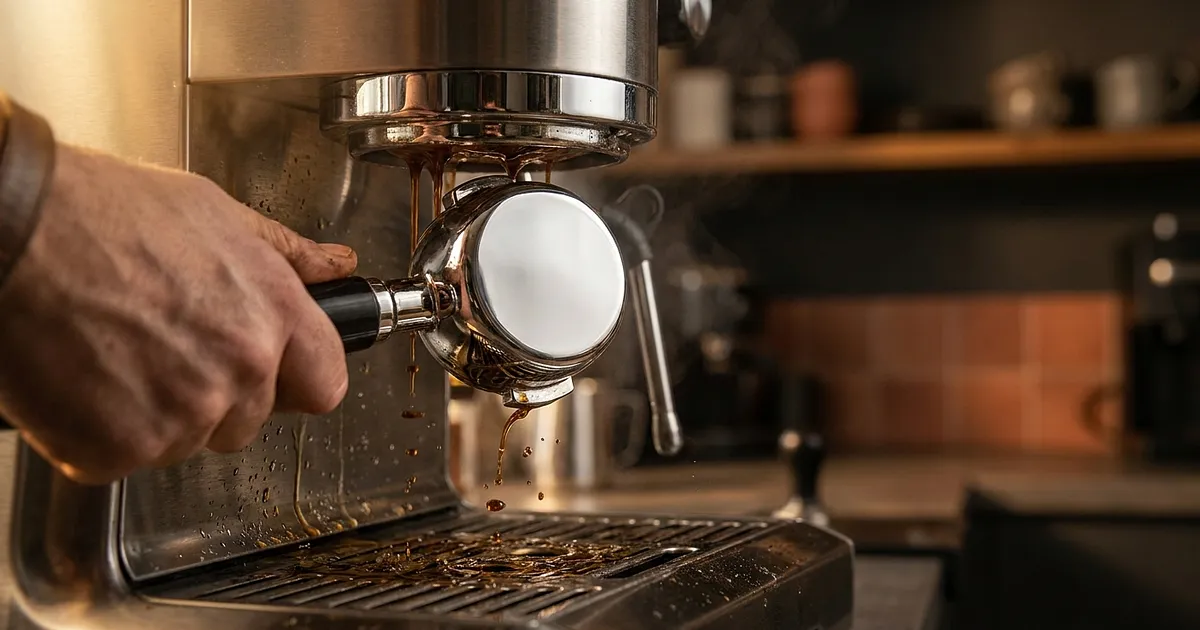
Pull the shower screen out of your group head and hold it up to the light. If it looks glossy and slick, that is not household grime. It is polymerised coffee oil, and the water rinse you do after every shot has never once touched it. La Marzocco puts that greasy film at the top of its list of tells for a neglected group, alongside two others every owner recognises without naming: the portafilter that sputters when you unlock it, and the coffee smell that survives a rinse (La Marzocco Home).
Backflushing is how you get at that oil. You block the basket, the pump pushes, the water has nowhere to go downward, so it runs back up through the group and out through the drain valve.
That sentence hides the whole problem, and it is the only real subject of this article. "Out through the drain valve" assumes there is a drain valve. Plenty of machines have none. On those, backflushing cleans nothing and can break something.
First: does your machine have a 3-way solenoid valve?
A 3-way solenoid valve is the electrovalve that, at the end of a shot, cuts the water supply and simultaneously opens a path down to the drip tray. It is what depressurises the portafilter and hands you a dry puck instead of a swamp.
Without it, the water the pump drives against a blind basket has no exit. The circuit is sealed at both ends.
The listening test, thirty seconds from now
Pull an ordinary shot. The instant the pump stops, listen to the group.
You should hear a short hiss and see a small amount of water drop into the drip tray. That is the test Seattle Coffee Gear gives, and that noise is your 3-way valve doing its job. No hiss, no drainage, a soaking puck when you knock it out: your machine either has no valve, or its valve is clogged.
The second clue is in the box the machine came in. If the manufacturer shipped a blind basket with it, the machine was designed to be backflushed. Nobody supplies an accessory whose use would wreck the product.
What happens if you do it anyway
I want to be precise about where this comes from. No manufacturer manual I could open states this failure in its own words. Technicians and specialist retailers document it, and it should be read as exactly that.
The bluntest version, from coffeemachinespecialist.com.au: on an incompatible machine the blind basket "forces the pump to work against a completely closed system," which can "overstress the pump motor, rupture internal seals, or damage the boiler's pressure relief valve." Kanen Coffee, writing about the De'Longhi Dedica, describes the same thing differently: excessive pressure build-up, with the pump, the seals and the heating element in the firing line.
Not a manufacturer warning, then. A consensus among people who repair these machines, and it always points the same way.
Who has one, who does not
| Machine or family | 3-way valve | What the claim rests on |
|---|---|---|
| Any genuine E61 group (ECM, Profitec, Rocket, Izzo, Lelit PL41 Anna, PL62 Mara) | Yes, by design | The valve is part of the E61 group's design; French retailer MaxiCoffee states it that way in its own tutorial |
| Gaggia Classic, Classic Pro, Classic Evo | Yes, stock | Independent maintenance guides (Papel Espresso). I could not extract readable text from Gaggia's own manual |
| Rancilio Silvia (single boiler) | Yes, stock | OEM replacement valve listed as fitting "all Silvia single boiler models" (1st-line) |
| Sage / Breville Barista Express, Express Impress, Dual Boiler | Yes | Breville publishes its own clear water backflush tutorial and ships a cleaning disc |
| De'Longhi Dedica EC685 / EC680 | No | Kanen Coffee technical page; De'Longhi's own FAQ is not readable directly |
| Entry-level thermoblock machines generally | Usually not | Run the listening test before anything else |
If your model is not in that table, the listening test settles it in ten seconds and beats guessing by price bracket.
What backflushing removes, and what it does not
Two completely different jobs get confused constantly.
Backflushing goes after coffee oils: the lipids clinging to the shower screen, the gasket and the group body, quietly going rancid. That is a flavour problem before it is a mechanical one. A loaded group produces espresso with a stale, bitter undertone no matter how good the beans are.
Descaling goes after limescale, which builds up in the boiler and the clean-water circuit. Different product, different interval, different part of the machine, and neither one substitutes for the other. If scale is what worries you, that is a separate subject: how often to descale and what it costs you.
A group backflushed every week on very hard water will scale up at exactly the same rate as one that never gets touched.
The blind basket, the tool that blocks everything
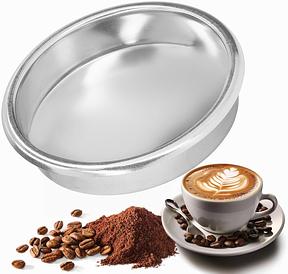
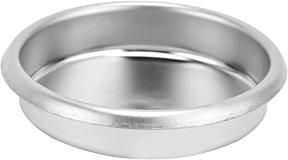
A blind basket is a portafilter basket with no perforations at all. It goes in place of your normal basket and turns the portafilter into a plug.
[product:PANIERAVEUGLE58]
Two forms exist and both work. A stainless blind basket is one solid piece. A rubber or silicone disc sits in the bottom of your ordinary perforated basket and seals the holes. The soft disc hardens and deforms over time; the steel one never moves, but you have to buy the right diameter first time.
Diameter is where people get it wrong. 58 mm is the E61 standard and covers most prosumer machines. 54 mm is the Sage / Breville format. 51 mm shows up on a slice of compact machines. A colour convention circulates among retailers for the soft discs (black for 50-51 mm, green for 54 mm, blue for 58 mm), but that is trade habit, not a standard. Measure your basket rather than trusting the colour.
[product:PANIERAVEUGLE54]
A fourth diameter, 53 mm, turns up in some listings. I could not find a source establishing it as a standard distinct from 54 mm, so treat it as machine-dependent and check your own spec sheet.
Water only or detergent: two different jobs
A water-only backflush does one thing. It mechanically pushes fresh residue out before it hardens. No product, no rinse phase to plan, and you can do it daily without thinking about it. Breville built a tutorial around it precisely because it is the everyday move.
A detergent backflush is a chemical operation. The powder dissolves the fats water alone leaves behind, and it is the one that makes a shower screen matte again.
[product:CAFIZA]
On chemistry, exactly one safety data sheet gave me readable percentages: Puly Caff Plus, revision 05, dated 29/01/2018. Sodium sulphate 65-75%, sodium carbonate 5-15%, sodium percarbonate 5-15%, sodium tripolyphosphate under 5%. That is percarbonate chemistry, which means active oxygen in an alkaline medium. The same sheet classifies percarbonate as a severe eye irritant and an oxidising solid depending on concentration, which is why you do not handle it bare-handed over the drip tray (Puly Caff Plus SDS).
For Cafiza I could not obtain a verifiable composition table, only confirmation that sodium percarbonate is one of its actives. So I will say no more than that: same chemical family, figures not published in the open.
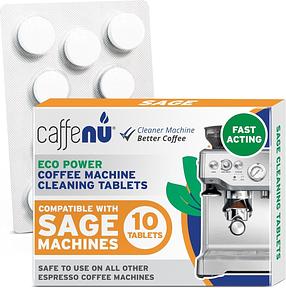
Powder has one genuine drawback. It gets dosed by the spoon, and a heaped spoon puts more product into the group than the planned rinse will take back out. Tablets fix that by fixing the dose. They do not clean any better. They just remove the step where you get it wrong.
[product:CAFFENU_TABLETTES]
Two prohibitions come up everywhere and deserve to be taken seriously. Dishwasher tablets are not a substitute; they carry agents the circuit does not rinse out and that clog the group. And percarbonate attacks aluminium, so none of this goes anywhere near a moka pot or an old aluminium basket.
How often? The manufacturers disagree
This is where most articles invent a number. I would rather show you the spread, because it is real and it changes everything depending on how you use the machine.
La Marzocco recommends backflushing every two to four hours of commercial service, plus once at end of day. The same brand, advising on a home machine pulling one or two shots a day, drops to a detergent backflush once or twice a month with a daily water-only flush.
Profitec sets its interval by counter rather than by calendar: a coffee-oil-remover clean every 150 shots or two months, plus a daily water flush.
The two detergent makers themselves publish no calendar frequency at all. Their instructions are measured in cycles, not in weeks.
Which means nobody can honestly hand you "once a week" as a universal truth, and a source that does has made its number up. Your machine's manual settles it. Failing a manual, Profitec's shot-counted interval is the one that adapts best to irregular home use.
The procedure, as the manufacturers describe it
The two best-documented protocols agree in spirit and differ in the counts.
Cafiza, per Urnex's own instructions: half a teaspoon of powder (about 3 g) in the blind basket, group on for 10 seconds, off for 10 seconds, five times. Then pull the portafilter and run the group on its own to clear the shower screen. Then repeat exactly the same five-by-ten-second cycle with no product at all.
Puly Caff, per the instructions distributed by 1st-line: a teaspoon in the blind basket, run the group 10 seconds, remove, rinse, and repeat at least six times. Then three 15-second cycles with nothing in the basket, until the discharge runs clear.
Profitec describes its own product with a visual cue instead of a count: 15-second runs "until the foam coming out of the group head drain is white," followed by ten water-only shots.
That white-foam cue is the only sourced endpoint I found, and it is the most useful of the three, because it adapts to the actual state of your group instead of making you count blind.
One detail La Marzocco specifies that plenty of tutorials skip: leave the shower screen in place throughout. It filters undissolved product particles and stops them travelling up into the group.
The rinse is not optional
This is the part people cut short, and it is the part that ruins coffee.
Residual percarbonate in the group tastes soapy and metallic in a way you cannot mistake for anything else, and it survives several shots. It is not dangerous. It is simply undrinkable, and the first instinct is almost always to blame the beans.
All three protocols above build in a rinse phase as long as the wash phase or longer. Five cycles for Cafiza, three for Puly Caff, ten shots for Profitec. Profitec adds an instruction I find refreshingly honest: throw away the first espresso you pull after cleaning. It will not be good, and the coffee is not at fault.
Shower screen, group gasket, puck screen
Backflushing passes through the shower screen. It does not remove it. A screen that has been caked for a long time needs unscrewing and scrubbing.
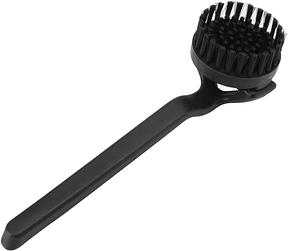
[product:BROSSE_GROUPE]
An angled group brush handles that, and something else too: scraping out the gasket seat with the screen still fitted, between shots. It is the most ordinary tool on this list and probably the one that changes the most day to day.
The gasket gets replaced on failure, not on a schedule. Profitec is clear about it. Change the portafilter gasket when water leaks past the portafilter during extraction despite a firm lock-in, and change the shower screen at the same time while you are in there. None of the manufacturers I checked gives a fixed interval in months or shots for the gasket alone.
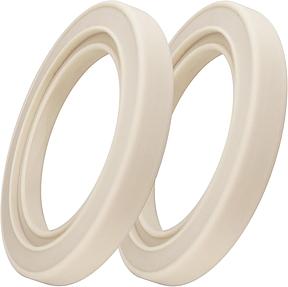
[product:JOINTGROUPE58]
Watch the part number if you buy a spare in advance. A gasket is chosen by machine model, not by diameter alone. Two 58 mm groups can call for different thicknesses, and a gasket that is too thick stops the portafilter reaching its stop position.
What backflushing changes here is the diagnosis. A hardened gasket and a filthy gasket feel identical when you lock the portafilter in: both fight you. After a detergent clean, if it still fights you, the gasket is finished and needs replacing.
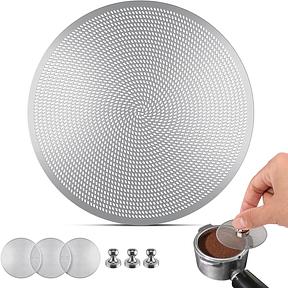
[product:PUCK_SCREEN]
A puck screen, the metal mesh disc that sits on top of the coffee, is not a substitute for backflushing. It limits how many fines migrate up to the shower screen, so it slows the fouling down. It dissolves nothing at all, and marketing copy implying otherwise is wrong.
What the dirty water tells you
Do not read too much into the colour. I found no serious technical source on it. The useful cue is Profitec's: the foam coming out of the drain turns white when the group is clean. While it is still tinted, there is work left.
If a used machine throws out something genuinely filthy on its first backflush, that is not a disaster. It is everything the previous owner did not do. Run two more cycles than planned, rinse for as long again, and judge it on the third shot.
And if the end-of-shot hiss disappears one day when it used to be there, this is no longer about a dirty group. The 3-way valve itself is clogging. La Marzocco files that symptom, along with the soggy puck, under signs that the valve needs cleaning rather than the group.
Own a bean-to-cup machine? None of this applies
If your machine grinds, tamps and ejects the puck by itself, you have no portafilter to block and there is no blind basket for you. Nothing above applies.
Those machines run their own programme. JURA says so directly: every one of its fully automatic machines has a maintenance-free brewing unit that "cleans itself at the touch of a button," through an electronically controlled programme paired with three-phase tablets that lift coffee fats from between the brewing unit and the spout. There is no manual step to add.
De'Longhi, Philips and Saeco work differently: the brew unit comes out and gets rinsed under the tap. De'Longhi insists on one point that sounds counter-intuitive at first, then follows exactly the same residue logic as the rinse section above. Water only, no detergent, because the product would sit in a part nothing rinses afterwards.
Still weighing the two worlds against each other? That question gets a straight answer here: choosing a bean-to-cup machine. And if you have only just moved to a portafilter, the beginner's guide to a manual espresso machine covers everything that comes before cleaning.
What I take from all this
Backflushing is a simple job that suffers from being explained by people who all happen to own the same machine. The procedure travels without its precondition, and the precondition is the only part that can cost you real money.
Listen to the end of your shot. If it hisses and drips, you have everything you need: a blind basket, a powder, and a rinse longer than you think. If it does not hiss, close this page and go wipe the shower screen by hand. The rest of the barista accessories that actually earn their place will do more for you.
All products from this post
The ones we named above are marked; the rest are alternatives in the same category.
Affiliate notice: As an Amazon Associate, we earn from qualifying purchases. Product prices and availability are subject to change.
Frequently Asked Questions
Can I backflush without a blind basket?
Not properly. You have to block the water path completely, and a perforated basket does not. A rubber disc laid in the bottom of a normal basket does the same job as a solid stainless blind basket. Improvising with cling film or a coin is a bad idea: whatever deforms under 9 bars ends up inside the group.
Does backflushing replace descaling?
No. Backflushing clears coffee oils on the group side; descaling dissolves limescale in the boiler and the clean-water circuit. Different products, different intervals, different parts of the machine. A perfectly backflushed machine can be completely scaled up.
Can I use washing-up liquid or a dishwasher tablet?
No. Those carry surfactants and additives the circuit does not rinse out, they leave a lingering taste, and they can attack seals. Backflush detergents are formulated to rinse away entirely in hot water under pressure. Percarbonate also attacks aluminium, so none of it goes near a moka pot.
My puck is soaking wet after every shot. Should I backflush?
That is the symptom of a 3-way valve no longer depressurising, either because it is clogged or because the machine never had one. Run the listening test at the end of a shot. If the hiss used to be there and has gone, the valve needs cleaning, and a detergent backflush is the first thing to try.
How many rinse cycles after detergent?
Urnex's Cafiza instructions call for a second full cycle of five 10-second runs with plain water, identical to the wash cycle. Puly Caff asks for three 15-second runs until the discharge runs clear. Profitec says ten water-only shots. In all three, the rinse is at least as long as the wash.
Should I remove the shower screen before backflushing?
No, La Marzocco recommends leaving it in. It catches undissolved product particles and stops them travelling up into the group. Taking the screen off and scrubbing it is a separate job, for when it stays greasy despite regular backflushing.
Sources
- La Marzocco Home home.lamarzoccousa.com
- Seattle Coffee Gear seattlecoffeegear.com
- coffeemachinespecialist.com.au coffeemachinespecialist.com.au
- Kanen Coffee help.kanencoffee.com
- MaxiCoffee coffee-spirit.maxicoffee.com
- Papel Espresso papelespresso.com
- 1st-line 1st-line.com
- clear water backflush tutorial breville.com
- Puly Caff Plus SDS kingdomcoffee.co.uk
- La Marzocco lamarzoccousa.com
- Profitec profitec-espresso.com
- Urnex's own instructions urnex.com
- JURA says so directly us.jura.com