Bean-to-cup coffee machine lifespan: how many years, and when to replace it
 15 min read
Updated 28/09/2026
Nobody searches for "bean-to-cup coffee machine lifespan" out of idle curiosity. Usually the machine has just made a noise it never made before, the coffee tastes flat, or a repair quote is sitting on the kitchen counter. Underneath all of that there's one question: does it still have years left in it, or is every euro you spend on it money down the drain?
The baseline number comes from the Netherlands. In February 2021 the Dutch consumer organisation Consumentenbond published a study finding that a coffee machine lasts 6 years on average, and a JURA 9 years, which is 50% longer. The figure is repeated by JURA Switzerland itself, and that detail matters: it's the best-ranked manufacturer spreading the number.
How long does a bean-to-cup coffee machine last on average?
Between 6 and 15 years, depending on what you paid and the brand. That 6-year average hides a huge spread. An entry-level machine that's never been descaled can die before year three, while a well-kept high-end one can pass the decade without drama. That's the real range for bean-to-cup coffee machine lifespan once you look past the headline average.
The most detailed data published in French comes from Graindexpert, which in March 2026 combined three things: 31 models used in-house for at least 30 days, more than 4,200 customer reviews filtered from Amazon and Boulanger (the ones mentioning breakdowns or warranty claims), and manufacturers' warranty and spare-parts data. That's a buying-guide site's own method, not an audited consumer body. I'd treat it as exactly that.
All figures below: Graindexpert, March 2026.
| Price tier | Estimated lifespan |
|---|---|
| Entry level, under €350 | 6 to 9 years |
| Mid-range, €350 to €700 | 8 to 10 years |
| High end, over €700 | 10 to 15 years |
The ranges overlap, and honestly that's the real lesson of the table. Going from €300 to €600 doesn't buy you many extra years. The gap only opens up above €700, on paper at least.
And by brand: Jura, De'Longhi, Philips, Krups, Melitta?
The same study gives a five-year failure rate per brand. For Krups and Melitta, none of the sources used here publishes a lifespan, so the table says "not disclosed" rather than making a row up.
The first five rows: Graindexpert, March 2026. For Krups and Melitta, none of the sources used here publishes a lifespan.
| Brand | Failure rate at 5 years | Estimated lifespan |
|---|---|---|
| Jura | 3% | 10 to 15 years |
| De'Longhi | 7% | 8 to 12 years |
| Sage | 8% | 8 to 12 years |
| Philips | 9% | 7 to 10 years |
| Saeco | 10% | 6 to 9 years |
| Krups | not disclosed | not disclosed |
| Melitta | not disclosed | not disclosed |
De'Longhi deserves a closer look, because the sources flatly contradict each other. Javry gives 2 to 3 years for an entry-level De'Longhi (article updated May 2026), nowhere near Graindexpert's 8 to 12.
The repair technician behind Coffeediag, who has specialised in bean-to-cup machines for more than 20 years, logged 42 De'Longhi breakdowns in his workshop records against 19 for Jura, with De'Longhi units dying after one month and others lasting 8 years (data updated 2025). His line on Jura sums it up, translated from French: "A Jura machine is like a Porsche: demanding, but extremely reliable if it's well looked after."
So who's right? Probably everyone. De'Longhi sells an enormous number of machines at every price point, so the average can hold up while the spread stays huge. And Coffeediag's figures come from one workshop, not a national sample.
And by how much you use it?
Fountain, an office coffee-machine specialist, split lifespan by daily volume on its blog in June 2026:
All figures below: Fountain, June 2026.
| Daily use | Indicative lifespan |
|---|---|
| Up to 20 coffees a day | 6 to 10 years |
| 20 to 80 coffees a day | 5 to 7 years |
| More than 80 coffees a day | 4 to 6 years |
At home you're almost always in the first row. A more useful yardstick for a household comes from UFC-Que Choisir (December 2023): a warranty of 5,000 cups over 2 years works out at roughly 7 coffees a day, a pace that an industry quality expert quoted in the article calls intensive and higher than 90% of private users. A couple drinking two coffees each a day pulls about 1,460 cups a year (our own arithmetic: 4 × 365).
Nobody has published a table crossing usage with brand on solid data. I'm not going to invent one here.
Signs it's time to replace your machine (or just one part)
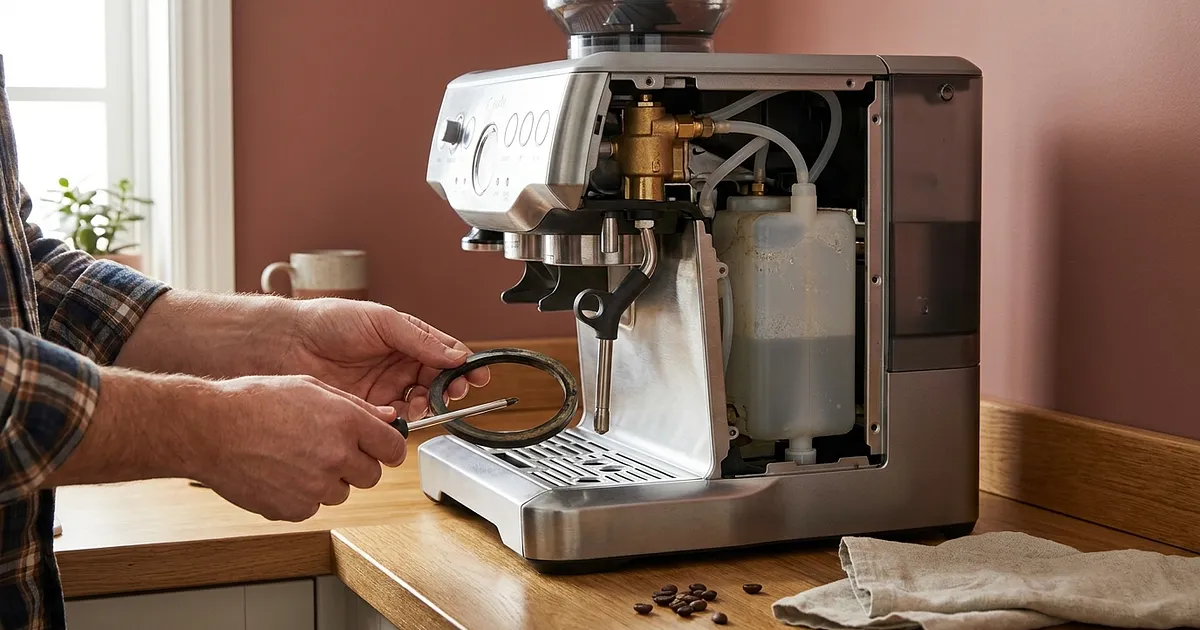
Most symptoms point to a wear part, not a dead machine. According to Graindexpert (March 2026), recorded breakdowns split like this: limescale 38%, brew group wear 22%, jammed grinder 17%, water-circuit leaks 12%, electronic board 8%. The first four come down to maintenance or a part you can swap.
The symptom lists published by Javry (May 2026) and Fountain overlap: taste getting worse, odd noises, leaks, weaker pressure or flow, an error code that keeps coming back. The table below links each one to its likely cause and what to try before you buy anything.
| What you notice | Likely cause | Try this first | When it smells like the end |
|---|---|---|---|
| Lukewarm coffee, slower flow | limescale in the circuit | full descale, filtered water | it keeps coming back despite regular descaling |
| Flat coffee, uneven grind, grinder straining | worn burrs or jammed grinder | cleaning, then new burrs | grinder breaks on an old, out-of-warranty machine |
| Puddle under the machine | tired gasket, hose or brew group | replace the gasket | the leak comes from a corroded boiler |
| Error code that keeps returning | sensor or electronic board | diagnosis by the brand or a repairer | new board needed on a machine older than 5 to 8 years |
| Louder pump, dropping pressure | scaled-up or worn pump | descale, then diagnosis | pump needs replacing, and other parts follow |
Two parts come up again and again in these diagnoses. Burrs first: we've covered how long grinder burrs last and how to tell they're worn. Then the group gasket, often behind leaks and pressure loss, along with the shower screen that sits next to it: it's all in our piece on the group gasket and shower screen. Before anyone talks about a new machine, that's where to start.
A quick aside, because the question keeps coming up. The pressure printed on the box, 15 or 19 bar, tells you nothing about how long the machine will last. It's a peak pump figure, a marketing number, while an espresso actually extracts at around 9 bar. None of the sources cited here uses it to predict lifespan, and good.
Repair or replace: where to draw the line?
Repair if the quote stays under 30 to 40% of the price of an equivalent new machine and your machine is less than 5 to 8 years old. Beyond that, replace. That's the rule of thumb from La Fourchette Verte (April 2026), and it's the clearest one I found.
The same guide says gaskets, filters and hydraulic parts are cheap and fix around 80% of common breakdowns. Pumps, solenoid valves and heating elements cost more. And replacing the boiler, often eaten away by corrosion, is frequently the point where repairing stops making sense.
A worked example. If the new equivalent of your machine costs €569 (the Philips Series 5500 on Amazon.fr, updated 28/09/2026), the 30 to 40% threshold lands between €171 and €228 (our own arithmetic). A €250 quote on a seven-year-old machine? Replace it. A gasket on a three-year-old one? Repair, obviously.
For labour, a French appliance repairer typically charges €40 to €75 an hour before tax (MesDépanneurs.fr, updated 30/12/2025). You won't find a price for a pump or an electronic board here. The ranges floating around online don't point back to any source I could verify, and a detailed quote will get you the real answer faster anyway.
One last rule, and this one's ours, not a source's. Two different breakdowns within a year on a machine that's past five is the signal. At that point you're not fixing a fault, you're funding a series.
Does the warranty cover wear and tear?
Not always, and some brands cap their warranty by number of coffees as well as by years. UFC-Que Choisir listed these caps in December 2023:
All figures below: UFC-Que Choisir, December 2023.
| Brand | Warranty as reported |
|---|---|
| De'Longhi | 2 years and/or 5,000 cycles |
| WMF (Perfection 800L) | 2 years and/or 8,000 cycles, capped at 4,000 cycles a year |
| Melitta | 25 months and 15,000 coffees |
| JURA | no cup-count cap |
Those terms date from late 2023 and were reported for France. Check your own contract before you rely on them.
The trap is real for a household that drinks a lot. At 7 coffees a day, De'Longhi's 5,000 cups are used up before the end of year two, and a breakdown after that point is no longer covered, even inside the 2 years. If your machine shows a drinks counter somewhere in its menus, write the number down before the warranty ends.
Another myth: that machines are built to fail right at the cap. A former employee of a major brand, quoted in the same Que Choisir article, says the opposite: models are qualified internally for around 20,000 cups, far beyond the 5,000 to 15,000 in the warranties. After that, maintenance is what makes the difference. For what your manufacturer counts as normal wear and what it actually pays for, see our guide to bean-to-cup coffee machine warranty coverage.
How to make a bean-to-cup coffee machine last longer
Descale on time, with the right product. At 38% of the breakdowns Graindexpert recorded, limescale is the leading cause of early death, far ahead of everything else.
Frédéric Thomas, a repairer in Tours and a member of the French STARSAV network, put it bluntly to Homap in October 2020 (translated from French):
"Limescale stops the water flowing properly, spoils the taste of the coffee and damages the machine!"
And on vinegar, the kitchen-cupboard fix that just won't die:
"I strongly advise against it, because it risks damaging your machine's seals."
On frequency, sources converge on descaling roughly every three months, adjusted for your water hardness and how much you drink (Longtime Label, November 2024). In practice the machine's own alert is a decent guide, as long as you don't ignore it for three weeks. Filtered or softer water stretches the time between descales. Emptying the grounds drawer, rinsing the brew group when it's removable, cleaning the bean hopper now and then: none of it is exciting, but it's the routine every source cited here keeps pointing to.
For a De'Longhi machine, the De'Longhi EcoDecalk Détartrant DLSC500, 5 doses de décalcification, 500 ml is the brand's own descaler, sold for about €8.56 on Amazon.fr for 5 doses and rated 4.8/5 across 125,547 reviews (updated 28/09/2026). On a Jura, Philips or Melitta, use whatever your manual specifies.
One honest counterpoint. In 2017 UFC-Que Choisir published a durability test run by its Portuguese partner Deco Proteste: two units each of four models (Siemens TE501205RW, De'Longhi ECAM22.110 Magnifica, Krups EA815070 and Philips Saeco Intelia HD8902/01), around 2,500 coffees over two and a half years. No notable wear, and maintenance made no measurable difference. Should you stop descaling, then? No. At 3 coffees a day for two and a half years you're nowhere near 5,000 cups, and eight machines is a tiny sample. What the test mostly shows is that a fairly new machine doesn't wear out fast. It says nothing about year six.
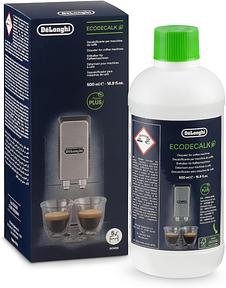
De'Longhi EcoDecalk Détartrant DLSC500, 5 doses de décalcification, 500 ml
View at Amazon (as of Sep 04)Affiliate link. Buying through it earns us a commission; the price stays the same for you.
Replacing it: new or refurbished?
If the verdict is in, refurbished deserves a proper look before new. A refurbished high-end machine found at the price of a new entry-level one will often, going by the numbers above, have more years ahead of it, provided the brew group and burrs were checked. The risk is real, and we've unpacked it in our look at refurbished bean-to-cup machines: bargain or hidden risk.
If you're buying new, here are three machines at different price points, picked for what they say about lifespan. Novebar hasn't tested any of them: prices and ratings are from Amazon.fr, checked on 28/09/2026.
Tight budget: De'Longhi Magnifica S
The De'Longhi Magnifica S ECAM11.112.B - Perfetto Machine à Café Automatique avec Mousseur à Lait Manuel is listed at about €299.99, rated 4.1/5 across 7,729 reviews. It sits in the entry tier, 6 to 9 years according to Graindexpert. Nice detail: a previous-generation Magnifica, the ECAM22.110, was one of the models with no notable wear in that 2017 Que Choisir test. It's a simple machine, two drinks according to its listing, which means fewer functions and fewer circuits to look after. If you drink a lot, keep De'Longhi's cup-count warranty cap, as reported by Que Choisir in late 2023, in mind.
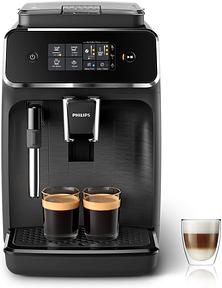
Not available in your region — closest match
Philips Série 2200 EP2220/10 - Expresso Broyeur avec Mousseur à Lait, Écran Tactile
View at Amazon (as of Aug 10)Affiliate link. Buying through it earns us a commission; the price stays the same for you.
Mid-range: Philips Series 5500
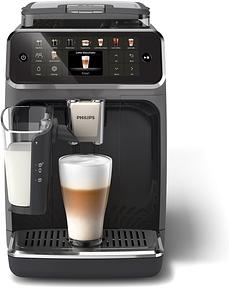
The PHILIPS machine à café grain 5500, 20 boissons chaudes & glacées, LatteGo | Carafe LatteGo facile à nettoyer, SilentBrew 40% plus silencieux, QuickStart, App HomeID, Expresso broyeur Noir (EP5544/50) runs around €569.00, rated 4.4/5 across 2,109 reviews. Mid-range, so 8 to 10 years according to Graindexpert, from a brand with a 9% five-year failure rate and a 7 to 10 year estimated lifespan in the same study. Its LatteGo milk system and 20 hot and iced drinks make it the versatile pick. The flip side, I think: more recipes means more circuits to clean.
Affiliate link. Buying through it earns us a commission; the price stays the same for you.
High end: De'Longhi Eletta Explore
The De'Longhi Eletta Explore Cold Brew ECAM452.67.G, Machine à Café Barista avec LatteCrema Hot and Cool, Machine à Espresso, Machine à Café Automatique, Extraction Froide, Pot à Café Inclus, Gris Foncé costs about €999.99 and is rated 4.2/5 across 699 reviews. On paper that puts it in the 10 to 15 year tier. But it's a De'Longhi, and in Graindexpert's data the brand still sits at 7% failures and 8 to 12 years. Let's be blunt: at this price you're mostly paying for recipes (50 drinks, cold brew), not Jura-level reliability. If longevity is your only criterion, every source cited here puts Jura ahead, and there isn't a Jura model in this selection.
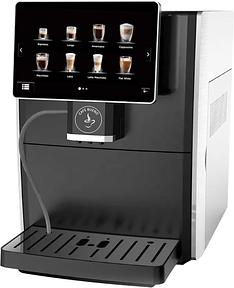
Not available in your region — closest match
View at Amazon (as of Aug 14)Affiliate link. Buying through it earns us a commission; the price stays the same for you.
So, keep it or replace it?
Before you order anything, run a full descale and see whether the symptom goes away. It's the cheapest test there is. If the problem sticks, get a quote and compare it with the 30 to 40% threshold of an equivalent new machine. Under five years old with a reasonable quote: repair it. A boiler to replace on an eight-year-old machine: don't even think about it. At the end of the day, that repair-or-replace call is what decides the bean-to-cup coffee machine lifespan you actually get, far more than any published average.
And if your machine is getting on without being at the end of its life, there may be better things to do than replace it. Have a look at what we'd change in an espresso setup after one year.
All products from this post
The ones we named above are marked; the rest are alternatives in the same category.
Not available in your region — closest match
Philips Série 2200 EP2220/10 - Expresso Broyeur avec Mousseur à Lait, Écran Tactile
View at Amazon (as of Aug 10)
Affiliate notice: As an Amazon Associate, we earn from qualifying purchases. Product prices and availability are subject to change.
Frequently Asked Questions
How long does a Jura, De'Longhi, Krups or Melitta last?
According to Graindexpert (March 2026), bean-to-cup coffee machine lifespan comes down mostly to brand: a Jura lasts 10 to 15 years and a De'Longhi 8 to 12 years, with five-year failure rates of 3% and 7%. For Krups and Melitta, no independent source used here publishes a lifespan. All we know is that Melitta warranties its machines for 25 months and 15,000 coffees (UFC-Que Choisir, December 2023).
Does descaling really extend a bean-to-cup machine's life?
Yes. Limescale is the leading recorded cause of breakdowns, 38% of cases according to Graindexpert (March 2026), and repairer Frédéric Thomas warns that it damages the machine. Skip vinegar, which can harm the seals. A 2017 UFC-Que Choisir test saw no difference over 2,500 coffees, but on just four models.
Does a high-end machine last longer than an entry-level one?
On average, yes: 10 to 15 years above €700 versus 6 to 9 years under €350, according to Graindexpert (March 2026). Price alone isn't enough, though. A high-end De'Longhi is still a De'Longhi, at a 7% five-year failure rate in the same study, against 3% for Jura.
How many coffees can a bean-to-cup machine make before it breaks?
A former employee of a major brand quoted by UFC-Que Choisir (December 2023) says models are qualified internally for around 20,000 cups. Warranties stop well before that: 5,000 cycles at De'Longhi, 8,000 at WMF, 15,000 at Melitta. Maintenance decides whether your machine gets anywhere near that ceiling.
How much does a repair cost compared with a new machine?
La Fourchette Verte's rule (April 2026): repair as long as parts and labour stay under 30 to 40% of the price of an equivalent new machine, and the machine is less than 5 to 8 years old. A French appliance repairer charges roughly €40 to €75 an hour before tax (MesDépanneurs.fr, December 2025).
Is a refurbished or a new machine better for durability?
None of the sources cited here compares the two directly. On a refurbished machine, check its real age, which parts were replaced (gaskets, brew group, burrs) and how long the refurbisher's warranty runs. A recent, properly serviced high-end machine can outlast a new entry-level one.
Sources
- JURA Switzerland ch.jura.com
- Graindexpert, March 2026 graindexpert.fr
- La Fourchette Verte, April 2026 lafourchetteverte.fr
- Javry javry.com
- Coffeediag coffeediag.com
- Fountain fountain.eu
- UFC-Que Choisir quechoisir.org
- Javry javry.com
- MesDépanneurs.fr mesdepanneurs.fr
- Homap homap.fr
- Longtime Label, November 2024 longtimelabel.com
- UFC-Que Choisir quechoisir.org