Sage Barista Express alternatives: the machines that actually compare
 12 min read
Updated 2 September 2026
The Sage Barista Express has become the default answer to "which portafilter machine with a built-in grinder should I buy", and that is exactly why people start looking elsewhere. The price swings hard, stock comes and goes, and nobody loves owning the same machine as everyone else on the forum. The trouble is that most "alternatives" lists throw in appliances that do a completely different job.
A superautomatic bean-to-cup machine is not a portafilter machine. This guide stays inside one category: semi-automatic, portafilter, grinder built in (or knowingly absent), same price bracket. The market is heading that way too. According to Gifam and NielsenIQ-GfK figures published in February 2026, manual espresso machines with an integrated grinder grew 53% by volume in France across 2025, while fully automatic machines fell 6%.
What the Sage Barista Express does, and why people shop away from it
On Sage's own site the Barista Express lists at €729.90, with occasional promotions down around €499.90 (manufacturer product page, checked 2026). Our own Amazon.fr snapshot says €727, but it dates from 2023, so read it as a ballpark rather than today's price.
What it does well is real. Integrated conical grinder, 16 grind settings, a pressure gauge you can watch during the shot, and manual tamping that leaves the decisions with you.
What pushes people away is real too. The gap between list price and promotional price runs past €200, which makes buying at the wrong moment genuinely annoying. It is heavy, it eats counter space, and European service runs through a single importer. None of that is disqualifying. It is enough to go look.
Sage The Barista Express (Acier Inoxydable Brossé)
One naming note, because it comes up constantly. Sage and Breville are the same machine. Breville took the Sage name for Europe and the UK in 2013 to avoid a clash with an unrelated British appliance brand already trading as Breville. So an English-language review of the "Breville Barista Express" is reviewing your machine.
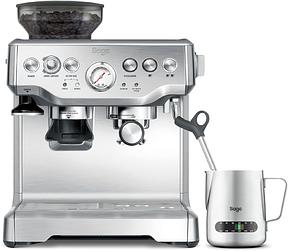
Sage The Barista Express (Acier Inoxydable Brossé)
View at AmazonAffiliate link. Buying through it earns us a commission; the price stays the same for you.
Sage Barista Express, Impress, Pro, Touch: these are not alternatives
This is the trap almost everyone falls into first. As Tom's Coffee Corner lays out, the Barista Express, the Express Impress, the Barista Pro and the Barista Touch are all still Sage machines. What changes between them is the tamping mechanism (the Impress lever guides the press), heat-up time and the interface. Not the brand, and not the philosophy.
The Barista Pro is the clearest case. Digital display, a claimed three-second heat-up, stepless grind adjustment, and no pressure gauge. It is a sibling, not an escape route. Our Amazon.fr snapshot puts it at €440.83 (recorded mid-2025), which often makes it the cheapest Sage on the shelf.
If the goal is to spend less and stay with Sage, that is an honest option. If the goal is to leave Sage, it does not answer the question you asked.
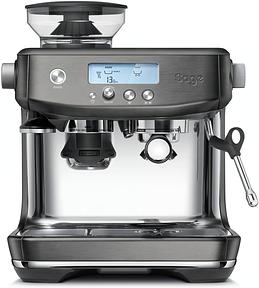
Affiliate link. Buying through it earns us a commission; the price stays the same for you.
De'Longhi La Specialista Arte: the closest match, machine for machine
This is the one that ticks the most boxes. The Terres de Café listing gives the raw numbers: 1,300 W, pump rated at 15 bar, 1.5 L tank, 250 g hopper, integrated grinder. Three-year warranty on top. The price spread is wide: €579 at that specialist retailer, listings near €361 on comparison sites, and €419 on Amazon.fr in June 2026.
Those 15 bar are a pump peak, not the working pressure. Espresso extracts at roughly 9 bar at the puck, and that is the number that decides the cup. No machine in this comparison wins because it prints a bigger figure on the box.
The real gap against the Sage sits elsewhere, and it is documented. As Coffeeness notes in its head-to-head, the Sage "appears more professionally finished" than the De'Longhi despite weighing more, and the Specialista Arte's 8 grind positions stay limited next to the Sage's 16.
Eight settings means coarser steps when you dial in. On a light roast or a very fresh bag you can end up stuck between two positions with nowhere to go. You're trading that for €200 to €300 in savings, your call whether it's worth it.
Who it suits: someone who wants the Sage Barista Express's all-in-one footprint, accepts slightly blunter adjustment, and would rather put the difference into better beans.
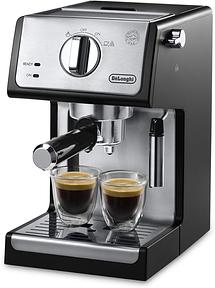
Not available in your region — closest match
View at Amazon (as of Aug 14)Affiliate link. Buying through it earns us a commission; the price stays the same for you.
Gaggia Classic Pro: the purist pick, with no grinder
Say it up front, because half the alternatives lists quietly skip it. The Gaggia Classic Pro has no grinder. It arrives with a portafilter and nothing to grind with, so budget for an external burr grinder on top.
As Grain d'Expert puts it in a test published in March 2026, "the grinder is at least as important as the machine". Teddy Steis, who has been testing coffee equipment for over ten years, scores the machine 8.2/10 and gives three concrete pairing tiers: a 1Zpresso JX-Pro hand grinder around €150, a Eureka Mignon Notte around €230, and a Eureka Mignon Specialita around €350 for what he calls the ideal pairing.
So the arithmetic changes completely.
| Line item | Entry tier | Mid tier | "Ideal" pairing |
|---|---|---|---|
| Gaggia Classic Pro | approx. €349 | approx. €349 | approx. €349 |
| Separate grinder | approx. €150 | approx. €230 | approx. €350 |
| Estimated total | approx. €499 | approx. €579 | approx. €699 |
Estimated total: our own arithmetic from the line items above. The machine price comes from the editorial €349 to €500 range found in the tests cited, the grinder prices come from Grain d'Expert (March 2026). No single retailer snapshot could be confirmed for the machine itself, so treat these totals as an order of magnitude.
What you get back is a simpler machine, easier to service, with an adjustable OPV. Coffeeness writes that it "proves that certain classics never go out of style" while calling it temperamental and saying you have to learn its habits. Honestly, this is not a machine you plug in on a Saturday morning expecting a good shot first try.
Who it suits: someone who wants to learn, tinker, and keep the thing for a decade, and who has done the sum and accepted that the total lands near the Sage anyway.
Krups Precision, not Krups Essential: the real alternative
There is a real naming mix-up here, and it is worth clearing up before you spend anything.
The Krups Essential range (EA810870, EA815070 and their siblings) is a fully automatic bean-to-cup machine. No portafilter, no tamping, no control over the shot. It is a decent machine in its own category, but it is not an equivalent of the Sage Barista Express, and any list presenting it that way is comparing two different appliances.
The Krups Precision, the XP801T10, is the one that genuinely compares to the Sage. Tested by UFC-Que Choisir in January 2026, it is catalogued as a manual espresso machine with an integrated conical grinder: 30 grind settings, a 15 bar pump, a 3.5 L tank, a 222 g hopper. Double espresso capability too. Que Choisir's price panel starts at €337.79, with a launch price quoted as high as €649.99 elsewhere.
Thirty settings is finer than the Sage Barista Express's 16 and much finer than the Specialista Arte's 8. On paper that is the strongest single argument in this whole list. We do not track its price on Novebar, so check today's figure before you commit, because the spread is close to double.
What actually decides the cup: settings, not the presence of a grinder
"Built-in grinder: yes or no" is too blunt a question for this category. On an espresso machine with grinder, what matters is how finely you can adjust, and how evenly the burrs cut.
As Ryan Godinho explains, an SCAA-accredited AST coordinator with a postgraduate certificate in coffee excellence from ZHAW, uneven grind causes over-extraction of the fines and under-extraction of the boulders in the same shot. What you taste is a coffee that is bitter and sour at once.
Which is why the 8 / 16 / 30 spread is not a spec-sheet detail. It is the room you will have left on the day your shot runs in 15 seconds instead of 28.
Comparison table
| Machine | Built-in grinder | Grind settings | Pump rating | Target extraction | Price seen |
|---|---|---|---|---|---|
| Sage Barista Express | Yes, conical | 16 settings | not stated here | ~9 bar at the puck | €729.90 Sage list, promo seen at €499.90 (2026) |
| Sage Barista Pro | Yes, conical | stepless | not stated here | ~9 bar at the puck | €440.83 (Amazon.fr snapshot, mid-2025) |
| De'Longhi La Specialista Arte | Yes, conical | 8 settings | 15 bar (manufacturer figure) | ~9 bar at the puck | €419 (Amazon.fr snapshot, June 2026), €361 to €579 by retailer |
| Gaggia Classic Pro | None at all | not applicable | not stated here | ~9 bar at the puck, adjustable OPV | approx. €349 to €500 (editorial range), plus €150 to €350 for a grinder |
| Krups Precision XP801T10 | Yes, conical | 30 settings | 15 bar (manufacturer figure) | ~9 bar at the puck | from €337.79 (Que Choisir panel, Jan 2026) |
The "not stated here" cells are deliberate. That figure was not tied to a source in this research, and a pump peak quoted from memory helps nobody. The column next to it is the one that matters anyway.
Which one suits which buyer
You want the most direct replacement. De'Longhi La Specialista Arte. Same shape, same logic as the Sage Barista Express, €200 to €300 less, with blunter grind adjustment as the price of admission.
You want to properly learn espresso. Gaggia Classic Pro plus a separate grinder chosen to your budget. Count the total, not the machine, and expect two or three weeks of fiddling before the shots settle.
You want the finest adjustment. Krups Precision XP801T10 and its 30 settings, subject to checking today's price, which moves a lot between retailers.
You just want to pay less and stay with Sage. Barista Pro. Not an alternative, a stablemate, and a perfectly good buy if the ecosystem suits you.
You are still torn between a built-in grinder and a separate one. Go built-in (the La Specialista Arte or the Precision) if you want one machine on the counter. Go separate (the Gaggia plus a 1Zpresso or a Eureka) if you're ready to run two machines for finer control. The grinder decides more of the cup than the machine does, but you still have to pick where it lives.
The verdict: which Sage Barista Express alternative to pick
If you want to replace the Sage Barista Express without changing how you make coffee, take the La Specialista Arte and live with its 8 settings. If you mainly want to understand what you are drinking, take the Gaggia and a real grinder, knowing the bill ends up in roughly the same place. And if adjustment range is the thing you obsess over, the Krups Precision is the only one offering 30 settings at this money.
The one thing worth rechecking before you order is today's price. In this category the gap between list and promotion regularly clears €200, and it is the only number in this article that will have moved by next week.
All products from this post
The ones we named above are marked; the rest are alternatives in the same category.
Affiliate notice: As an Amazon Associate, we earn from qualifying purchases. Product prices and availability are subject to change.
Frequently Asked Questions
What is the best replacement for the Sage Barista Express?
The De'Longhi La Specialista Arte. Only this one repeats the same formula here: portafilter, integrated conical grinder, semi-automatic, same price bracket. It was recorded at €419 on Amazon.fr in June 2026 against Sage's €729.90 list price. Its weakness is real, though: 8 grind settings against the Sage's 16.
Can you use a separate grinder with a machine that has none built in?
Yes, and it is the classic home espresso setup. The Gaggia Classic Pro ships without a grinder and expects an external burr grinder alongside it. Using the tiers Grain d'Expert quoted in March 2026, budget roughly €150 for a good hand grinder, €230 for a decent electric one, and €350 for the pairing they recommend.
How much does a comparable espresso machine with a grinder cost?
Between €340 and €730, depending on model and timing. The Que Choisir panel from January 2026 starts at €337.79 for the Krups Precision, the La Specialista Arte shows up between €361 and €579 depending on retailer, and the Sage lists at €729.90. Add €150 to €350 if the machine has no grinder.
Is the Sage Barista Pro an alternative to the Barista Express?
No, it is another Sage. It changes the tamping, the heat-up time and the interface, and it drops the pressure gauge, but it sits in the same range and the same ecosystem. Our Amazon.fr snapshot puts it at €440.83 in mid-2025, often cheaper than the Express. Useful for staying with Sage, beside the point for leaving.
Krups Essential or Krups Precision: which one compares?
The Precision XP801T10. The Essential range (EA810870, EA815070) is fully automatic with no portafilter, which makes it a different class of appliance. The Precision is a manual machine with a 30-setting conical grinder, tested by UFC-Que Choisir in January 2026. Put that one next to the Sage, not the Essential.
Sources
- Gifam and NielsenIQ-GfK figures placesducafe.com
- Sage's own site sageappliances.com
- Tom's Coffee Corner tomscoffeecorner.com
- Terres de Café listing terresdecafe.com
- Coffeeness coffeeness.de
- Grain d'Expert graindexpert.fr
- Coffeeness coffeeness.de
- UFC-Que Choisir quechoisir.org
- Ryan Godinho specialtybatch.com