Espresso cup size: ristretto, espresso and lungo in ml
 6 min read
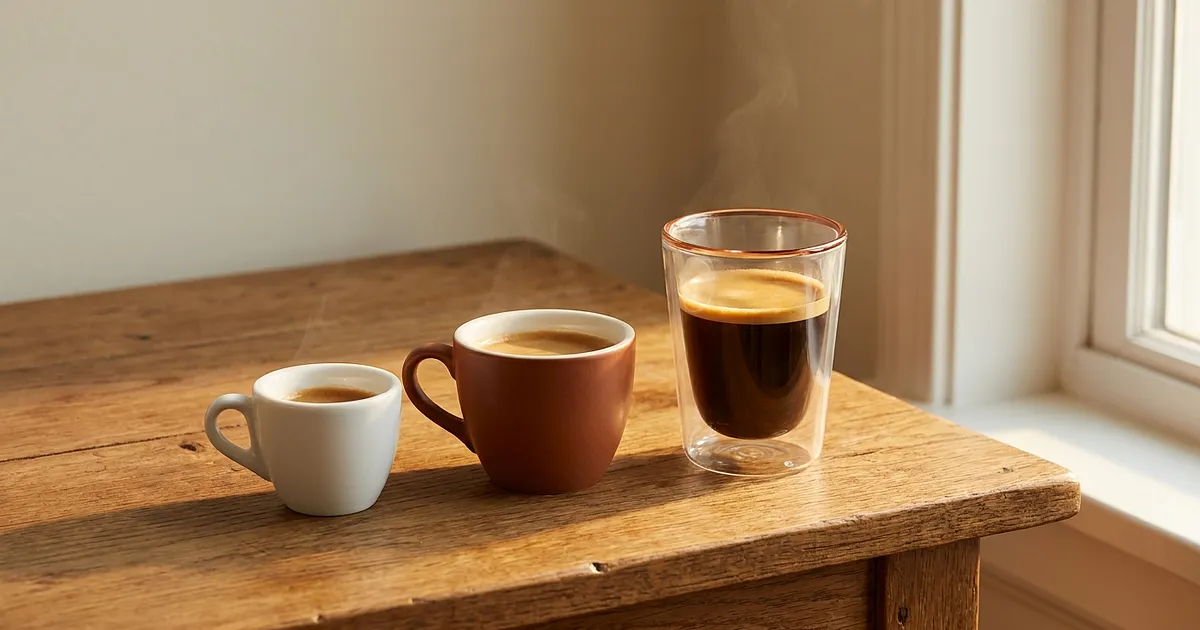
Ask several websites about espresso cup size and you'll probably get a different set of millilitres from each. No international standard fixes how much a ristretto or a lungo should be, or how big the cup should be. What exists are conventions, and they don't measure the same thing.
Drink volume vs cup capacity
Most guides blur the two. Here, the middle column is what you drink and the right one is what the cup holds.
| Drink | Volume in the cup (reference) | Published cup capacity |
|---|---|---|
| Ristretto | 25 ml, Original capsule (Nespresso) | not stated |
| Espresso | about 25 ml incl. crema (INEI spec, via ViniPlus); about 30 ml (WBC 2026); 40 ml (Nespresso) | 50-100 ml (INEI, via ViniPlus); 60-90 ml (Lavazza); 80 ml (TOUCH cup, Nespresso) |
| Lungo | 50-70 ml (Wikipedia); 110 ml (Nespresso) | 170 ml (TOUCH Lungo cup, Nespresso) |
| Café allongé (French usage) | 60-100 ml extracted (Malongo, 2025) | not stated |
Nespresso and Lavazza pages checked 28 September 2026. Ranges are quoted as published.
Why the numbers don't match
Nespresso's 25, 40 and 110 ml are the volumes the brand pairs with its Original capsules (Nespresso FAQ).
The Italian figure comes from somewhere else entirely. The certified Italian espresso spec (INEI, certified in 1999) targets about 25 ml including crema (ViniPlus, 2010), and Beverfood (2009) gives 25 ml ± 2.5 from 7 g ± 0.5 of coffee. Both are second-hand reproductions, because the institute's own site doesn't show the numbers, at least not anywhere we could find.
The same spec sets extraction pressure at 9 bar ± 1, which is a different figure from the pump pressure printed on machine boxes. And the 2026 World Barista Championship rules define espresso as around 30 ml (1 fl. oz.) without setting any cup size.
Ratio definitions count in grams instead. La Marzocco Home (2014) puts a ristretto at 1:1 to 1:2 and a lungo at 1:3 to 1:4, while Wikipedia gives roughly 1:1 for a ristretto, 1:2 for an espresso and 1:4 for a lungo. So the final volume depends on your dose, and our espresso brew ratio guide walks through the maths.
One more trap: a lungo isn't an Americano. A lungo pushes more water through the coffee, while an Americano adds hot water to an espresso that's already been pulled (Malongo). In French, "café allongé" usually means the lungo, which is probably where a lot of the confusion starts.
Which cup size for which drink
Novebar hasn't tested any cups. The effects below come from manufacturers, or from the only two sources we found with actual data.
Material and preheating
Lavazza describes its 60 ml porcelain cup as narrow enough to concentrate the aroma and thick enough to hold the temperature (Lavazza). That's a manufacturer claim with no published measurement behind it.
The one measurement we found comes from Glew Engineering (undated page): 3 oz of espresso in a preheated ceramic cup dropped from 78.6 °C to 41.7 °C over about 23 minutes. One test, and no comparison of wall thickness. The same test also measured a Styrofoam cup, which cooled by about 3 °C less than the ceramic one, and a paper cup, which cooled more than both. The engineers still recommend ceramic, citing reuse and the environment.
For ceramic, the seller's listing calls the cups thick-walled and gives a capacity inside Lavazza's range: Cosumy – 6 tasses espresso en céramique 70 ml avec soucoupes.
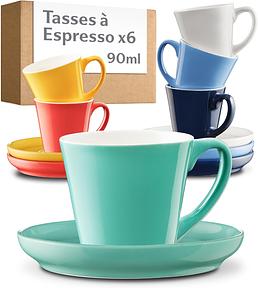
Cosumy – 6 tasses espresso en céramique 70 ml avec soucoupes
View at Amazon (as of Oct 02)Affiliate link. Buying through it earns us a commission; the price stays the same for you.
Shape, and glass
A study by Carvalho and Spence (2018) with 276 participants found aroma rated stronger in a tulip-shaped cup. It looked at how specialty coffee is perceived, not at crema or temperature.
Double-wall glass isn't measured by any of these sources. If you'd still like to see your shot, here's a glass listed at the same capacity as the espresso cup in Nespresso's TOUCH set: Bodum Pavina – 2 verres espresso double paroi 80 ml.
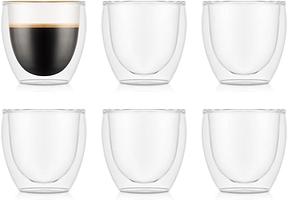
Bodum Pavina – 2 verres espresso double paroi 80 ml
View at Amazon (as of Oct 02)Affiliate link. Buying through it earns us a commission; the price stays the same for you.
A cup for the lungo
Nespresso itself pairs its 110 ml lungo with a 170 ml cup (TOUCH set). A double-wall glass with a handle, listed at 15 cl (that's 150 ml), falls between the two (a comparison of published figures, not a measurement): Bodum Bistro – 2 tasses double paroi en verre 150 ml.
To find out what a cup you already own really holds, fill it to the brim with water and pour that into a measuring jug. Then you'll know whether your lungo is going to overflow. (Milk drinks change the scale: Lavazza gives 150 to 200 ml for a cappuccino cup, and the size of the milk pitcher comes into play too.)
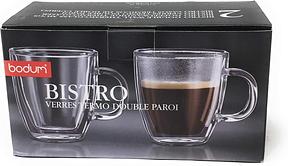
Bodum Bistro – 2 tasses double paroi en verre 150 ml
View at Amazon (as of Oct 02)Affiliate link. Buying through it earns us a commission; the price stays the same for you.
The one number worth keeping
To pick an espresso cup size, remember the gap between drink and cup above all. At Nespresso, a 40 ml espresso goes into an 80 ml cup (TOUCH set).
All products from this post
The ones we named above are marked; the rest are alternatives in the same category.
Affiliate notice: As an Amazon Associate, we earn from qualifying purchases. Product prices and availability are subject to change.
Frequently Asked Questions
Ristretto vs espresso vs lungo: what is the difference in volume?
There's no shared standard, only reference points: 25, 40 and 110 ml at Nespresso (ristretto, espresso, lungo), about 25 ml for the certified Italian espresso, 50 to 70 ml for a lungo on Wikipedia. The table in the article gives each figure with its source.
What size cup do I need for a regular espresso?
Lavazza gives 60 to 90 ml for a standard espresso cup, with a 60 ml cup as its reference size. The Italian spec says 50 to 100 ml and the espresso cup in Nespresso's TOUCH set holds 80 ml: reference points from makers and a spec, not a standard.
What cup should I use for a ristretto?
None of the sources we checked gives a capacity specific to the ristretto. Since the drink is shorter than an espresso (25 ml at Nespresso), an ordinary espresso cup does the job. If you want a small one, aim for the low end of Lavazza's 60 to 90 ml range. That's an inference from those figures, not a published reference.
Is a lungo the same as an Americano?
A lungo, like the café allongé Malongo describes, pushes more water through the coffee, while an Americano adds hot water to an espresso that's already been pulled. For a lungo, Wikipedia gives 50 to 70 ml and Nespresso 110 ml (see the table).
Should I preheat my espresso cup?
The 2026 World Barista Championship rules allow cups to be preheated, as long as no water is left in them. Glew Engineering's test (undated page), run on preheated cups, recorded a ceramic cup falling from 78.6 °C to 41.7 °C in about 23 minutes. None of the sources we checked compares a preheated cup directly with a cold one.
Sources
- ViniPlus, 2010 aislombardia.it
- Nespresso FAQ nespresso.com
- Lavazza France lavazza.fr
- WBC 2026 static1.squarespace.com
- TOUCH cup, Nespresso nespresso.com
- Wikipedia en.wikipedia.org
- Malongo, 2025 malongo.com
- Beverfood (2009) beverfood.com
- La Marzocco Home (2014) home.lamarzoccousa.com
- Glew Engineering glewengineering.com
- Carvalho and Spence (2018) ora.ox.ac.uk