Tamping Pressure: How Hard You Should Actually Press (and Why 30 lb Is a Myth)
 17 min read
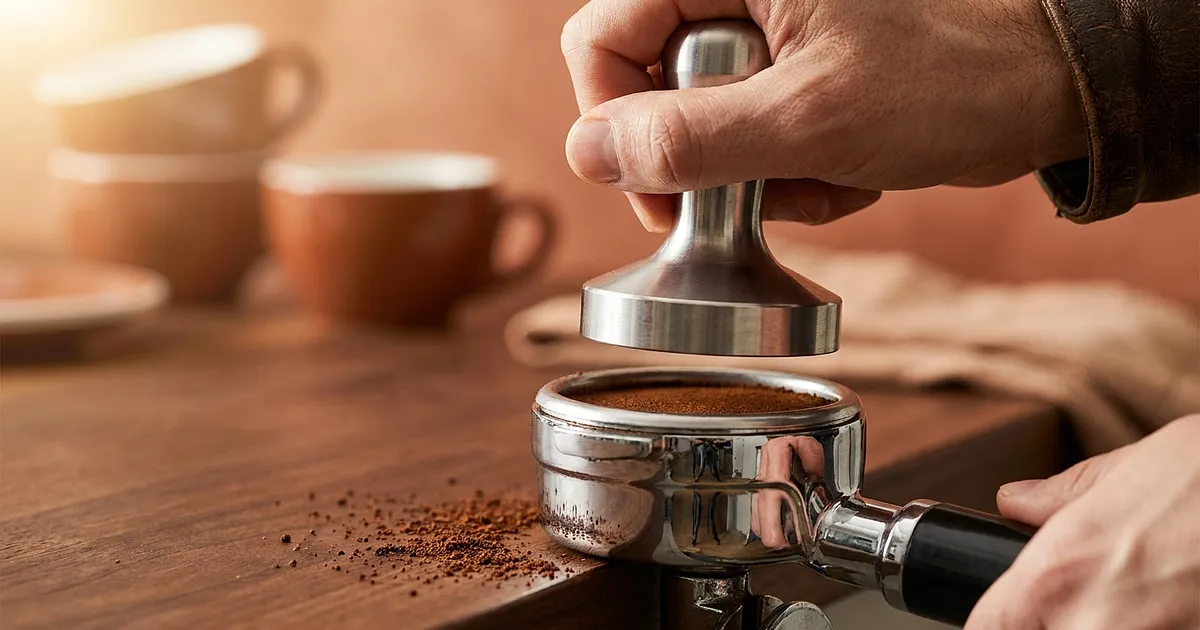
Somebody told you to tamp at 30 pounds. Or 15 kilos, depending on which corner of the internet you landed in. So you press. Hard. And every time a shot runs sour you press a bit harder next time, because honestly, you have no idea what 30 pounds feels like in your hand. Nobody does. That is the whole problem with the number: it cannot be checked, so it cannot be missed, so it can never be corrected.
Nothing here is based on in-house testing. We have not measured, weighed or tasted anything. What follows draws on a published Barista Hustle experiment, a puck-resistance study by Jonathan Gagné, the diameter figures basket makers publish themselves, and one calculation you can redo with a phone calculator. Every time, we say who says what.
The calculation that settles it in three lines
Here is the argument. It needs no experiment, just an area and a pressure.
A 58 mm basket has an internal diameter of roughly 58 mm, so a radius of about 1.14 inches. Its surface area is π × 1.14², which is about 4.09 square inches. Espresso extracts at around 9 bar at the group, and 9 bar is 130.5 psi. Multiply 130.5 by 4.09.
That comes to 534 pounds, or about 242 kg.
That is the force the pump puts on your puck for the twenty-five seconds of the shot. Your 30 lb tamp is roughly 6% of it. However carefully you crush those grounds, the water compresses them ten to fifteen times harder a second later. The argument is old and usually traced back to Scott Rao in The Professional Barista's Handbook, but you do not have to take anyone's word for it. The maths is right there. Redo it.
None of which means tamping is pointless. It means tamping is not there to compress. The pump handles compression. Tamping gives the bed its starting shape: flat, even, no air pockets, no corner softer than the rest. Surveyor's work, not lumberjack's.
If you want to know where those 9 bar come from, and why the box your machine came in claims 15 or 19, we wrote a whole piece on it: why 9 bars is the espresso pressure that matters.
Where does 30 lb come from? Nobody knows
I went looking. Properly, and for a while.
The rule travels in two versions, 30 lb in English and 15 kg elsewhere, and those are not even the same number: 30 lb is 13.6 kg. Neither traces back to an identifiable primary source. Not a manufacturer's manual, not a training curriculum, not a founding article. Perfect Daily Grind devoted a whole piece to knocking the figure down back in February 2017 and could not trace its origin either. That piece does quote Charles Babinski of G&B Coffee and Scott Callender of La Marzocco, both saying publicly that they are not sold on the rule and that consistency matters more than the number.
So it is not exactly a lie. It is something more awkward: an orphaned instruction. Someone said it once, it sounded precise, it spread, and now everyone repeats it assuming the next person knows where it came from.
Then there is the detail that should really end the argument. Almost nobody weighs their tamp. "I tamp at 30 pounds" is therefore, in nearly every case, a belief rather than a measurement. It is unfalsifiable: the person pressing at 18 lb and the person pressing at 55 lb will both tell you, in complete good faith, that they tamp at 30. I could find no published study putting a number on the gap between the force people think they apply and the force they actually apply. As far as I can tell it does not exist, and I would rather it did.
What the one available measurement says
There is an experiment that gets cited constantly here, run by Barista Hustle: compare puck compression between a comfortable tamp and a very heavy one. The measured gap is 3%, according to Clive Coffee's writeup, which credits Barista Hustle explicitly.
Standard honesty: Barista Hustle's own page sits behind a login, so I could not read the method. Sample size, tamper model, scale precision, none of that is public in what is reachable. What is verifiable is the reported result, and it points the same way the calculation above does. Three percent. For an arm working three times harder.
Academic work does not contradict it either. The reference paper from that era, Systematically Improving Espresso, published in Matter in 2020 by Cameron and co-authors, does not treat tamping force as an interesting variable at all: its conclusions are about grind and dose. I will not make it say more than that. It is paywalled and I have not read it in full.
Level beats hard. That is the whole article in one line
A bed tamped crooked at 45 lb channels. A bed tamped dead flat at 20 lb does not.
The mechanism is straightforward. Tilt the tamper two degrees and the puck is thicker on one side than the other, so it resists more on one side than the other. Water is not sentimental. It goes where resistance is lowest. You get over-extraction on one side of the basket, under-extraction on the other, and in the cup a mixture of bitter and sour that no grinder adjustment will rescue.
A note on method, because it matters: I found no controlled study measuring tilt angle against channelling severity. It is a coherent mechanical explanation, repeated identically by trainers and manufacturers, but it is not a dataset. Take it as practitioner consensus, not as a measurement.
What follows from it is far more useful than a number in pounds. Force is not reproducible by feel, and neither is levelness. Your left hand and your right hand do not tamp the same. Neither does your morning tamp and your evening one.
That is exactly the problem self-levelling and spring tampers solve: they trade a variable for a constant. The body of the tool rests on the rim of the basket, which stops it going in at an angle, and a sprung stop releases at a set force regardless of your arm's enthusiasm. You are no longer tamping "properly", you are tamping identically. Less glorious, considerably more effective.
The makers themselves do not agree on the number
The funny part is that if you look at the forces these tools are calibrated to, they openly contradict each other.
| Tool | Published calibrated force |
|---|---|
| Normcore Spring-Loaded Tamper V4 | interchangeable springs at 15, 25 or 30 lb (Normcore product page) |
| ECM Pressure Regulating Tamper | 44.09 lb, or 20 kg, fixed (Whole Latte Love listing) |
| The rule everyone repeats | 30 lb, no source |
| Its metric twin | 15 kg, which is 33 lb, so not the same rule |
That is a threefold spread between Normcore's softest spring and ECM's fixed value. These are companies whose product exists for the sole purpose of pinning that value down. When the people selling you the constant cannot agree on which constant it is, the sensible conclusion is not to go hunting for the real number. It is to stop hunting for a number.
The Normcore V4 58.5 mm is the archetype of the category: interchangeable calibrated springs, a flat stainless base, and a force that no longer depends on your mood at 7 a.m.
Normcore Tamper à café expresso V4 58,5 mm à ressort calibré (6,8/11,3/13,6 kg)
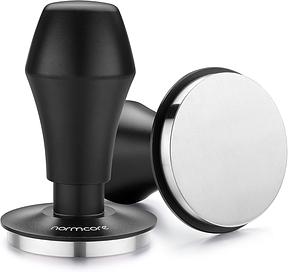
Normcore Tamper à café expresso V4 58,5 mm à ressort calibré (6,8/11,3/13,6 kg)
View at AmazonAffiliate link. Buying through it earns us a commission; the price stays the same for you.
The bathroom-scale exercise
Do it once. Once is enough. Not to learn to tamp at 30 lb, but to find out what your idea of "hard" actually weighs.
Put a bathroom scale on the counter, rest the loaded portafilter on it, and tamp the way you normally do while watching the display. Most people are a long way from where they think they are, in one direction or the other. Some discover they press at 18 lb while believing they are leaning in like a gorilla. Others crush at 55 and wonder why their wrist hurts.
One caveat, because I am not going to oversell this. The technique appears in barista training content almost everywhere, but I found no named, dated primary source that formalises it. It is not an SCA protocol, it is a workshop trick. And its value is not in hitting a target: it is in showing you that your judgement by feel is bad. Once you have seen that, you stop reasoning in pounds and move to what actually matters, which is levelness and repeatability.
If you insist on a cue: tamp until the bed stops giving under the tool, then stop. That moment is perceptible, it arrives quickly, and it does not sit at 30 lb. It sits wherever it sits for today's grind, dose and basket.
Diameter: the variable nobody checks, and the one you can
Here is a parameter far more concrete than force, because it is printed on a spec sheet.
A "58 mm" basket does not have a 58.00 mm internal diameter, and a 58 mm tamper leaves a ring of untamped grounds against the wall. Water finds that ring. It is a ready-made preferential path, running the whole circumference.
Manufacturers publish their recommendations, and they are specific:
VST, whose baskets are ridged, specifies a 58.3 mm tamper.
Decent Espresso recommends a 58.35 mm base for its baskets and explicitly advises against 58.5 mm: per their basket page, too tight a fit can lift the puck when you withdraw the tool.
Ridgeless baskets such as IMS and Pullman tolerate a wider band, 58.3 to 58.55 mm, according to Clive Coffee's comparison.
Notice the reversal. The failure mode manufacturers actually document is not the undersized tamper, it is the oversized one on a ridged basket. For the untamped ring left by a small tamper I found no published measurement either, only the same mechanical explanation repeated everywhere. It is consistent with the rest, it is not quantified, and I am giving it to you on those terms.
The practical rule fits on one line: read the diameter your basket's maker recommends, not the one on your tamper. And if you upgrade to a precision basket, check again.
And if you are on a 51 or 54 mm portafilter, which covers a lot of entry-level De'Longhi and Breville machines, the rule holds but the number changes: measure your basket before you order anything. Two-in-one tools combining levelling and tamping exist in that diameter too, which settles evenness and distribution in a single motion.
NEOUZA Distributeur et presse à café 2 en 1, 51 mm double tête
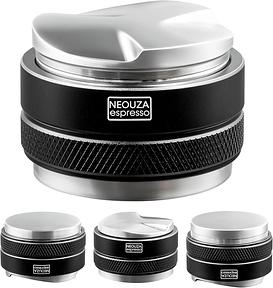
NEOUZA Distributeur et presse à café 2 en 1, 51 mm double tête
View at AmazonAffiliate link. Buying through it earns us a commission; the price stays the same for you.
Before the tamp comes distribution
This is where the real lever hides, and where most people are not looking.
If the grounds leave the grinder in clumps, no amount of tamping pressure will break them up. Tamping on clumps just makes denser clumps. The tamp freezes the distribution, it does not repair it.
Jonathan Gagné published a puck-resistance study on Coffee ad Astra on 16 January 2021 that goes straight at this. Comparing deep WDT against surface WDT, he measures roughly a 40% reduction in the variation of puck-resistance values in favour of deep WDT. And one protocol detail is worth more than any argument: he held tamping force constant, at a Force Tamper's default setting, for the whole study. The thing worth testing was distribution.
His own conclusion is harsher still, and deserves quoting as he put it: no style of WDT really fixes underlying problems in ground distribution that come from the grinding itself. Which pushes the chain one step further back, to the grinder.
The priority order that falls out of this is fairly brutal on the ego of the arm:
- Grinder quality and grind consistency.
- Distribution in the basket, WDT included.
- A level tamp.
- Considerably further behind, tamping force.
We broke down what each tool actually does in a separate piece, if you want to work out which of the three is your problem: tamper, WDT and scale, what they actually do.
A WDT tool is a handle carrying fine needles that you stir through the grounds before tamping. Nothing sophisticated, and that is rather the point: it breaks up the clumps the grinder made.
Normcore Outil WDT V3 avec support, agitateur à aiguilles pour café moulu
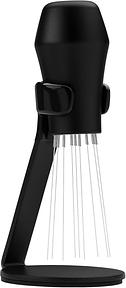
Normcore Outil WDT V3 avec support, agitateur à aiguilles pour café moulu
View at AmazonAffiliate link. Buying through it earns us a commission; the price stays the same for you.
WDT or levelling tool, which of the two
These are two different jobs that get conflated constantly. WDT agitates the grounds in depth with needles. A levelling tool spins flat on top of the basket and evens the surface to an adjustable depth without going down into the bed. The second tidies the top layer, the first undoes the clumps where they actually are. If you can only take one to start with, take the WDT. Levelling can be recovered with a clean tamp; the reverse is not true.
Normcore Outil de distribution de café 58,5 mm (profondeur réglable)
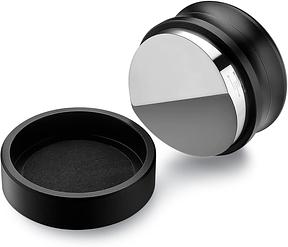
Normcore Outil de distribution de café 58,5 mm (profondeur réglable)
View at AmazonAffiliate link. Buying through it earns us a commission; the price stays the same for you.
Flat or convex, and does it change anything
A question that comes up constantly, with a shorter answer than you might hope.
A flat base gives a flat surface, so in theory even resistance across the diameter. A convex base compresses slightly more in the centre, on the idea that it compensates for water's tendency to favour the basket walls. Both camps exist, both have defenders, and I found no published data settling it.
What I can say honestly is that flat versus convex sits a long way behind levelness and diameter on the list of things that decide your shot. If you are starting out, get flat. It is easier to see whether a surface is level when it is supposed to be flat.
A basic flat stainless tamper does the job perfectly well, with no mechanism to understand and no spring to pick. Just check it matches your basket's diameter.
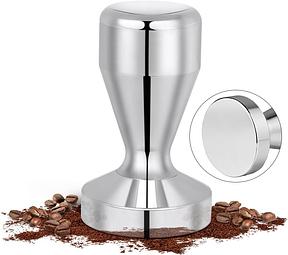
Vicloon Presse à café 51 mm en acier inoxydable
View at AmazonAffiliate link. Buying through it earns us a commission; the price stays the same for you.
The gesture itself
Not much to it, but these bits count.
Rest the portafilter on something stable instead of tamping while holding it in the air. Holding the portafilter in one hand and pressing with the other is the most reliable way to introduce a tilt, because nothing guarantees the two forces line up. A tamping mat or a tamping station settles that in one move.
Line your forearm up with the axis of the tamper. Wrist straight, elbow over the top. A broken wrist sends your force off-axis and you will not feel it happen.
Press down, feel the bed stop giving, stop.
On the famous quarter-turn polish, opinion is split and I have nothing solid to offer either way. It smooths the surface; it can also break the puck away from the wall. I do not use it, but that is a preference, not a demonstration. Same for tapping the portafilter: it can knock down grounds stuck to the wall, and it can also crack the bed. If you tap, tap gently, and tamp afterwards.
A food-grade rubber mat set into the corner of the counter is enough: it wedges the portafilter spout and leaves both your hands free to press straight down.
Normcore Tapis de tamping en caoutchouc alimentaire pour porte-filtre
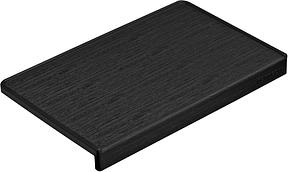
Normcore Tapis de tamping en caoutchouc alimentaire pour porte-filtre
View at AmazonAffiliate link. Buying through it earns us a commission; the price stays the same for you.
On a bean-to-cup machine you are not tamping at all
Worth saying plainly, because plenty of readers will get this far and have nothing to apply it to.
On an automatic bean-to-cup machine everything happens inside a sealed brew unit. A piston compacts the grounds through a proprietary, patented mechanism that differs by brand. You cannot see it, you cannot adjust it, and you cannot change the force applied.
Worth noting: no manufacturer, neither De'Longhi nor Jura, publishes a compaction figure in its consumer spec sheets. They publish pump pressure, 15 or 19 bar depending on the range, which is a completely different quantity. The internal compaction force stays in the patents.
If that is you, the part of this article that applies is the grind-and-dose part, not the technique part. Your levers are grind fineness, dose per cup and bean freshness. We go through them in the 7 settings that decide the shot.
Last word
If you take one thing away: stop replacing 30 lb with a different number. Drop the number.
The bed does not need crushing. It needs to be flat, even, and sitting on grounds that were properly distributed. The pump will do the rest, and it will do it with ten to fifteen times more force than you can anyway.
What mildly annoys me about all this is that the 30 lb figure has spent years absorbing attention that belonged to the grinder. The plainest tamper on the shelf, set down dead flat on an even bed, will beat a competition tamper pressed crooked into clumps, every time. Not a great sales pitch. Still true.
And if you are starting out and cannot work out what to buy first, we put the accessories in order here: what to buy first when you are starting out.
All products from this post
The ones we named above are marked; the rest are alternatives in the same category.
Affiliate notice: As an Amazon Associate, we earn from qualifying purchases. Product prices and availability are subject to change.
Frequently Asked Questions
Do I really need to tamp at 30 lb?
No, and the figure has no identifiable source. Perfect Daily Grind devoted an article to dismantling it in 2017 without managing to trace its origin, quoting trainers at La Marzocco and G&B Coffee who publicly reject the rule. The clearer argument is arithmetic: the pump applies roughly 534 lb across a 58 mm puck at 9 bar, against 30 lb from your arm. Aim for a flat, even bed rather than a number.
Does tamping harder make espresso stronger?
No. A Barista Hustle experiment, reported by Clive Coffee, measures about 3% difference in compression between a comfortable tamp and a very heavy one. Past the point where the bed stops giving, extra force compacts almost nothing more. If your shot lacks body, look at grind, dose and brew ratio rather than at your wrist.
How do I know whether my tamp is level?
Look at the surface of the bed in good light before you lock the portafilter in. It should be flat, with no side sitting visibly lower. Always rest the portafilter on something stable and keep your forearm in line with the tamper. If you want the question gone entirely, a self-levelling tamper braces on the rim of the basket and mechanically cannot go in crooked.
What tamper diameter should I use for a 58 mm basket?
Follow your basket maker's recommendation rather than a general rule. VST specifies 58.3 mm for its ridged baskets. Decent Espresso recommends 58.35 mm and advises against 58.5 mm, which can lift the puck as you withdraw. Ridgeless baskets like IMS and Pullman tolerate 58.3 to 58.55 mm. A tamper that is too small leaves a ring of untamped grounds against the wall.
Should I do a quarter-turn to polish the puck?
Opinion is split and I found no published data settling it. The twist smooths the surface but can also break the puck away from the basket wall. It is not an essential step. If you do it, keep it light and always do it the same way, because consistency beats a perfect technique applied half the time.
Does tamping matter on a bean-to-cup machine?
No, you have no control over it. Compaction happens inside a sealed brew unit, driven by an internal piston through a patented mechanism specific to each brand. Neither De'Longhi nor Jura publishes a compaction figure in its consumer documentation. On that kind of machine your real levers are grind fineness, dose per cup and bean freshness.
Sources
- back in February 2017 perfectdailygrind.com
- according to Clive Coffee's writeup clivecoffee.com
- *Systematically Improving Espresso*, published in Matter in 2020 doi.org
- Normcore product page normcorewares.com
- Whole Latte Love listing wholelattelove.com
- per their basket page decentespresso.com
- according to Clive Coffee's comparison clivecoffee.com
- on 16 January 2021 coffeeadastra.com