Compact manual espresso machine: the small-space guide
 14 min read
Updated 02/09/2026
A Gaggia Classic Pro sits on 20.3 x 24.1 cm of counter, according to the Gaggia North America product page. A Rancilio Silvia wants roughly 24 x 28 cm, per Seattle Coffee Gear. Four centimetres apart, and both are manual espresso machines everyone files under the same label.
That's the whole problem with this category. "Compact" is an adjective every retailer writes and almost nobody puts a number on.
This guide covers portafilter machines only, manual and semi-automatic. Not bean-to-cup machines, the ones with a built-in grinder and a sealed brew unit, which follow completely different footprint logic. If that's what you're actually shopping for, read compact bean-to-cup coffee machine for a small kitchen instead. And if portafilters are new to you, the manual espresso machine beginner's guide covers technique. This one is about centimetres.
Why the space problem lands differently on a manual espresso machine with a portafilter
On a bean-to-cup machine, the blocking dimension is height under a wall cabinet, because you have to lift the bean hopper lid. Not on a manual espresso machine. On a portafilter machine the constraint moves to depth, and to the clearance in front, since you're handling a portafilter you need to pull out, knock, fill and lock without hitting a cupboard door.
There's a second difference, and most comparison articles skip it.
Entry-level manual machines, 150 to 400 €, 51 to 54 mm portafilters, come in a compact format suited to small kitchens, while semi-professional models with 58 mm portafilters need a long warm-up and a bigger footprint, as the Coffee Spirit buying guide sets out. So portafilter diameter works as a size proxy. Wider basket, more thermal mass behind it, more counter eaten.
Which doesn't mean 58 mm always equals bulky. The Silvia disproves that, and it's in the table below. But the correlation holds well enough to filter a shortlist when you don't have spec sheets in front of you.
One more thing before the numbers, because it's the most misused spec on the shelf. The 15 or 19 bar printed on the box is a pump peak, not the working pressure. Espresso extracts at around 9 bar at the puck. That box number tells you nothing about the cup, and nothing whatsoever about the footprint. We take it apart in why 9 bars is the ideal espresso pressure.
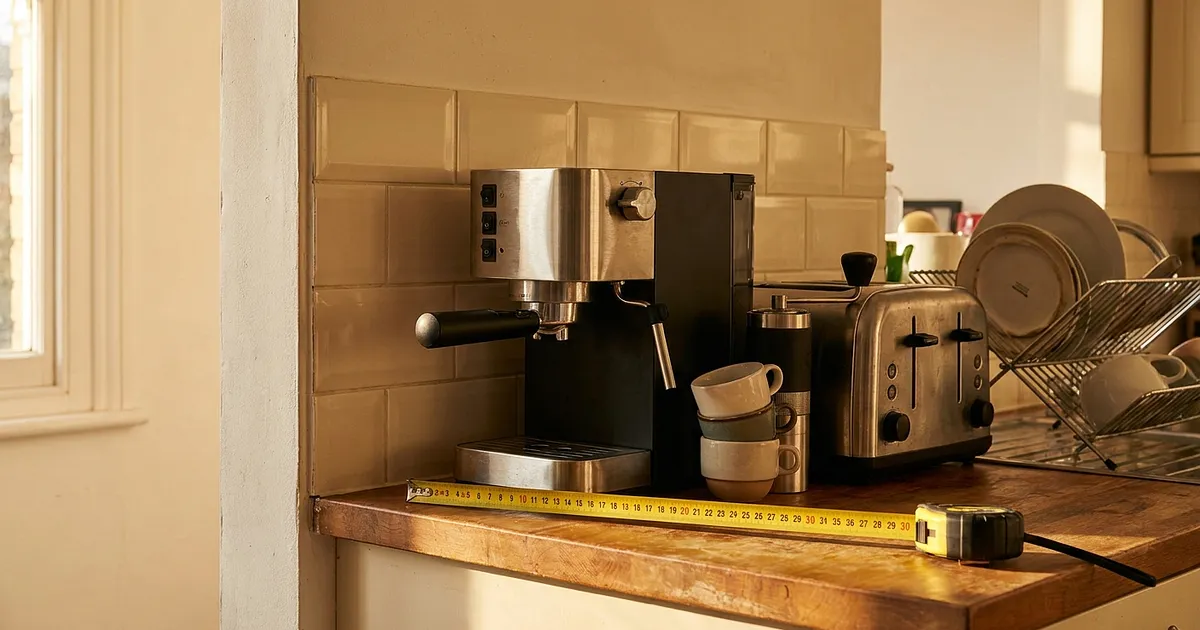
Five measurements to take at home before you order
Get a tape measure. Seriously, before you start comparing models.
- Usable width, between the two real obstacles (wall, toaster, drying rack), not the theoretical width of the counter.
- Usable depth, from the front edge back to the splashback. A 28 cm deep machine on a 30 cm counter leaves two centimetres for the power cable, which isn't a thing.
- Clearance above, so you can open the water tank. Plenty of portafilter machines fill from the top.
- Clearance in front, maybe fifteen centimetres, so you can pull the portafilter out and twist it off.
- Space for the grinder, which isn't a machine dimension at all but still lands on your counter. There's a whole section on it below.
Five measurements, four minutes. It's the only prep work that stops a return.
The table: actual footprints of a manual espresso machine, in centimetres
Three manual espresso machines, one real question: does it actually fit your counter? The values come from manufacturer or retailer spec sheets, not from any measurement of our own.
| Model | Width | Depth | Height | Weight | Source of the figure |
|---|---|---|---|---|---|
| Sage / Breville Bambino | 15.5 cm | 30.2 cm | 34.3 cm | not published | official Breville BES450 page |
| Gaggia Classic Pro | 20.3 cm | 24.1 cm | 36.1 cm | 8.6 kg | Gaggia North America product page |
| Rancilio Silvia | approx. 24 cm | approx. 28 cm | 33 to 35 cm | 14 to 16 kg | Seattle Coffee Gear and retailer listings, which disagree on weight |
Three things fall out of that.
The Bambino wins on width and loses on depth: 15.5 cm across the front, 30.2 cm going back. On a narrow, deep counter that's the right trade. On a wide, shallow one it's the wrong one.
The Gaggia Classic Pro is the most balanced of the three, and it's also the only one whose spec sheet states a weight in the open: 8.6 kg. This is not a machine you tuck into a cupboard between coffees.
The Silvia breaks the "58 mm means bulky" rule outright. Its roughly 24 x 28 cm base still works on a narrow counter, which is what Seattle Coffee Gear points out in its listing. The price is weight: somewhere between 14 and 16 kg depending on which retailer you read, and they don't agree.
Two heavily searched machines are missing from that table, the De'Longhi Dedica Style and the Sage Barista Express. Their dimensions don't appear in any spec sheet we could verify for this guide. So we write not published rather than repeat a number that circulates. Pull them off the manufacturer's own spec sheet before you order. That's exactly the detail that decides a return.
What compact actually costs you, and what it doesn't
The usual fear is that a small espresso machine makes mediocre coffee. It doesn't, and not just out of optimism.
A machine's size mostly affects thermal stability and steam power, not the intrinsic quality of the extraction, which comes down to grind and tamp (Espresso Atlas). In practice: on a single shot, a 15 cm wide machine does the job as well as a 30 cm one. On six shots back to back plus two cappuccinos, it falls apart.
What you genuinely give up:
temperature stability from one shot to the next, because there's less metal holding heat (covered properly in thermoblock, single boiler and dual boiler);
steam power, so milk takes longer to texture;
water tank capacity, which means refilling more often;
and sometimes ergonomics, a point Espresso Atlas makes bluntly: a narrow machine with a top-filling tank, parked under a wall cabinet, is more annoying day to day than a slightly wider one with front access.
What you don't give up is control over the extraction. That's the only thing a portafilter machine is really selling you, and it isn't measured in centimetres.
As Gaëlle, the manual espresso machine specialist at Coffee Spirit, puts it, all of these machines let you get the full aroma of freshly ground coffee, compact format included.
The picks, by budget
The budget splits into three bands, each with its own space argument. Prices below were taken from Amazon.fr on 02/09/2026, they move fast, and your own local store will read differently.
Under 150 €: the narrow thermoblock
This band is where the market's best-selling compact espresso machine lives. It's also the band Coffee Spirit puts at 150 to 400 € with 51 to 54 mm portafilters, and it's where the narrowest machines on the market live. The De'Longhi Dedica Style Perfetto is the best-selling model in that category, at 139.99 € on Amazon.fr with 4.2/5 from 41,891 reviews as of 02/09/2026.
De'Longhi Dedica Style EC685.BK
The trade is honest enough: thermoblock, fast heat-up, low thermal mass. You pull a shot, then a second one, then you wait. For one person in a studio flat that's the right calibration. For two people on a weekday morning it isn't.
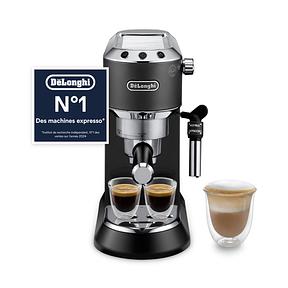
De'Longhi Dedica Style EC685.BK
View at Amazon (as of Aug 11)Affiliate link. Buying through it earns us a commission; the price stays the same for you.
Around 500 €: machine and grinder in one box
The Sage Barista Express has its grinder built in. That's a footprint decision before it's a coffee decision, because instead of two appliances side by side you put down one. It's at 499.00 € on Amazon.fr with 4.2/5 from 3,272 reviews as of 02/09/2026.
Sage The Barista Express (Acier Inoxydable Brossé)
Watch out for the reverse argument, which is this category's trap. A machine with an integrated grinder isn't compact because it's small. It's compact because it replaces two objects. On raw width it rarely beats a Dedica or a Bambino.
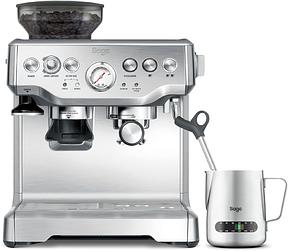
Sage The Barista Express (Acier Inoxydable Brossé)
View at AmazonAffiliate link. Buying through it earns us a commission; the price stays the same for you.
Above 550 €: the reference portafilter machine
The Gaggia Classic Pro is the best-documented machine in this guide: 20.3 x 24.1 x 36.1 cm at 8.6 kg per Gaggia North America. It's at 576.17 € on Amazon.fr with 4.4/5 from 621 reviews as of 02/09/2026.
It isn't the cheapest and it isn't the narrowest. It's the one you know will fit, with numbers to back it. On a tight counter that certainty is worth something. Add that you'll need a separate grinder, so budget more room to one side.
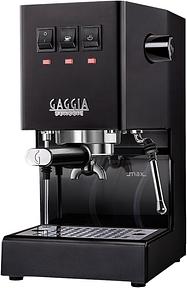
Affiliate link. Buying through it earns us a commission; the price stays the same for you.
The lever machine, the stripped-down option
A lever espresso machine drops the electric pump. Your arm builds the pressure instead. The classic countertop shape, the La Pavoni sort, is tall and narrow rather than wide and deep. On a 20 cm deep counter where nothing else fits, that's occasionally the only answer.
The downside is real and it isn't dimensional. A lever forgives nothing on grind or technique, and consistency from cup to cup takes practice. This isn't a fallback for a small space. It's a choice of method that happens to fit one.
The grinder: the dimension nobody counts
Here's the part comparison articles leave out almost every time.
The grinder is often the real space culprit on a counter, not the manual espresso machine itself, as Seattle Coffee Gear points out in its compact-setup guide. You buy the narrowest machine on the market, park an electric grinder beside it, and your setup ends up taking double the frontage you planned for.
Three ways to claw that space back:
A hand grinder. It lives in a drawer between uses and the good ones do go down to espresso fineness. Zero permanent footprint. Full treatment in the manual coffee grinder guide.
A machine with a built-in grinder, like the Barista Express above. One object, one plug.
A compact electric grinder kept somewhere else, on a shelf or in a cupboard, brought out to grind. Less convenient, but the space you save is real.
The integrated-versus-separate question isn't purely about space, either. We compare the two setups in built-in grinder or separate grinder for espresso.
Where to put it: kitchen, desk nook, studio flat
The kitchen counter
The best-documented case, and the least constrained of the three. The deciding dimension is almost always the depth left between the splashback and the front edge once you've subtracted the cable. Leave a few centimetres behind the machine for a plug and a cord that isn't bent double.
If a wall cabinet hangs over the counter, measure the free height with the water tank open. A 34 cm machine whose tank lifts a good way up needs considerably more than 34 cm of clearance.
The desk nook
The most interesting case, because the constraint isn't only spatial. The Home-Barista forum documents a five-person office setup built around a semi automatic espresso machine and an adjustable grinder, where one person dials in the grind and everyone else follows a fixed grind time and a fixed shot duration.
That's the key to a shared portafilter machine. One setting, one written routine, and the machine survives users who don't want to learn anything. Without it, an office portafilter becomes a thing two people use and everyone else avoids.
On space, add a constraint kitchens don't have: getting rid of the puck. Nobody wants an open knock box on a desk. A closed one is another object on the surface.
The studio flat and the kitchenette
Space isn't the only issue here. Grinder noise carries in a one-room flat, and steam from a wand in a kitchenette with no extractor ends up on the walls.
The combination that actually works in a studio: a narrow thermoblock machine, a hand grinder in a drawer, and nothing else permanently on the counter. Total resting footprint, the width of one machine.
If even that doesn't fit, the answer probably isn't a smaller espresso machine. It's a different brew method, and moka pot versus espresso machine lays that choice out honestly.
Compact or built-in: two different needs
Compact and built-in aren't the same purchase, and Google confuses the two searches more than shoppers do.
A built-in espresso machine goes into a kitchen column, gets plumbed or wired in, and disappears behind a cabinet front. It uses no counter because it isn't on the counter. The budget and the joinery have nothing to do with this guide.
A compact machine is a countertop appliance you can move, and take with you when you move out. If you rent, that's the only one of the two that concerns you.
The verdict: which manual espresso machine to choose, by constraint
Choosing a compact manual espresso machine comes down to one measurement: your real constraint, not the word "compact" on the box.
If width is your constraint, look at the narrow thermoblocks and accept the depth that comes with them.
If depth is your constraint, the Gaggia Classic Pro is the only machine here whose manufacturer publishes a low figure in the open, 24.1 cm.
If your constraint is the number of objects on the counter, buy a machine with a built-in grinder and stop counting machine centimetres.
And if none of the three fits, the problem isn't the machine. Measure first, choose second. That's the order everyone gets backwards.
All products from this post
The ones we named above are marked; the rest are alternatives in the same category.
Affiliate notice: As an Amazon Associate, we earn from qualifying purchases. Product prices and availability are subject to change.
Frequently Asked Questions
What is the minimum width for a manual espresso machine?
The narrowest portafilter machines get down to around 15 cm wide. The Sage/Breville Bambino is listed at 15.5 cm wide on Breville's own page. Width alone isn't enough though: that same machine wants 30.2 cm of depth. Measure both, plus the clearance in front for handling the portafilter.
Does a small espresso machine make worse coffee?
Not on a single shot. Espresso Atlas argues that machine size drives thermal stability and steam power, not extraction quality, which comes down to grind and tamp. The gap shows up on back-to-back shots and on milk drinks, not on your first cup of the day.
Which is the best compact manual espresso machine?
Depends which dimension is blocking you. For minimum width, the Bambino at 15.5 cm. For minimum depth, the Gaggia Classic Pro at 24.1 cm. For one appliance instead of two, a machine with a built-in grinder like the Barista Express. No generic ranking replaces measuring your own counter.
Do I need a separate grinder with a compact espresso machine?
Yes, unless the machine has one built in. And that's the space cost most guides skip: an electric grinder parked next to the machine can roughly double the frontage of your setup. A hand grinder goes in a drawer and drops that footprint to nothing between uses.
Manual or semi automatic espresso machine for a small space?
Semi-automatic is the sensible middle. You keep the portafilter and control over the grind, with a pump handling pressure for you. A full manual lever often takes less counter but asks a lot more practice before the cups come out consistent.
Does a lever espresso machine take up less space?
Often yes in footprint, because the classic shape is tall and narrow rather than wide and deep. The trade isn't dimensional though: a lever needs an accurate grind and a steady hand, or the shot changes from one pull to the next.
Sources
- Gaggia North America product page gaggia-na.com
- Seattle Coffee Gear seattlecoffeegear.com
- Coffee Spirit buying guide coffee-spirit.maxicoffee.com
- official Breville BES450 page breville.com
- Espresso Atlas espressoatlas.com
- Coffee Spirit coffee-spirit.maxicoffee.com
- Seattle Coffee Gear seattlecoffeegear.com
- Home-Barista forum home-barista.com